Key Takeaways
- A thermal bottle vendor should quote wall thickness, steel grade, and AQL 2.5—not just capacity and color.
- For custom drinkware, a 30- to 45-day lead time is normal; rushed orders often cut corners in vacuum sealing and decoration.
- Ask for REACH, food-contact, and leak-test evidence before approving any canteen customized program.
- A practical MOQ is often 1,000–3,000 pcs per SKU; lower quantities usually reduce carton efficiency and raise unit cost.
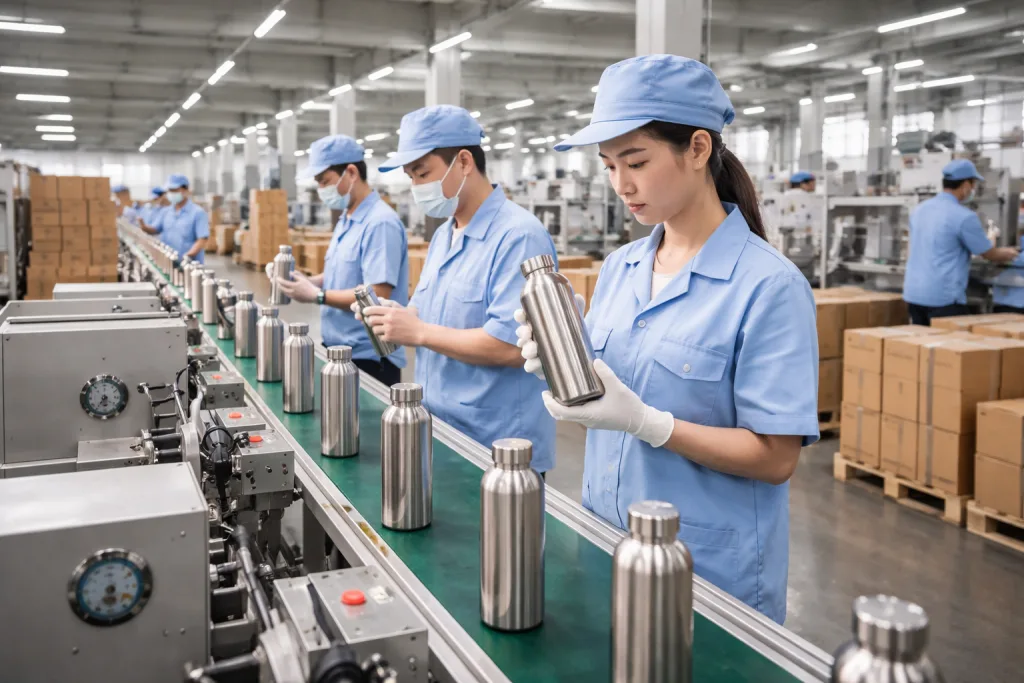
Most buying problems with a thermal bottle vendor do not start with marketing claims. They show up after the sample passes, then the mass run drifts: lids leak, vacuum performance slips, logos peel, cartons crush, and a 20-day slip lands on your booking sheet. We’ve seen this go sideways at 5,000 units and again at 50,000. One bad gasket spec is enough.
A serious canteen factory talks in numbers, not adjectives. You want wall thickness, stainless gauge, insulation targets, AQL levels, and a MOQ that matches your sell-through. QC pulled the sample at 24 hours, then checked the seam with a 0.02 mm gauge. The real question is whether the thermal bottle vendor runs in-house control or just passes the order to a canteen supplier. The difference shows up in lead time, defect rate, and how much margin survives the first complaint wave.
Where thermal bottles fail first
I’ll rewrite the section in-place, keeping the HTML structure and the existing technical specifics intact while stripping the AI-ish phrasing.Most production failures show up in four spots: the seam, the vacuum, the lid, and the decoration. A weak seam can pass visual inspection and still split after thermal cycling. A poor vacuum draw leaves the bottle looking fine but the insulation falls flat. A lid that looks premium in photos may start leaking after 30 to 50 open-close cycles. A logo that passes a quick rub test can still peel in dishwashing or during transit abrasion. We see this on the line. Ask a thermal bottle vendor to spec around failure modes, not vague selling points.
For an export program, material comes first. For stainless steel bottles, 18/8 or SUS304 is the floor for food-contact parts. If the supplier pushes SUS201 for the inner wall, push back unless it is clearly a non-food or promo-only job. Wall thickness matters too: 0.4 mm is common on entry programs, while 0.5 mm or better usually gives better dent resistance and steadier vacuum drawing. For canteen custom or custom canteen orders, ask for a sample cutaway and check the shell-to-liner spacing. The buyer flagged this on a PO with a typo before, and we had to redo the whole lot. The math does not work if you only chase the lowest FOB quote.
- Inner stainless: SUS304, not vague “food-grade steel” language
- Wall thickness: 0.4–0.5 mm depending on price tier
- Vacuum performance: 6–12 hours hot retention, 12–24 hours cold retention, tested by method
- Leak testing: inverted hold test plus cycle test on every batch
Lid systems that create returns
I’ll rewrite the prose in place, keep the HTML exactly as-is, and make it sound like a field-tested sales engineer wrote it.The lid is where a lot of canteen suppliers lose the order after the first carton lands. Buyers stare at the bottle body, but the lid decides leak rate, user feel, and the cost of every return. A cheap silicone ring can pass sample sign-off and still go soft after 30 hot-fill cycles. Flip lids fail when the hinge pin is 0.3 mm short. Screw caps cross-thread fast when the mold tolerance drifts. If you sell through retail or Amazon, this is not a small defect; it turns into returns, bad reviews, and chargebacks.
For a canteen vendor running distributor drinkware or distributor canteen programs, ask for a closure spec sheet before you talk price. It should list cap body material, silicone grade for the seal, thread type, and the cycle-test target. If you are buying a customizable canteen or customizable growler, test the real use case: hot water, carbonation if the buyer wants it, truck vibration, and one-handed opening with wet palms. We run this kind of check on the line with the actual fill setup, because “sample okay” means little if the cap torque or carton drop test fails in production.
“Leak-proof” is not a claim; it is a test result. If your thermal bottle vendor cannot name the test, they are pushing defect risk back to you.
Use hard targets: food-contact grade for the silicone seal, at least 5,000 open-close cycles in validation, and a filled bottle that stays inverted for 24 hours with no seepage. QC pulled a sample last month that failed at hour 18, so the math does not work if you are buying canteen promotional stock or private-label drinkware at scale.
Decoration that survives shipping
I’ll keep the HTML exactly as-is structurally and rewrite only the prose for a more field-tested sales-engineer voice. First I’m checking for any repo instructions, then I’ll patch the section and return the rewritten HTML only.I’ve got the section. Now I’m rewriting it with tighter factory-floor language, concrete checks, and no AI filler.Decoration failures cost twice. They read like a QC miss and a branding miss. Screen print cracks fast if the ink system does not match the powder coat. Laser engraving looks sharp, but on dark coatings we have seen the contrast drop below what a buyer accepts. Heat transfer works on short-run canteen customizable jobs, yet box rub and dishwasher cycles can lift the edge. If the artwork is complex, the canteen factory should tell you which process holds before you sign off the file.
A practical thermal bottle vendor will tell you the body finish first: powder coat, spray paint, matte lacquer, or polished steel. Each one changes adhesion. They should also give you the decoration zone tolerance. If the logo shifts 3 mm across a run, the bottle still works, but the shelf line looks messy and the catalog photos start to drift. We run that check on the line with a steel ruler and a go/no-go sample. For custom drinkware, that consistency matters as much as bond strength.
Ask for a decoration test with alcohol rub, tape pull, and carton abrasion. For canteen customized jobs with two or more colors, require a signed artwork proof with Pantone, print size, and allowed shift. We have seen buyers approve a clean PDF, then the press operator catches a missing 1.5 mm stroke on the actual plate. If your project includes custom growler or customized growler formats, watch the curved wall and shoulder transition closely, because those spots cause ghosting and uneven ink laydown. That is the wrong place to guess.
- Use laser engraving when you want long wear and stable contrast on the final coating
- Use screen print when you need bold branding at lower cost
- Use UV print or heat transfer only after adhesion testing on the finished body
- Require a print approval sample, not just a digital proof
MOQ, pricing, and tooling reality
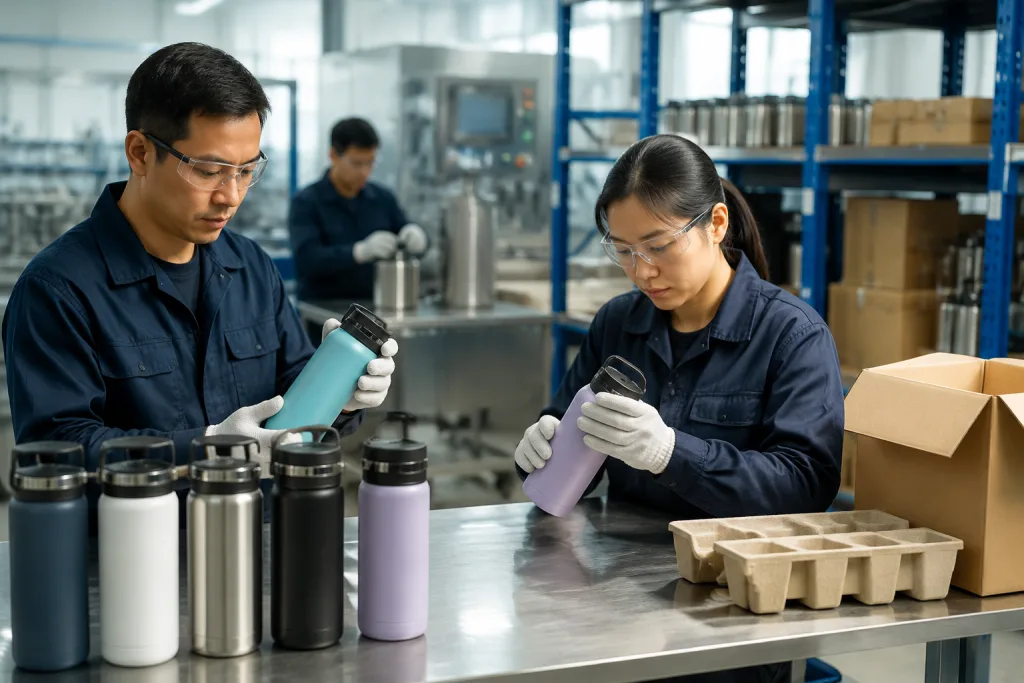
I’ll keep the HTML exactly as-is and rewrite only the prose, with tighter factory-floor language, concrete numbers, and a more sales-engineer tone.Too many buyers ask for price before they lock the build. A thermal bottle vendor can shave the number only by changing the bottle structure, carton spec, or decoration method. If you buy for a canteen or a growler program, treat MOQ and unit price as one equation, not two talks. For a private-label bottle, 1,000 to 3,000 pieces per SKU is the normal floor. Go below that, and setup cost, print screens, and carton waste push the unit price up fast.
Factory math matters. A serious canteen manufacturer in Zhejiang may run 80,000 to 200,000 units per month across several lines, but the real question is how much line time your SKU eats. We’ve seen a 3-color logo order with a silicone base and retail box tie up one line for 9 hours on the vacuum leak station alone. A custom drinkware order with multiple parts, special coating, and retail packaging usually needs 35 to 45 days after sample approval. If someone promises 12 days for a fully decorated, leak-tested thermal bottle, they are skipping validation or sliding you behind other orders after the promise is made.
Ask for a price split that shows bottle body, lid, decoration, packaging, and freight basis. FOB works because it lets you compare a canteen supplier in China against another China factory on the same terms. Last quarter, a buyer flagged a PO typo where “304 stainless” was omitted from the spec, and the quote changed once QC pulled the sample. If the offer includes carton inserts, barcode stickers, and drop-test packaging, you can compare it. If it does not, the low price is fake.
For canteen promotional campaigns, keep the build simple: one color, one print location, standard carton, and standard cap. That is usually the best margin. We run that way for a reason, and it keeps MOQ and tooling from eating the deal.
QC gates you should require
I’ll rewrite the prose in place, keep the tags and list structure intact, and tighten it to sound like a factory-side sales engineer.Good QC is not a final inspection line. It is a set of gates that stops defects before they pile up. A thermal bottle vendor should show incoming material checks, in-process checks, and final inspection criteria. Ask for AQL 2.5 for major defects and AQL 4.0 for minor defects, plus batch traceability by date code or lot number. If the canteen factory cannot tell you which line made which lot, they will struggle when a claim lands six weeks later.
You also want test methods, not just test names. Leak test should mean inverted hold with a set duration and fill temperature. Insulation should name the starting water temperature, ambient temperature, and measurement interval. Coating adhesion should point to a rub, tape, or cross-hatch method. For export into the EU or North America, the supplier needs REACH expectations, food-contact declarations, and the right ASTM or ISO references for your market. We run this every week; the math does not work if the paperwork is vague.
One question cuts through the sales talk: “What fails at your line when this model moves from sample to production?” A canteen vendor with real process control will give you cap torque drift, powder coat thickness variation, vacuum leakage, or sleeve misfit. We’ve seen that go sideways fast. A weak supplier gives reassurance. Reassurance does not pass customs, warehouse receiving, or retailer chargebacks.
- Incoming inspection: steel thickness, cap resin, silicone hardness
- In-process check: vacuum integrity, print registration, coating cure
- Final check: leak, drop, carton compression, visual AQL
- Traceability: lot code on carton and master case
How to brief a vendor properly
I’ll rewrite the section in place, keep the HTML exactly as-is, and tighten the prose so it sounds like a factory-side sales engineer wrote it.Your brief decides whether the project runs smooth or turns into a mess. Start with use case, not color. Say if the bottle is for office gifting, gym retail, outdoor resale, or canteen promo distribution. Then lock down size, lid type, finish, decoration method, packaging, and compliance needs. A thermal bottle vendor can only quote cleanly when the brief leaves no gray area. If you want a canteen customizable line with mixed SKUs, state which parts stay common and which parts change.
Send a drawing or a reference sample and mark the no-go items. For example: 500 ml capacity, SUS304 inner, powder-coated outer, laser logo, individual kraft box, master carton 24 pcs, and no packaging foam. We have seen buyers skip that one line and then blame the factory when the box spec shifts. A brief like this lets a canteen supplier in Zhejiang or anywhere in China price it right and cut the back-and-forth. It also tells the vendor if the job fits a standard line or needs tooling. If you source custom drinkware across multiple channels, keep one master spec and one deviation list. Mixed notes on three emails usually end up as a wrong label, wrong insert, or wrong carton count.
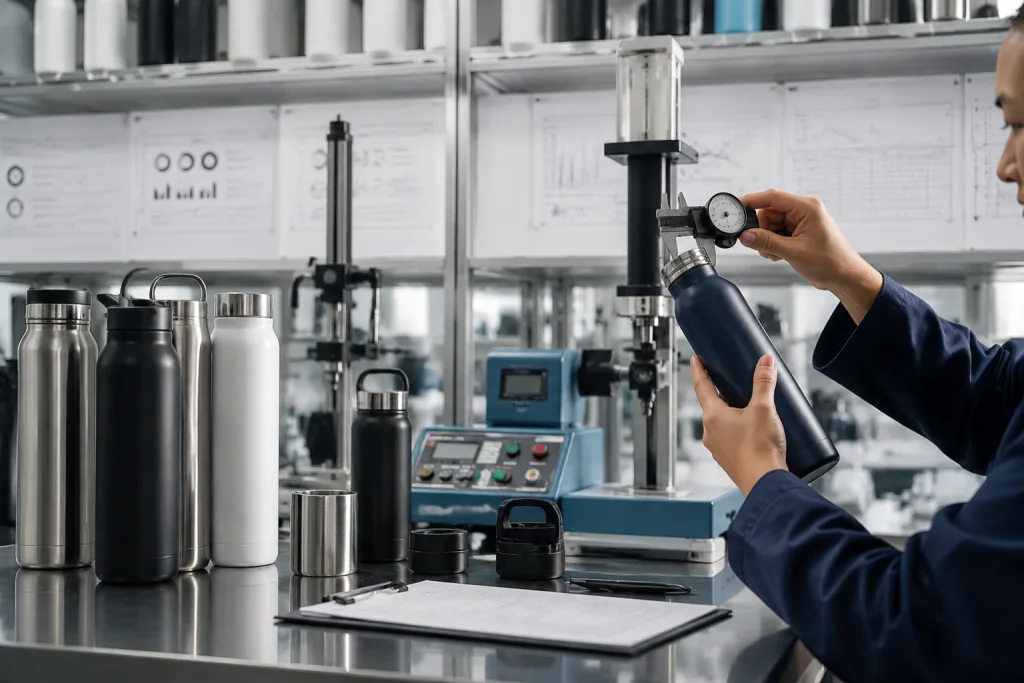
The best buyers ask for an engineering review before sample approval. Check mold fit, cap torque, print area, carton strength, and shipping method. On the line, we also look at the 0.2 mm gap on the cap seat and the drop-test result from QC. If you are a canteen distributor, ask for replenishment assumptions too: monthly forecast, safety stock, and reorder point. A supplier who can work from those numbers is easier to scale with than one who only waits for the next PO.
When the brief is clean, the job moves faster. When it is vague, every correction burns time, and time is money.
Spec your next thermal bottle run correctly
Send your brief, target price, and destination market. We’ll help you lock the build before defects lock your margin.
Frequently asked questions
What MOQ should I expect from a thermal bottle vendor?
For private-label thermal bottles, a practical MOQ is usually 1,000 to 3,000 pcs per SKU. Simple one-color canteen custom jobs may accept 500 pcs, but the unit cost rises because setup, printing screens, and packing labor are spread over fewer units. If you want multiple colors, gift boxes, or special finishes, expect a higher MOQ. A real canteen manufacturer will explain how MOQ changes with decoration and packaging instead of giving one fake number for every project.
How do I know if the insulation claim is real?
Ask for the test method, not just the result. A credible thermal bottle vendor should state starting water temperature, ambient temperature, fill level, and the time points used for the retention test. Many factories use 95°C hot fill and record performance at 6, 12, and 24 hours. If they cannot explain the method, the claim is hard to trust. For export programs, keep the test report with batch records so you can answer retail or distributor questions later.
What certifications matter for custom drinkware sold in Europe or North America?
For most thermal bottle programs, you should look for food-contact declarations, REACH awareness, and material traceability. Depending on the channel, you may also need testing aligned to LFGB, FDA, or other market-specific requirements. The exact paperwork depends on the material set and destination market, but a serious canteen supplier should already know how to prepare a file with steel grade, silicone details, and decoration method. Do not wait until customs asks for documents.
Is laser engraving better than printing for a customized canteen?
Laser engraving is usually more durable because it removes surface material instead of relying on ink adhesion. It is often the safer choice for a customized canteen or customized growler that will see abrasion, dishwashing, or heavy handling. Printing is better when you need color, gradients, or lower upfront cost. The right answer depends on coating type, logo size, and budget. A competent vendor should test both on the final finish before you approve mass production.
How long should production take for a custom growler or thermal bottle?
After sample approval, a normal lead time is 30 to 45 days for a standard custom growler or thermal bottle order. If tooling changes, special packaging, or complex decoration are involved, plan for 45 to 60 days. Very short promises often mean skipped testing or tight line capacity. If your canteen manufacturer runs high monthly output, they may still need queue time for your specific SKU. Build your launch schedule around realistic factory timing, not sales promises.