Key Takeaways
- Ask each supplier for MOQ, sample lead time, production lead time, and monthly capacity before discussing artwork
- A 500 ml double-wall bottle usually needs 0.4-0.5 mm inner steel and proper vacuum testing
- Use AQL 2.5 for major defects and AQL 4.0 for minor defects on standard custom drinkware orders
- For custom logo thermal bottles, realistic mass production lead time is usually 30-45 days after deposit and sample approval
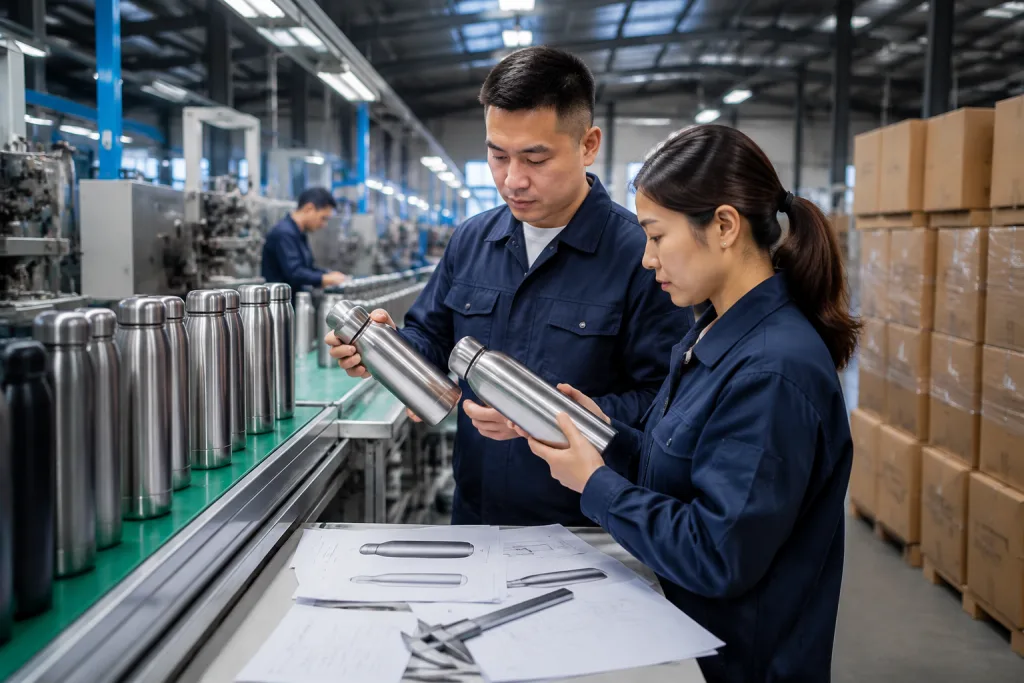
A thermal bottle supplier list looks useful until 30 canteen suppliers all claim 24-hour insulation, food-grade steel, low MOQ, fast logo service, and export experience. Names are easy. The real filter is whether the factory can talk through 0.4 mm inner wall thickness, vacuum leak rate, AQL, 1.2 m carton drop tests, and REACH paperwork without sending you a copied PDF. We’ve seen this go sideways when QC pulled the sample and the “factory” could not explain why the cup body was 18 g lighter than the approved sample.
If you buy custom drinkware for retail, promo programs, or distributor channels, read the spec sheet like a cost sheet. Every line hits price, defect risk, shipping weight, and repeat-order consistency. At our Hangzhou, Zhejiang export desk, we run RFQs where buyers in Europe and North America lose 20-40 days because the first request says “500 ml bottle, logo, good quality” instead of naming 304 stainless, coating type, lid material, carton size, and test standard. That is the wrong question to ask.
Start With Capacity, Not Catalogs
I’ll rewrite the section in place, keep the HTML unchanged, and tighten the sales-engineer tone with concrete factory details and fewer filler phrases.Most buyers build a thermal bottle supplier list by saving product photos. That is backward. Photos tell you almost nothing about whether a canteen manufacturer can ship 12,000 units with the same color, lid fit, insulation result, and barcode placement. Start with capacity and order structure.
Ask every canteen vendor for four numbers: standard MOQ, customized MOQ, sample lead time, and monthly output. At BottleForge Industrial in Zhejiang, China, our normal MOQ for stainless thermal bottles is 1,000 units per SKU for stock shapes and 3,000-5,000 units when you need new color coating, special lid combinations, or packaging changes. We run 450,000-600,000 stainless units per month depending on bottle mix, coating load, and inspection level. If a supplier says “any quantity is fine” for deep customization, ask what process they are outsourcing. The math does not work otherwise.
For distributor drinkware and distributor canteen programs, capacity matters more than the first order. A 1,000-unit trial is easy. The pain starts when your sales team needs 20,000 units split across black, navy, sand, and white, each with carton marks and customer-specific labels. We have seen this go sideways on the line: the buyer flagged a PO typo on carton marks, and QC pulled the sample because the laser code sat 3 mm off center. A real canteen factory should tell you how many powder coating lines, vacuum test stations, laser machines, and packing tables are live in peak season.
Also ask whether the supplier is a factory, export agent, or hybrid. A trading company is not automatically bad, but your risk goes up when technical answers move through three people. If you are building a long-term supplier list, note who answers spec questions directly and who only forwards a catalog. We ship faster when the buyer talks to the line lead, not a middle desk.
Steel Grade And Wall Thickness
I’ll rewrite the section in-place, keep the HTML tags untouched, and tighten the wording so it reads like a factory-side sales engineer wrote it.The material line on a spec sheet is where cheap quotations hide. For a stainless thermal bottle, the common commercial setup is 304 stainless steel on the inner wall and 304 or 201 stainless steel on the outer wall. For food-contact compliance in Europe and North America, 304 inner steel is the safer baseline. We’ve seen buyers save USD 0.15 on the first sample and lose the deal at QA later. That is the wrong place to cut cost.
Ask for steel grade, wall thickness, and test records. A common 500 ml double-wall bottle may use 0.4-0.5 mm inner wall and 0.5 mm outer wall before forming, depending on shape. On a 1.9 L or 2 L body, the math changes fast: more surface area, more forming stress, more shipping weight. QC pulled a sample with 0.38 mm inner stock once, and the body dented in carton compression. Thin steel shows up fast.
For customized drinkware, do not stop at the material certificate. Ask whether the supplier runs incoming material inspection and whether coil batches can be traced to each production order. This matters on canteen customized programs with repeat orders. If batch one uses one coil and batch two uses another, weight, polish, and weld behavior can shift. The buyer flagged it on a 20,000-piece reorder, and we had to separate the line.
A practical RFQ line should read like this: “Inner wall 304 stainless steel, outer wall 304 or 201 quoted separately, wall thickness stated, LFGB or FDA food-contact test available, no internal copper exposure at drinking contact areas.” That sentence filters weak canteen suppliers faster than a long brand story. We run this check on every serious inquiry.
Vacuum Performance And Heat Claims
I’ll rewrite this section in-place, keep the HTML tags untouched, and tighten the claims so it reads like a factory-side sales engineer wrote it.Insulation claims are easy to print and hard to back up. When a canteen manufacturer says “keeps hot 12 hours, cold 24 hours,” ask for the test method, the starting water temperature, the room temperature, and whether the lid stayed closed. We’ve had buyers flag a PO that said “12 hours hot” but never mentioned preheating. That line matters.
For a typical 500 ml thermal bottle, a normal hot-water check starts at about 95°C and gets measured after 6 hours at room temperature around 20°C. On our line, results usually land around 62-72°C, depending on body shape and lid stack-up. A wide-mouth customized canteen with a handle lid loses heat faster than a narrow-mouth screw cap bottle. Same spec sheet, different physics. So the wrong question is “Can you promise one number for all styles?”
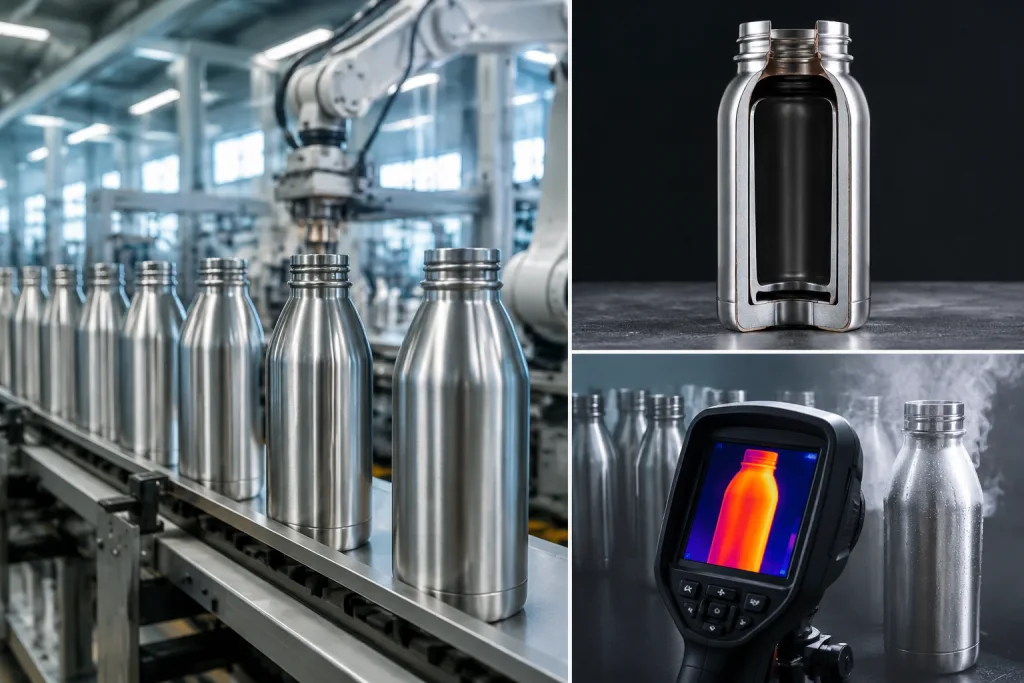
The real factory check is vacuum testing. Good factories run temperature decay tests or vacuum detection right after sealing, then QC pulls the sample before packing. Ask for the reject rate by item, not one blended average. On mature BottleForge molds in Zhejiang, vacuum-related rejection before packing is usually below 1.5%, but new shapes or large growlers can jump during trial production. We’ve seen a 2 mm lid-seat issue turn into a full batch recheck.
Buyer impact is direct. If vacuum yield slips, the factory either holds shipment to sort weak units or ships them and eats the complaint later. For promo canteen orders, a few failures may be tolerable if the price is low. For retail customized growler programs, the math does not work: insulation misses turn into returns, bad reviews, and chargebacks. Put the test requirement in the purchase order, not just the chat thread.
Lids, Threads, And Leak Testing
I’ll rewrite the four paragraphs in-place, keep the HTML exactly as-is, and tune the tone to sound like a factory-side sales engineer.Most bottle complaints are not about the steel body. They start at the lid. A canteen customizable project can fail because the silicone ring is too soft, the thread engagement is shallow, the straw valve weeps, or the carry handle cracks after 500 pulls on the test rig. Buyers spend 90% of the call on color and logo, then approve the lid from one photo. That is the wrong move.
For every custom canteen or custom growler, ask for lid material and gasket material. Common lid materials are PP, Tritan, and stainless over PP. Silicone gaskets should be food-contact grade and removable for cleaning when possible. If you sell into children’s channels, check the migration and mechanical safety rules for that market. For adult sports and travel products, we care about leak resistance, drop resistance, and whether replacement lids can ship in 7 days or 21.
A proper leak test is plain work: fill with water, close the lid, invert, shake, and check for drops. For stronger validation, we run pressure or vacuum tests based on the lid type. On a mid-size lot, we normally pull 80-125 pieces for pre-shipment inspection under AQL sampling, then hit straw lids and flip lids with extra spot checks. I’ve seen one loose lid ruin a whole mixed carton, so this is not busywork.
Thread fit also changes how the bottle feels in hand. Stainless threads can feel rough when polishing is poor. Plastic threads can deform if the lid material is weak or the mold tolerance is loose. Ask whether the lids are made in-house or by an outside mold shop. Outsourcing is common in China, but the supplier still has to hold fit, color match, and spare-part continuity. We once caught a PO typo on thread spec and QC pulled the sample before the line ran 3,000 pieces.
Decoration Specs Change The Price
I’ll rewrite the section in place, keep the HTML untouched, and sharpen the wording with more factory-side detail and cleaner pricing logic.Custom drinkware is never one price with “logo included.” Decoration method, logo size, color count, print position, and order quantity all move the cost and the lead time. If your thermal bottle supplier list does not compare those specs line by line, the quote sheet is smoke and mirrors.
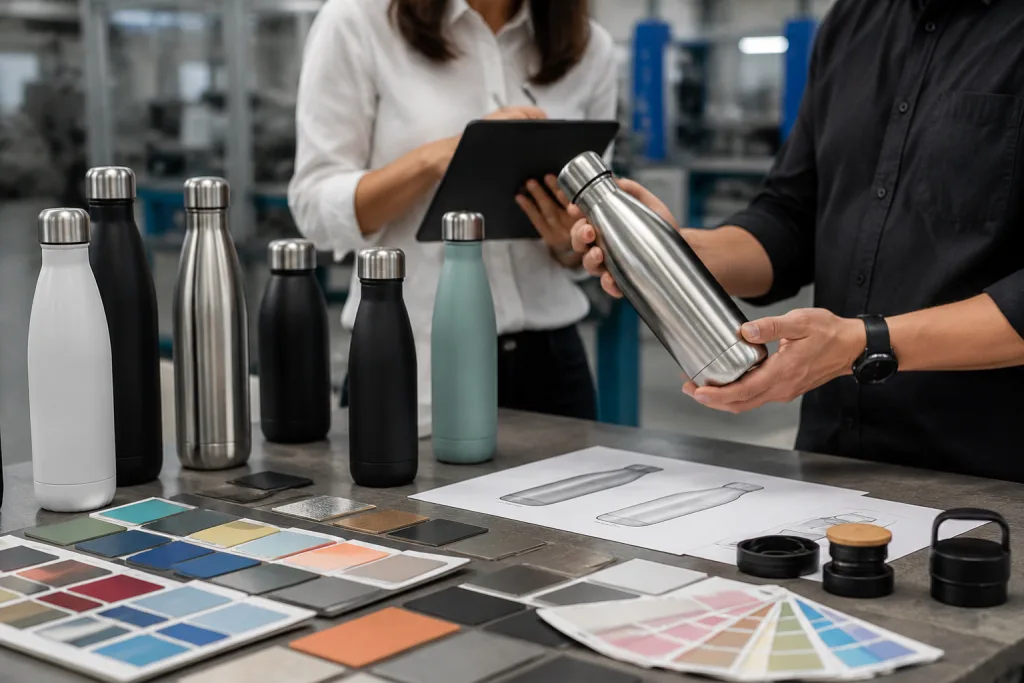
Laser engraving is clean and holds up well on powder coated stainless bottles. We run it a lot for corporate gifts, distributor growler programs, and premium retail SKUs. The price is often higher than a simple one-color silkscreen on a large logo, but there is no ink adhesion issue. Silkscreen usually lands around USD 0.08-0.25 per position, depending on size and quantity, and a two-color logo means another setup and another screen. Heat transfer and water transfer can do full-color art, but QC pulled the sample for abrasion checks and packing needs to be tighter.
Powder coating is another cost line that buyers miss. Stock colors are easy. Custom Pantone-like colors may need 3,000 units or more per color because the line needs setup, cleaning, and powder loss allowance. A canteen promo order with five colors at 500 units each looks neat on paper, but the math does not work on the line. If you want that split, expect a surcharge or switch to stock colors.
Packaging belongs in the decoration quote too. A plain white box is not the same as a printed retail box with EAN, FNSKU, suffocation warning, insert card, and carton drop test requirement. For Amazon FBA drinkware, label accuracy matters as much as logo quality. We’ve seen a PO typo on the carton mark turn into a week of back-and-forth. Tell your canteen suppliers whether the order is FOB Ningbo, FOB Shanghai, DDP warehouse, or FBA-ready before they quote, or you will get a nice unit price that leaves out half the work.
Compliance Lines Buyers Should Demand
I’ll rewrite the section in a more senior, buyer-facing voice and keep the HTML structure untouched. Then I’ll quickly sanity-check the tone against the compliance and phrasing constraints.Compliance is not a certificate folder you ask for after production. It has to shape the supplier list from the first RFQ. For Europe, ask for LFGB, EU food-contact migration, REACH, and packaging rules. For the United States, FDA food-contact expectations and any state-specific rules matter. If the product is for children, bring up CPSIA, ASTM mechanical checks, and warning labels at the sample stage. If your customer needs social compliance, ask for BSCI, Sedex, or ISO audit status before we cut samples.
Do not take “we can make certificate” as an answer. Ask which lab, which material, which SKU, and which test date. A report for a plastic lunch box does not prove a stainless customized canteen with a painted body and silicone gasket. A report older than 3 years may still help as background, but the buyer flagged the exact material and color for a reason, and the math does not work if the report does not match.
For customized drinkware, coating compliance gets missed all the time. The metal may pass, but the powder coat, ink, rubber finish, or printed box can trigger REACH or heavy metal questions. Dark matte coatings, soft-touch finishes, and metallic paints need extra checks. If your channel includes Germany, France, California, or a chain retailer, run the conservative route. We have seen this go sideways on a 1,000-piece sample lot because the print ink was fine on paper and failed on the real pack.
A China supplier that exports regularly should know these documents and quote test cost separately when needed. At our Hangzhou office in Zhejiang, we line up the required tests before deposit because third-party lab work adds 7-12 working days. That sounds small until QC pulled the sample on Tuesday and the vessel closes next week. Put the test plan in the PO, and avoid the typo that turns “matte black” into “matt black” on a 5,000-unit order.
Build The Shortlist From Specs
I’ll rewrite the section in place, keep the HTML exactly as-is, and tighten the language so it reads like a real sourcing note from the factory floor.Once you line up capacity, steel grade, insulation, lid structure, decoration, compliance, and packing, the thermal bottle supplier list gets short fast. Good. A tight list of qualified canteen manufacturers beats 40 names copied from trade platforms.
We run a scoring sheet with weighted items. For one buyer, the split was 20% factory capability, 20% product engineering, 15% compliance, 15% quality control, 15% price, 10% communication, and 5% payment flexibility. Price matters, but it should not run the show. A USD 0.30 saving disappears when you pay for air freight on replacement lids or the distributor drinkware customer rejects a carton because of a labeling typo.
Request a golden sample and keep it on the shelf. For every canteen custom project, that approved piece sets the color, logo position, lid fit, surface finish, packaging, and barcode. QC pulled the sample and checked the lid gap at 0.3 mm before we signed off. Send photos with measurements in the approval email. For repeat orders, match new production against that sample, not against memory.
Be clear about inspection from the start. A common pre-shipment inspection uses ANSI/ASQ Z1.4 sampling with AQL 2.5 major and AQL 4.0 minor, though some retail buyers ask for tighter limits. Define critical defects as leakage, wrong material, sharp edges, severe coating failure, wrong logo, and barcode scan failure. We’ve seen this go sideways when the PO said only “per photo.” If you buy through canteen distributors or a distributor canteen program, push the same standard down to the factory. The purchase order should name the product spec, not just the product photo.
Send us your bottle spec sheet for review
We will check MOQ, steel, lid, logo, packing, and compliance points before you lock your supplier list.
Frequently asked questions
How many suppliers should be on my thermal bottle supplier list?
For serious B2B sourcing, keep 5-8 initial names, then reduce to 2-3 approved suppliers after samples and document checks. One supplier is risky during peak season or material shortages. More than eight usually wastes time because you cannot properly compare steel grade, vacuum testing, AQL inspection, packaging, and compliance. For a custom canteen or customized growler program, I would rather have three canteen vendors with clear specs than 20 vendors sending the same catalog photos. Keep one primary factory, one backup factory, and one development partner for unusual shapes or lids.
What MOQ should I expect for customized thermal bottles?
For standard stainless thermal bottles with one-color logo, expect MOQ around 1,000 units per SKU from many China factories. For powder coated custom colors, special lids, retail packaging, or canteen customizable designs, 3,000-5,000 units is more realistic. New mold development can require 10,000 units or a separate tooling fee, often USD 2,000-8,000 depending on lid and body complexity. If a canteen supplier offers 100 units with full customization at factory pricing, check whether it is stock inventory with simple logo service rather than true production customization.
What is a realistic price range for custom drinkware?
A basic 500 ml double-wall stainless bottle may quote around USD 3.20-5.80 FOB China depending on steel grade, lid, coating, logo, and packaging. A larger custom growler or customized growler can range from USD 8.00-18.00 FOB, especially with handle lids, retail boxes, or copper-lined vacuum construction. Very low prices often remove inspection, use thinner steel, simplify packaging, or exclude testing. Always compare the same Incoterm, carton specification, decoration method, and compliance scope. FOB Ningbo and DDP warehouse pricing are not comparable.
How long does sampling and production usually take?
For an existing bottle shape with laser logo or silkscreen, sample lead time is usually 5-10 days after artwork confirmation. Custom color samples may take 10-15 days because coating setup is involved. Mass production is commonly 30-45 days after deposit and sample approval for 3,000-20,000 units. Peak season, new molds, retail packaging, or third-party testing can add 10-20 days. A good canteen manufacturer should give you a dated timeline covering sample, deposit, material purchase, production, inspection, and shipment booking.
Should I work with a canteen factory or a trading company?
If you have technical specs, repeat orders, or retailer compliance needs, a direct canteen factory is usually better because engineering answers are faster and cost breakdowns are clearer. A trading company may help if you need mixed categories, very low MOQs, or consolidated shipments from several factories. The key is transparency. Ask who owns the molds, who performs vacuum testing, who controls AQL inspection, and whose name appears on test reports. For distributor growler and distributor drinkware programs, direct factory communication usually reduces mistakes across repeat orders.