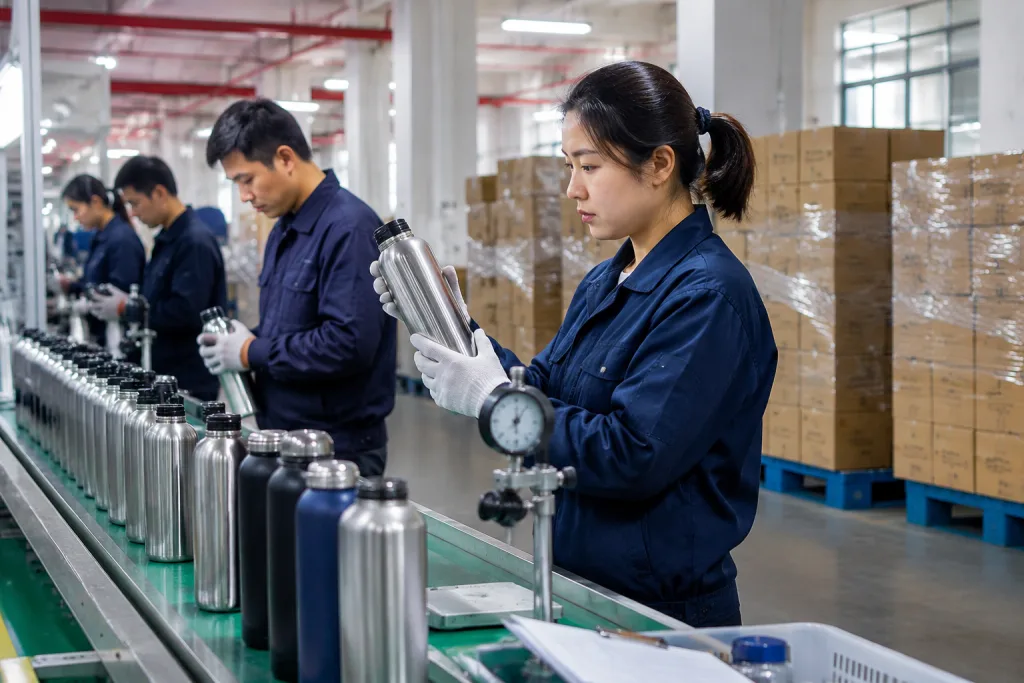
Key Takeaways
- Most thermal bottle promotional orders start at MOQ 1,000 pcs, with factory lead time around 20–30 days after sample approval
- A 304 stainless body at 0.5 mm wall thickness is usually the safest balance of cost, weight, and dent resistance
- Laser engraving adds about USD 0.20–0.45 per piece; 1-color silk screen is often cheaper at USD 0.10–0.25
- For EU and U.S. buyers, ask for REACH, LFGB, and dishwasher test data before you place a 5,000+ pc order
If you are buying thermal bottle promotional products, the hard part is not finding a bottle. The hard part is picking one that holds up in a commuter bag, prints cleanly on the line, and still leaves room for your margin. We have seen a low-grade vacuum bottle kill a campaign because the coating scratched after 2 weeks. A solid one can ship in 5,000 units with almost no aftersales noise.
At BottleForge Industrial in Zhejiang, we see this every week from Europe and North America: one buyer wants a gift item that looks sharp, another wants a stable SKU, and procurement wants fewer headaches on FOB terms. The answer changes with wall thickness, lid style, coating, MOQ, and whether you need a canteen custom look or a plain corporate giveaway. QC pulled a sample last month for a 0.3 mm seam gap, and the buyer flagged it fast. Below, I compare the main options the way a buyer should, by spec, by use case, and by what actually ships from a canteen factory in China.
Specs Beat Marketing Claims
I’ll rewrite the prose only, keep the HTML exactly as-is, and make the copy sound like a factory-side sales engineer wrote it.Buyers comparing thermal bottle promotional samples usually look at finish and price first. Wrong order. Start with the spec sheet. A bottle can look premium and still come with thin steel, a weak vacuum seam, or a soft PP cap; that turns into return claims and discount pressure later. We run comparisons on stainless grade, body thickness, insulation time, lid build, decoration method, and carton packing.
For promo work, 304 stainless steel is the safe default. If a factory pushes 201 on the inner wall to shave cost, the quote looks better, but corrosion risk and odor complaints climb fast. For most custom drinkware programs, we build a double-wall vacuum bottle with 18/8 stainless inside and out, 0.4–0.6 mm wall thickness, and a lid that passes a 1.2 m drop test without leaking. QC pulled that sample three times last month on the line; the one that fails is the one the buyer flags. That is the gap between a canteen promotional item people keep and a canteen customizable product that comes back.
Typical spec comparison
- Budget promo bottle: 500 ml, 304 outer / 201 inner, 6–8 hour heat retention, FOB China around USD 2.10–2.80
- Mainstream corporate bottle: 500–750 ml, full 304, 8–12 hour heat retention, FOB around USD 2.80–4.20
- Retail-grade bottle: 500–750 ml, full 304, powder coat, 12–24 hour heat retention, FOB around USD 4.20–6.80
That spread matters because a canteen supplier in Zhejiang can quote all three in one week, and the math still does not work if you mix them up. One PO typo we saw last quarter swapped 500 ml for 750 ml, and the carton count changed by 12%; the buyer caught it before shipment. If your customer is a distributor canteen buyer in Europe, the middle tier usually gives the cleanest balance of shelf appeal and claim safety.
Head-to-Head By Use Case
I’ll rewrite the section in place, keep the HTML structure intact, and tune the prose to sound like a factory-side sales engineer. Then I’ll do a quick pass for any banned filler or awkward LLM phrasing.The quickest way to pick a thermal bottle promotional model is to match the bottle to the job. A stadium giveaway does not need the same lid as a boardroom gift. A distributor growler program does not need the same finish as a school campaign. If you sell through canteen distributors, the spec has to stay broad enough for three channels without making one buyer pay for the others.
Use-case fit table
| Use case | Best bottle type | Decoration | Why it works |
|---|---|---|---|
| Trade show giveaway | 500 ml slim thermal bottle | 1-color silk screen | Low unit cost, fast handout, clear logo on the line |
| Corporate gifting | 750 ml matte powder-coated bottle | Laser engraving | Better perceived value, branding that holds up after 200 washes |
| Retail / e-commerce | Wide-mouth insulated bottle | Full wrap print or laser | More shelf pull and a cleaner story for product pages |
| Outdoor / sports | Handle lid bottle | Laser or one-color print | Better grip, easier carry, fewer buyer complaints |
If you need a custom canteen for school or camping channels, do not overcomplicate it. Buyers call it canteen custom, customizable canteen, or customized canteen, but the product that ships best still has a strong handle, a tight seal, and a cap that QC can clean in under 2 minutes. We’ve seen this go sideways when someone adds a fancy lid and then the buyer flags leaks on the first carton.
A practical rule from our China factory: if the bottle sells below USD 15 retail, keep the decoration simple and the body shape standard. Once you ask for custom growler geometry, tooling jumps, the carton grows 8 to 12 mm, and freight gets ugly for no real sales gain unless the channel is locked in. The math doesn’t work.
Decoration Cost Changes Everything
I’ll rewrite the section in-place, keeping the exact HTML structure and preserving the technical facts and pricing ranges.Decoration is where a lot of thermal bottle promotional jobs give up margin. The bottle can be fine, and the logo method still blows up the landed cost. On our line, we run silk screen, pad print, UV print, and laser engraving. Each one hits setup fee, cycle time, and wear resistance differently.
Typical decoration economics
- Silk screen: best for 1–2 colors, usually USD 0.10–0.25 per piece at 1,000 pcs, solid for canteen promotional work
- Laser engraving: usually USD 0.20–0.45 per piece, better for premium custom drinkware and branding that needs to stay put
- UV print: stronger visual impact, often USD 0.25–0.60 per piece, but it marks up faster under abrasion than engraving
- Full wrap print: works for retail storytelling, but the carton spec and color control need tighter QC
For a canteen manufacturer in Zhejiang, laser is usually the safer call if the buyer wants fewer returns. It will not peel. It will not fade the way a weak print can. We had one buyer flag a PO typo on the logo size, and the sample still saved the order because the mark stayed clean after the abrasion test. If your customer sells to offices or schools, that matters more than a flashy finish. For canteen suppliers shipping to North America, a conservative decoration spec clears QC faster and stays consistent on repeat runs.
“Buyers often ask for the cheapest logo method first. That is the wrong question. Ask what still looks acceptable after 300 hand washes and one season of use.”
If you need separate SKUs for distributor canteen and retailer channels, keep the bottle body the same and change only the decoration. The math works better that way. You get cleaner MOQs, better purchasing leverage, and fewer boxes stuck in the warehouse.
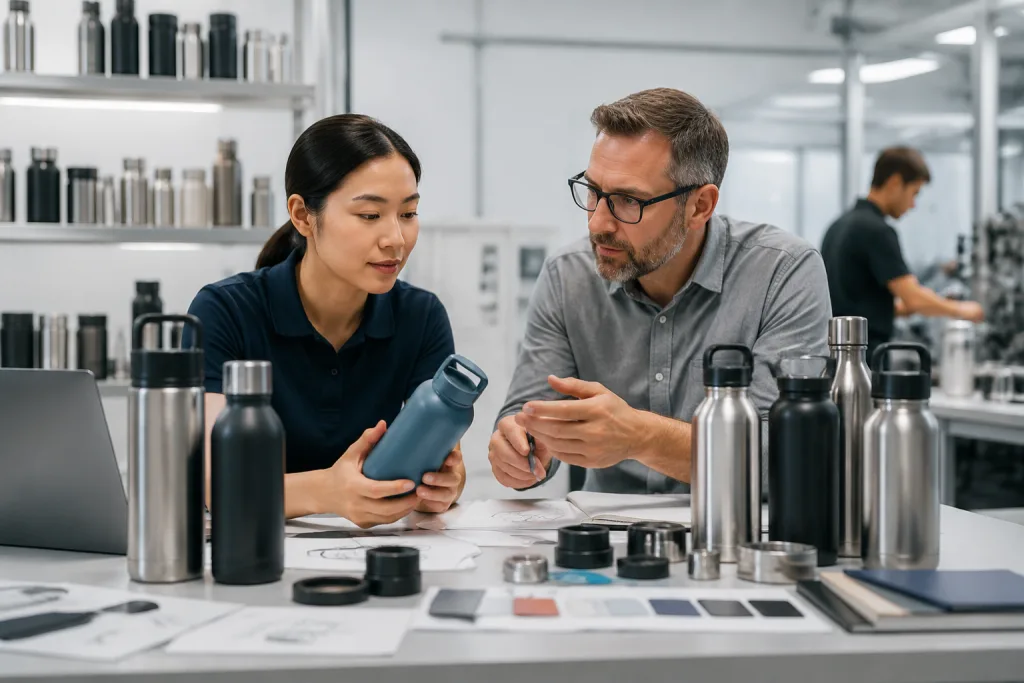
MOQ, Lead Time, and Factory Reality
I’ll rewrite the section in-place, keep the HTML exactly as-is, and strip the AI-ish phrasing while adding the factory-floor details the brief asks for.Promotional drinkware gets messy fast when the buyer ignores production economics. A factory quote means little until you know the MOQ, mold status, and packing method. At our Hangzhou plant in Zhejiang, the standard MOQ for a stock thermal bottle with logo is 1,000 pcs. For a customized lid, special handle, or color-matched cap, we usually push to 3,000 pcs or charge a small tooling fee. Monthly output runs about 300,000 units, so repeat orders are fine. A new shape is another story.
Lead time is usually 20–30 days after sample approval for normal promotional orders. If you want custom color coating, extra carton inserts, or strict retail barcoding, add 5–7 days. Ocean freight from China to the U.S. West Coast is often 18–28 days depending on routing. We had a buyer flag a launch date three weeks out last season. The math did not work. The line had already booked for two 40HQ containers, and we could not bend drying time just to save the calendar.
Practical sourcing checkpoints
- Ask for a production sample before mass run if your logo has fine text under 2 mm
- Confirm vacuum performance target, usually 8+ hours hot / 12+ hours cold for promo grade
- Request carton drop test and leak test data
- Use AQL 2.5 for major defects and 4.0 for minor defects on normal export orders
If you buy through a canteen distributor network, the real risk is lot-to-lot drift. QC pulled the sample on one batch and found a 0.3 mm shift in print registration after a nozzle change on the pad printer. A good canteen factory in China keeps the body mold, coating formula, and print setup locked so the second order matches the first. That beats shaving USD 0.08 off unit price. Every time.
Materials Buyers Actually Trust
I’ll rewrite the section in place, keep the HTML intact, and tighten the copy so it sounds like a factory-side sales engineer.Not every customizable drinkware material holds up the same on a promo order. Stainless steel is still the baseline for thermal bottle promotional programs because it balances insulation, drop resistance, and the value buyers can see. Glass looks premium on a sample table, but for field use, gift-with-purchase runs, or distributor stock, breakage cost kills the math. Plastic is cheaper, yes, but once the buyer asks for real heat retention, the story falls apart fast.
For a canteen custom campaign, look at the inner wall and coating first, not the outer finish. We run powder coating on the line because it cuts fingerprints and gives better grip. A copper-plated inner wall can lift thermal performance, but only when the vacuum seal stays tight; QC pulled one sample at 12 hours because the seal line was off by 0.3 mm. Silicone bases help with table noise and sliding. A wide-mouth opening makes ice loading and cleaning easier, but it also changes lid cost and carton size, so the buyer needs to see that early.
If your buyer asks for a canteen customizable product for food-safe markets in Europe, ask for compliance papers before the PO lands. REACH and LFGB are the usual starting point. For the U.S., ask for food-contact declarations and the exact test method used. If you are selling as a custom growler or customized growler, check closure integrity too; we’ve seen one loose cap turn into a full returns issue, and that is not a minor defect.
We usually spec 304 stainless for the body, food-grade PP or Tritan for lids where the structure needs it, and silicone seals with documented compression resistance. That setup keeps the SKU workable for canteen distributors and retail accounts without building a science project. If a buyer pushes for cheaper resin on a thermal bottle, the wrong question is “can we do it?” The better one is “what fails first?”
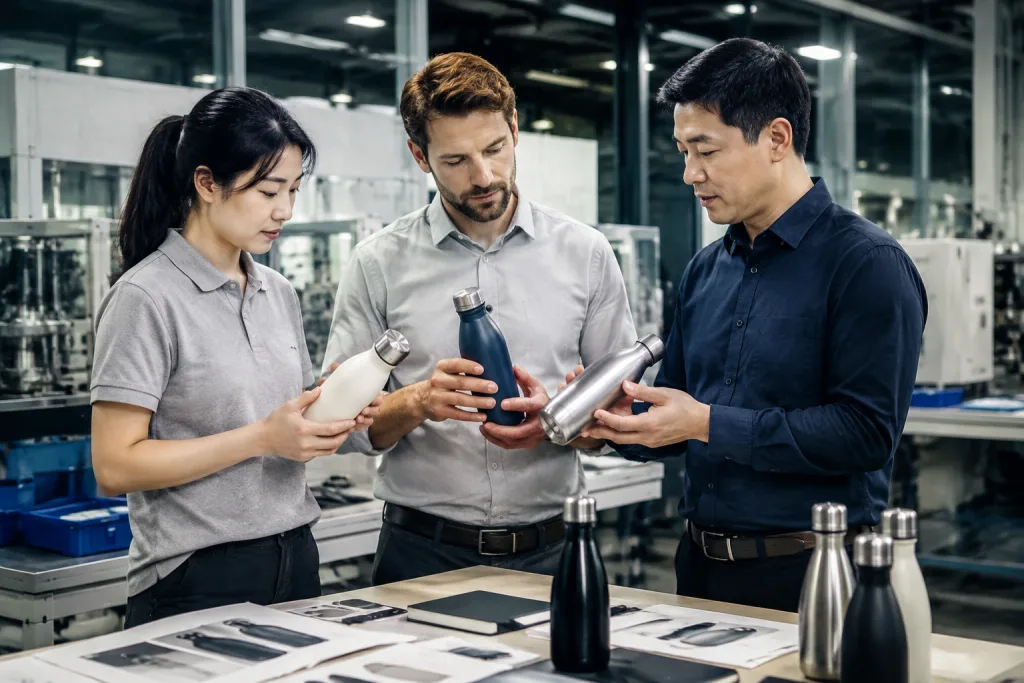
What To Ask Your Supplier
I’ll rewrite the section in place, keep the HTML exactly as-is, and tighten the prose so it sounds like a buyer-facing sales engineer wrote it.If you are comparing a canteen supplier, canteen vendors, or a canteen manufacturer in China, do not stop at price. Ask about tooling, QC, and shipping dates. A serious supplier will send sample photos, test results, and carton specs in one reply. A weak one sends a polished picture and a vague promise.
Ask these directly:
- What is the MOQ for stock color versus custom Pantone color?
- Can you show the BSCI audit status and factory photos?
- What insulation test method do you use, and at what fill temperature?
- Can the carton fit Amazon FNSKU labels if I need retail prep?
- What AQL standard do you inspect under before shipment?
For distributor growler or distributor drinkware programs, I would also ask about spare lid supply. We had one buyer flag a 5,000-piece order because the lid backup plan was thin, and that kind of gap kills repeat business. On our line, the 38 mm gasket and the lid SKU get checked with the sample pack before we lock the carton. In Zhejiang, the better canteen manufacturers treat packaging and spare parts as part of the job, not extra work.
One more point: if a vendor says they can do a tiny MOQ and a fully customized canteen with no tooling cost, the math does not work. QC pulled a sample once with a rushed claim like that, and the print shifted 2 mm after approval. Honest numbers beat a pretty quote that gets revised later. If you want stable supply, buy from a canteen factory that can explain where the cost comes from.
Send your spec, get a real factory quote
We’ll match your target price, logo method, and MOQ with the right Zhejiang production route and ship a quote that actually holds.
Frequently asked questions
What is a normal MOQ for thermal bottle promotional orders?
For a standard stock shape with logo, MOQ is usually 1,000 pcs. If you want custom color coating, a new lid, or special packaging, 3,000 pcs is more realistic. Some canteen suppliers will quote 500 pcs, but the unit price is usually 15–30% higher and the carton mix is less efficient. For repeat orders, a Zhejiang canteen manufacturer with stable molds can usually keep the MOQ steady while improving lead time to 20–25 days after sample approval.
Which decoration method lasts longest on custom drinkware?
Laser engraving is usually the most durable for thermal bottle promotional work. It does not peel, and it resists wash wear better than screen print. On average, laser adds about USD 0.20–0.45 per piece, while 1-color silk screen is often USD 0.10–0.25. If you need a premium look without too much cost, laser on a powder-coated body is the safest choice. For multi-color branding, UV print works, but it needs better handling and packaging control.
Is 304 stainless steel enough for a promotional bottle?
Yes, for most B2B orders 304 stainless steel is the right choice. It gives a good balance of corrosion resistance, price, and food safety. A common spec is full 304 with 0.4–0.6 mm wall thickness. If a canteen factory offers 201 inner steel to save cost, you should check the end market carefully because the savings may not be worth the risk. For Europe and North America, 304 plus REACH or LFGB documentation is the safer export setup.
How long should a thermal bottle keep drinks hot?
For promotional grade, 8–12 hours hot retention is a realistic target. Retail-grade insulated bottles can reach 12–24 hours depending on fill temperature, lid design, and vacuum quality. If a canteen vendor claims 24 hours on a very low-cost bottle, ask for the test method and ambient conditions. A real test should state the starting liquid temperature, ambient temperature, and measurement interval. That keeps your claim honest and reduces post-sale disputes.
What should I check before choosing a canteen manufacturer in China?
Check factory output, audit status, test documents, and packaging control. A good canteen manufacturer should be able to show monthly capacity, for example 300,000 units, and explain the difference between stock and custom projects. Ask for BSCI, AQL inspection standard, and leak test data. If you are shipping to Amazon or retail, confirm barcode and carton labeling. A clear production process matters more than a low sample price, especially for canteen distributors handling repeat orders.