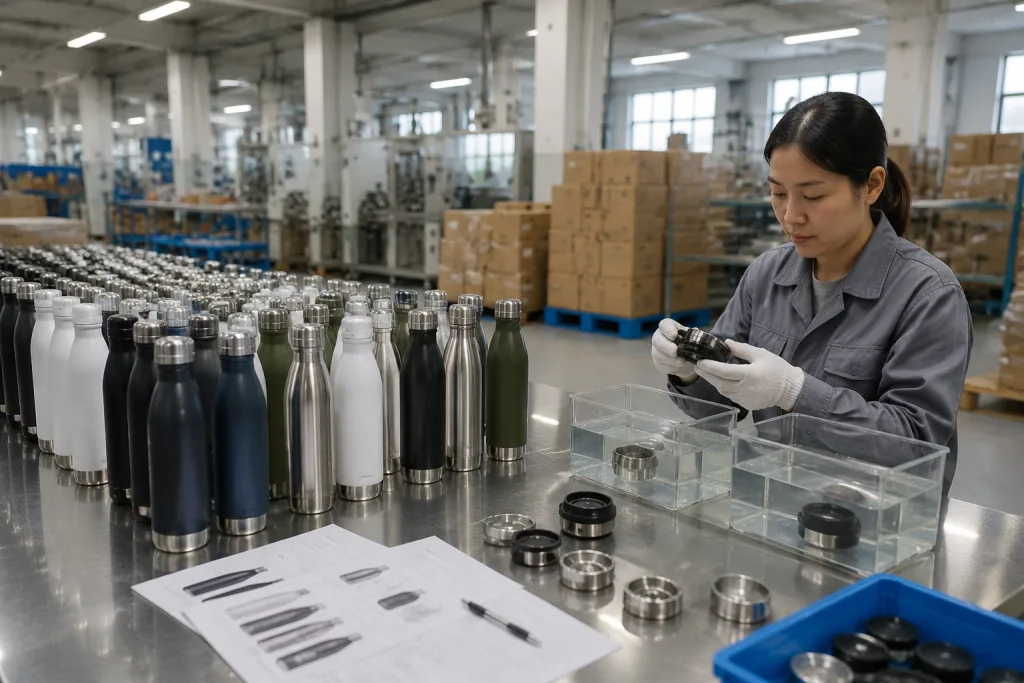
Key Takeaways
- A 500 ml 304 stainless thermal bottle usually starts around USD 2.10-3.80 FOB China at 1,000 pcs, while premium double-wall builds can add 20-35%.
- For most thermal bottle promotional products, 304 stainless steel and 0.4 mm wall thickness give a better balance than ultra-thin 0.25 mm builds.
- A typical canteen manufacturer in Zhejiang can hold MOQ at 500-1,000 pcs and ship in 20-35 days after sample approval.
- Leak testing, lid torque, and carton drop testing matter more than a fancy render when you buy customized drinkware for B2B resale.
Most buyers do not lose money on thermal bottle promotional products because the bottle looks bad. They lose money because the spec missed the channel. A 500 ml vacuum bottle with a 0.35 mm inner wall works for office gifting, but it is a weak fit for a distributor program that needs better heat retention and fewer dent claims in transit. We have seen that go sideways on the line.
If you are buying in bulk from China or working with a canteen factory in Zhejiang, compare thermal bottles like a sales engineer would: steel grade, lid system, coating, leakage risk, carton pack, and the real use case. QC pulled one sample last week with a lid torque issue at 1.8 N·m, and the buyer flagged it before the PO went out. That is how you separate custom drinkware that moves from custom drinkware that sits in a warehouse. The wrong question is “which bottle is popular.” The math is “which spec fits this customer, this budget, and this route to market.”
Start With the Sales Channel
I’ll rewrite this section in-place, keep the HTML structure untouched, and tune the prose to sound like a factory-side sales engineer.Before you compare lids or finishes, decide where the bottle sells. A thermal bottle promotional products run for corporate gifts behaves differently from retail drinkware, and both move differently from event canteen packs. If the buyer is a brand owner placing a 3,000-piece campaign, we usually hear three asks: clean logo, low unit cost, and a 7-10 day sample cycle. If the buyer is a canteen distributor, they push for fewer claims, better carton efficiency, and the same spec over a 6-12 month repeat order.
So we start with channel fit, not decoration. A customized canteen for a sports club may need a wide-mouth lid and a carabiner loop; a customized growler for a brewery gift set needs heavier gauge steel and a tighter cap seal. A custom canteen for a university campaign may need a powder coat that holds up in a backpack. On the line, we’ve seen the wrong question sink a quote: the buyer asks for “best price,” then changes the use case after QC pulled the sample. The right canteen vendor asks who uses it first, because a giveaway, a resale item, and a bundled gift all need different specs.
- Office gifting: prioritize clean branding, 450-500 ml capacity, and gift-ready presentation.
- Retail resale: prioritize retention, leakage control, and carton durability.
- Outdoor promotion: prioritize grip, lid strength, and abrasion-resistant coating.
Spec Table That Actually Matters
I’ll rewrite just the prose inside the existing HTML, keep the tags and table structure unchanged, and make it read like a buyer-facing sales engineer note with concrete factory detail.Buyers asking for thermal bottle promotional products usually get a shiny sample and no numbers. That is the wrong way to buy. Compare steel grade, wall thickness, and test standard. If a canteen supplier cannot give those three on the PO, you are buying blind. On our line, QC pulled 20 samples from one batch and the dent rate jumped as soon as the wall dropped under 0.30 mm.
Spec comparison for common promotional use cases:
| Spec | Entry Option | Better Option | Use-Case Fit |
|---|---|---|---|
| Material | 201 stainless | 304 stainless | 304 is the safer pick for long-term B2B resale and fewer complaint emails |
| Wall thickness | 0.25-0.30 mm | 0.35-0.45 mm | Thicker walls hold shape better and keep vacuum performance steadier |
| Capacity | 350-450 ml | 500-750 ml | 500 ml fits most thermal bottle promotional products without looking oversized |
| Lid | Screw cap | Push-button or leakproof flip lid | Better for commuters and distributor drinkware programs |
| MOQ | 1,000-3,000 pcs | 500-1,000 pcs | Lower MOQ lets you test one market before you scale |
For most buyers, the cleanest spec is a 500 ml 304 stainless double-wall vacuum bottle with a 0.4 mm body, silicone gasket, and matte powder coat. It is not the cheapest quote, and that is fine. The math does not work if you save 18 cents and then eat reprints. We ship this build often in the USD 2.35-4.20 FOB range, depending on lid, finish, and decoration method, and the buyer flagged it only once when a PO typo called for 450 ml instead of 500 ml.
Lid Choice Changes Everything
I’ll rewrite the section in-place, keep the HTML tags intact, and tighten the sales-engineer voice with concrete factory details and cleaner wording.You can sink a good bottle with the wrong lid. Buyers usually start with insulation, but the lid drives leak risk, line speed, and how the customer feels after week two. If you need a canteen customized for travel retail, the simplest lid often wins. Extra parts slow the line and create more failure points. A plain screw cap is fine for a custom canteen sold as a lower-risk premium item, while a one-touch lid fits commuter-style customized drinkware better.
Here is the split we use on the line. A wide-mouth lid helps with ice, cleaning, and hot drinks, but a weak gasket turns it into a spill problem fast. A push-button lid is easy to use, yet it needs a better spring and a tight torque spec. A straw lid works for cold drink use, but it is the wrong question for true thermal retention. For a custom growler, we run a stout locking cap and leave the exterior alone; brewery buyers care about seal integrity and headspace, not gimmicks. Ask your canteen factory for a torque target and a hot-water leak test at 70-80°C. If they cannot give you numbers, walk away.
We see the fewest claims on bottles that pass a 30-minute inverted leak test, a 1.2-meter carton drop test, and a 24-hour closure check at room temperature.
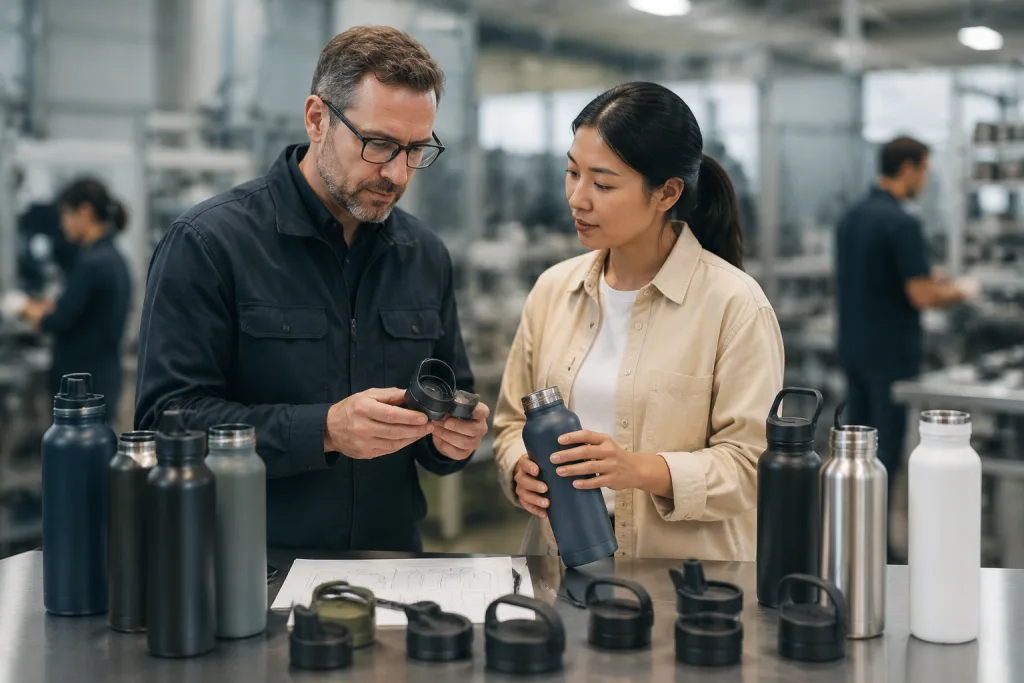
Decoration Should Match Volume
I’ll rewrite just the prose, keep the HTML structure intact, and tune the copy to sound like a real sales engineer with concrete production details.Decoration is not a sticker on top; it changes the quote. For thermal bottle promotional products, the usual miss is picking decoration by appearance instead of order volume and artwork setup. Silk screen still runs well for a single-color logo on a canteen promotional order, especially when the buyer wants a fast turn and the unit price has to stay tight. Laser engraving costs more at the start, but on matte stainless it gives a cleaner finish and holds up better on premium distributor canteen jobs. We run this on the line every week.
For repeat orders under 1,000 pcs, a 2-3 color screen print usually makes sense if the logo file stays unchanged. For premium custom drinkware, laser or UV print can carry the higher price because the product feels less temporary and the branding reads better in hand. If you sell through canteen distributors, pick a decoration that survives bag drops and dishwasher cycles, not just a nice photo. We’ve seen a printed logo rub thin after 6 weeks, and the buyer flagged it on the next reorder. A Zhejiang canteen supplier should return the decoration impact within 24 hours and send a digital proof before production starts.
- Silk screen: best for simple logos and 500-5,000 pcs.
- Laser engraving: best for premium stainless and permanent branding.
- UV print: best for color-heavy artwork on flat areas.
MOQ, Price, and Lead Time
I’ll rewrite the prose in place, keep the HTML untouched, and make the copy sound like a real factory-side sales engineer.Price only makes sense beside MOQ and lead time. We run into this on the line all the time: a Zhejiang canteen factory may hold a 500-piece MOQ for a plain thermal bottle, then the unit price jumps once the buyer asks for a custom lid, matte spray, or two mixed body colors. For a 500 ml vacuum bottle, FOB usually lands around USD 2.10 to 3.80 at 1,000 pcs. A heavier steel growler sits closer to USD 4.50-7.20, depending on capacity and finish. If you want gift box packaging, budget another 0.25-0.80 USD per set. The math does not work any other way.
Lead time usually runs 20-35 days after sample approval for standard builds, and 35-45 days if the job needs complex printing or new tooling. We had a buyer flag a PO typo once—“2,000 pcs” became “20,000 pcs” on the draft—and QC pulled the sample set before we booked carton space. That is the kind of detail that matters when a distributor drinkware program is tied to a trade show or a retail reset. I would rather quote a real 28-day schedule from a China factory than promise 15 days and miss the vessel. Ask for the sampling fee, sample lead time, and whether the charge gets credited back on mass production. That is normal export practice.

Quality Checks You Should Demand
I’ll keep the HTML structure intact and rewrite the copy to sound like a factory-side sales engineer, with tighter language and a few concrete shop-floor details.Quality control decides whether thermal bottle promotional products make money or turn into a claim. If you buy from China, ask for the test method, not just “passed.” We run 304 stainless cert checks, coating adhesion pull tests, and a 1-meter leak test on the line. For EU and North America, ask for REACH papers, food-contact declarations, and carton artwork that matches retail barcodes or FNSKU labels before the goods leave packing.
For bulk orders, the clean setup is simple: pre-production sample approval, inline inspection, and final AQL sampling. AQL 2.5 is standard for major defects, but logo position and lid feel need their own tolerance. If you place 5,000 units, do not skip carton testing. We’ve seen a bottle pass QC and still arrive dented because the carton fit was loose and the pallet wrap was too thin. QC pulled the sample, checked closure torque, vacuum hold, and a 1.2 m drop test before packing; that is the level you want. Ask for photos or a 30-second QC video. If a supplier dodges that, the math does not work.
- Request: material spec sheet, leak test record, and carton drop results.
- Check: logo alignment, coating uniformity, and lid fit on 10-20 random samples.
- Confirm: outer carton strength, master carton count, and pallet loading plan.
Best Fit by Buyer Type
I’ll rewrite the section in-place, keeping the HTML tags and structure intact while making the prose sound like a sales engineer wrote it. Then I’ll return only the rewritten HTML.Different buyers need different bottles, even when they all search for thermal bottle promotional products. A school distributor cares about claim rate and repeat supply. A brand-owner campaign will pay more if the bottle lands as a premium gift. We run the same body across channels, then change the lid, print, and pack-out so the line stays simple.
Use-case fit guide:
- Brand owner: pick 500 ml, matte powder coat, laser logo, and a rigid carton. QC pulled the sample with a 0.3 mm logo shift; that is the kind of thing buyers notice fast.
- Distributor: pick 304 stainless, a screw lid or flip lid, and packing that we can repeat on every PO.
- Retail promotional set: pick a bottle that matches a notebook, lunch bag, or gift box. The buyer flagged a carton size mismatch on a 1,000-set order once, and the math did not work.
- Outdoor or sports channel: pick a tough custom canteen with grip texture and geometry that fits a carabiner hook.
If you sell customized canteen or customizable canteen programs, keep the range tight. Too many colors and lid combinations create stock drag. One body, two lid choices, and three decoration options is enough. We’ve seen this go sideways when a buyer asked for six caps and four finishes; the warehouse sat on dead stock for 90 days. A canteen supplier in China keeps the line moving with one proven thermal body, then adjusts branding and pack-out by channel.
Send your spec sheet, get a real quote
We will match your channel, MOQ, and budget to the right thermal bottle build from our Zhejiang line.
Frequently asked questions
What is a normal MOQ for thermal bottle promotional products?
For a standard 500 ml stainless thermal bottle, many canteen manufacturers in Zhejiang can work with 500-1,000 pcs MOQ. If you want custom packaging, special color coating, or a custom lid, expect the MOQ to rise to 1,500-3,000 pcs. For a first-time buyer, I recommend starting with 500-1,000 pcs so you can test market response before scaling. A factory that offers 300 pcs on a complex build may still be fine, but unit cost usually climbs 10-25%.
How much should I budget per bottle FOB China?
For thermal bottle promotional products, a basic 500 ml 304 stainless vacuum bottle usually lands around USD 2.10-3.80 FOB China at 1,000 pcs. If you add laser engraving, a premium lid, or gift box packaging, the landed FOB can move to USD 3.20-5.00. Heavier custom growler styles with thick walls and better closures often sit higher, around USD 4.50-7.20. Ask your canteen supplier to separate body cost, decoration cost, and packing cost so you can compare apples to apples.
Which material is better, 201 or 304 stainless steel?
For B2B resale and long-life promotional use, 304 stainless is the safer choice. It is better suited to thermal bottle promotional products because it gives you a stronger quality story and usually fewer customer complaints. 201 stainless can lower cost, but it is more often used when the buyer is pushing price first. If your order will be distributed in Europe or North America, I would treat 304 as the default and use 201 only when the channel is very price sensitive.
Can I get a sample before mass production?
Yes, and you should. A serious canteen factory in China should provide a pre-production sample in about 5-10 days for a standard model, or 10-15 days if you need custom printing or a special finish. Sample charges are often USD 30-120 depending on decoration and shipping, and many factories deduct that fee from the bulk order. Always approve the sample for logo position, lid function, wall feel, and carton fit before you release production.
What quality checks matter most for a custom canteen order?
The most important checks are leak resistance, vacuum retention, logo accuracy, and carton strength. For customized drinkware, ask for inverted leak testing, a closure torque check, and AQL sampling on the finished cartons. If you are buying for retail or distributor drinkware, also confirm food-contact compliance documents and REACH-related paperwork where needed. A bottle that looks good but fails a 1.2-meter drop test will cost you more than a slightly higher unit price from a better canteen vendor.