Key Takeaways
- Start with insulation target first: 12 hours hot / 24 hours cold is common, but not every 304 vacuum bottle achieves it.
- Expect MOQs of 1,000-3,000 units per SKU from a serious thermal bottle OEM manufacturer in Zhejiang.
- For compliant custom drinkware, ask for LFGB, REACH, FDA, and BPA-free declarations before you approve samples.
- A good OEM quote should state material gauge, finish, lead time, carton packout, and defect AQL, not just FOB price.
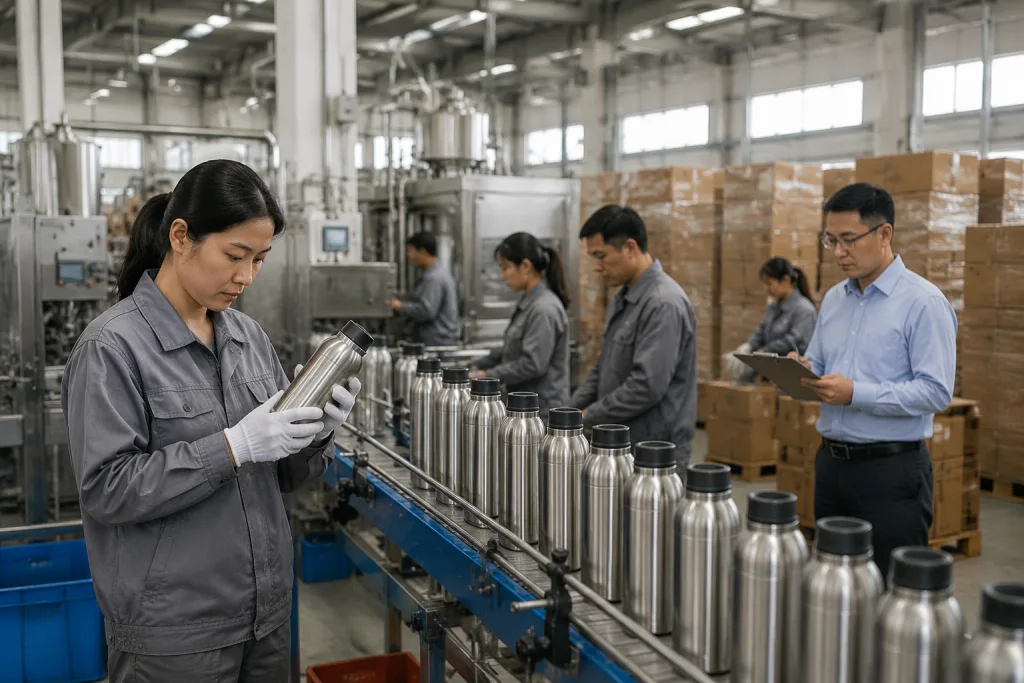
If you are buying from a thermal bottle OEM manufacturer, the first mistake is treating every quote as the same. It is not. We have seen a USD 1.80 price on a 500 ml bottle hide thin 304 steel, a lid that loosens after a week in transit, or a print that starts scuffing before 3,000 rub cycles. Another supplier may sit at USD 2.60 and still save money because the bottle holds vacuum, passes drop testing, and does not turn into a returns problem.
The real question is not who is cheapest. It is which canteen factory can keep your margin, compliance file, and launch date intact without surprise costs later. In Zhejiang, the line people look at wall thickness, lid tooling, coating wear, and carton count per 40HQ, not just the unit price. If you are sourcing custom drinkware for Europe or North America, this is the wrong question to ask: “What is your lowest quote?” The math does not work unless you compare the full spec and the hidden rework cost.
What actually drives your buy decision
I’ll rewrite the section to sound like a factory-side sales engineer, keep the HTML intact, and fold in sharper buyer logic plus a few line-floor details.Before you compare canteen suppliers, pin down the job the bottle has to do. A warehouse account bottle is not the same thing as a promo item for a roadshow, and both are different from retail stock that has to survive shelf time and returns. Mix those up and you pay for a fancy cap you never use, or you ship a weak spec that comes back as a complaint. We’ve seen that go sideways fast.
The first three calls usually shape the whole order:
- Performance: 12-hour hot hold, 24-hour cold hold, or basic temperature retention only.
- Price band: USD 1.80-2.30 for mass promotion, USD 2.50-4.50 for retail-grade thermal bottles, more for premium finishes.
- Brand impact: one-color silkscreen, laser engraving, powder coat, or custom packaging.
If you need a custom canteen for a niche market, ask one blunt question: does it need shelf pull or lower landed cost? A distributor pushing 20,000 units through wholesale usually cares more about carton density and defect rate than a curved bottle body. A DTC brand may pay for a softer coating and a better cap feel. The math does not work if you add 8-12% to landed cost and get no lift in sell-through. QC pulled the sample, and the buyer flagged the cap torque first.
Good buying starts with the use case, not the catalogue.
In China, plenty of canteen vendors will nod to every request. We run into that all the time. Put the trade-offs on paper: material, volume, decoration, and schedule. That is how you tell a real thermal bottle OEM manufacturer from a trading reply that looks neat but cannot hold water at the line. Last week a PO came in with the wrong carton count, 24 pcs instead of 30 pcs, and that sort of typo burns a week.
Material choices change everything
I’ll rewrite just the prose, keep the HTML structure intact, and make it sound like a factory-side sales engineer wrote it.Most custom drinkware projects start with stainless steel, but the real decision is the grade and the gauge. For a thermal bottle, 304 stainless is the usual entry point. If the market is food-contact sensitive, we do 316 on select parts or premium lines, but the cost jumps fast. A proper vacuum bottle usually runs inner and outer walls at 0.4-0.5 mm; go thinner and you start seeing dents, vacuum leaks, and weak heat retention. On our line, QC once pulled a 0.35 mm sample that passed the look check but failed the drop test.
Ask your canteen manufacturer to put the steel grade and wall thickness in writing. If they cannot tell you whether the inner wall is 0.4 mm or 0.45 mm, that is a red flag. The gap sounds tiny, but on a 500 ml bottle it changes hand feel and scrap rate. In Zhejiang, a mature canteen factory will usually send material certificates with the first sample; weaker canteen manufacturers often send only a bottle and a quote. We’ve seen a buyer flag a PO typo on the thickness callout and save a full rework.
- 304 stainless: best balance of cost and corrosion resistance for most custom canteen orders.
- 316 stainless: better resistance for aggressive environments, but usually adds 15-25% to material cost.
- Exterior finish: powder coat, spray paint, or bare steel; powder coat usually holds up best on customized canteen projects, and our 80-mesh spray head gives a cleaner coat.
If your brand plans a custom growler or customizable growler for outdoor or beverage retail, test odor pickup and carbonation pressure before you lock the spec. Beer, kombucha, and other pressure drinks are a different game. This is the wrong question to ask after production starts. The better canteen supplier will tell you when the material choice does not fit the drink, instead of chasing the order and letting the buyer eat the return.
MOQ, lead time, and factory reality
I’ll keep the HTML intact and rewrite the copy so it sounds like a factory-side sales engineer, with specific numbers and a few line-floor details.This is where a lot of buyers get caught. A real thermal bottle OEM manufacturer in China usually quotes MOQs at 1,000 units per color or design on standard tooling, and 3,000 units or more once you ask for a custom canteen shape. If someone offers 300 units with deep customization, the math does not work; you are paying for setup waste somewhere in the quote.
Lead time is where launch plans either hold up or fall apart. For a standard custom drinkware order on existing tooling, we run 25-35 days after sample approval. New tooling, or a canteen with a special lid stack, lands closer to 45-60 days. Add 7-12 days for ocean freight to the West Coast, and more if the consignee sits inland in Europe. We have seen buyers miss a retail drop by two weeks, then rush into air freight to save the season.
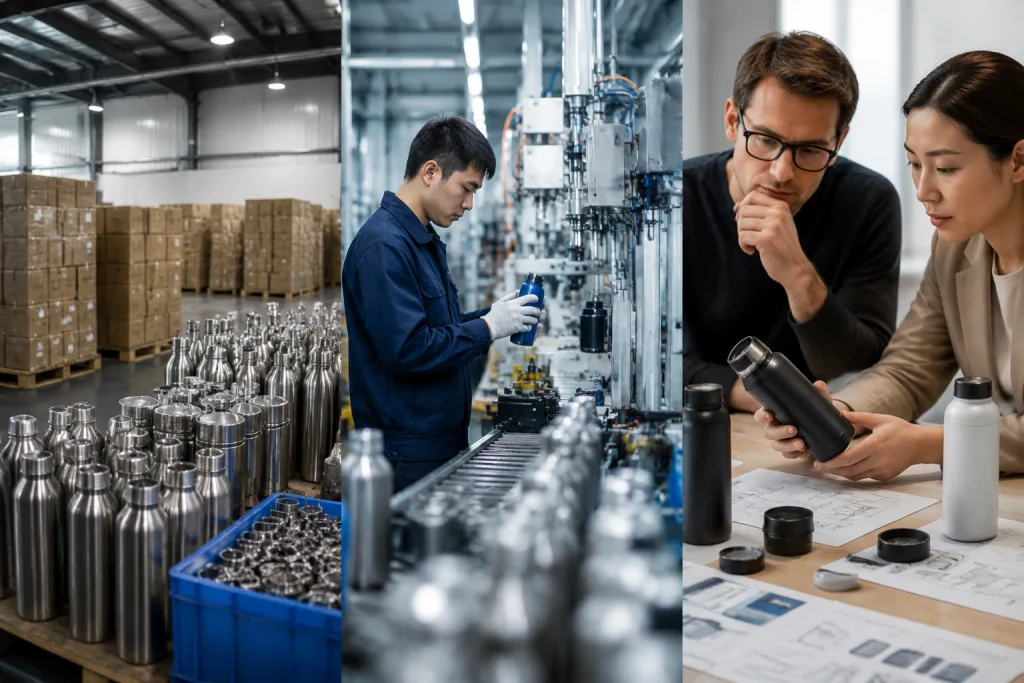
A credible canteen vendor should give you monthly output, not hand-waving. At BottleForge in Hangzhou, Zhejiang, our thermal line runs above 400,000 units per month across bottle and tumbler programs, and QC pulled the sample from the line with calipers on a 0.2 mm lid gap check before the buyer signed off. If a canteen supplier cannot explain monthly capacity, OTD history, and peak-season bottlenecks, they are not ready for serious distributor drinkware programs.
Use these numbers to pressure-test the quote:
- Sample lead time: 5-10 days for existing shapes, 12-20 days for new tooling.
- Mass production: 25-60 days depending on customization depth.
- Defect standard: AQL 2.5 is common for general goods; tighter specs may be needed for premium retail.
That is the gap between a canteen distributor who buys when the market is hot and a buyer who actually runs the supply chain.
Decoration and branding trade-offs
I’ll rewrite just the prose, keep the HTML and list structure intact, and tune the copy to sound like a factory-side sales engineer.Decoration is not a cosmetic afterthought. It moves unit cost, lead time, scratch resistance, and how the bottle reads on shelf. For canteen customizable branding on a promo run, silkscreen can do the job. For retail bottles that need to hold up, laser engraving or powder-coat printing usually wins. On one 5000 pcs order, we ran a laser logo with a matte coat because the buyer wanted a premium look without adding a second setup.
A canteen promotional product usually needs speed and a low MOQ. That is why one-color printing still shows up on the line. If you sell to brand owners in Europe or North America, ask how the decoration holds up to dishwashing, rubbing, and condensation. We have seen a clean logo fail after 20 cycles because the ink system was the weak link, and the buyer flagged it right away.
For custom canteen projects, the call is simple:
- Silkscreen: best for low cost and simple branding, often 1-2 colors.
- Laser engraving: strong for metal bottles and premium perception, usually no color fill.
- Heat transfer or UV print: useful for detailed graphics, but check abrasion resistance with a rub test.
For customizable canteen orders, packaging gets ignored too often. A gift box adds about USD 0.20-0.60 per unit, and it can also cut damage and improve conversion. We quote inserts, barcode labels, and carton marks from the start, because the math does not work when those items show up after PO approval. QC pulled a sample last month and found a missing barcode on the carton spec.
For custom growler programs, especially a distributor growler or customized growler SKU, confirm the print against cold condensation and transit vibration. The bottle can pass inspection and still look bad in retail if the edges chip during shipping. We once caught a PO typo on the artwork file and fixed it before the line started, which saved a reprint and 12 days of delay.
Compliance you should actually ask for
I’ll rewrite the section in place, keep the HTML structure intact, and tighten the language so it reads like a factory-side sales engineer wrote it.If your market is Europe or North America, compliance is not a checkbox. It is what gets the carton through customs and keeps it on the shelf. For a thermal bottle OEM manufacturer, the papers we get asked for most are REACH, LFGB for food-contact items sold into Germany or similar markets, and FDA-related declarations for the US. BPA-free claims come up all the time, but the real question is what resin sits in the lids, seals, and drink spouts.
A serious canteen factory should be able to provide:
- Food-contact test reports for the bottle body and lid parts, with the lab name and report date.
- Material declarations for 304 or 316 stainless steel and silicone seals, plus the grade on the PO if needed.
- Factory audits such as BSCI or similar social compliance documents if your channel asks for them.
- Quality standards such as the AQL inspection plan, drop-test criteria, and leak-test method we run on the line.
Do not accept vague “safe material” wording. Ask for the test scope, the date, and the lab name. We’ve seen buyers lose a week because the file said “food safe” but the actual report only covered the cup body, not the lid gasket. A canteen supplier in Zhejiang that ships export orders every week knows this drill. A domestic-only vendor may not. That is the difference when your customs broker wants backup documents 48 hours before vessel cut-off.
If you sell customizable drinkware under private label, packaging inks, coatings, and adhesive labels can trigger compliance trouble. The bottle body may pass, then the carton fails on heavy metals in print. QC pulled the sample on one order because the outer box used the wrong varnish spec. This is why experienced canteen manufacturers check the full pack-out, not just the bottle.
How to compare quotes without guessing
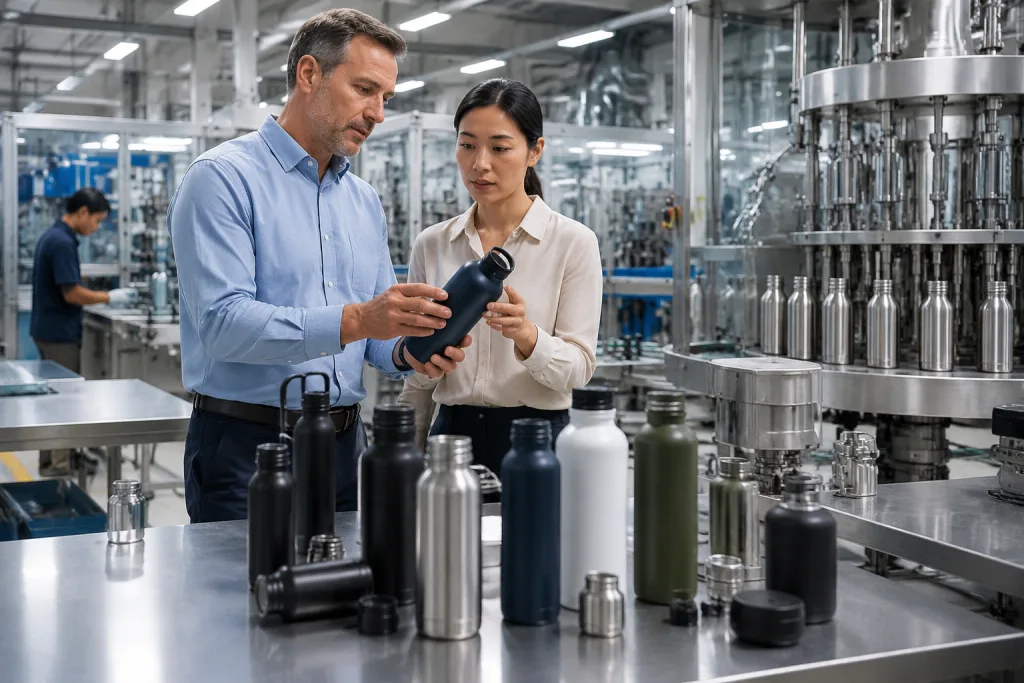
I’ll rewrite the prose in place, keep the HTML exactly as-is, and strip the AI-ish phrasing while adding sharper factory-side detail.Most buyers start with unit price and regret it later. A quote from one canteen manufacturer at USD 2.10 FOB can end up more expensive than a USD 2.35 quote if the first one carries higher freight, a loose scrap allowance, and extra rework. We run this comparison on the line all the time: same spec, same carton count, same Incoterm, or the math does not work.
Use this checklist on every quote from canteen manufacturers, canteen distributors, or a canteen supplier acting as an OEM partner:
- Exact product spec: capacity, steel grade, wall thickness, lid type, finish, and color code.
- Incoterms: FOB Ningbo, FOB Shanghai, or EXW changes your landed cost sharply in Zhejiang.
- Sample policy: free sample, refundable sample fee, or paid prototype.
- Packing details: units per carton, carton size, gross weight, and pallet configuration.
- Inspection terms: AQL level, third-party inspection option, and responsibility for rework.
If you are buying distributor canteen volume, ask for a price ladder at 1,000, 3,000, and 10,000 units. That shows whether the factory can hold the number or is just throwing out a guess. On custom drinkware jobs, we often see a 5-12% cost drop after tooling is paid and the PMS color is locked; QC pulled the sample with a 0.3 mm lid gap, and that is the sort of detail that changes the quote.
One thing we push back on in China sourcing: do not split product, packaging, and freight across three people and hope it stays clean. The buyer flagged a PO typo on carton size once, and we burned two days fixing it. A good thermal bottle OEM manufacturer should own the full BOM, not just the bottle body.
What good buyers ask before ordering
I’ll rewrite the section in place, keep the HTML tags intact, and tighten the language so it reads like a factory-side sales engineer wrote it.The best procurement managers ask the awkward questions first. Not because they doubt the factory, but because they know a project dies fast once the line starts and the answers get vague. If you are working on a custom canteen, customizable canteen, or customized canteen program, push for numbers, not slogans.
Ask these straight:
- What vacuum retention test do you run, and is the hold time 12 hours or 24 hours?
- What is the AQL for leakage, cosmetic defects, and lid function?
- Which parts stay in-house, and which parts come from outside vendors?
- How many units can you ship per month without slipping the schedule?
- Can you handle custom logo, custom carton, and replacement parts on the next order?
If you are a canteen distributor or distributor drinkware buyer, ask how they track repeat orders. Good canteen suppliers keep the artwork files, Pantone references, and mold revisions on record; bad ones make you resend the same PO notes twice. The buyer flagged it on our side before, and the fix was simple: one SKU sheet with revision date, no guessing.
For custom growler or custom canteen programs, I would ask for a sealed sample and a transit test sample. A bottle can pass a static leak check and still crack its lid under drop vibration, especially when the cap thread is off by 0.2 mm. We’ve seen that go sideways. In Zhejiang, a decent canteen vendor will call out the weak carton, the loose foam insert, or the bad divider before you sign the PO.
That is the mindset you want from a thermal bottle OEM manufacturer: practical, specific, and willing to tell you what fails before you place the order.
Request a quote with your real spec
Send capacity, material, logo method, and target market. We’ll price it like an OEM project, not a guess.
Frequently asked questions
What MOQ should I expect from a thermal bottle OEM manufacturer?
For standard thermal bottle orders, expect 1,000 units per SKU as a practical MOQ, with 3,000 units common for deep customization. A canteen factory in Zhejiang may quote lower for stock shapes, but new molds or custom lid tooling usually push the MOQ up. If you need multiple colors, the MOQ often applies per color or per print design. Always ask whether sample orders are deducted from production cost and whether mixed cartons are allowed.
How much should I budget for a custom drinkware bottle?
For a basic 304 stainless custom drinkware bottle, budget about USD 1.80-2.30 FOB for promo-grade orders and USD 2.50-4.50 FOB for retail-grade bottles with better coating and packaging. Decoration, gift boxes, and custom lids can add USD 0.20-0.80 per unit. Freight, duty, and inland delivery are separate. If you need customized drinkware for North America or Europe, always calculate landed cost, not factory cost only.
What compliance documents do buyers in Europe and North America need?
At minimum, ask for REACH-related declarations, food-contact test reports, and material declarations for steel, silicone, and plastic parts. For Germany or similar EU markets, LFGB support is often important. For US channels, FDA-related declarations are standard. If you sell through major retailers, BSCI or equivalent factory audit evidence can also matter. A thermal bottle OEM manufacturer should provide the test scope, lab name, and report date, not just a claim sheet.
Can I order a custom growler from the same factory?
Yes, but only if the factory understands pressure, sealing, and beverage-use requirements. A custom growler or customizable growler usually needs stronger lid design, leak testing, and packaging that survives transport. Not every thermal bottle OEM manufacturer is suitable for beer or kombucha products. Ask for previous growler samples, seal material specs, and whether the product was tested with cold-fill and carbonation conditions before you approve production.
What lead time should I plan for first orders?
For existing tooling and clear artwork, plan 25-35 days after sample approval. If you need a customized canteen or new mold work, 45-60 days is a more realistic window. Add another 7-12 days for ocean freight to the US West Coast, and longer for inland Europe. A serious canteen supplier in China should also tell you peak-season capacity and whether they can hold your booking if the order is delayed by artwork or payment changes.