Key Takeaways
- A dependable thermal bottle manufacturer should state MOQ, lead time, and monthly capacity up front: 5,000 units, 18-28 days, and 300,000 units/month are realistic benchmarks.
- For most B2B programs, 304 stainless steel is the default; 316 is worth the premium only when corrosion resistance matters and pricing can absorb a 15-25% increase.
- A vacuum bottle with 0.4-0.5 mm inner and outer wall thickness usually balances cost, weight, and insulation better than overbuilt heavy gauges.
- If you need canteen custom or canteen customizable SKUs for retail or promotions, ask for AQL 2.5/4.0 inspection, REACH documentation, and packaging compatibility with FNSKU or barcode labeling.
If you buy drinkware for a brand, distributor, or private label program, the wrong thermal bottle manufacturer will cost you twice: once in defects, then again in missed launch time. The question is not whether the bottle looks good in a photo. It is whether the factory holds vacuum quality, keeps coating color within spec, and ships on your FOB schedule without turning a 3,000-unit order into a 9-week headache. We have seen that go sideways fast when the buyer approved a sample off a phone screen.
In Zhejiang and across China, the good suppliers stand out once you stop chasing slogans and start comparing specs. A serious canteen factory will give you wall thickness, 304 or 316 steel grade, AQL limits, and monthly output without dancing around it. At BottleForge Industrial in Hangzhou, we run 300,000 units per month, keep a 5,000-piece MOQ, and work on 18-28 day lead times depending on decoration. QC pulled the sample on the line with a caliper at 0.8 mm last week; that is the kind of number that matters when you are choosing between a canteen manufacturer, a canteen supplier, or a canteen vendor for your next custom drinkware program.
Specs That Actually Change Buy Decisions
I’ll rewrite the prose in-place, keep the HTML structure untouched, and make the copy sound like a factory-side sales engineer.Buyers like to start with capacity. Wrong first move. In a sourcing meeting, the number that matters is whether the factory can hold the same thermal result, print quality, and carton strength when the order moves from 500 pcs to 5,000 pcs. A real thermal bottle manufacturer shows a spec sheet with steel grade, vacuum gap, lid material, coating method, and test standard. If that sheet is missing, you are looking at sample sellers, not production capacity.
For custom drinkware, compare the product by use case, not by brochure language. A 500 ml bottle sells well in North America, while a 750 ml canteen custom build often fits EU outdoor channels better. A 12 oz tumbler is easier to decorate on the line, but a 32 oz customized canteen usually gives the buyer more shelf value at the same FOB. We ship a lot of both, and the buyer flagged the same issue more than once: sample pricing looks sharp, then the wall thickness drifts on mass orders. Do not let that slide. Ask for the same gauge, the same lid insert, and the same coating thickness on pilot lots and production lots.
| Spec | Practical range | What it changes |
|---|---|---|
| Steel grade | 304 standard, 316 premium | Corrosion resistance, cost |
| Wall thickness | 0.4-0.5 mm typical | Weight, dent resistance |
| Vacuum hold | 6-12 hours hot/cold claim | Marketability, complaint rate |
| MOQ | 3,000-5,000 pcs | Entry cost, SKU flexibility |
That table is the starting point. QC pulled the sample on a 0.45 mm canteen and the carton test failed first, not the steel, so the math is never just about the bottle. A canteen distributor needs repeatability more than novelty, while a promotional buyer may accept a simpler lid if the print area is larger and the price drops under USD 4.20 FOB. Different jobs. Different specs.
Thermal Bottle Vs Canteen
I’ll rewrite the section in place, keep the HTML exactly as-is, and tighten the sales language so it reads like a factory-side buyer guide.People use thermal bottle, canteen, and growler loosely, but the use case is not the same. A thermal bottle manufacturer usually focuses on insulated daily-use items: office carry, commuting, gym bags, and short travel. A canteen manufacturer may build outdoor formats with handles, carabiner loops, and wider mouths. A custom growler is heavier, usually larger, and tied to beverage service or takeaway beer programs. If you are sourcing for retail, that split changes more than the name on the spec sheet. It changes the lid, the neck finish, the carton size, and the return rate.
For a distributor canteen program, the question is whether the item can be reordered without color drift. We run color checks with a Pantone card on the line, because a 0.5 delta shows up fast when the buyer flags it. For distributor drinkware, a lower-end retail line may need a 3-color print at USD 0.28 to 0.40 per location, while premium laser engraving can run USD 0.55 to 0.80 depending on area. A customizable canteen with powder coat and laser logo has a different margin profile than a canteen promotional item with a one-color silk screen. One is built to sell through. The other is built to move volume fast.
Use-case fit matters more than category labels:
- Retail outdoor: custom growler or customized growler, 64 oz or 128 oz sizes, thicker body, less decoration.
- Corporate gifting: customized drinkware or canteen promotional, fast branding, stable lead time.
- Distributor programs: canteen distributor or canteen vendors usually need repeat color control and carton consistency.
- Private label: canteen customized or custom canteen should support barcode labels, retail-ready inserts, and compliance documents.
A good China partner will tell you when a canteen is the wrong product. We have pushed back on that more than once, and the math usually does not work if the buyer wants office use, a wide mouth, and beer-barrel weight in the same SKU. Zhejiang factories that ship to the US and Europe every week know the gap between a sample that photographs well and a product that survives a 90-day replenishment cycle.
Compare Three Buying Paths
I’ll rewrite the section in place, keep the HTML unchanged, and tighten the sales-engineer voice with concrete factory details and fewer AI tells.When buyers ask whether to work with a canteen supplier, a canteen factory, or a canteen vendor, they are really asking who controls cost, lead time, and risk. A direct canteen factory in China gives tighter control over tooling, coating, and packaging. A canteen supplier or canteen vendor can move faster on 300-piece or 500-piece runs, but you pay for that speed in less visibility. A canteen distributor sits in the middle, handy for mixed SKUs or domestic stock, but it is the wrong setup for a true custom canteen program.
If you are comparing options head to head, use these questions:
- Can the factory show BSCI, ISO 9001, or equivalent audit evidence?
- Can they share salt spray, dishwasher, and thermal retention test data from the line?
- Do they quote FOB Ningbo or FOB Shanghai clearly, including carton count and inner box specs?
- Can they split tooling cost from unit price so you can see landed cost?
A canteen manufacturer with clean process control will answer directly. A weak seller hides behind “high quality” and “best price.” We have seen that go sideways when a buyer flagged a lid leak after 500 cycles and the whole launch slipped. For custom drinkware buyers in Europe and North America, the real risk is inconsistency. One bad carton can sink the order.
For reference, a first order from a Zhejiang factory usually sits at 5,000 to 10,000 pieces, with a 30 percent deposit and balance against copy of bill of lading. If the quote skips carton specs, label placement, or AQL 2.5, you are not comparing suppliers yet. You are comparing promises. On one PO last month, the buyer even typoed the logo position as “10mm from seam” instead of “10 mm from seam” — QC pulled the sample, and the math did not work.
What Your Spec Table Should Show
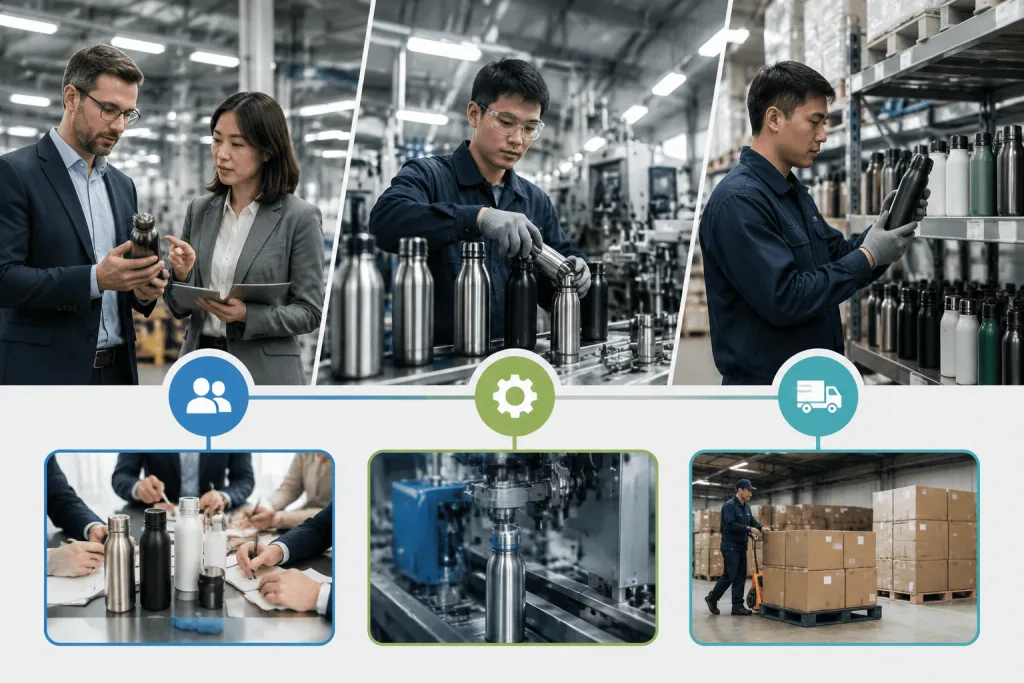
I’ll rewrite the prose inside the existing HTML, keep every tag and the table structure intact, and strip the AI-ish phrasing while adding concrete factory-floor detail and sharper buying-language.A useful buyer guide should read like a procurement sheet, not a brochure. Build a spec table that shows the numbers that change margin, rejection risk, and launch timing. At minimum, include capacity, steel grade, insulation performance, decoration method, lid type, packing, MOQ, lead time, and sample timeline. For retail chains, add barcode label support and master carton dimensions. For canteen custom items sold for promotions, add print area and decoration cost by method. We run these checks on the line with a 0.01 mm gauge, because vague specs turn into PO disputes fast.
Here is how the numbers usually behave in China manufacturing:
| Item | Typical input | Buyer impact |
|---|---|---|
| Sample lead time | 5-7 days | Faster approval |
| Production lead time | 18-28 days | Launch timing |
| Inspection standard | AQL 2.5 major / 4.0 minor | Defect control |
| Logo cost | USD 0.12-0.80 | Margin planning |
| Carton test | Drop and compression | E-commerce survival |
Do not ignore packaging. A canteen customized for Amazon FBA may need polybag warnings, suffocation labels, and FNSKU placement. A distributor growler for warehouse clubs may need heavier outer cartons and fewer units per master case to cut breakage. We had one buyer flag a PO typo on carton count, and the math did not work until QC pulled the sample and we rechecked the packing list. This is where a real thermal bottle manufacturer earns its keep. The factory is not just stamping steel. It is shipping a unit that survives your channel.
Check coating and print durability too. Powder coating holds up better than glossy paint for daily-use products. Laser engraving costs more, but it stays clean on premium customized canteen programs. If your customer wants a tactile finish and long service life, that extra spend usually makes sense. We have seen glossy paint fail abrasion testing in 200 rubs, while powder coating stayed presentable after the same run.
Questions That Expose Weak Suppliers
I’ll rewrite the section in a more field-tested sales voice, keep the HTML exactly as-is, and make sure the prose sounds like a factory-side buyer conversation.Good buyers ask hard questions. Weak suppliers answer fast and stay vague. Start with materials: is it 304 or 316 stainless, and can you show mill certs? Then go to the line: what welding method do you run, what leak test pressure do you use, and how many pieces a month can you ship without pushing QC? A serious thermal bottle manufacturer in China will answer straight. If the factory cannot explain process control, it is not ready for volume.
Ask about compliance early. For Europe, REACH is on the table. For North America, you may need food-contact declarations, California Proposition 65 support, and retail carton coordination. If you are buying canteen promotional items for a branded campaign, ask whether the inks and coatings are approved for food-adjacent use. We have seen orders get stuck over a 2 mm print offset and a missing declaration. That is the wrong place to learn the lesson.
“Can you show me the exact production spec, not the sample spec?” That one question filters out a lot of trouble.
Ask how the factory handles mixed orders. A lot of canteen manufacturers will accept a low MOQ on paper, then stall when you want four colors, two lid styles, and two logo methods in the same run. If your program needs a customizable canteen line with several variants, get the split cost in writing. We had a buyer flag a PO typo on lid color, and the rework ate 12 days. For a canteen distributor or canteen vendors serving retail chains, that math does not work.
In Zhejiang, the stronger factories are usually the boring ones: stable process, steady cadence, no drama. QC pulled the sample, the test passed, and the shipment moved. That is not flashy. It is what keeps your margin in place.
Choosing The Right Partner
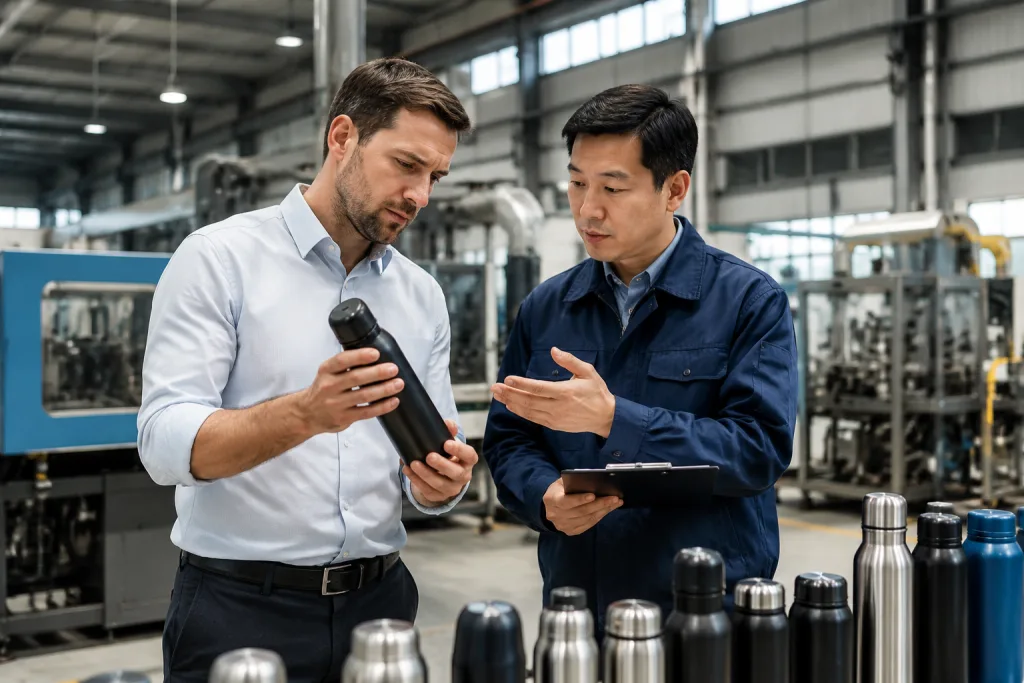
I’ll rewrite the section in place, keep the HTML tags exactly as-is, and tighten the sales-engineer voice while preserving the structure.The best partner depends on how you sell. If you need a fast-turn, low-complexity line, a canteen supplier with stock shells and standard lids may be enough. If brand control matters, a direct canteen factory gives you cleaner color control, logo placement, and fewer middleman mistakes. If you sell through distributors, you may need a canteen distributor who can split cartons and handle mixed packs. If you are building a premium outdoor line, a custom growler or customized growler program belongs with a factory that already runs heavier gauges, bigger lids, and 24-hour leak testing.
For most B2B buyers, the decision comes down to three things: how much customization you need, how fast you need it, and how much defect risk you can live with. A canteen customizable line with one print method and one lid is easier to launch than a fully customized drinkware program with four finishes and retail packaging. That is not a product problem. It is a sourcing choice. We’ve seen this go sideways when a buyer tried to stack powder coat, laser logo, and gift box on a 3,000-piece order.
Before you sign, pin down these numbers in the quote: MOQ, unit price at 5,000 and 10,000 pieces, sample charge, tooling charge if any, lead time, and inspection standard. If the supplier in China cannot put each step on paper, the “cheap” quote is unfinished. The math does not work. On our line, a missing lid spec once turned into a 12-day delay because the PO said “matte cap” instead of 38 mm matte cap. If you are working with a Zhejiang manufacturer that can show test reports, packaging specs, and monthly output, you are in the right room.
That is the practical difference between a good thermal bottle manufacturer and a generic seller: one helps you buy a product, the other helps you build a program.
Send your spec sheet for a direct quote
We’ll confirm MOQ, unit price, lead time, and decoration options within one working day for your canteen or thermal bottle program.
Frequently asked questions
What MOQ should I expect from a thermal bottle manufacturer?
For a custom order, a realistic MOQ is usually 3,000 to 5,000 pieces per SKU. At our Hangzhou factory in Zhejiang, 5,000 pcs is the normal starting point for most thermal bottles, canteens, and custom drinkware lines. If you want multiple colors or logo methods, the effective MOQ can rise because each variant needs setup time and separate packaging. For stock-only items, some factories will quote lower, but you lose control over color, lid style, and branding. Ask whether the MOQ includes mixed cartons, because that changes both pricing and warehouse handling.
Should I choose 304 or 316 stainless steel?
For most canteen custom and customized drinkware projects, 304 stainless steel is the correct default. It keeps costs sane and performs well for daily use. Move to 316 only when you need better corrosion resistance, such as salty environments, higher-acid contact, or premium outdoor positioning. The price difference is commonly 15-25% higher for 316, sometimes more depending on market steel costs. If your buyer is a canteen distributor serving mass retail, 304 usually gives better margin. If you are selling a premium customizable canteen, 316 can support a higher retail price.
How do I compare thermal insulation claims?
Ignore vague claims like “keeps hot for hours” unless the factory gives test conditions. Ask for a defined retention test at a stated starting temperature, room temperature, fill volume, and time interval. A useful report will specify whether the bottle held above 60°C after 6 hours or above 45°C after 12 hours. Different lid designs and capacities change results, so compare the same size and same lid. A serious thermal bottle manufacturer should be able to provide lab data, not just marketing copy. If they can’t, treat the claim as unverified.
What should I check before placing a first order from China?
Confirm the commercial basics: FOB port, payment terms, sample approval, production lead time, and inspection standard. For China sourcing, also ask for BSCI or ISO documents if your retailer requires them. On the product side, check wall thickness, logo durability, leak test method, and carton strength. For e-commerce programs, ask whether the package supports FNSKU labels, suffocation warnings, and drop testing. A factory in Zhejiang that ships 300,000 units per month should have this documentation ready. If the answers are vague, the risk will show up later in rework or returns.
Can I source canteen promotional items and premium retail SKUs from the same factory?
Yes, if the canteen manufacturer has enough process control. A canteen promotional SKU usually needs faster decoration, lower unit cost, and simpler packing, while a premium retail line may need powder coat, laser engraving, and upgraded cartons. The same factory can handle both if it has separate production flows and clear QC checkpoints. Ask whether they can support canteen promotional, canteen customizable, and custom growler programs without mixing specs. The key is not whether they can make both; it is whether they can keep the cheaper line from diluting the premium one.