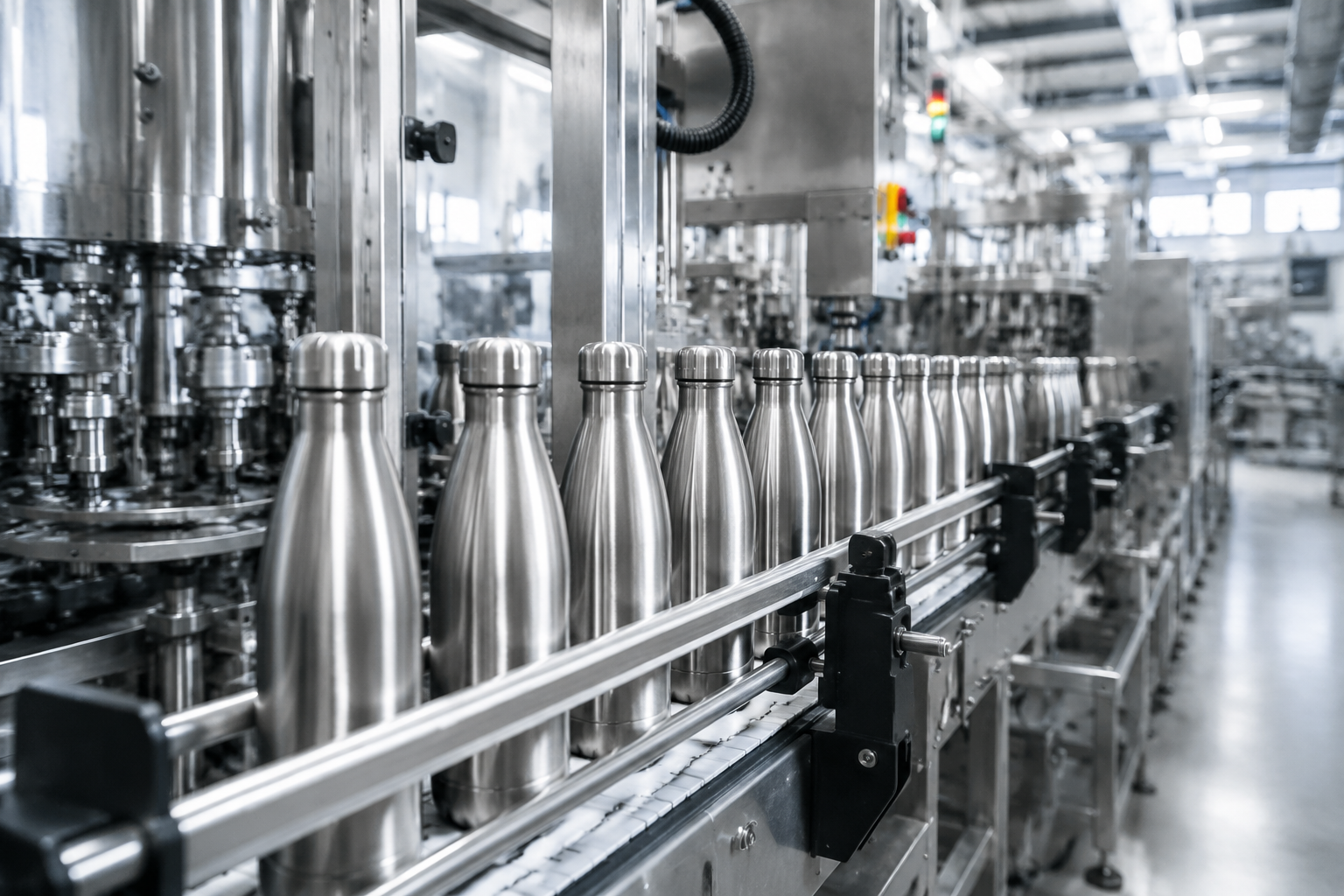
Key Takeaways
- A serious thermal bottle factory in Zhejiang should quote 3,000-5,000 pcs MOQ and 30-45 days lead time for standard orders
- Insist on 18/8 stainless steel, 0.5-0.8 mm wall specs, and vacuum retention testing before you approve a canteen customized run
- Decoration choice changes risk: laser engraving is durable, silkscreen is cheaper, and UV print needs tighter surface prep
- For export programs, ask for REACH, food-contact documentation, carton drop testing, and AQL 2.5/4.0 inspection terms
If you are buying from a thermal bottle factory, do not treat every quote as the same bottle with a different logo. It is not. Two suppliers in Zhejiang can both quote a 500 ml stainless steel bottle, but one gives you 18/8 steel, a 0.7 mm inner wall, and a 35-day lead time; the other ships thinner steel, weaker vacuum hold, and cartons that fail drop testing. We have seen that gap blow up a retail launch fast.
The better way to judge a factory is plain: pick the bottle structure, lock the material and test standard, match the decoration method to the channel, then press on MOQ, lead time, and export control. A buyer once flagged a PO typo on “500ml” versus “550ml,” and QC pulled the sample before the line packed 2,000 units. That is the real question to ask. If a canteen factory cannot explain cost, packaging, AQL, and failure risk without dancing around the numbers, keep walking.
Start With The Use Case
I’ll rewrite the prose in place, keep the HTML exactly as-is, and tune the tone to sound like a factory-side sales engineer.Before you compare suppliers, pin down what the bottle has to do for the buyer. A custom canteen for outdoor retail is a different job from a giveaway bottle at a trade show. We ship both, and the line does not treat them the same. A distributor drinkware order for Europe usually needs stronger packaging, multilingual labels, and a tighter defect target. A custom growler for craft-beer channels needs a different cap system and leak test than a school canteen program. Skip this step and you approve the wrong mold, the wrong lid, or the wrong coating.
Ask one blunt question: what must the bottle survive? A commuter bottle may only need 6-8 hours of hot retention, while a premium insulated bottle should hold temp for 12 hours or more. On one PO, the buyer wrote “EU carton” and meant master carton, but the spec sheet said retail box; QC pulled the sample and caught the mismatch before we printed 5,000 sets. For a customized drinkware program, I split the market into four channels: retail, Amazon FBA, promotions, and distributor canteen orders. Each one changes the spec. Amazon buyers care about FNSKU labels, insert cards, and carton size. Promotions care about price and artwork speed. Distributors care about repeat orders and margin. That is why a canteen manufacturer in China should ask about your channel before quoting. If they do not, they are guessing.
Match channel to product intent
- Retail: tighter finish standards, better packaging, lower visual defect tolerance
- Amazon: carton efficiency, barcode placement, and stable SKU control
- Promotions: fast decoration, simple lids, and competitive FOB pricing
- Distributor: repeat orders, color consistency, and predictable replacement parts
If the factory does not ask how you will sell the product, you are probably talking to a quote machine, not a canteen supplier.
Choose The Right Bottle Construction
I’ll rewrite the prose in place, keep the HTML structure untouched, and tighten the language so it sounds like a factory-side sales engineer.The real technical decision is the bottle build, not the logo. For thermal bottles, double-wall vacuum stainless steel is the workhorse because it keeps cost, durability, and insulation in line. A standard 500 ml body usually runs 304 or 316 on the inner wall, with the outer shell in 304 or powder-coated stainless. On our line, 304 is the normal choice for export orders; it passes for most drinkware programs. 316 costs more, and we only push it when the buyer has a clear corrosion or high-heat need. If the customer just wants a basic customized canteen for office desks or gym use, paying for 316 is the wrong question.
Wall thickness changes the feel in hand. Thin tubes save a few cents, but they dent fast and QC will spot that before packing. We often see inner wall thickness at 0.5-0.6 mm and outer wall at 0.4-0.5 mm, depending on the shape and forming method. For a premium custom drinkware line, moving to 0.7-0.8 mm in key sections gives better rigidity, especially on tall bottles and custom growler shapes. The cap build matters too. A straw lid, screw lid, flip lid, or handle lid changes leak risk, assembly time, and the parts count on the production sheet.
Practical rule: if the buyer will touch the bottle every day, go heavier on the body and cleaner on the finish; if it is a promo item, keep the structure simple and put the money into decoration. That is the gap between a canteen customizable item that feels retail-ready and a canteen promotional product that just fills a giveaway box.
- 304 stainless: best value for most custom canteen orders
- 316 stainless: upgrade option for demanding markets
- PP or Tritan lids: lighter, but check heat resistance and sealing
- Silicone gaskets: essential for leak control and long-term use
Separate Decoration From Structure
I’ll rewrite the prose in-place, keep the HTML structure intact, and make it sound like a factory-side sales engineer wrote it.Decoration is where buyers overpromise and under-specify. A canteen customized with a clean laser logo costs more upfront, but it holds up better against abrasion than cheap silkscreen. For a canteen custom program in corporate gifting, laser engraving is the safer call because QC pulled the sample after 20 wash cycles and the mark still held. If you need color branding on a full-wrap body, silkscreen or heat transfer fits better, but then we run into ink adhesion, curing temperature, and scratch resistance.
Do not ask for “custom” and stop there. State the finish: matte powder coat, gloss paint, gradient print, spot color, or debossed logo. A canteen distributor selling to chain stores should ask for decoration samples on the same substrate, not a generic proof. For a customized growler, the surface area is larger and print failure risk climbs fast; the factory has to control curvature, curing temperature, and edge lift. If the vendor says every finish comes at the same price, the math does not work.
When buying from China, decoration cost can move from $0.20 to $1.20 per unit based on method, color count, and coverage. In Zhejiang, a lot of factories keep multiple decoration lines in-house, while others send printing out. That changes lead time and consistency. Ask whether the canteen manufacturer owns the process or just brokers it. We’ve seen this go sideways on a PO typo alone: one buyer wrote “matte black” but the artwork callout said gloss, and the line had to stop. A real canteen manufacturer should answer that directly.
- Laser engraving: durable, clean, and a solid pick for premium logos
- Silkscreen: economical for flat-color branding on simple artwork
- UV print: sharp graphics, but it needs solid surface prep
- Full-wrap heat transfer: useful for promotional runs and color-heavy art
Test The Factory, Not The Sample
I’ll keep the HTML exactly as-is and rewrite only the prose, with tighter factory-floor language and concrete checks.Samples can lie. Production does not. A thermal bottle factory should show test data, not just a polished sample on the sales table. Ask for vacuum retention, leak test, dishwasher risk guidance, coating adhesion, and carton drop results. On export drinkware, I want food-contact documents, REACH support for Europe, and a plain statement on whether the product passed ASTM or ISO-based internal checks. If the factory cannot trace those records back to a batch code, that is a bad sign.
AQL matters. For a mass order, buyers usually use AQL 2.5 for major defects and 4.0 for minor defects, though some promo runs accept looser terms. The better question is where the rejects come from. Are dents from forming? Are leaks from stopper assembly? Is paint chipping from cure issues? We have seen this go sideways when a supplier only counts bad units and never pins down the source. If a canteen supplier cannot name the defect point, they are sorting problems after the fact. Not controlling them.
In Zhejiang and across China, strong factories often run monthly output above 300,000 units across multiple drinkware lines. That number only helps if the line stays stable. We have seen a plant ship 300,000 units a month and still fail cap torque at 0.8 N·m or show vacuum drift after 24 hours. Ask for the production flow, not the brochure. A serious canteen vendor should also tell you whether your order runs on dedicated tooling or a shared line. Shared lines are fine if changeover control is tight; if not, the buyer flagged it for a reason.
Samples are sales tools. Test records are what protect your margin.
Price The Program Correctly
I’ll keep the HTML structure intact and rewrite the prose to sound like a factory-side sales engineer, with sharper numbers and fewer AI phrases.Most buyers ask for a unit price too early. That is backwards. Price only works after you lock steel grade, lid type, coating, packaging, and carton size. A plain 500 ml insulated bottle can start around $3.20 to $4.80 FOB China on a basic run, while a better retail bottle with an upgraded lid and decoration lands around $5.50 to $8.50. We ran one 12,000-piece order where the buyer pushed for a promo canteen price first, then came back after QC flagged the lid torque. The math did not work. If the target is a canteen promotional campaign, strip cost out of packaging and keep the artwork simple.
Ask the factory to break out the cost drivers. On our line, the big ones are raw material, lid complexity, finishing, printing, packing, and labor. A canteen distributor should check whether the quote includes inner boxes, master cartons, and barcode labels. A distributor canteen order may look cheap at bottle level, then jump once export cartons, drop-test upgrades, and retail inserts go in. We’ve seen it go sideways on a PO typo for “500ml” versus “550ml” — that small miss changed the carton layout and the buyer flagged it before shipment. Also watch for hidden tooling, sample, and mold charges. Some canteen factories in China absorb them on larger orders, but get it in writing.
Pricing reality: if one supplier is 18% cheaper than the rest, you should know exactly what they cut. Usually it is steel thickness, print durability, leak control, or packaging quality.
- FOB China: the cleanest basis for comparing offers
- Tooling: confirm whether the price covers embossing or custom lids
- Packaging: confirm inner box, carton, and label costs
- Sampling: ask whether sample charges are refundable on PO
Plan For Repeat Orders
I’ll rewrite just this section, keep the HTML structure intact, and tighten the sales-engineer voice with concrete shop-floor details.Your first PO is not the real deal. The repeat order is. A canteen distributor or brand owner should check whether the factory can hit the same color, the same print offset, and the same seal performance 90 days later, not just on sample day. We’ve seen this go sideways when coating batches shift by 1 Delta E, gasket hardness drifts from 65A to 72A, or a new packing crew folds cartons the wrong way. Ask for control points, batch records, and the QC sheet the line actually signs off.
Lead time has to be real, not sales talk. For a standard thermal bottle factory order in China, plan on 30-45 days after sample approval and deposit, depending on season and decoration complexity. Before Q3 and again near year-end, we see that stretch by 10-20 days; one buyer flagged a PO typo on the lid code, and the whole lot sat for 4 extra days while artwork was corrected. A Zhejiang line can move faster, but only if material, carton spec, and print file are already locked. That is where the math works.
If you are planning canteen customizable SKUs across several colors or lid options, lock the matrix early. Three solid SKUs beat six shaky ones every time. For distributor drinkware programs, fewer SKUs usually mean cleaner reorders and less cash tied up in slow stock. The same is true for custom growler and customizable growler programs, only more so, because a 2 mm change in closure fit can force a tool reset and a new QC pull.
- Repeat color control: request Pantone references and pre-production samples
- Seal consistency: confirm gasket material and compression spec
- Carton stability: require drop-test-ready packaging for export
- Reorder speed: keep tooling, artwork, and packaging files locked
Send your spec sheet and get a real quote
We can review your bottle structure, MOQ, decoration, and lead time, then map the cleanest sourcing path from a thermal bottle factory in China.
Frequently asked questions
What MOQ should I expect from a thermal bottle factory?
For standard insulated bottles, a practical MOQ is usually 3,000 to 5,000 pcs per color or SKU. Some Zhejiang factories will accept 1,000 pcs for simple models, but pricing is higher and color choice is tighter. If you need canteen customized artwork, expect a cleaner price at 3,000 pcs or more. For a custom growler or special lid, MOQ can rise to 5,000-10,000 pcs because tooling and setup time increase. Always ask whether the MOQ is by model, by color, or by print version.
How do I compare canteen manufacturers in China fairly?
Compare them on the same terms: steel grade, wall thickness, lid type, decoration method, packaging, and test requirements. A quote from one canteen manufacturer at $3.80 FOB may not be cheaper than another at $4.25 if the first one uses thinner steel or weaker cartons. Ask for 18/8 stainless, AQL terms, REACH support if you sell in Europe, and the actual lead time from sample approval. A serious canteen factory in Zhejiang should answer each item without changing the subject.
Is laser engraving better than silkscreen for custom drinkware?
It depends on the channel. Laser engraving is usually better for premium custom drinkware because it is durable and resists abrasion. Silkscreen is often cheaper and works well for simple logos, especially on canteen promotional orders. If you need a canteen custom item for a retailer, laser or UV print may justify the higher cost. If you need thousands of distributor canteen units for giveaways, silkscreen often gives the best price-to-speed ratio. Always test the decoration on the actual coating, not a similar sample.
What certifications should I request from a canteen supplier?
For Europe and North America, ask for food-contact documentation, REACH support where needed, and the factory’s internal QC records. If the factory claims broader compliance, request the exact test report scope and date. Many canteen suppliers in China can provide material certificates for 304 stainless steel, silicone gaskets, and PP lids. If you are buying for Amazon or retail, also ask for carton drop testing and barcode readiness. Do not rely on verbal promises; get documents tied to your PO.
Can I source a canteen customizable program with mixed colors?
Yes, but mixed colors increase complexity and often slow production by 7-15 days. A canteen customizable program with 3 body colors and 2 lid colors can be manageable, but the factory must lock the schedule, coating batch, and assembly sequence. If you are working with a canteen distributor model, keep the color matrix simple so reorders stay consistent. In Zhejiang, experienced factories can handle this well, but they will usually charge a little more for changeovers and color controls.