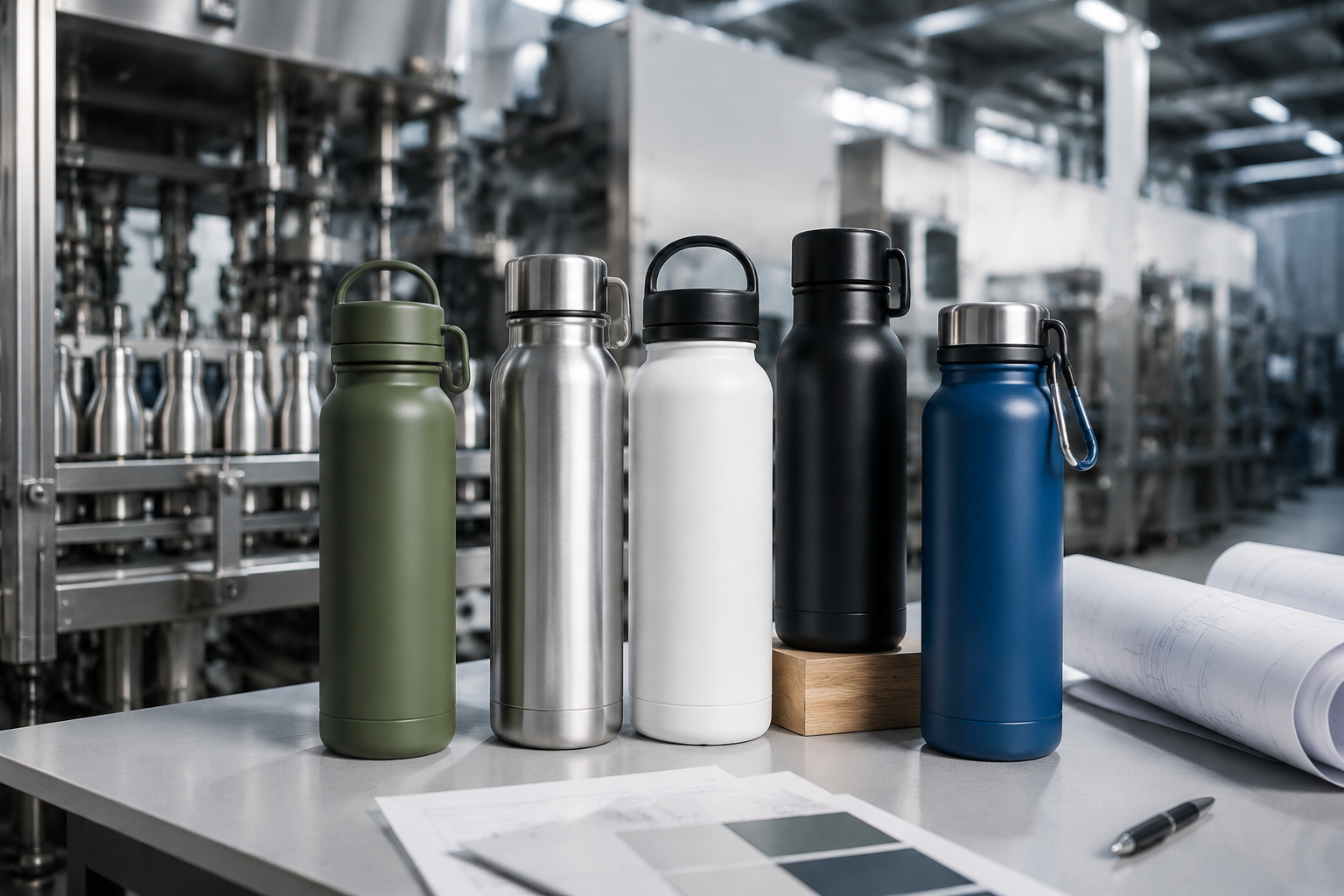
Key Takeaways
- Vacuum loss, not print quality, is the most expensive thermal bottle customizable failure; specify 24-hour hot/12-hour cold retention and inspect 100% leak tests on lids.
- For a 500 ml stainless canteen custom order, common MOQ starts at 3,000 pcs with 25–35 day lead time from artwork approval in Zhejiang.
- 304 stainless inner wall at 0.4–0.5 mm and 201 outer shells are common; if you want lower corrosion risk, keep both layers at 304.
- For branded custom drinkware, ask for AQL 2.5 for major defects, REACH documentation for Europe, and food-contact declarations for your market.
Most buyers start with artwork and color. That is where the trouble starts. If you want a thermal bottle customizable for retail, promotions, or corporate gifting, the real job is not decoration; it is controlling the failure points that show up once production starts. In Zhejiang and across China, the same bottle can pass a showroom sample and still fail vacuum retention, lid fit, coating adhesion, or leak rate when we run 20,000 pieces on the line.
If you buy custom drinkware as a procurement manager or brand owner, think like a production engineer. Ask what breaks, where it breaks, and what tolerance you are paying for. A canteen factory shipping 300,000 units a month should talk about gauge, AQL, REACH, and drop tests without waving hands. If they cannot, this is the wrong supplier question to ask; you are buying a risk package with your logo on it. QC pulled a sample with a 0.3 mm cap gap last month, and that tiny miss turned into a leak claim after packing.
Where Bottle Programs Break First
I’ll rewrite the section in place, keeping the HTML structure and tightening the prose so it reads like a factory-side sales engineer.The first failure mode is usually hidden: the vacuum seal. A thermal bottle customizable program can look clean on the sample table and still lose heat because the weld line is weak, the neck finish is off by 0.2 mm, or the stopper leaks after thermal cycling. We had a buyer flag that exact issue on a 500 ml bottle last season. A good canteen manufacturer talks about seam integrity before print methods.
On the line, the weak points show up fast. Bad draw depth gives you an uneven mouth. Poor laser welds in the inner liner create slow vacuum decay. A sloppy closure system gives intermittent leaks that show up after transport vibration, not on day one. If you are sourcing from a canteen supplier in Zhejiang, ask for the test sequence: vacuum check, inverted leak test, hot-water hold, and cap torque control. “Passed QC” is not enough. We want the numbers.
What to specify:
- Vacuum retention test at 24 hours, with a target delta that matches your market claim
- Leak test on every lid design, especially straw and flip-top closures
- Torque range for threaded caps so a canteen distributor can reorder consistently
For distributor drinkware programs, one leaked carton costs more than a better closure spec. The math does not work any other way. We ship enough cartons to see that mistake repeat.
Metal Thickness You Should Insist On
I’ll rewrite the section in-place, keep the HTML structure unchanged, and tighten the sales-engineer tone with concrete factory details and cleaner buyer language.Buyers often stop at “304 stainless.” That is too vague. Grade matters, but wall thickness and gauge drive dent resistance, thermal hold, and how the bottle survives carton pressure. For a 500 ml custom canteen, we run an inner wall at 0.4–0.5 mm as the normal target. Go thinner and you start seeing oil-canning, weld instability, and dents from a 1.2 m drop test. Go thicker and the weight and unit cost climb fast.
A canteen factory in China will usually quote the inner and outer shell separately. For a premium customized drinkware line, ask for 304/304 and make the supplier show the mill cert. If you are pushing a promo SKU and the buyer wants the lowest landed price, 304 inner plus 201 outer is a common offer. That can work for short-run canteen promotions, but the finish and corrosion margin are weaker. Don’t accept “standard quality” as an answer. We’ve seen that phrase hide a 0.35 mm outer shell on the line.
Practical spec: 500 ml bottle, double-wall vacuum, 304 inner at 0.45 mm, 304 outer at 0.4 mm, lid PP or Tritan, food-contact compliant for the destination market.
For custom growler projects or larger distributor growler campaigns, the same rule still holds. Bigger format means more wall load, and the weak spot moves to denting and handle attachment. QC pulled the sample on one 64 oz order because the handle weld cracked after repeated swing testing. The buyer flagged it, and the math did not work.
Prints Fail Faster Than You Think
I’ll rewrite this section in-place, keep the HTML structure unchanged, and tighten the language so it reads like a factory-side sales note.Decoration is where a lot of canteen vendors talk big and miss the weak point. Your logo can look clean on day one, then start flaking after a week of warehouse handling if the coating and cure are off. We see it most on matte powder coat and soft-touch finishes. The logo is not the real issue. Surface prep and cure profile are.
If you want a thermal bottle customizable program to hold up in retail and e-commerce, ask how the factory checks adhesion. Cross-hatch testing, tape pull, abrasion checks, and carton rub tests are standard if the bottles will be resold by canteen distributors or shipped as distributor canteen stock. For laser engraving, check depth and contrast on the actual coating color, not the sample card. For silkscreen, ask how many color layers they run before registration starts to wander.
Good rules of thumb:
- Laser engraving works best for long-life branding on stainless surfaces
- Powder coat is fine only when cure is controlled and abrasion is tested
- Pad print suits small logos, but ask for scratch testing
If you are ordering customized canteen or customized growler sets for multiple regions, standardize the decoration file and cut the finish count. More finish variants mean more QC drift. We’ve seen that go sideways in Zhejiang and in other China plants too.
Lid Systems Decide Returns
I’ll rewrite the four paragraphs in-place, keep the HTML exactly as-is, and tune the copy to sound like a factory-side sales engineer.A custom canteen order usually lives or dies on the lid. Buyers stare at body color because it pops in renders, but returns come from closure failure, not shade drift. Flip lids crack at the hinge. Straw lids leak when the silicone ring is 0.2 mm off. Screw caps bind when the thread pitch is wrong by half a turn, and we have seen that go sideways on a full pallet.
For a canteen customizable line, ask for material and fit records on every closure part. PP and Tritan do not behave the same under heat or impact. Silicone rings need size control, not just a material statement. If your buyers sit in outdoor or travel retail, we run a 1-meter drop test with the bottle filled, plus an inverted leak test after thermal cycling. For a custom canteen used in gyms or promo runs, the lid has to take abuse on the line, not just look clean in a render.
Ask one direct question: does the factory pre-assemble lids or ship the parts loose? Pre-assembly cuts customer mistakes, but it can trap dust and distort the seal if QC misses the last check. We had a buyer flag a PO typo once, and the sample run exposed the same issue in the gasket groove. A serious canteen supplier will explain that trade-off instead of selling fairy dust.
When you buy from canteen manufacturers in China, do not skip spare-part planning. A canteen vendor that ships extra gaskets, lids, and straws in the same carton lot saves your team from support tickets later. We usually quote spare parts at 2% to 3% of order volume, and that math works better than scrambling after the first complaint.
MOQ, Lead Time, and Factory Reality
I’m rewriting this section in-place, keeping the HTML exactly as-is and tightening the sales-engineering tone. I’ll preserve the structure, keep the numbers, and add a few factory-floor specifics without changing the tags.The sourcing fantasy says you can order 500 pieces, change every detail, and ship in 10 days. That is not how the line runs. For most thermal bottle customizable programs, a workable MOQ is 3,000 pcs for one color and one logo method, with 25–35 days lead time after sample approval. If you want multi-color gradients, mixed lids, or retail-grade packaging, plan for 35–45 days. A Zhejiang factory with real export work will say that on day one; the others promise the moon and then come back asking for a new PO.
Buyers should price around the process, not the brochure. We run a 500 ml canteen line with the same body, lid family, and insert spec when the order needs control, and the math works. Split it across five colors and three lid types, and the unit cost climbs fast. QC pulled the sample, flagged the cap fit, and that order needed a rework. That is the wrong question to ask if you want stable supply.
Typical commercial ranges for a 500 ml stainless program:
- FOB China: USD 2.80–4.80 for basic promotional quality
- FOB China: USD 4.90–7.50 for premium insulated specs with better finish
- Sample lead time: 5–10 days, depending on decoration and mold status
If you are sourcing custom drinkware for Amazon or wholesale distribution, ask the supplier to split tooling, sample, and mass-production dates. One PO typo on the lid code can cost you a week, and that is usually where launch dates slip.
Compliance Is Not Paperwork
I’ll rewrite the section in-place, keeping the HTML and structure unchanged while tightening the prose and adding a few concrete factory-floor details.Compliance is not a checkbox you ask for at the end. It sits in the product spec from day one. For Europe, we run REACH-related declarations and food-contact files. For North America, buyers ask for traceable material declarations and test reports against the right food-contact standard. If the bottle is sold as customized drinkware for daily use, the paperwork has to match the claim, the coating, and the lid material.
Ask a canteen supplier for the exact test standard, not “passed test.” That answer is too loose. We want the report number, the lab name, and the test scope. The line has seen buyers accept a generic PDF, then the buyer flagged it later because the ink was for the cup body, not repeated hand contact. For outer coatings, check heavy metals and abrasion resistance. For printed logos, the ink system needs to hold up under washing. On a custom canteen for retail, ask for batch traceability on key materials so a recall does not turn into a hunt through six cartons and a wrong PO typo.
This is where canteen distributors get hit hardest: they buy a clean sample and find out the file does not support the market. We have seen this go sideways on a 5000 pcs order, and the math does not work after the vessel laser-marking is done. If your factory is in China, keep the compliance file with the PO, not in someone’s inbox. Zhejiang plants that export every week already run this way; the rest learn it after one delay at QC, when QC pulled the sample and found the coating code did not match the declaration.
Practical buyer checklist:
- REACH documentation for Europe
- Food-contact declarations matched to lid and body materials
- AQL inspection plan written into the PO
- Batch coding for traceability
Spec your next bottle like a factory buyer
Send your target capacity, finish, and market. We’ll map the failure points, quote MOQ, and align the build to China export reality.
Frequently asked questions
What is a realistic MOQ for thermal bottle customizable orders?
For a standard stainless thermal bottle customizable program, 3,000 pcs is a common MOQ in China if you want one body color and one decoration method. If you add multiple colors, mixed lids, or premium packaging, MOQ can rise to 5,000 pcs or more. A Zhejiang canteen factory with stable output may handle smaller trial orders, but you usually pay a higher unit price. For a 500 ml bottle, ask for a confirmed MOQ tied to the actual finish, not a vague “flexible” answer. If a canteen manufacturer cannot state MOQ in writing, expect friction later.
How do I check if the bottle will really hold temperature?
Ask for the exact thermal test claim and the test method. A practical baseline for a double-wall vacuum bottle is around 24 hours hot and 12 hours cold, but the measured result depends on fill level, lid design, and ambient temperature. Ask the supplier to test at a consistent water temperature and document the starting and ending values. For custom drinkware, also request a vacuum leak check and a lid seal test. A thermal bottle can look good in photos and still underperform if the vacuum weld or stopper is weak.
Should I choose 304 or 201 stainless steel?
For the inner wall, 304 is the safer choice for most canteen custom and customized canteen projects because it resists corrosion better and supports broader market acceptance. Some canteen suppliers offer 304 inner with 201 outer to reduce cost. That is acceptable for some canteen promotional or distributor canteen programs, but the finish and dent resistance need more attention. If you want a premium custom canteen or custom growler, 304/304 is the cleaner spec. Ask for material declarations by layer, not just a single grade on the quote.
What QC should I require from a canteen factory?
At minimum, ask for AQL 2.5 for major defects, 4.0 for minor defects, 100% leak testing on lids, and random checks on vacuum performance. For painted or powder-coated bottles, add tape adhesion and abrasion checks. If you are buying from a canteen factory in Zhejiang for export, ask for batch photos, carton drop testing, and packaging compression checks. A good canteen manufacturer will give you a written inspection plan before mass production. That matters more than a glossy sample.
Can I customize packaging as well as the bottle?
Yes, and you probably should if you are selling through retail or e-commerce. Custom cartons, inserts, and barcode labels help reduce damage and make receiving easier for distributor drinkware and canteen distributors. For Amazon-type workflows, include the right barcode placement and carton markings early, because relabeling after packing is expensive. Packaging changes can extend lead time by 5–7 days and increase MOQ if you need printed cartons. If the supplier is also a canteen vendor with export experience, they should know how to pack for transit, not just for presentation.