Key Takeaways
- Most tea infuser bottle failures come from 4 parts: lid seal, basket mesh, thread fit, and heat deformation.
- A practical MOQ for a factory tea infuser bottle in Zhejiang is 3,000-5,000 units, with 25-35 day lead time after sample approval.
- For hot-fill use, ask for Tritan or 304 stainless parts with documented REACH and LFGB status, not just a marketing claim.
- AQL 2.5 for major defects and 4.0 for minor defects is a reasonable baseline for bulk tea infuser bottle orders.
If you are buying from tea infuser bottle vendors, the first bad batch usually does not fail in a loud way. It shows up as a mesh basket that rusts after one wash, a lid that leaks only when the bottle is tilted in transit, or a fruit chamber that jams when someone loads real citrus slices instead of a studio sample. We have seen that on the line. That is the sourcing problem. Wellness brands and hydration startups do not lose margin only on unit cost; they lose it when cartons come back from a warehouse, a retailer, or a one-star review.
We build drinkware in Zhejiang, and the pattern stays the same across China: the easiest bottle to quote is often the hardest bottle to control. If you want a custom infuser bottle that survives retail, Amazon FBA, or distributor handling, you need to lock down the failure points before artwork approval. Ask for wall thickness, mesh gauge, seal geometry, test standard, and MOQ in the first round. QC pulled the sample at 0.6 mm tolerance once, and the buyer flagged a typo on the PO before production started. A factory-direct infuser bottle can work, but only if you treat it like a controlled assembly, not a lifestyle accessory.
Why infuser bottles fail in the field
I’ll rewrite the section in-place, keep the HTML structure unchanged, and make the prose sound like a factory-side sales engineer wrote it. Then I’ll return only the HTML.The weakest tea infuser bottle is usually not the one that cracks in a drop test. It is the one that looks fine in the sample room, then starts slipping after 500 uses on the line. Field failures are boring in a bad way: odor stays in the infuser chamber, the mesh sags after repeated wash cycles, the o-ring swells in citrus tea, and leakage starts when the bottle body thread and cap thread are off by 0.2 mm. If you are sourcing a custom tea infuser bottle, do not let the factory stop at capacity and color. Ask what happens after boiling water, ice, peppermint oil, and 30 dishwasher cycles.
That matters for wellness brands because the buyer reads the bottle like a health product. One rusty insert, one cloudy wall, and the trust issue starts. For hydration startups, the math does not work if one bad lot kills repeat orders. We have seen this go sideways in Zhejiang and in export orders too: the buyer approves a clean sample, then QC pulls the production sample and finds a thinner gasket, 180-mesh wire swapped for a lighter spec, or thread tolerance that drifts enough to loosen the cap. If it is sold as a customizable infuser bottle, the custom part should be the print or colorway, not the seal path.
- Spec the lid seal with a compression target, not just the resin name.
- Require mesh wire gauge and opening size for the strainer basket.
- Lock the mouth thread tolerance and cap fit before mass production.
- Define whether the bottle must handle hot-fill, cold brew, or both.
Mesh and basket failures
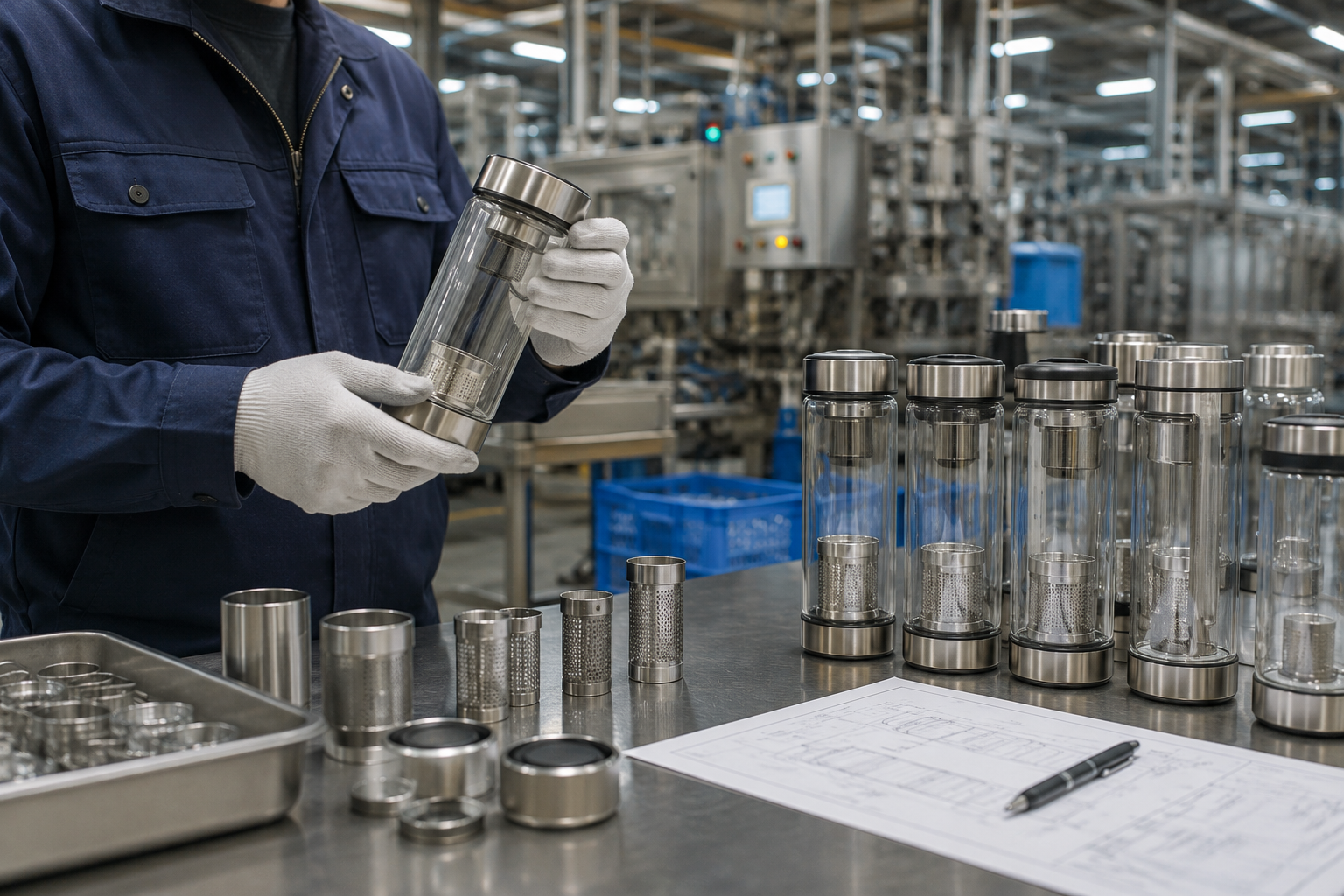
I’ll rewrite the section in-place, keep the HTML tags untouched, and make the wording sound like a factory-side sales engineer wrote it.The tea basket is where a lot of bulk tea infuser bottle jobs quietly lose quality. We have seen a basket look clean in photos and still fail on the line because the mesh is too soft, the weld points are weak, or the perforation pattern is too coarse. For loose-leaf tea, a filter opening around 0.5-1.0 mm works better, depending on leaf size; for fruit slices, finer mesh keeps pulp from leaking. If your customer wants a bulk fruit infuser bottle, size the basket for real fruit weight, not a lab cup with tea leaves.
Material choice is not about the label. 304 stainless is the usual baseline for the basket and insert parts, but wall thickness and weld quality matter more. We run a 24-hour soak test at 60-70°C, then check for discoloration, metallic taste, and mesh deformation; QC pulled one sample last month that passed visually and still left a faint odor after hot water. If the basket is removable, the retention ring has to survive repeated pull-out cycles without loosening. The vendor should show a tested jig, not a hand-fit sample line in Zhejiang. This is the wrong question to ask: “Is it stainless?” Ask for the weld map and the cycle count.
Never approve a tea basket from a photo. Approve it from a measured sample and a cycle test.
Leakage starts at the threads
I’ll rewrite just the prose inside the existing HTML, keep the tag structure intact, and make it sound like a factory-side sales engineer wrote it.Most buyers blame the gasket when a lid leaks, but the thread is usually where the trouble starts. A custom logo infuser bottle can look clean on the shelf and still seep if the cap seats at the wrong compression depth or the thread pitch drifts from cavity to cavity. We run into this on the line when the mold is over-polished, cooling is uneven, or the cap comes out warped after injection. It passes a quick hand twist, then fails a 45-degree tilt once the carton starts moving.
For a bulk infuser bottle order, ask for a water leak test, plus a vacuum or pressure check if the bottle structure allows it, and pin down the closing torque in N·cm. If the vendor cannot give you that number, the math does not work. For a custom made infuser bottle, lock the lid and body to the same tooling set and sample every cavity in the first article run. We’ve seen cross-tool mixing go sideways in Zhejiang plants running three bottle programs at once, and QC pulled the sample only after the buyer flagged a small mismatch. It is a control issue, not a theory issue.
- Ask for thread pitch drawings and cap seating depth.
- Require leak testing at room temperature and after 60°C conditioning.
- Confirm gasket hardness in Shore A, not just silicone color.
- Reject mixed tooling runs unless every cavity is identified and measured.
Heat, odor, and material drift
I’ll rewrite the section in place, keep the HTML exactly as-is, and tighten the wording so it reads like a factory-side sales engineer.If your customer uses hot tea, the bottle is a thermal system, not a simple cup. Cheap plastics can warp, smell, or haze after 80°C hot-fill runs. A customizable tea infuser bottle for wellness retail should not rest on “BPA-free” alone. Ask for the resin grade, the real temperature limit, and how the lid, liner, and insert behave when the line runs hot. Tritan, PP, 304 stainless, and borosilicate glass each solve a different problem, and each one can fail if the process is sloppy.
For a customized infuser bottle, ask the factory for a hot-water odor test, a 50-cycle wash test, and a dimensional stability check after thermal shock. QC pulled one sample last month and the cap liner still held shape, but the body had a slight haze after the 90°C soak. If the bottle has a fruit chamber, lemon and orange acids can speed up stress whitening in lower-grade plastics. This is the wrong question to ask: “Is it food-safe?” A custom fruit infuser bottle needs the full stack checked—body, cap liner, basket, and any decorative sleeve. We ship to buyers in Zhejiang who sell into Europe and North America, so REACH and food-contact files start on day one, not after the carton lands.
MOQ, sampling, and factory control
I’ll rewrite the section in-place, keep the HTML structure intact, and tighten the sales-engineer voice while preserving the key numbers and list structure.Tea infuser bottle vendors like to lead with a low sample price and a soft MOQ. Fine. The real bill shows up once tooling, decoration, and carton work hit the line. For a factory-direct infuser bottle from China, 3,000 units is the normal floor for a standard structure, and 5,000 units is where new molds, a special lid, or a nonstandard basket start to make sense. Sample lead time usually runs 7-12 days, and mass production in a capable Zhejiang factory is often 25-35 days after sample sign-off. We’ve seen buyers try to save 300 units and end up paying rush pricing on the next order; the math does not work.
Do not stop at unit price. Ask for the landed structure: EXW, FOB Ningbo or Shanghai, carton count, master carton drop resistance, and whether the factory can follow your barcode, FNSKU, or retail hangtag plan. A distributor infuser bottle order also needs packing discipline: individual polybag, insert card, silica if required, and a pallet layout that QC can check without guessing. If you are building a distributor fruit infuser bottle program, ask how mixed-SKU cartons are separated and how colorways are kept apart. One PO typo on carton marks can delay a shipment by 3 days. At BottleForge in Hangzhou, Zhejiang, we run this kind of control every week, and the same rule applies across China: if the vendor cannot explain the packing flow, the QC risk is already on your side.
- Standard MOQ: 3,000-5,000 units depending on tooling.
- Sample lead time: 7-12 days; mass production: 25-35 days.
- Request AQL 2.5 for major defects and 4.0 for minor defects.
- Confirm monthly capacity if you need repeat distributor shipments, not just one PO.
How to spec a safer order
I’ll rewrite the section in place, keep the HTML structure unchanged, and tighten the sales-engineer voice with concrete factory details.The cleanest purchase brief removes guesswork. A good tea infuser bottle spec states capacity, body material, insert material, lid style, seal hardness, mesh opening, temperature range, logo method, and test requirements. If you need a custom logo infuser bottle for retail, say whether the logo is silk screen, laser engraving, or transfer print. If the bottle rides in a gym bag or moves through e-commerce fulfillment, spell out cap torque and leak test limits. If it is a customizable infuser bottle for promotions, define which parts can change without new tooling and which parts stay fixed.
Write it in factory language, not brochure language. We run better on numbers: 650 ml body, 1.2 mm minimum wall thickness on the Tritan shell, 304 stainless basket, 0.8 mm mesh opening, leak test at 180 seconds inverted, AQL 2.5 major, REACH-compliant materials, and carton drop test from 80 cm. For a custom tea infuser bottle sold into Europe, ask for LFGB or other food-contact support where applicable, plus resin and ink batch records. A vendor can still tune the design. They just cannot wander off spec without you catching it. QC pulled the sample on a 90 mm cap once because the gasket groove was 0.3 mm shallow; that is the kind of miss a vague brief invites.
Useful purchase-language
- “Bulk tea infuser bottle for retail, with documented leak and odor testing.”
- “Custom made infuser bottle, same tooling set for body and cap.”
- “Distributor tea infuser bottle program, packed by colorway and SKU.”
- “Customized tea infuser bottle with REACH-ready material declarations.”
Request a controlled infuser bottle quote
Send your capacity, material, and artwork spec. We will quote a factory direct infuser bottle program with MOQ, lead time, and QC points laid out clearly.
Frequently asked questions
What is a realistic MOQ for tea infuser bottle vendors?
For a standard bulk tea infuser bottle, a realistic MOQ is usually 3,000 units. If you need a new mold, a special lid, or a new basket shape, 5,000 units is more typical. Some factories in Zhejiang will quote lower, but the unit price often rises fast and your QC leverage drops. For repeat distributor orders, ask for capacity in units/month, not just MOQ. A capable factory direct infuser bottle line should be able to support 80,000-120,000 units/month across multiple SKUs if the program is well planned.
How do I prevent leaks in a custom infuser bottle?
Start with the thread, not the gasket. Ask the vendor for thread pitch, cap seating depth, and torque range in N·cm. Then require a water leak test in inverted position for at least 180 seconds, plus a hot-condition test if your bottle will handle tea. If you are buying a custom logo infuser bottle or customized infuser bottle, make sure decoration does not interfere with sealing surfaces. A good factory will show you measured samples from all cavities, not just one perfect hand-picked sample.
Which materials are best for a custom tea infuser bottle?
For hot tea, Tritan or borosilicate glass are common for the body, with 304 stainless for the basket and lid components where appropriate. For lighter promotional orders, PP can work if the temperature range is low and odor control is acceptable. What matters is system behavior: body, cap liner, basket, and print ink all need to survive heat and repeated washing. Ask for REACH documentation for Europe and food-contact support for your target market. Do not approve materials by description alone.
Can I order a bulk fruit infuser bottle for both tea and fruit?
Yes, but you need to spec it for the harsher use case. Fruit adds acid, pulp, and extra weight, so a bulk fruit infuser bottle should have stronger mesh retention, better seal compression, and a chamber that is easy to clean. If you want one product to do both tea and fruit, tell the factory to test with citrus, berries, and hot water. A customizable fruit infuser bottle often needs a finer mesh than a tea-only model, and the vendor should confirm cleaning cycles, not just appearance.
What QC standard should I use with distributors infuser bottles?
Use a written inspection plan with AQL 2.5 for major defects and 4.0 for minor defects as a practical starting point. For distributor tea infuser bottle orders, add carton drop testing, barcode verification, and SKU segregation rules. If your program includes FNSKU or retail labels, verify print placement and scanability before shipment. A distributor infuser bottle program fails when the product is fine but the packing is mixed, mislabeled, or under-tested. In China and especially in Zhejiang, the best factories will accept this level of control.