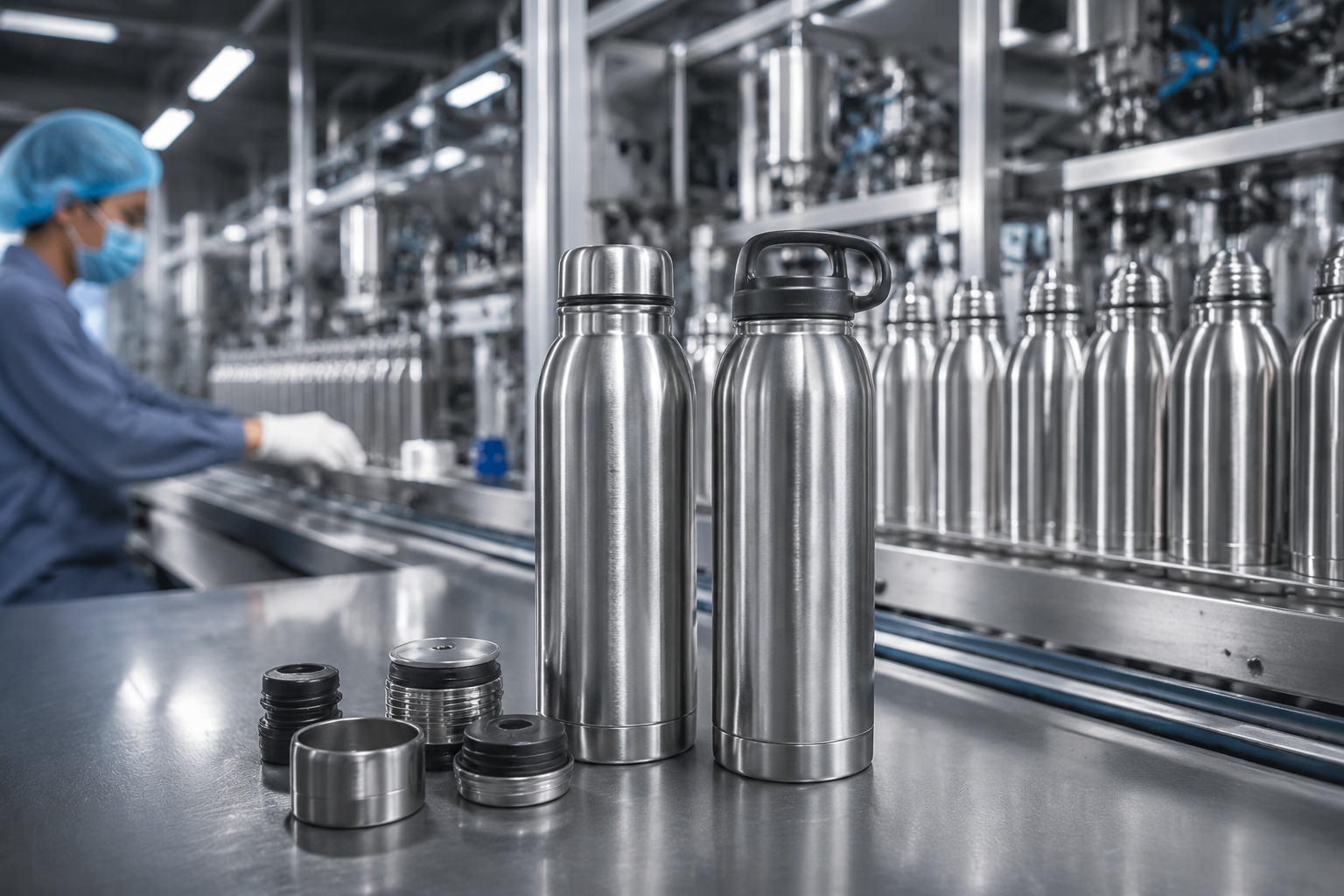
Key Takeaways
- Typical tea bottle MOQ in Zhejiang factories starts at 1,000 units per SKU; custom lid or color work often pushes it to 3,000.
- FOB China pricing for common tea bottles usually sits around USD 1.35-4.80 depending on stainless grade, glass thickness, and lid type.
- A practical production lead time is 20-35 days after sample approval; busy seasons in China can add 7-10 days.
- For retail tea bottles, 304 stainless at 0.5-0.7 mm wall thickness or borosilicate glass at 1.8-2.2 mm is the safer spec band.
If you are buying tea bottle wholesale bulk, the real question is not “which bottle looks nice?” It is which spec survives transit, protects your margin, and avoids claims after launch. A buyer in Germany will ask for REACH paperwork and dishwasher test results; a U.S. brand owner will push on leak rate, carton count per 40HQ, and whether the bottle still reads as a premium tea SKU when landed cost creeps 8% over target.
We run drinkware out of Hangzhou, Zhejiang every month, so we see the same mistake on the line: buyers judge samples by shape and ignore the build. That is the wrong question to ask. QC pulled a 500 ml tea bottle last week and the lid torque was off by 1.2 N·m, which is the sort of detail that bites later. You need a side-by-side read on capacity, wall thickness, lid system, decoration method, MOQ, and lead time. The same logic applies whether you are sourcing wholesale drinkware, canteen wholesale, or a tea line that has to sit next to bulk canteen and wholesale growler programs without looking off-spec.
Spec table: what really changes the cost
I’ll rewrite the prose in-place, keep the HTML structure intact, and make the cost drivers sound like a factory-side buyer note.When you compare tea bottle wholesale bulk offers, start with a spec table, not a sales pitch. The price gap usually comes down to four things: body material, lid structure, surface finish, and test scope. A plain 304 stainless bottle with a PP lid and silicone seal runs clean on our line in Zhejiang. Once you add double-wall vacuum construction, powder coating, bamboo trim, or a tea filter insert, the math moves fast.
Here is the practical buyer view:
- Glass tea bottle: FOB China usually USD 1.20-2.80, good for clear tea presentation, but breakage shows up fast in export cartons.
- 304 stainless tea bottle: FOB China usually USD 1.80-4.20, stronger for insulation and daily carry.
- Borosilicate + sleeve: FOB China usually USD 2.10-4.80, a fit for premium tea gift sets.
- MOQ: 1,000 pcs for stock shapes; 3,000-5,000 pcs for custom color or logo tooling.
The mistake is to compare unit price only. We’ve seen a bottle save USD 0.18 and lose 2% more in transit; that is the wrong question to ask. QC pulled the sample on a 45 cm drop test, and the lid torque was off by 0.3 N·m, so the real cost was higher. Good factories will quote packaging density, carton drop test, and lid torque without you pushing twice. If they cannot spell that out, the offer is not ready for serious wholesale drinkware procurement.
Glass or stainless for tea
I’ll rewrite this section in-place, keep the HTML structure untouched, and strip the AI-ish phrasing while adding a few factory-floor details and sharper commercial language.This is the first real head-to-head call. For loose-leaf tea, glass wins on shelf appeal. Buyers want to see fruit, herbs, and the color in the bottle. For commuter tea, stainless wins on heat hold and abuse resistance. If the channel is gift retail or premium e-commerce, a glass body with a stainless cap works. If the channel is office, travel, or outdoor, a vacuum stainless body is the safer buy.
Use-case fit matters more than brand preference:
- Glass tea bottle: best for cold brew, desk use, and premium packaging.
- 304/316 stainless: best for daily carry, tea-to-go, and insulated programs.
- Silicone-sleeved glass: good when you want less breakage and a better grip.
- Borosilicate: better thermal shock resistance than soda-lime glass; that matters if users rinse with hot water at the sink.
For Europe, REACH paperwork and food-contact declarations are standard. For North America, buyers usually ask for FDA food-contact compliance, though the lab pack still depends on the channel. We run this on the line every week: a 1.2 mm wall spec, AQL 2.5, and third-party test reports are what keep a PO alive. A pretty sample is not enough. The buyer flags it the first time a carton cracks or the claim sheet is thin. If you are building a broader range, the same logic applies across bulk drinkware, canteen bulk, and a small run of bulk canteen SKUs for promo accounts.
Lids, filters, and leak risk
I’ll keep the HTML structure fixed and rewrite the prose to sound like a factory-side sales engineer. Next I’m tightening the leak-risk language, adding a couple of concrete shop-floor details, and avoiding the AI filler the brief flagged.Most tea bottle failures come from the lid, not the body. The leak shows up at the hinge, the gasket, or the thread tolerance. So we judge closure design like a line engineer, not a showroom buyer. A bamboo cap looks premium on the shelf, but the seal stack under it does the real work. A one-piece stainless cap usually holds up better on 5,000-piece wholesale runs. Flip lids are handy, and they add parts. That means more scrap risk.
For tea bottles with infusion baskets, we check three points on the bench:
- Mesh size: fine enough to keep leaf escape down, usually 0.3-0.5 mm openings.
- Basket fit: it should sit tight, with no rattle when QC shakes the sample tray.
- Seal compression: too loose leaks; too tight cuts gasket life short.
Buyer rule: if the supplier will not state the leak test standard, ask for a 1-meter inverted hold test and a 24-hour room-temperature check before you approve production.
This is where bulk canteen projects and wholesale canteen programs go sideways. One lid gets copied across too many products, and the math does not work. Tea, coffee, beer growler wholesale, and alcohol flask wholesale bulk orders do not want the same closure. A tea bottle needs easy cleaning and leaf control. A growler bulk order needs carbonation handling. An alcohol flask in bulk order needs compact size and a lock-tight seal. Different use, different cap. We had a buyer flag a PO once because the lid code was typed as `L-02` instead of `L-20`; the line caught it before packing.
Use cases by channel and margin
I’ll rewrite the section in a more sales-engineer voice, keep the HTML structure intact, and tighten the prose so it sounds grounded in factory-side quoting and channel fit.Think by channel, not by category. A tea bottle can move through several sales routes, but each route changes the spec. On Amazon or DTC, we watch packability and claim control. Through distributors, carton count and reorder stability carry more weight. For gifting or corporate orders, decoration area and perceived value beat a 30-gram weight cut every time.
Here is the practical fit:
- Retail tea bottle: premium finish, clean logo print, and an unboxing that feels worth the shelf price.
- Office promo line: lower tooling cost, stable MOQ, and simple pad print that runs clean on the line.
- Outdoor or commuting line: vacuum insulation, dent resistance, and a leak-proof lid that QC can pass without debate.
- Tea gift set: glass body, basket insert, kraft box, and shelf presence that wins the buyer’s first glance.
For margin planning, landed cost matters more than the FOB quote. A tea bottle at USD 2.20 FOB can land at USD 3.80-5.10 after freight, duty, inland, and packaging, depending on order size. We see this go sideways when buyers over-spec the finish and under-spec the carton math. One 48-piece carton drops to 36 pieces because the sleeve is 8 mm too tall, and the savings disappear fast. If you need a best wholesale drink bottle for multi-channel use, keep the structure simple and the pack-out tight. That wins more often than “premium” for its own sake.
MOQ, lead time, and factory reality
I’ll rewrite the section in-place, keep the HTML structure intact, and tighten the language so it sounds like a factory-side sales engineer wrote it.Factory reality decides whether your launch date survives. For a standard tea bottle run from China, the workable MOQ is 1,000 pcs per color or per SKU. If the buyer wants custom tooling, a custom lid color, or a new mold, 3,000 pcs is the number we usually put on the table. In our Hangzhou line, a tea bottle order goes through sampling, pre-production, assembly, and inspection in 20-35 days after approval. That is fine for a seasonal program, but only if the artwork, carton marks, and test list are locked. We’ve seen a buyer flag a PO typo on carton marks and lose 4 days before the line could start.
Ask the factory how many units it ships per month, then ask how much of that belongs to your SKU. A Zhejiang drinkware plant may run 300,000-500,000 units/month across bottle categories, but the real answer depends on mold queue and decoration line. Capacity is not a brochure number. It is a slot on the line. Ask for:
- Sample lead time: 5-10 days for existing shapes.
- Mass production lead time: 20-35 days after sample sign-off.
- Inspection standard: AQL 2.5 for major defects is common, but confirm by category.
- Packing method: inner box, master carton, drop-test performance.
That is how you avoid the usual trap: a supplier quotes low, then tacks on time for “unexpected packaging work.” The math does not work if the packing spec was never clear. If you are comparing bulk drinkware, drinkware wholesale, or growler wholesale programs, tie the capacity promise to the exact line you are buying, not the whole factory. We run this check with a 5-layer carton spec and a 1.2 mm divider, and QC pulled the sample before we release mass production.
Decoration choices that hold up
I’ll keep the HTML structure intact and rewrite only the prose with a more grounded, factory-side sales tone. Next I’m checking for any repo-specific instructions, then I’ll patch the section directly.I’ve got the target section. Now I’m rewriting it with sharper sourcing language, one or two concrete factory details, and no filler.Decoration is where a tea bottle looks premium in the sample room and tired after 6 months on the shelf. We run into that gap all the time. The line has to survive hand washing, carton rub, and one bad drop test. Screen print is still the workhorse for a 1-color logo. Laser engraving holds up well on 304 stainless and gives a clean, low-risk finish. Heat transfer works for detailed art, but the coating and ink system decide whether it passes after repeated washing. On glass, frosting and decal work are common when the buyer wants a tea-style premium feel. QC pulled a laser sample last month and the mark stayed clear after 200 rub cycles; that is the kind of result we want before sign-off.
Match decoration to channel:
- Screen print: economical for 1-color logos and larger runs.
- Laser engraving: durable on stainless; strong for premium placement.
- UV print: sharp visuals, but test scratch resistance before approval.
- Debossed or embossed marks: good for mold-integrated branding when volume justifies tooling.
If your line later expands into alcohol flask bulk, beer tumbler bulk, or beer growler wholesale bulk, do not carry over the same logo spec by habit. Tea bottles usually need softer branding and cleaner visual balance. A growler can take a rougher look. The wrong decoration call burns margin fast because rework means extra labor, extra packing, and a second QC pass. We’ve seen a buyer flag a PO typo on logo size by 2 mm, and that small miss turned into a full reprint. The math does not work on the factory floor.
Send your tea bottle spec sheet today
We will quote matching materials, MOQ, and lead time from China so you can compare landed cost without guessing.
Frequently asked questions
What is a realistic MOQ for tea bottle wholesale bulk?
For standard stock shapes, a realistic MOQ is 1,000 pieces per SKU in China. If you want custom color, custom lid parts, or a new mold, expect 3,000 to 5,000 pieces. Some Zhejiang factories can mix colors within a larger run, but they will usually charge a setup fee. For tea bottles with a printed logo, many suppliers can keep MOQ at 1,000 if the artwork is simple. If the order also includes custom gift boxes or special inserts, the carton and packing MOQ may become the real constraint, not the bottle body.
How much does a tea bottle cost at wholesale?
Typical FOB China pricing runs from USD 1.20 to 4.80 depending on material and structure. Glass tea bottles with basic caps are often USD 1.20-2.80. Stainless vacuum tea bottles usually land around USD 1.80-4.20. Premium borosilicate models with sleeves or gift packaging can reach USD 4.80. If you are buying tea bottle wholesale bulk, always separate body cost, decoration, and packaging cost. A carton insert or upgraded cap can add USD 0.15-0.40 each, which matters a lot at 5,000 units.
What documents should I ask for from a China supplier?
Ask for a food-contact declaration, material specification, test reports, and the factory’s quality documents. For Europe, REACH-related material control is important. For North America, buyers usually ask about FDA food-contact suitability, though the exact documents depend on the product and channel. Also ask for AQL terms, packaging specs, and if possible a leak test or thermal test report. A serious factory in Zhejiang should be able to show these quickly. If they cannot, they may still be a trader or a small workshop rather than a stable production partner.
What lead time should I plan for first orders?
For first orders, plan 20-35 days after sample approval if the design uses existing molds. If you need new tooling, add 15-30 days depending on complexity. Artwork approval, carton design, and lab testing can add more time if you are slow on feedback. In Hangzhou and the wider Zhejiang supply base, faster projects happen when specs are frozen early. If you want to hit a retail season, give yourself at least 60 days from quote to warehouse delivery, especially if you are importing drinkware wholesale into a tight launch window.
Can one supplier handle tea bottles, canteens, and growlers?
Yes, but only if the factory truly has multiple relevant lines. A capable Zhejiang supplier may cover wholesale drinkware, canteen wholesale, and growler wholesale, but each product needs its own lid system, packaging, and test logic. A tea bottle is not the same as a beer growler wholesale bulk item or an alcohol flask wholesale bulk item. Ask for line-specific samples and production photos. If the supplier can show stable output across several categories, that is a good sign. If they keep reusing one body and changing the cap, be cautious.