Key Takeaways
- MOQ often starts at 500 units, but true custom printing can change that by SKU and finish
- Double-wall stainless tea bottles usually use 18/8 steel with 0.4-0.5 mm inner wall
- A workable export lead time is 25-35 days, not vague “soon” promises
- REACH, LFGB, and AQL 2.5 are the baseline checks you should ask for
If you buy drinkware for retail, corporate gifting, or marketplace fulfillment, the wrong tea bottle vendor will cost you returns, missed launch dates, and thin margin. The issue is not finding a factory in China or Zhejiang; it is sorting a real canteen maker from a middleman who quotes fast but cannot hold tolerances, pass REACH, or keep color steady on the second order.
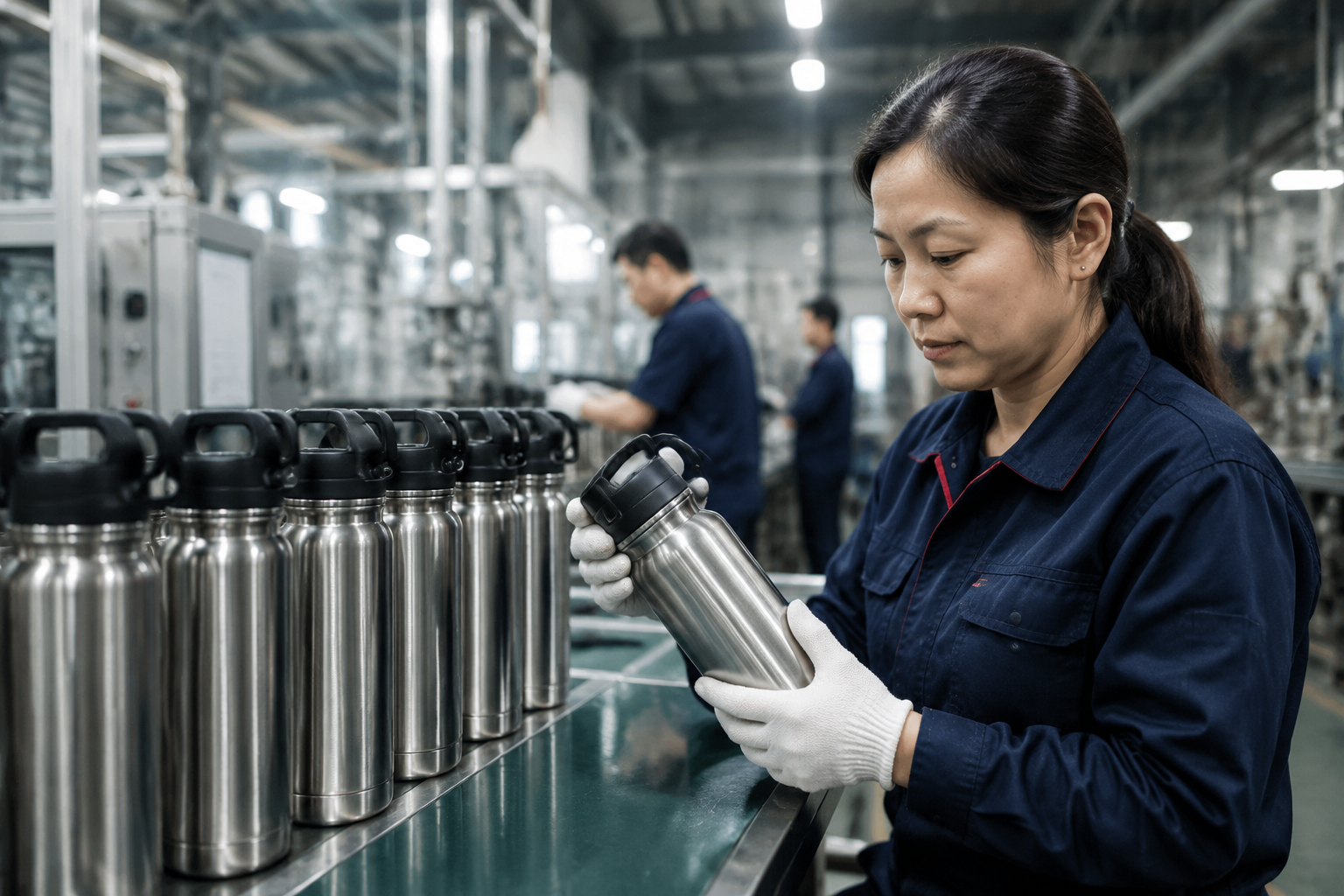
Read the spec sheet the right way, and you stop buying “a bottle” and start buying wall thickness, lid torque, seal material, coating wear, and packing accuracy. That is where custom drinkware turns profitable. At BottleForge Industrial in Hangzhou, Zhejiang, we run 120,000 units per month, keep a 25-day standard lead time, and start MOQ at 500 units for many SKUs, so the math matters as much as the artwork. We ship from the line, QC pulls the sample, and we judge a tea bottle vendor the way an engineer does: line by line, not by a glossy sample on the desk.
Start With the Material Callout
I’ll rewrite the section in place, keep the HTML tags intact, and make it read like a real factory-side sales note with concrete sourcing details.The first line on a tea bottle spec sheet should say what the body is made of, not just how it looks. For insulated metal drinkware, 304 stainless steel, also written as 18/8, is the safe call. It stands up to tea tannins, survives repeated washing, and does not hold odor the way cheap steel does. On one 500 ml sample run, QC pulled the liner after an acid test and the 304 surface stayed clean. If you are sourcing customized drinkware for Europe or North America, ask for material declarations, not sample photos. A serious canteen supplier will tell you whether the inner liner is 304, whether the outer shell is 201 or 304, and whether the lid uses PP, Tritan, or silicone.
That line changes the price on day one. A 304/304 build costs more than a 304/201 mix, but the scrap rate is lower and the shelf value is stronger. We had a buyer flag a PO typo once—304/301 instead of 304/201—and the math did not work until we corrected it. For tea bottle vendor comparisons, that matters when you are placing a distributor drinkware order for retail or a customized canteen program for a corporate client. If a canteen factory hides the material callout, expect corrosion claims, odor complaints, or a finish mismatch later. In Zhejiang, the good factories treat that line as part of the contract.
- 304 stainless steel: best all-around choice for custom drinkware
- 201 stainless steel: lower cost, weaker corrosion resistance
- Tritan lids: clearer and more impact-resistant than basic AS
- Silicone seals: needed for tea bottles, especially leakproof caps
Read Wall Thickness Like a Buyer
I’ll rewrite the section in place, keep the HTML exactly as-is, and tighten the language so it sounds like a factory-side sales engineer.Wall thickness is where a tea bottle vendor either knows the line or just repeats catalog copy. For vacuum-insulated tea bottles, the inner wall usually sits at 0.4 mm to 0.5 mm, while the outer shell lands around 0.35 mm to 0.45 mm, depending on the shape. Go thinner and you start seeing dents in transit or at retail. Go thicker and the weight goes up for no gain, which hurts margin on canteen promotional orders where every gram shows up in freight and selling price.
Weight changes the quote, the carton rate, and how the buyer feels when they pick up the sample. A 350 ml bottle at 230 g can read as premium; at 290 g, the carton cost climbs fast across a distributor canteen program. Ask the canteen manufacturer for net weight, gross weight, and carton count in the first reply. If they need a second email, the line is not under control. We run this check with a digital scale on the packing table, and the better canteen manufacturers in China will also give you forming method, seam position, and whether the shoulder radius shifts after polishing.
Buyer rule: if a sample feels heavy but the spec sheet stays vague, you are probably paying for extra metal, not better performance.
Lid Design Decides Leakage Risk
I’ll rewrite the prose in-place, keep the HTML structure untouched, and tighten it so it reads like a factory-side sales engineer wrote it.Most tea bottle complaints do not start with the body. They start with the lid. A custom canteen for tea needs a lid that handles hot liquid, pressure swings, and daily opening without the cap ring going soft. We run one-button samples on the line, and they look good until the spring or latch starts drifting after heat soak. For hot tea, a screw lid with a silicone gasket and a separate infuser is the safer pick for a B2B launch. If you want a canteen customizable for retail, seal path first, branding second.
Ask the tea bottle vendor for the seal hardness, thread standard, and torque range. Sounds picky. It is not. We have seen buyers approve a nice-looking lid, then the first carton of test stock shows a 0.3 mm mismatch on the thread and the buyer flags it before packing. A good canteen supplier should tell you whether the lid holds up through 1,000 open-close cycles, whether the stopper leaks at 90°C, and whether the vent keeps pressure from building up. If you are buying a custom growler or customized growler style bottle for tea concentrates, the lid spec matters even more because wide-mouth caps and thermal cycling expose weak spots fast. For distributor growler programs, one drip becomes a warehouse problem.
- Silicone gasket: stable under heat, common MOQ part
- Wide-mouth lid: easier to wash, higher leak risk if the thread is sloppy
- Flip top: handy for retail, more parts on the line
- Infuser basket: check mesh gauge and the 2-3 mm attachment depth
Capacity Changes the Whole Cost Stack
I’ll rewrite the prose in place, keep the HTML untouched, and tighten the sales-engineer tone with more concrete factory detail.Capacity is not a marketing number. A 400 ml tea bottle, 500 ml bottle, and 750 ml bottle change carton loading, vacuum cycle time, and freight cost in different ways. On our line, the 500 ml size usually fits 24 pcs per master carton; the 750 ml version often drops to 12 pcs, and the math moves fast. For a tea bottle vendor, capacity also decides whether the piece reads like a lifestyle bottle or a travel bottle. Buyers in Europe and North America often ask for 450 ml to 600 ml because that range keeps the bottle portable without looking too small on shelf. For custom drinkware sold through retail, that window usually gives us the best balance between shelf appeal and shipping efficiency.
If you are comparing a canteen vendor against a canteen distributor, ask for actual usable volume, not brim capacity. The gap can be 5% to 12%, especially in double-wall products with insulation space inside. QC pulled the sample on a 500 ml unit last month and measured 462 ml usable; the buyer flagged it because the PO copy said 500 ml net. That gap changes how your brand talks about hydration or tea serving size. For promotional orders, price usually drives the decision, but for distributor drinkware programs, the volume has to match the packaging copy. A canteen promotional item that claims 500 ml but delivers only 455 ml creates complaints nobody wants. This is the wrong question to ask if you ignore it. Precision protects your review score and your reorder rate.
Finish, Print, and Brand Durability
I’ll rewrite the prose in-place, keep the HTML structure intact, and tighten the sales-engineer tone with concrete shop-floor details.Finish is where a canteen customized program either looks like a retail piece or like a rushed line job. Powder coating, spray paint, electrolysis, and brushed metal wear differently in abrasion checks. A matte powder coat hides small handling marks, but ask for a 50-cycle or 100-cycle rub test if the order will move through distributor canteen channels. We run that test with a Taber wheel on the line, and the buyer usually spots the weak point fast. Laser engraving holds up better than silk printing, though it changes the look. If you want a clean premium face, laser is the safer call. If the brand needs strong color, printing fits better. We cover that choice in detail on our logo guide for custom drinkware and custom logo placement.
For canteen custom orders, the print method has to match the sales channel. A canteen promotional order for events can take a simpler print and a thinner coat, but a customized canteen for retail cannot. Ask the tea bottle vendor for ink adhesion data, coating thickness, and whether the finished cup passes a tape test after 24 hours of curing. QC pulled the sample on one job at 8 microns, and the buyer flagged it before shipment. In Zhejiang factories that export every week, these numbers are normal. In loose supply chains, you get “good quality” and no test report. That answer does not ship.
- Powder coat: durable, matte, good for premium retail
- Silk screen: cost-effective for larger logos and simple artwork
- Laser engraving: permanent, clean, usually higher perceived value
- UV print: detailed graphics, but check abrasion resistance carefully
Certifications and Audit Basics
I’ll rewrite the section in place, keep the HTML tags untouched, and tune the prose to sound like a real factory-side sales engineer.Any tea bottle vendor selling into Europe or North America needs to speak clearly on REACH, LFGB, FDA-related material compliance, and factory audit status. These are not decoration. They show whether the factory understands export paperwork and whether the upstream suppliers can support repeat orders without swapping material at the last minute. If you are buying customized drinkware at scale, ask for test reports tied to the exact material lot, not a generic file from 2023.
BSCI, Sedex, or a similar social compliance audit may matter if your retailer or brand owner asks for it. A procurement manager should also ask for the inspection plan before production starts. AQL 2.5 for major defects and 4.0 for minor defects is common for drinkware, but the math does not work if everyone says “standard QC” and no one defines it. If your tea bottle vendor cannot say how packaging crush, print misalignment, and lid leakage are sorted, the line is probably loose. We run this check every batch in Hangzhou, Zhejiang, and QC pulled the sample before carton sealing.
Do not buy on certificates alone. Ask which SKU was tested, which material lot was used, and whether the report matches your final artwork and lid structure.
MOQ, Lead Time, and Freight Reality
I’ll keep the HTML structure exactly, rewrite the prose to sound like a factory-side sales engineer, and leave the numbers/terms intact.MOQ and lead time are where buyers lose margin. We’ve seen a 300-unit canteen quote turn into a mess once the buyer asks for a custom Pantone, a logo plate, and gift box print; the math does not work the same way. For most tea bottle programs, MOQ starts at 500 units, and custom packaging or a new mold can push that to 1,000 or 3,000 units. If you buy as a canteen distributor or a drinkware buyer, ask straight: does the price cover color matching, logo tooling, and carton labeling? Those three items move landed cost fast.
Lead time needs hard dates. On our line, a normal export order usually runs 7 days for sample confirmation, 15 to 20 days for body production, and 5 to 7 days for packing and final inspection, so you are looking at 25 to 35 days before sea freight. QC pulled a sample last week because the cap torque was off by 0.3 N·m, and that kind of miss eats a day. A tea bottle vendor in China or Zhejiang should tell you whether the shipment goes FOB Ningbo, FOB Shanghai, or another port. If you sell on Amazon or retail, lock carton labels, FNSKU, and master carton specs before mass production starts. A late label change can burn a week.
- Typical MOQ: 500 to 1,000 units for branded orders
- Standard lead time: 25 to 35 days after sample approval
- Common export terms: FOB, CIF, or EXW depending on buyer setup
- Monthly output at a capable factory: 120,000 units or more
Send your spec sheet for a factory quote
Give us material, capacity, finish, and logo details. We’ll quote clearly from Hangzhou, Zhejiang, with MOQ and lead time in writing.
Frequently asked questions
What should I ask a tea bottle vendor before ordering?
Start with material, wall thickness, lid structure, certification, MOQ, and lead time. A serious tea bottle vendor should tell you whether the body is 304/18-8 stainless steel, whether the lid uses silicone sealing, and whether the finish passes basic abrasion checks. Ask for exact MOQ by color and print method; many custom drinkware orders begin at 500 units, but premium packaging or new artwork can push that higher. You should also ask for REACH or LFGB reports tied to the exact SKU, not a general file. If the vendor cannot answer in writing, the risk is on your side, not theirs.
Is custom drinkware cheaper with print or laser engraving?
Usually print is cheaper on the unit price, especially for simple one-color logos on 500 to 2,000 pieces. Laser engraving often costs more upfront because the setup is different, but it can lower complaint risk because the mark does not peel. For canteen promotional orders, print is often the practical choice. For retail or premium distributor canteen programs, laser may give better perceived value. The right answer depends on your sell price, not just the factory quote. Ask for a unit price difference of USD 0.20 to 0.80 between methods so you can compare landed cost properly.
What is a realistic MOQ for a customized canteen?
For many standard shapes, a realistic MOQ is 500 units for a branded order and 1,000 units if you want multiple colors or special packaging. If the product needs a new mold, MOQ can jump to 3,000 pieces or more. Some canteen manufacturers in China will quote lower, but the price usually rises sharply or the quality control gets loose. For a distributor drinkware buyer, it is better to order one stable SKU at 1,000 pieces than to split attention across three weak variants. Ask the canteen factory to confirm MOQ by lid, body color, and carton type separately.
How do I know if a canteen supplier is export-ready?
Look for three things: documented testing, stable production capacity, and clean communication. An export-ready canteen supplier should provide material certificates, AQL inspection standards, and photos or videos from the actual line. If they can handle 120,000 units per month, quote a 25 to 35 day lead time, and ship FOB from China without confusion, that is a good sign. Also check whether they understand US or EU packaging rules, barcode labels, and carton markings. A vendor who says yes to everything but cannot name the test standard is not export-ready.
Can I source a canteen customized order from Zhejiang with small volume?
Yes, but the structure needs to be realistic. In Zhejiang, many factories are set up for both large and mid-size orders, so a small custom canteen run of 500 to 800 units is possible if the design uses existing tooling. If you need new shapes, special lids, or custom growler sizing, the setup cost will rise. Ask whether the tea bottle vendor can use existing molds, because that can cut your tooling fee from several hundred USD to near zero. Small-volume custom drinkware works best when you keep the shape standard and customize finish, print, and packaging.