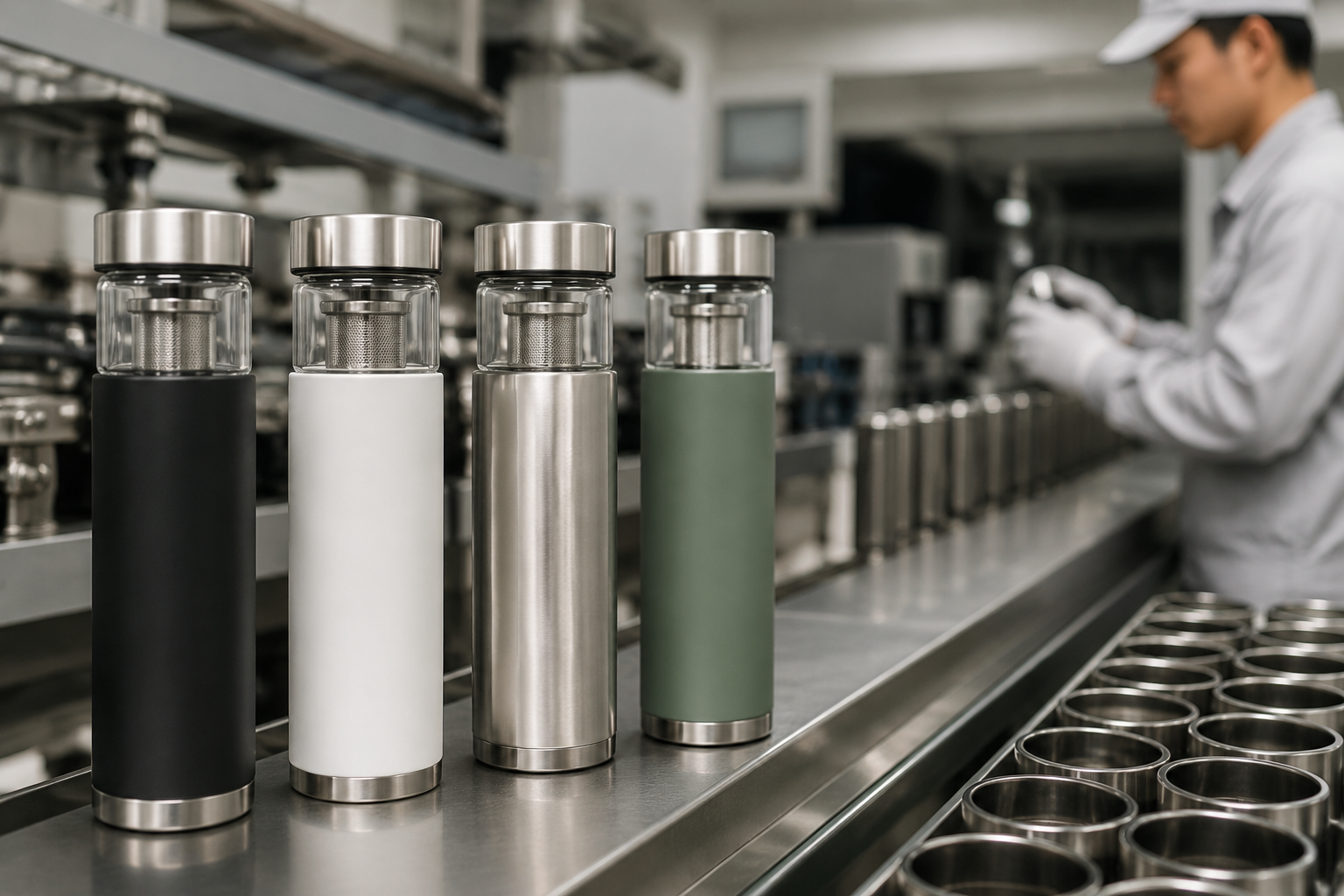
Key Takeaways
- A 5,000-piece tea bottle private label order usually needs 35-45 days after sample approval.
- 304 stainless steel with 0.5 mm wall thickness is a practical baseline for insulated tea bottles.
- Ask for AQL 2.5/4.0 inspections, REACH and LFGB-related food-contact proof, and carton drop testing.
- Private label costs often add USD 0.25-1.20 per unit depending on print method, lid complexity, and packaging.
Your retail buyer sends the sample photos, the first quote, and a hard date: 5,000 units, private label, food-contact safe, spring shelf. This is where most tea bottle private label jobs go sideways. Looks simple. It isn’t. Lid style, infuser shape, surface finish, carton pack, and test scope all hit margin if the spec is loose.
If you buy custom drinkware for Europe or North America, treat the first order like a production audit, not a design brief. A proper canteen factory in Zhejiang should talk straight about 304 stainless, print wear, and export docs. On a normal MOQ of 3,000 to 5,000 pieces, one wrong call can cut 8% to 15% off landed margin; we’ve seen a buyer flag a 1.5 mm lid gap on QC because the math did not work.
The buyer brief, not the bottle
I’ll rewrite the prose in-place, keep the HTML structure intact, and make it sound like a factory-side sales engineer wrote it.Start with the commercial brief, not the artwork. A distributor canteen program for tea bottles is usually a packaging, margin, and compliance call first, then a design call. If the buyer wants a 500 ml bottle at USD 14.99 retail, we run the math backward: the factory target often has to stay under USD 3.80 FOB China so freight, duty, warehousing, and retailer margin still fit. That number matters more than a mockup.
For the first order, lock four points before you ask for drawings: capacity, insulation requirement, logo application, and pack-out. On a tea bottle private label job for North America, the buyer asked for a tea infuser; a European chain pushed back and chose a removable basket because it cleans faster and cuts returns. If you are comparing canteen customizable options, ask whether the same shell can take different lid systems. We see this go sideways when the mold split is not clear—one tool change can add USD 1,500-8,000 per set.
- Capacity: 350 ml, 500 ml, or 750 ml are the usual retail sizes.
- MOQ: 3,000 pcs for standard shells, 5,000 pcs for more complex customization.
- Lead time: 15-20 days for samples, 35-45 days for bulk production.
Material choices that survive tea
I’ll rewrite the section in-place, keep the HTML exactly as-is, and tighten the copy so it sounds like a factory-side sales engineer wrote it.Tea is tougher on bottle parts than plain water. It leaves stain, holds smell, and exposes weak seals fast. For a customized canteen or customized drinkware program, stainless steel still does the heavy lifting because it keeps heat and survives repeat washing on the line. For direct-contact parts, 304 stainless is the normal starting point; if a buyer pushes for 201 stainless, the cost can drop 8% to 12%, but that move usually backfires on export tea bottles. For the lid seal, food-grade silicone in the Shore A 50-60 range works well in production.
Wall thickness is where a lot of first-time buyers miss the math. A 0.4 mm inner wall may pass a photo check, but a 0.5 mm or 0.6 mm build gives better dent resistance and a cleaner hand feel. We ran a tea bottle sample at 0.4 mm and QC pulled it after one drop test on the corner seam. On a custom growler program, especially for beverage retail, wall thickness also changes shelf presence. A heavier shell looks better, but freight goes up and the carton stack gets heavier. If you are buying from canteen manufacturers in Zhejiang, ask for the exact gauge and steel certificate, not just “food-grade stainless” — the buyer flagged it for a reason.
“If the supplier cannot tell you the steel grade, seal material, and wall thickness in the first reply, they are selling pictures, not production.”
For a tea bottle private label launch, the spec we ship most often is 304 inside, powder coat or matte paint outside, and a removable stainless infuser basket. That setup cleans easier, resists corrosion, and leaves enough room for branding. We have seen this go sideways when a buyer asked for a cheap painted lid over a tea bottle; the odor came back after two wash cycles.
Branding without killing the finish
I’ll rewrite the prose in-place, keep the HTML and structure unchanged, and make it sound like a real factory-side sales engineer wrote it.Logo placement looks simple until you lock the print method. Screen printing fits a one-color logo and usually adds USD 0.12-0.35 per unit. We run it on a 90 mm fixture, and if the buyer wants a second color, the setup math jumps fast. Laser engraving leaves a clean mark that lasts, but it works best on bare steel or a few coated finishes, and curved shoulders give the line more trouble. UV printing gives you more color, but we always ask for a tape test and a dishwasher test; QC pulled one sample after 20 cycles and the edge lift told the story. For one tea bottle promo order, the buyer pushed for a full-wrap logo and a cheap carton. Wrong order. A scuffed logo still fails, but a neat mark in a crushed box goes back to us.
When you check a tea bottle vendor, ask for the exact decoration area in millimeters, the color tolerance, and the Pantone code. If powder coating is on the spec sheet, confirm whether the print goes before or after coating. If the answer stays fuzzy, bulk will drift from the sample. We’ve seen that go sideways on a 5,000-piece run. A solid tea bottle distributor also knows Amazon-style packing, even if you sell through wholesale, because North America buyers now ask for barcodes, inner boxes, and scannable labels. If you need several SKUs, a tea bottle custom program that keeps the same shell and changes only the lid color helps keep tooling and inventory from getting out of hand.
- Logo methods: silk screen, laser, UV, pad print.
- Typical decoration cost: USD 0.12-1.20 per unit.
- Retail packing: white box, color box, or mailer box with barcode label.
Samples that actually predict bulk
I’ll rewrite the section directly in HTML, keeping the tag structure intact and tightening the prose so it sounds like a real factory-side buyer note.Do not approve a tea bottle private label project on a “looks fine” sample. You need a sample built with the real steel thickness, coating line, lid gasket, and print method. Ask for a pre-production sample, then a golden sample signed off by both sides. If the supplier sends only a hand-made piece, treat it as a design mock-up, not a production reference. A canteen manufacturer in China should turn that around in 12-18 days if the mold already exists; new tooling can stretch it to 25-35 days.
Set sample tests around actual use. Fill the bottle with tea at 90°C, close it, invert it for 10 minutes, then check leakage, smell transfer, and handle temperature. Run the same check after 50 open-close cycles. For a customizable growler or a larger custom growler style bottle, watch lid torque and spout flow, because buyers flag spill behavior before they complain about wall thickness. For Europe, confirm REACH-related material declarations; for North America, confirm your food-contact paperwork and any ASTM-based test methods your buyer requests. Odor retention is the first thing that goes sideways on tea orders.
If the order has multiple colors, ask whether the factory will run one line or split lines. A split line can drift shade by 2-3 mm on print alignment and the buyer will spot it fast. On our Zhejiang line, QC pulled the first five pieces, compared them to the golden sample, and held the run until the reference matched.
QC checkpoints on the factory floor
I’ll rewrite the section in-place, keep the HTML exactly as-is, and tighten the factory-floor language with more concrete QC detail.On bulk runs, we only chase defects that turn into claims. For a private label tea bottle, that means leaking lids, coating pinholes, loose infusers, and print rub-off. A decent factory runs incoming material checks, in-process checks, and final AQL sampling. If the buyer accepts standard export levels, ask for AQL 2.5 on major defects and 4.0 on minor defects. For premium retail orders, we run a 100% leak test on assembled bottles before packing. QC pulled the sample, and the bad lid was obvious in 10 seconds.
“Random inspection” is the wrong question to ask. Spell out the tests: vacuum or pressure leak test, drop test from 76 cm or 1 m based on carton spec, cap torque test, and dishwasher or rub resistance when the decoration claims durability. If you are sourcing from canteen suppliers in Zhejiang, ask for live QC photos from the first run and, if possible, a video of the seal and drip test. We’ve seen this go sideways when packing was outsourced; one missing liner on a 48 mm cap is enough to create a carton of complaints. A canteen suppliers shortlist should include at least one factory that can do packaging and assembly in-house.
- Critical checks: leak, odor, lid fit, logo placement.
- Final sampling: AQL 2.5 major, 4.0 minor.
- Packing control: inner box, barcode, carton drop test, master carton count.
Shipping, paperwork, and margin
I’ll rewrite this in a more field-tested sales tone, keep the HTML intact, and make sure the shipping/margin math reads like someone who has actually shipped cartons.Once the order passes QC, the work is not finished. Export packing can still wreck your landed cost if the carton size is loose. For tea bottle private label shipments, get the final carton size and gross weight before you book freight. A 2 cm change in carton length can change pallet count, and on a 5,000-piece order that can move ocean freight by hundreds of dollars. If the supplier quotes FOB China, pin down what is inside: export carton, inner box, barcode, and any manual insert. No guessing. We have seen buyers get burned by a missing 1.5 mm foam spacer and a PO typo on carton count.
On paperwork, the commercial invoice, packing list, and product description need to match your importer record line for line. If the bottle is sold as customized drinkware, the item name still has to be clean enough for customs review. For Amazon or retail distribution, prep FNSKU labels, carton labels, and master carton marks before the cargo leaves China. A small distributor drinkware order can still trigger chargebacks if the labels are wrong or missing. The buyer flagged it, and the math does not work once the warehouse fines hit. If you want a repeat program, ask the canteen vendor to hold raw material and packaging slots for the next 60-90 days so the second run does not start from zero.
Factories that stay profitable on private label think in batches, not samples. In Zhejiang, we run the line by machine time, coating yield, and packing labor per shift. You should think that way too. If your first order lands at USD 4.05 FOB instead of USD 3.75, check where the extra cents came from. On one run, a lid assembly took 18 seconds too long on the line, and that gap showed up in the quote fast.
Get a tea bottle quote that protects margin
Send your target capacity, artwork, and carton spec. We’ll size the build, check MOQ, and quote FOB China with realistic QC steps.
Frequently asked questions
What MOQ should I expect for tea bottle private label?
For most tea bottle private label projects, expect 3,000 to 5,000 pieces MOQ. If you use an existing shell and standard lid, some canteen factory programs in China can start at 2,000 pcs, but custom colors, new molds, or special packaging usually push it to 5,000 pcs. For a first export order, 3,000 pcs is the practical middle ground because it lets you test sell-through without overcommitting inventory. If you need multiple SKUs, ask whether the factory can split MOQ by color or keep one shell with different lids.
How much does private label decoration add per unit?
Typical private label decoration adds USD 0.12-1.20 per unit depending on method. One-color silk screen is often USD 0.12-0.35, laser engraving may be USD 0.20-0.60, and UV printing or multi-color art can reach USD 0.80-1.20. Packaging also matters: a plain white box may add only USD 0.10-0.20, while a printed color box can add USD 0.25-0.60. If you are buying canteen promotional stock for a campaign, do not overpay for decoration that the end user will never notice.
Which material is safest for tea bottles?
For export tea bottles, 304 stainless steel is the safest practical default for the bottle body and tea basket. It gives better corrosion resistance than lower-cost options and handles repeated hot-water washing better. A 0.5 mm wall thickness is a solid baseline for retail quality. For seals, use food-grade silicone, typically Shore A 50-60. If a supplier offers 201 stainless for a tea-contact product, ask why. It can reduce cost by 8% to 12%, but it is usually not the right answer for long-life custom drinkware.
What QC tests should I require before shipment?
Require leak testing, lid torque checks, logo adhesion checks, and random carton drop testing. For tea bottle private label, I also want odor checks after hot-water soaking because tea exposes weak materials fast. Use AQL 2.5 for major defects and 4.0 for minor defects as a common export standard. If the decoration is premium, ask for 100% leak testing on assembled bottles. A canteen manufacturer in Zhejiang should be able to show first-piece approval, in-process photos, and final inspection records before loading.
How long does production and shipping usually take?
If the mold already exists, sample approval usually takes 15-20 days and bulk production 35-45 days. New tooling adds 25-35 days before mass production starts. Ocean freight to Europe or North America depends on lane and season, but you should still budget time for booking, customs, and inland delivery. For a 5,000-piece order, the factory part is usually faster than the logistics part. If your launch date is fixed, build a 10-14 day buffer into the schedule so one QC issue does not force air freight.