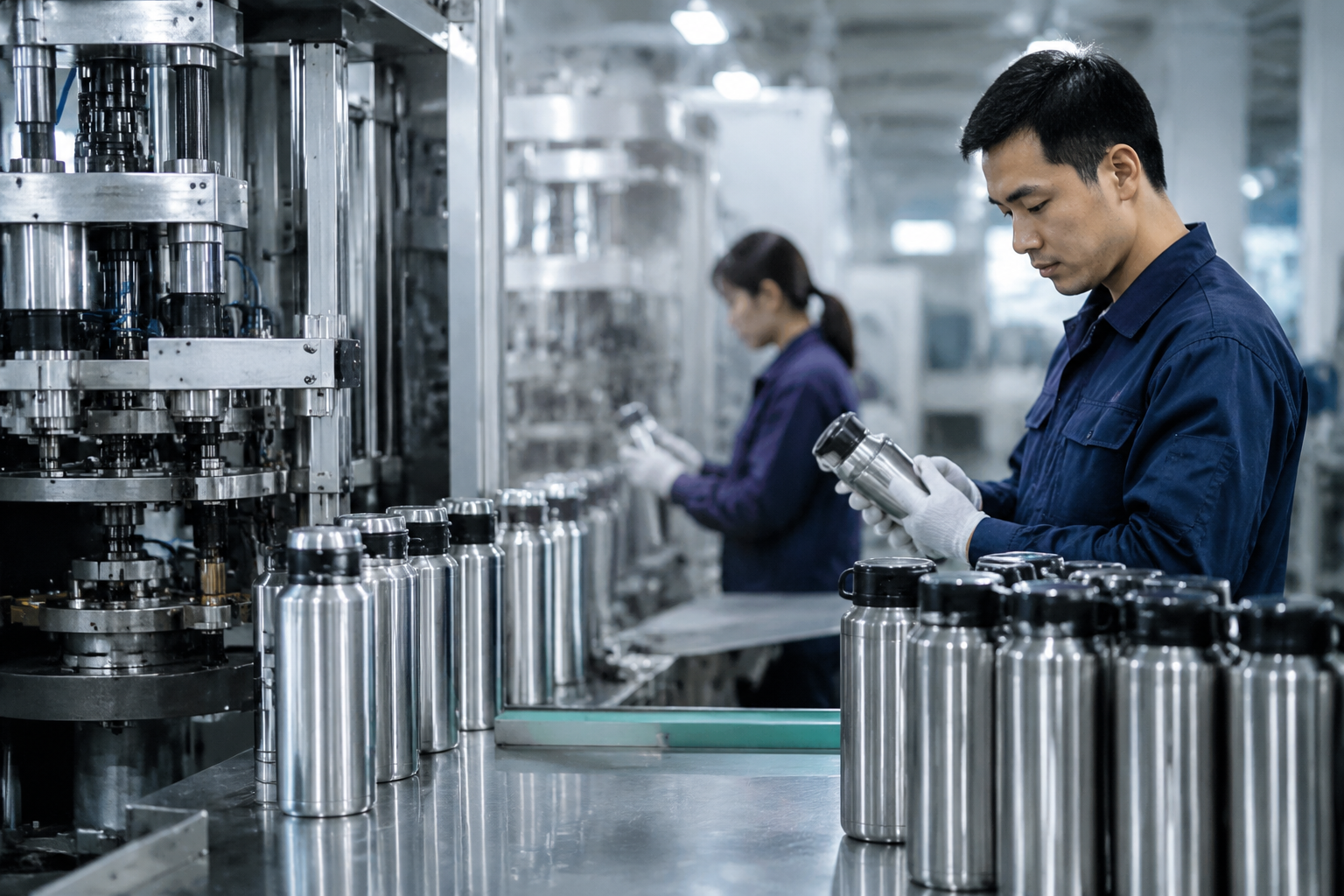
Key Takeaways
- A workable tea bottle OEM order usually starts at 1,000-3,000 pcs MOQ and 25-35 days lead time after sample approval.
- For most buyers, 304 stainless is enough; 316 is worth the extra cost only if you need stronger corrosion resistance and higher perceived value.
- A 0.4-0.7 mm wall thickness is normal; thinner often means lower cost but higher dent risk and worse thermal retention.
- Ask for AQL 2.5 major / 4.0 minor, REACH documentation, and lid leak testing before you approve production.
Buying a tea bottle looks simple until you start checking wall thickness, lid sealing, infuser mesh, and carton drop-test results. We’ve seen the buyer flag a 0.2 mm wall gap on the first PO, then the whole shipment got held back. For a B2B buyer, those details decide whether the product sells or comes back with leaks, rust stains, or warranty claims. If you are sourcing from a tea bottle OEM manufacturer, you are not just buying a bottle; you are buying a spec sheet, a compliance file, and a production line that repeats the same result batch after batch.
In Zhejiang and across China, the factories that keep repeat orders usually control the boring parts: 304 or 316 stainless, 0.4-0.7 mm wall thickness, 1,000-3,000 unit MOQ, and 25-35 day lead time after sample approval. QC pulled the sample with a thickness gauge and a lid torque tester, and that is where the real difference shows up. That is the level to compare, whether you need custom drinkware for retail, canteen custom programs, or distributor drinkware with private label packaging.
Start with the bottle body
I’ll keep the HTML structure intact and rewrite the prose to sound like a factory-side sales engineer, with sharper numbers and one factory-floor detail per paragraph.The bottle body is the first spec to pin down, because it sets durability, weight, thermal hold, and unit cost. A tea bottle OEM manufacturer will usually quote double-wall stainless steel first, then ask if you want powder coating, painted finish, or bare brushed metal. For B2B buyers, the body spec sets the shelf math: a 350 ml tea bottle in 0.4 mm stainless may land around USD 1.80-2.60 FOB, while a 0.5-0.6 mm build can move into USD 2.40-3.40 once you add finish and lid parts. We run this on the line every week, and the wrong wall spec shows up fast in drop tests.
Do not settle for “food grade steel.” Ask for the material grade, inner and outer wall thickness, and whether the liner is 304 or 316. For tea, 304 is the practical default. If the bottle will hold acidic fruit tea, salted lemon tea, or sit in humid shipping lanes for 60 days, 316 can make sense. In Zhejiang, many canteen manufacturer lines can run both grades, but the price gap is not just the steel; it also comes from tighter scrap control and slower polishing speed. QC pulled one sample last month with 0.38 mm spots on a spec sheet that said 0.4 mm, and the buyer flagged it immediately.
- 304 stainless: standard choice for most tea bottle programs
- 316 stainless: better corrosion resistance, higher price
- Wall thickness: 0.4-0.7 mm is the real buying range
- Finish: powder coat improves grip but can chip if cure is poor
If you are sourcing custom drinkware for retail, ask for a dent test and a salt-spray note. A supplier who can show a stable process is usually the better canteen supplier than one quoting only the lowest number. We’ve seen this go sideways when a PO typo called for “0.06 mm” instead of “0.6 mm”; the math does not work, and the sample room catches it before shipment if the factory is paying attention.
Check the lid like a buyer
I’ll rewrite the section in place, keep the HTML structure intact, and tune the copy to sound like a buyer-side factory handoff rather than generic marketing.The lid is where the first orders go wrong. A tea bottle can look clean on the render, then leak at 45 degrees or pick up a seal smell after hot filling, and that is a dead end. We split lid specs into three parts on the line: sealing ring, opening mechanism, and venting. That is how a buyer should read it. If the bottle goes to e-commerce, the lid has to survive courier drops, air-pressure swings, and repeated opening without chewing up the threads.
Ask what gasket material they use. Food-grade silicone is the normal answer, but you still need the temperature range, compression set data, and spare-ring availability. A hot-fill tea bottle should hold 95°C water without deformation, and the lid should stay dry after 3-5 minutes of inversion testing. For distributor drinkware programs, that data beats a pretty render. We’ve seen the math fail when a buyer skips it.
What to request on the sample
- 100% inversion leak test
- Thread torque check after 20 open-close cycles
- Hot water odor test at 90-95°C
- Drop test from 80-100 cm, depending on pack
Many canteen distributors get burned by “universal lids” that fit on paper and fail in the carton. If your bottle line includes custom canteen or customizable canteen options, keep the lid family small and repeatable. Fewer parts mean fewer failures and less spare-parts pain later. QC pulled the sample and found a 0.8 mm gap at the rim; that kind of miss shows up fast in transit.
Infuser and tea control
If tea is the use case, the infuser is the product. The cheap mesh basket can dump fines into the cup, slow the brew, or bend after a few cleaning cycles. A tea bottle OEM manufacturer should give you the mesh gauge, hole size, basket depth, and the lock point at the neck. On our line, QC pulled a sample with 0.8 mm gaps, and the buyer flagged sediment in the first infusion. For loose-leaf tea, 0.3-0.5 mm opening is common. Herbal tea usually needs a wider opening to keep flow moving.
There is a commercial call to make here. If your customer drinks tea in transit, they want a wide mouth and a removable infuser. If the bottle sits in an office or goes out as a promotional gift, a slimmer mouth looks cleaner and holds heat better. That tradeoff changes shelf appeal more than many buyers expect. We’ve seen a 420 ml body with a tea insert win on premium channels, but it weighs more and the freight math climbs fast. For a custom growler or customized growler concept, check landed cost before you lock the shape. A PO typo on neck size can turn into a 12 mm mismatch and a dead sample run.
- Mesh: finer mesh cuts sediment, but slows flow
- Basket depth: deeper baskets brew better, but add cost
- Removal: easy-clean designs cut complaints
- Compatibility: confirm the infuser with hot and cold tea
If you sell through a canteen vendor or distributor canteen channel, keep the explanation to one line. Simple sells. A clever infuser that takes three steps to explain usually loses to the plain one, and we’ve seen that go sideways in buyer meetings.
Print, logo, and finish choices
I’ll rewrite the prose in place, keep every tag and quote, and tighten the language so it sounds like a factory-side sales engineer.Most buyers treat logo decoration like a branding box to tick. On the line, it is process control. Silk screen, laser engraving, heat transfer, and UV print all behave differently on curved stainless steel. A good tea bottle OEM manufacturer should tell you which method fits your target unit price and MOQ. If you need a single-color mark, silk screen is usually the lowest-cost route. If you want a mark that holds up on brushed steel, laser engraving is cleaner and lasts longer.
The math is straightforward. Basic one-color silk screen may add USD 0.08-0.20 per piece, while laser engraving often adds USD 0.15-0.35 depending on size and setup. We had one buyer flag a PO typo on logo size last month, and QC pulled the sample before the line ran 5,000 units. For canteen customizable programs, the logo is often the cheapest line item, but it carries the most brand risk. A bad print makes a good bottle look cheap.
“If the logo fails after three wash cycles, the buyer remembers the failure, not the bottle.”
For customized drinkware and customizable drinkware programs, ask for pre-production color drawdowns, Pantone matching when the shade matters, and abrasion notes from the test rack. If you are building a canteen promotional SKU, keep the decoration simple and tough. We run into this all the time with Europe and North America buyers: they push back hard on paint odor, flaking edges, and weak adhesion after a dishwasher test at 65°C.
Packaging and carton specs matter
I’ll keep the HTML structure intact and rewrite the copy to sound like a factory-side sales engineer, with tighter numbers and a few shop-floor details.Packaging is where margin leaks out. A tea bottle can run well on the line and still lose money if the carton is 20 mm too big, the insert shifts, or the retail box gets flattened in transit. A tea bottle OEM manufacturer should quote the bottle, inner tray, gift box, master carton, and carton loading count. For exporter planning, ask for the outer carton size in centimeters, gross weight, and how many sets fit on a 1,100 x 1,100 mm pallet. We’ve seen a PO typo turn 48 cartons into 84; the math does not work.
If you sell on marketplaces, the pack has to fit FNSKU labels, barcode position, and damage control. For distributor drinkware orders, a plain white box is often enough, but carton strength still matters. Ask for 5-layer or 7-layer export cartons, especially if the bottle has a glass liner or a fragile lid window. On a 10,000-unit run, saving USD 0.05 per box gets wiped out fast if one container shows crushed caps. QC pulled the sample, and the edge crush test missed spec by 3 kgf.
- Retail box: better for premium canteen custom products with shelf display needs
- Master carton: should take 60-80 cm handling impacts without corner collapse
- Labeling: confirm barcode, care text, and origin mark before print
- Palletization: matters for North America and EU distribution, especially at 1,100 x 1,100 mm
Factories in Zhejiang that export every week usually know packaging discipline, but you still need to push for it. A canteen factory that quotes only the bottle and skips the outer pack is not giving you a real landed-cost number. We run into this all the time: the buyer flags the carton late, then the freight quote jumps by 8%.
Compliance and factory control
I’ll rewrite this section in a more factory-side voice, keep the HTML exactly as-is, and preserve the original compliance facts and numbers.Compliance is not paper decoration. It is what keeps a shipment from getting held, rejected, or relabeled at your cost. For a tea bottle OEM manufacturer, the basic set for Europe and North America is REACH awareness for coatings and plastics, food-contact declarations, and lot traceability. If the bottle uses silicone, PP, Tritan, or painted parts, each material needs its own file. One generic certificate is not enough, and we see buyers get burned by that all the time. Last month QC pulled a sample where the ink code on the carton did not match the lot sheet by one digit.
Ask how the factory checks incoming material, in-process dimensions, and final inspection. We run AQL 2.5 major and 4.0 minor on consumer drinkware, with calipers on neck finish and lid torque checked on the line. If the supplier cannot name the defect buckets, the math does not work for a serious canteen distributor program. For buyers who need one plant to cover both tea bottle and custom canteen orders, monthly output matters more than a polished sample table. A Zhejiang plant may run 300,000-500,000 units per month across multiple lines, and that is the number that keeps replenishment moving.
Lead time discipline matters too. Sample approval in 7-10 days, mass production in 25-35 days, and shipping documents within 3-5 days after balance payment is normal for a plant that actually controls its schedule. If a supplier cannot put those numbers in writing, they are selling capacity they do not own. We have seen this go sideways on a PO typo alone: one buyer wrote 5,000 pcs, the factory booked 50,000, and the line had to be reset. That is how late containers start.
Send your tea bottle spec sheet now
We can quote materials, MOQ, logo process, and packaging from one drawing. If you need Zhejiang factory support, send the target price and carton plan.
Frequently asked questions
What MOQ should I expect from a tea bottle OEM manufacturer?
For standard stainless tea bottles, 1,000-3,000 pcs is a realistic MOQ. Simple colors and shared molds may start at 500 pcs, but custom lids, special finishes, or branded packaging usually push the order higher. If you need a custom canteen program with multiple SKUs, keep each color under 2,000 pcs to protect cash flow. A factory in Zhejiang may offer a lower trial MOQ, but you should check whether the price jumps by 15-30% and whether tooling or print setup is added separately.
How much does a custom tea bottle usually cost FOB China?
For a 350-500 ml stainless tea bottle, FOB China pricing often lands around USD 1.80-3.80 per piece depending on steel grade, wall thickness, lid type, and decoration. 304 stainless with a basic lid and one-color print sits near the low end. A 316 version, powder coat, laser logo, and premium box can push the unit price above USD 4.00. Always ask for separate pricing on bottle, infuser, logo, and carton so you can see where the margin is going.
Which material is better: 304 or 316 stainless?
For most tea bottle orders, 304 stainless is the practical choice. It is food-safe, widely available, and cost-effective. 316 costs more, but it resists corrosion better and is a stronger selling point for premium drinkware or acidic beverages. If your program is a canteen promotional item or a distributor drinkware line with tight margin, 304 is usually enough. If you are selling into a high-end retail channel and want a better story, 316 can justify a higher price.
What testing should I ask for before production?
At minimum, ask for leak testing, hot-fill deformation testing, coating adhesion, and carton drop testing. For a serious order, request AQL 2.5 major / 4.0 minor inspection, plus a 95°C hot water hold test and a 20-cycle lid open-close test. If the product uses silicone or plastic components, ask for food-contact declarations and REACH-related material notes. A canteen manufacturer that can show these checks is usually safer than one that only sends photos.
Can one factory handle tea bottles and other drinkware?
Yes, many canteen factories in Zhejiang produce tea bottles, travel tumblers, and custom drinkware in the same campus or production group. That is useful if you want one supplier to manage multiple SKUs, because you can combine containers, cartons, and branding. The key is not whether they can make everything; it is whether each product has its own stable process. A canteen supplier that runs 300,000-500,000 units per month across mixed lines is usually more dependable than a small vendor with a broad catalog and no output discipline.