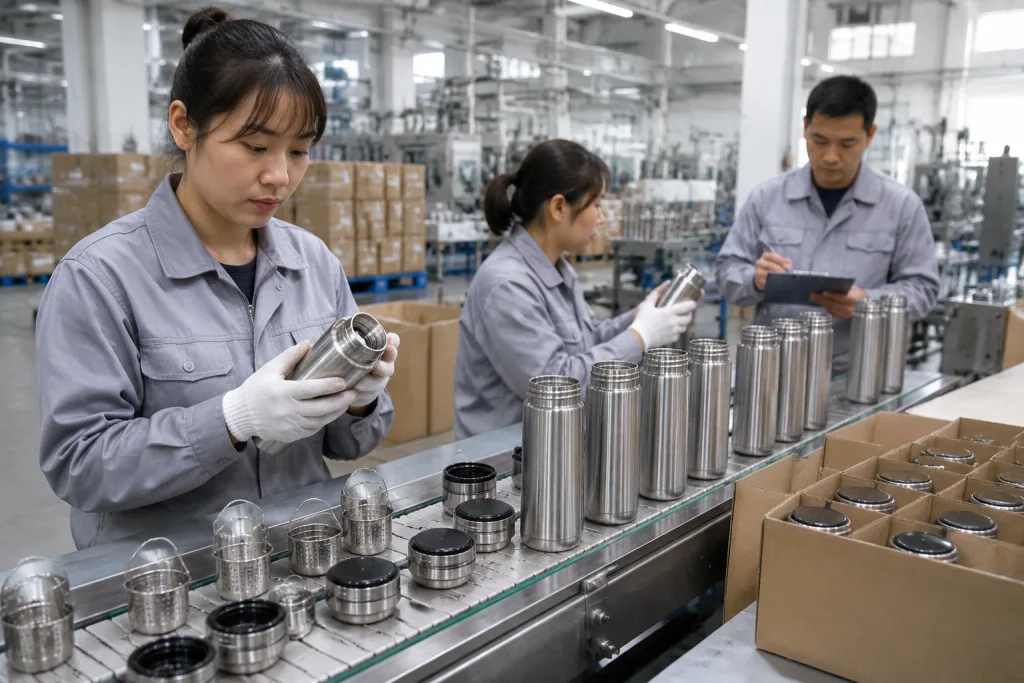
Key Takeaways
- A tea bottle factory should quote 304 or 316 steel, 0.4-0.6 mm wall thickness, and a clear sealing structure.
- For most custom drinkware runs, MOQ is 1,000 units and sample lead time should be 5-7 days.
- Leak control matters more than capacity; ask for AQL 2.5 checks on lids, threads, and gasket fit.
- A good canteen supplier will confirm REACH, food-contact safety, and carton drop-test readiness before production.
When you buy from a tea bottle factory, the first mistake is treating every bottle like a basic stainless tumbler. Tea bottles get judged on more than capacity and color. We check brew basket geometry, lid seal, condensation control, coating wear, and whether the line can hold the small tolerances that cause leaks. In Zhejiang and across China, the clean sample is easy; the profitable production run lives or dies on the spec sheet.
If you are sourcing custom drinkware for Europe or North America, you also need a factory that knows retail packaging, REACH, food-contact rules, and how cartons survive a 1.2-meter drop test. A real canteen manufacturer or canteen supplier should give you wall thickness, 304 or 316 stainless grade, sample lead time, and monthly output without hand-waving. We run MOQ at 1,000 units for most tea bottle builds at BottleForge in Hangzhou, Zhejiang, with lead time around 25 to 35 days depending on decoration. QC pulled the sample on a 0.3 mm lid gap last week; that is the kind of number you should ask every canteen factory for.
Start with the steel grade
I’ll rewrite the section in-place, keeping the HTML and list structure unchanged while making the copy sound like it came from the factory floor.The first line on a tea bottle spec sheet is the one buyers skip: material. Don’t. If you are sourcing from a tea bottle factory, ask whether the inner body is 304 stainless steel or 316 stainless steel, and whether the outer shell matches or uses a lower-cost grade. For most tea bottles shipped into North America and Europe, 304 is the normal baseline. If your buyer wants stronger corrosion resistance for acidic tea, fruit infusion, or salty transport environments, 316 is the better call, but it usually adds USD 0.60 to 1.20 per unit depending on volume. We had a buyer flag a PO that said “304 inside, 304 outside” but the sample split on the laser welder showed mixed grades; that sort of shortcut always comes back.
Wall thickness matters too. We usually see 0.4 mm to 0.6 mm on vacuum bottles. Below 0.4 mm, dent resistance drops fast and the bottle feels cheap in hand. Above 0.6 mm, weight climbs and forming cost goes up. On the line, QC pulled the sample gauge and one batch measured 0.38 mm at the seam, which was enough for a rejection. If you are comparing a canteen factory, a canteen manufacturer, or a canteen supplier, ask for the exact thickness by layer, not just “premium stainless.” The same goes for weld quality on seams and the finish around the rim. Tea drinkers notice taste transfer, and retail buyers notice staining after 30 days.
- 304 stainless steel: safe default for most custom drinkware programs
- 316 stainless steel: better for acidic use cases and premium positioning
- 0.4-0.6 mm wall thickness: practical range for durable export bottles
Check the lid like a leak engineer
I’ll rewrite this section in-place, keeping the HTML exactly as-is and tightening the copy so it reads like a factory sales engineer wrote it.Most complaints start at the lid, not the body. A proper tea bottle factory should spell out the cap build in plain terms: single-thread or double-thread, silicone gasket size in mm, vent path, tea basket lock, and whether the lid is PP, Tritan, or stainless-clad. If the factory cannot explain how pressure escapes when 95°C water and tea leaves go in, you are not talking to a serious canteen vendor.
For tea bottles, the seal matters more than the styling. A lid that looks clean but fails after 20 hot-cold cycles will cost more in claims than it saved in tooling. We run 100% leak checks on critical assemblies, then AQL sampling on full cartons; QC pulled the sample on the line with a torque meter, and that catches weak lids before shipment. For distributors, the math does not work once freight, storage, and relabeling land on the same invoice. If your order is for a canteen promo run, ask for torque testing and thermal cycle testing before production starts. We’ve seen one bad sample slip through and turn into 300 returns.
Ask for a hot-fill leak test at 95°C, then a 24-hour inversion test. If the factory cannot document both, keep looking.
Read the brew basket spec carefully
I’ll rewrite the prose in-place, keep the HTML exactly as-is, and make it sound like a factory-side sales engineer.Tea bottle buyers often stare at the body and skip the infuser. That is the wrong order. The tea basket decides whether the product feels clean or a pain to use. We check the basket opening with a caliper, and the spec has to balance two things: loose tea needs room to open, and stray leaves still have to stay out of the cup. A practical basket uses stainless mesh with a frame that holds shape after repeated dishwashing. For a custom growler or customizable growler crossover job, the basket gets even more sensitive because buyers want a bigger opening and faster flow.
Ask for mesh count, basket depth, and whether one hand can pull it out without fumbling. QC pulled a sample last week where the basket sat 8 mm too low, and the first pour came out bitter. That sort of issue is easy to miss on a PO, and we have seen it go sideways after mass production. A shallow basket cuts aroma and under-brews large leaf grades. In a canteen custom or customized canteen project, we usually set the basket so there is at least 18-25 mm of clearance above the liquid surface, depending on bottle volume. If your buyer wants customized drinkware for office use, that measurement matters more than a printed logo.
- Mesh count: specify it on the PO, do not leave it open
- Basket depth: controls leaf expansion and brew strength
- Clearance above waterline: target 18-25 mm for steadier brewing

Surface finish decides shelf appeal
I’ll keep the tags intact and rewrite the prose to sound like a factory-side sales engineer, with sharper numbers and a few line-floor details.Tea bottles have to win on shelf before they prove themselves in use. So the finish is not a side note; it gets checked panel by panel on the line. Powder coating holds up well and hides fingerprints, but the grain changes how buyers read the price. Matte spray gives a softer look and fits a canteen customizable program cleanly. Brushed metal shows the stainless character and suits a premium tea bottle factory order, though scratches show up faster. If you are buying for a canteen promotional campaign, the finish has to survive 12 days in transit, retail handling, and stack pressure in the warehouse.
Ask for adhesion test results, salt spray data if the bottle has metal exterior accents, and a clear answer on food-safe coverage for contact-adjacent zones. QC pulled the sample with a cross-hatch cutter and checked the edge lift at 5 mm; that tells you more than a glossy sales sheet. A true canteen manufacturer should quote coating thickness and explain when laser engraving beats silk screen for a logo. We often push one coating system across 3 to 5 SKUs for Zhejiang runs, because the math works and the buyer flagged the same problem we see every season: too many color breaks, too many setup mistakes, too many rework days.
Decoration cost is pretty direct: laser engraving usually adds USD 0.08 to 0.25 per unit, while complex multi-color print adds USD 0.15 to 0.45 depending on coverage and MOQ. One PO typo can shift the whole job, too—last month a buyer wrote “matt” instead of “matte,” and the sample card came back wrong by the next morning. That sort of miss is why we keep finish specs locked before the carton print goes to the line.
Packaging is part of the spec
I’ll rewrite the prose in-place, keep the HTML structure unchanged, and make it sound like a factory-side sales engineer wrote it.If you ship custom drinkware into Europe or North America, the product spec is only half the job. Packaging decides whether the bottles land ready to sell or arrive scratched and loose. A tea bottle factory should tell you if the carton is 3-ply or 5-ply, whether the insert is molded pulp or EPE foam, and how many drops the shipper carton can take. For e-commerce and distributor drinkware programs, “standard box” is the wrong answer. We size the box so the lid does not press down and the coating does not rub in transit.
For Amazon-style fulfillment, FNSKU labeling, master carton marks, and inner-box barcodes need to be settled before tooling starts. For retail, you may need a hangtag, window box, or shelf-ready tray. A canteen supplier that ignores packaging is not supporting a commercial launch; they are just filling a carton. In our Hangzhou plant in Zhejiang, we run about 300,000 units per month across several drinkware lines, and packaging mistakes still hold trucks at dispatch. QC pulled the sample on a 58 mm lid once because the buyer flagged carton crush in transit, so we lock the packaging drawing before mass production, not after approval photos.
- Outer carton: 3-ply for light freight, 5-ply for export risk
- Inner protection: molded pulp or EPE, depending on finish
- Labeling: FNSKU, lot code, and country-of-origin must match paperwork
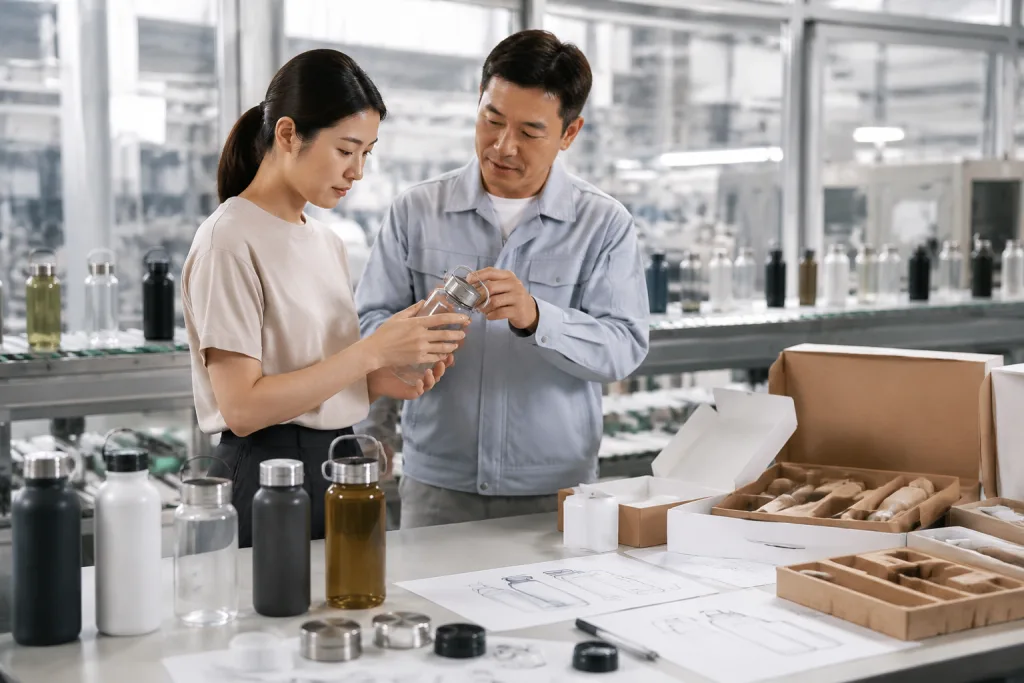
QC numbers should be visible
I’ll rewrite this section in place, keep the HTML exactly as-is, and tighten the sales-engineer tone with concrete QC detail and buyer-side pushback.Quality control is where buyers separate a real tea bottle factory from a trading outfit with glossy photos. Ask for the inspection standard in writing. AQL 2.5 is common for major defects in consumer drinkware, but that only works if the factory knows how to sort leaks, coating blisters, lid misalignment, and print offset. We run this on the line with a go/no-go gauge and a torque tester, not on memory. You want incoming material checks, in-process inspection, final sampling, and a clear hold-and-rework step for rejected lots.
If you are dealing with canteen manufacturers in China, especially in Zhejiang, ask for compliance records too: REACH for EU orders, food-contact declarations, and, where the market calls for it, ASTM or LFGB-related test reports. Do not accept a verbal “yes.” Ask for file names, test dates, and the lab name. We have seen buyers lose a week because the PO spelled the model code as “CN-500” instead of “CN500” and the paperwork did not match. That is the wrong question to ask if you only want a cheap quote; the math does not work when customs holds the carton.
Buyers who ask for AQL, drop test, and compliance documents before PI payment usually avoid the most expensive surprises.
Send your tea bottle spec sheet today
We’ll review materials, lid structure, MOQ, and packaging before quoting, so you know the real landed cost before production starts.
Frequently asked questions
What MOQ should I expect from a tea bottle factory?
For most custom tea bottle projects, a realistic MOQ is 1,000 units per design and per color. Some simpler canteen custom orders can start lower, around 500 units, but the per-unit price will usually rise by 10% to 20%. If you need multiple lids or mixed sizes, the factory may split MOQs by component. In Zhejiang, larger canteen manufacturers often prefer 3,000 units for best pricing, especially if you want custom logo printing plus retail packaging. Ask whether MOQ includes packaging changes, because box inserts and artwork can change the real minimum faster than the bottle itself.
How long is the lead time for custom drinkware?
Typical lead time for a tea bottle factory is 25 to 35 days after sample approval and deposit, assuming no unusual tooling. Simple customized drinkware with stock molds can move in 20 to 25 days. If you need new tooling, special lids, or a canteen promotional set with gift packaging, expect 35 to 45 days. Add 7 to 10 days for ocean freight preparation and inland export handling. A serious canteen supplier should separate sample time, production time, and shipping time so you can plan launch inventory without guesswork.
Which is better for tea bottles, 304 or 316 steel?
304 stainless steel is the standard for most tea bottles and covers the majority of retail and wholesale use cases. 316 stainless steel is worth it when the product will hold acidic tea, fruit-infused drinks, or when you want a stronger premium claim. The cost difference is usually USD 0.60 to 1.20 per unit depending on volume and finish. If your buyers are running a canteen distributor program or a private-label launch, 304 is usually the better margin choice unless the market specifically asks for upgraded corrosion resistance.
Can I order a customized canteen with branding and retail packaging?
Yes, and that is normal in China if you work with the right canteen factory. A canteen customizable program usually includes logo printing, laser engraving, color-matched coating, and boxed packaging. Expect decoration to add USD 0.08 to 0.45 per unit depending on method and coverage. Retail packaging may add another USD 0.20 to 0.80. If you want custom canteen, customized canteen, or customized drinkware for chain stores, make sure the factory confirms artwork format, carton size, and barcode placement before sampling.
What quality checks should I request before mass production?
Ask for incoming material inspection, first-article approval, in-process checks, final AQL sampling, and a leak test plan. For tea bottles, a practical leak test is hot water at 95°C, then inversion for 24 hours. Also request drop-test results for packed cartons and any REACH or food-contact paperwork needed for your market. A good canteen manufacturer in Zhejiang will be comfortable showing those records. If a supplier refuses to document QC, that is usually a sign to walk away rather than negotiate harder.