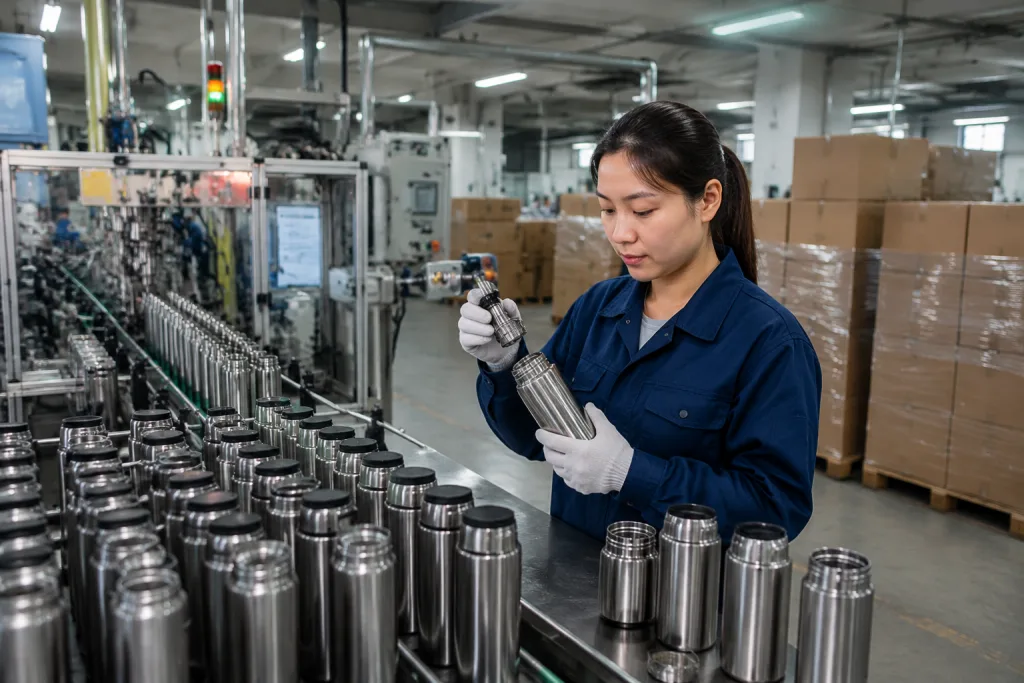
Key Takeaways
- Tea bottle distributors should decide on channel first, because a $1.80 FOB retail model and a $0.95 promotional canteen need different specs.
- MOQ usually starts at 500 units for one print position; full custom lids or molds often need 3,000-5,000 units.
- For tea use, 18/8 stainless, 0.5-0.7 mm wall thickness, and a 304 infuser are the safe baseline.
- A Zhejiang canteen manufacturer with 120,000 units/month can usually hold 35-45 day lead times after sample approval.
If you buy for retail, e-commerce, or promo channels, the wrong tea bottle order hurts twice: you sit on stock, then you spend time fixing it. Tea bottle distributors usually ask for price first. That is the wrong question to ask. A 1,000-unit run with a loose lid or smeared print costs more than a 20% higher FOB unit that ships clean and sells through. On our line, one buyer flagged a lid torque issue after QC pulled the sample at 18 N·cm, and we had to stop the packing table for a full recheck.
At BottleForge in Hangzhou, Zhejiang, we see that pattern every week. Buyers who treat the job as custom drinkware sourcing, not a simple catalog order, get better margin and fewer claims. The real decision is whether your canteen factory spec, closure, material, and compliance fit how the customer actually uses it in Europe or North America. We ship a lot of 500 ml and 750 ml units, and the math only works when the PO is tight on details like lid color, logo placement, and the 304 stainless callout.
Start With the Sales Channel
I’ll rewrite the section in place, keep the HTML structure untouched, and tune the prose to sound like a factory sales engineer.The first call is channel, not color or logo placement. We ship the same body into three different routes, and the math changes fast. A canteen sold through supermarkets needs a different margin stack than a customized drinkware item on Amazon, and both are different from a promotional giveaway. If you are handling tea bottle distributors for retail, the buyer watches shelf appeal, leak rate, and repeat use. For corporate promotions, unit cost and logo visibility carry more weight.
Set the target FOB from the channel. For North American retail, buyers usually need room for freight, duties, packaging, and 30-45% gross margin. That puts the factory target at USD 1.60-3.20, depending on size and insulation. For promotional orders, a custom canteen can sit lower, around USD 0.80-1.40, but the decoration has to stay simple. We’ve seen this go sideways when a buyer wanted one spec for both routes; the line could not hold price and performance at the same time.
Ask these three questions before you ask for samples:
- Will this be shelf stock, private label, or one-off canteen promotional work?
- Do you need retail carton packaging with UPC/FNSKU, or bulk packing?
- Do your canteen distributors need one SKU or a family of 2-3 sizes?
That answer drives the project more than any product photo. QC pulled the sample, and the first thing we check is whether the PO matches the channel, because a one-line typo there can waste a week.
Choose the Tea Bottle Construction
I’ll rewrite the section in-place, keeping every HTML tag and the heading structure intact, while tightening the prose to sound like a factory-side sales engineer.Tea is a tough category. Hot water, tannin stains, odor retention, and repeat washing expose weak construction fast. For a stainless tea bottle, we start with 304 inner and outer walls, 0.5-0.7 mm wall thickness, and a lid seal made from food-grade silicone. If a buyer wants a lighter body, we can go thinner, but once the wall drops below 0.4 mm, dent resistance gets ugly in distributor handling.
For tea bottle distributors, the infuser is usually where the trouble starts. A usable strainer needs enough open area for loose leaf tea to expand, and the basket must sit tight with no rattle. We usually specify 304 mesh with 0.3-0.4 mm perforations and a removable basket for cleaning. The buyer flagged this on one PO last month: they wanted a narrow sports neck, but tea and that shape do not get along, so a wide-mouth body with a tighter cap was the better call.
There is a branding trade-off here. Double-wall vacuum construction holds heat better, but it adds cost and slows the line. Single-wall canteen customizable models work for cold brew or dry retail gifting, but hot tea buyers expect real heat retention. A proper vacuum tea bottle can keep 60°C water above 55°C for 6 hours, depending on capacity and ambient temperature. We QC pulled the sample at 5 hours 40 minutes, and the math still beat the glossy catalog copy.
In Zhejiang, the factories that know tea products best are the ones that can tell you why a lid fails after 3,000 cycles, not just how it looks in a render.

Lock Branding Before Sampling
I’ll keep the HTML structure intact and rewrite the prose to sound like a factory-side sales note: tighter wording, concrete numbers, and a couple of floor details without changing the tags.Branding is where a lot of canteen distributors burn margin. We’ve seen a buyer approve a laser-engraved sample, then ask for full-color print or a wrap graphic after the quote was already out. That is not a small tweak; it changes unit cost, lead time, and sometimes the body finish. If you want customized canteen or customizable drinkware for retail, lock the decoration method before sampling. QC pulled a sample at the line last month because the artwork shift had already thrown off the sleeve tolerance.
For most projects, the working options are silk screen, laser engraving, heat transfer, or UV print. Laser gives a clean, permanent mark on stainless. Silk screen stays cheaper for one- or two-color art and fits canteen suppliers handling bulk promo orders. UV print can carry more complex branding, but curved bottles bring a higher reject rate, so the math does not work for every SKU. If you want a customized growler look with a premium finish, engraving plus matte powder coat is usually the safer call than large-area color print. We ship plenty of 500 ml and 750 ml bodies this way because the artwork holds up better in carton transit.
Typical decoration economics are straightforward:
- Silk screen: add USD 0.08-0.20 per unit.
- Laser engraving: add USD 0.12-0.35 per unit.
- Full-color wrap print: add USD 0.25-0.60 per unit.
When a buyer asks for canteen customized with three logo locations, the right answer is usually one location and one color. We had a PO last season with a typo on the logo position code, and the buyer flagged it only after pre-production. More artwork does not mean better sell-through, and in our book that is the wrong question to ask for distributor drinkware.
Ask for the Right Compliance Pack
I’ll rewrite the section to sound like a factory-side sales engineer, keep the HTML exactly as-is, and preserve the heading and list structure.For Europe and North America, compliance is a gate, not a checkbox. At minimum, your supplier should have REACH, food contact declarations, and material traceability for stainless steel, silicone, and any coating on the line. If the tea bottle touches hot liquid, buyers also ask for LFGB, FDA paperwork, or migration test data, depending on the market. A real factory keeps that pack on file before the PO lands; we see trouble when a vendor starts building documents after the buyer flags it.
Ask how the factory controls incoming material and finished goods. In our Zhejiang plant, we run AQL 2.5 on critical appearance and leak checks, then torque and drop tests on each lot. QC pulled a sample last month where the cap still spun loose at 1.8 N·m, and that unit would have come back from a distributor in a week. BSCI or a similar social audit helps on retail accounts, but the math does not work if product compliance and process control are weak.
When a canteen vendor says “passed quality” without naming the standard, push back. Ask for:
- Material certificates for 304/316 stainless and silicone
- Leak test method and pass rate
- Carton drop test requirement
- Whether the factory keeps batch traceability by date code
This is where tea bottle distributors protect margin. A clean compliance pack cuts chargebacks, delays, and dead stock. We have seen this go sideways from one typo on a PO, so get the documents before you confirm the order.

Use MOQ and Lead Time as Filters
I’ll rewrite the section in-place, keep the HTML structure intact, and tighten the sales language so it reads like a factory-side buyer guide.MOQ is not a random number on a quote. It tells you how flexible the canteen factory really is. If you need 500 units with one logo and standard packaging, plenty of Chinese plants can run that. If you want a custom mold, matched lid color, and retail sleeve, the real MOQ often jumps to 3,000 or 5,000 units. That is normal. The wrong move is pretending a 300-unit test order can support a fully customized canteen program.
At BottleForge in Hangzhou, Zhejiang, we run 120,000 units a month, so mixed distributor drinkware orders do not choke the line. QC pulled a sample last week and caught a 0.8 mm lid gap before packing, which is why we keep saying buyers should ask about process, not just price. For standard tea bottles, sample approval to shipment usually takes 35-45 days. Add new tooling, packaging development, or imported accessories, and you need 10-20 more days. A buyer once pushed for a 21-day launch; the math did not work.
Use this simple filter:
- 500-1,000 units: good for testing one canteen distributor market
- 3,000+ units: realistic for private label or national rollout
- 5,000+ units: better when you need custom lid tooling or color matching
If your channel can only absorb 800 units, a standard customizable drinkware base with one decoration change is the better play. We have seen this go sideways when buyers insist on a full custom canteen build for a small first drop.
Source Tea Bottles With Fewer Surprises
Tell us your channel, target FOB, and MOQ. We’ll match the build, decoration, and packaging to your tea bottle distributors plan.
Frequently asked questions
What MOQ should tea bottle distributors expect?
For a standard tea bottle with one logo color, expect MOQ around 500 units. If you want a custom lid, unique box, or color-matched body, the MOQ often moves to 3,000-5,000 units. For stainless vacuum models with special tooling, some canteen manufacturers may ask for 5,000 units to cover mold and setup cost. Always separate sample MOQ from mass production MOQ. A sample run may be 1-3 pieces, but that does not mean the factory will accept a 100-unit order. In Zhejiang, most serious canteen suppliers will quote by configuration, not just by volume.
Which material is best for tea bottles?
For hot tea, 18/8 stainless steel with a silicone seal is the safest default. I would use 304 inside and outside, 0.5-0.7 mm wall thickness, and a vacuum structure if insulation matters. Glass looks clean, but it is heavier and less forgiving in distributor channels. Plastic is cheaper, but it is harder to position as premium custom drinkware for tea. If your customer wants a custom growler or insulated bottle that can travel, stainless gives you better durability, better print options, and fewer breakage claims.
How do I compare canteen suppliers in China?
Do not compare only unit price. Ask each canteen supplier for material grade, decoration method, leak test standard, sample lead time, and carton packaging details. Then compare landed cost, not just FOB. A quote at USD 1.25 FOB with poor packaging can cost more than a USD 1.48 FOB quote with better cartons and lower damage rates. Good canteen suppliers in China will also tell you their monthly capacity, AQL standard, and whether they can provide REACH or LFGB paperwork. That is the difference between a real canteen vendor and a trading middleman.
Can I order canteen promotional and retail versions together?
Yes, but only if the base structure is the same. Many tea bottle distributors run a promotional canteen and a retail canteen customized version from one body, then change the logo, sleeve, and packaging. That keeps tooling costs under control. Once you change the lid mechanism, insulation wall, or infuser design, the order becomes two separate SKUs and the price goes up. If you want one platform for both channels, choose a common body and limit the variable parts to print, box, and accessory set.
What lead time should I plan from sample to shipment?
For standard custom drinkware, plan 35-45 days after sample approval. If the order needs new tooling, special coating, or a custom growler-style lid, add 10-20 days. Shipping time is separate: to Europe, sea freight often takes 28-40 days depending on port and routing; to the U.S., 18-30 days is common. Buyers in Europe and North America should also leave time for testing, label review, and FNSKU or carton setup. A rushed launch usually creates more cost than a delayed one.