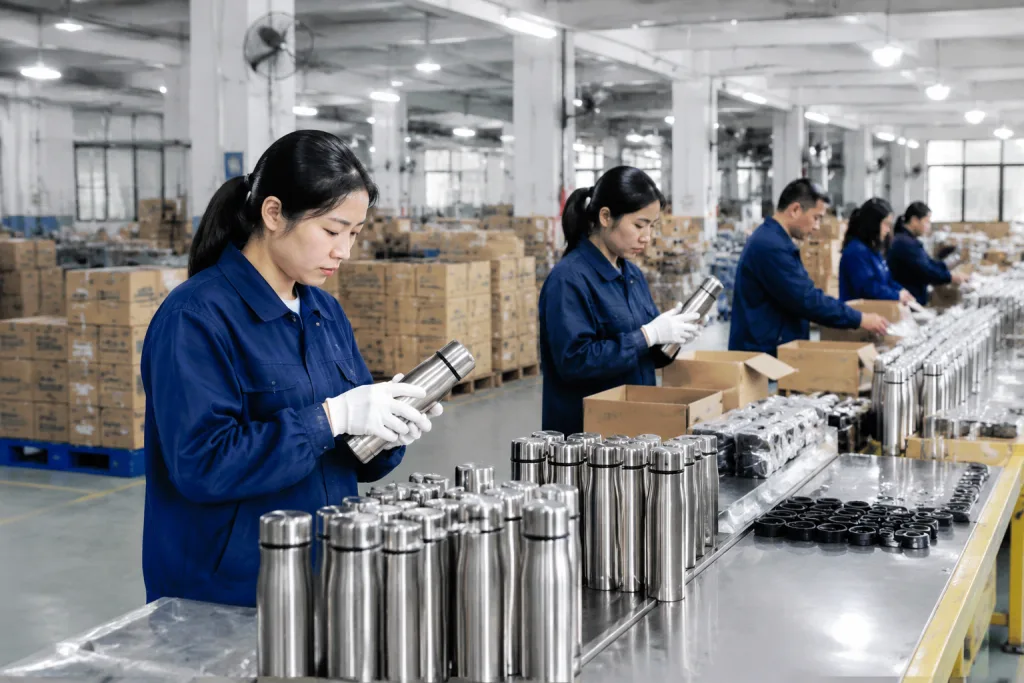
Key Takeaways
- Typical MOQ for tea bottle custom projects starts at 500–1,000 pcs per SKU, with 25–35 day lead time after sample approval
- A workable sample order usually costs USD 30–80 per style plus air freight, and tooling or logo setup can add USD 50–200
- Specify capacity tolerance, finish, logo method, and packaging on the PO; do not leave them to email threads
- A Zhejiang canteen manufacturer with 300,000 units/month capacity can usually handle custom drinkware, but only if your spec is frozen before mass production
If you are placing a tea bottle custom order, the hard part is not finding a factory. It is locking the spec before the first sample burns time and freight. A 1 mm lid gap, a loose finish note, or a missing carton mark can push a simple custom drinkware job into two more sample rounds.
For procurement teams, brand owners, and distributors, the job is to move from RFQ to sample to bulk without guessing. In Zhejiang and across China, a decent canteen factory will quote in 24 hours, but you still need to pin down wall thickness, capacity tolerance, logo method, and carton loading. We see this go sideways when buyers leave “tea bottle” too broad on the PO. The math does not work. If you buy tea bottles like generic drinkware, you pay later in rework, slower FOB timing, and chargebacks the buyer will flag.
Start with the use case
I’ll rewrite the section in place, keep the HTML structure intact, and tighten the copy so it sounds like a factory-side sales engineer wrote it.Before you send the RFQ, decide what the bottle has to do in the market. A tea bottle for office gifting is a different job from a thermal travel bottle for retail, and both are different from a promotional canteen for a sports event. Start with material: stainless steel, glass, Tritan, or a hybrid body with a tea infuser. If the buyer wants a premium feel, we run a double-wall 18/8 stainless body with 0.4 mm inner and outer wall as the baseline. For volume retail, a single-wall customizable canteen or glass bottle usually lands at a better unit price.
Write the use case in one sentence: hot tea for commuters, iced tea for gyms, office gifting, or e-commerce retail. Then lock the non-negotiables: capacity, leak proofing, dishwasher tolerance, and whether the bottle must fit standard cup holders. The math changes fast here. A 500 ml tea bottle and a 750 ml custom growler-style format do not get the same quote, and QC pulled the sample differently on each one. Factories in Zhejiang can quote multiple body styles fast, but they still need a clear target. If you buy for distribution, shape the product around the downstream channel now, not after the sample lands.
- Set target capacity: 350 ml, 500 ml, 750 ml, or 1,000 ml
- Choose body type: tea bottle, custom canteen, customizable growler, or insulated tumbler
- Define audience: retail, promotional, corporate, or distributor canteen
- Lock the core claim: hot retention, cold retention, lightweight, or premium gifting
Write a clean RFQ pack
I’ll rewrite just the prose inside the existing HTML, keep every tag and heading as-is, and tighten the RFQ language so it sounds like a factory-side sales engineer wrote it.A clean RFQ cuts out one sample round. Put everything in one file, not a chat thread full of screenshots. We need material, finish, dimensions, logo method, packaging, test standards, and target Incoterm in the first pass. A tea bottle custom quote moves faster when you state wall thickness, lid structure, and accessory parts. If you need a stainless tea infuser, silicone gasket, powder coat, or matte painted surface, say it up front. If this is a canteen promotional project, write that too. Promotional work usually runs with simpler decoration and lower-cost packaging; retail custom drinkware needs tighter cosmetic control, and that is the wrong place to be vague.
Add the commercial terms as well. From a Zhejiang canteen factory, FOB Ningbo or Shanghai, MOQ 500 pcs per design, and sample lead time of 5–10 days is a normal starting point. If your order is a customized canteen program with multiple colors, ask whether each color carries its own MOQ or shares the total quantity. When you compare canteen manufacturers, ask for unit price at 500, 1,000, and 3,000 pcs; the break at 3,000 pcs is often real. On a plain stainless tea bottle, we’ve seen a USD 1.20–2.00 gap per unit between 500 and 3,000 pcs, depending on decoration and packaging. The math doesn’t work if the PO is still fuzzy.
What should be on the PO draft
- Product name, capacity, and exact dimensions
- Material grade and wall thickness
- Logo position, size, and decoration method
- Packaging spec, carton count, and barcode requirement
- Test standard: REACH, food-contact, drop test, or insulation claim
Do not ask for “best price” before you give a complete spec. A canteen vendor can only quote cleanly when the drawing and packaging are fixed.
Compare samples like a buyer
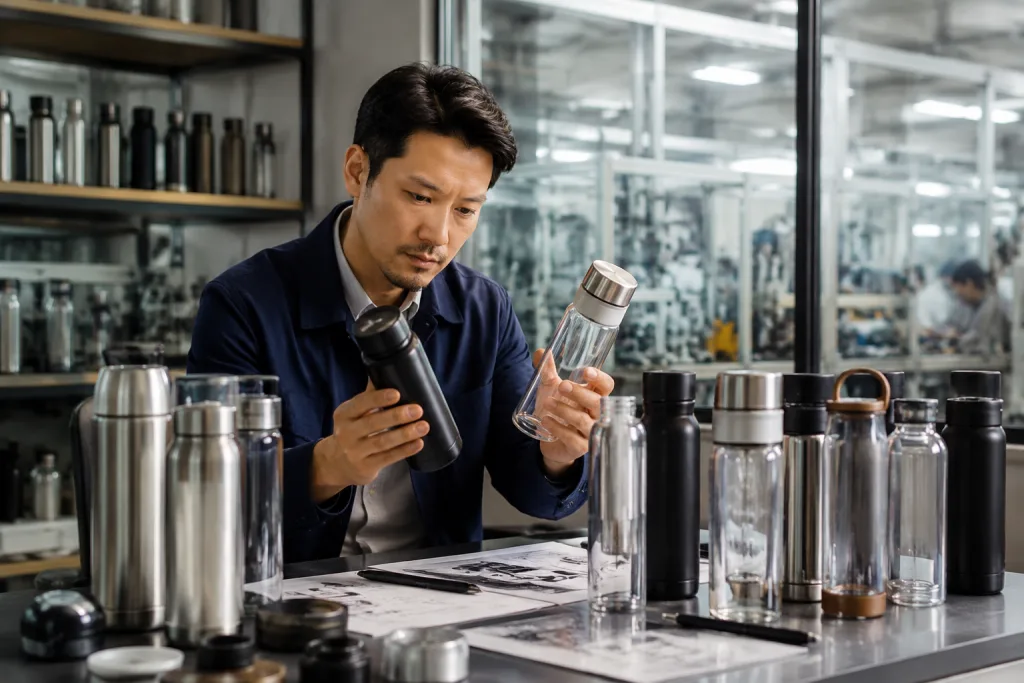
I’ll rewrite this section in a more field-tested buyer tone, keep the HTML structure intact, and make the sample-check language sound like a factory-side sales engineer wrote it.Once the quote lands, do not sign off on the cheapest sample just because it looks clean on the table. A tea bottle custom order should be checked like a run on the line, not like a showroom piece. We look at lid torque, thread bite, gasket seat, smell, coating adhesion, and the real bottle weight. A 500 ml insulated body that should hit 310 g but shows 280 g usually means thinner steel or weak insulation fill. That can pass for giveaway stock, not for a retail line. For customized drinkware sold into Europe or North America, color match matters, but return-causing faults matter more.
Ask for two samples at minimum: one pre-production sample and one decorated sample. If you buy from a canteen supplier in China, get photos before shipment and keep a signed sample approval sheet in the file. We had one buyer flag a PO typo on carton count, and QC pulled the sample back before dispatch. For logo work, silk screen usually runs at USD 0.15–0.40 per color, while laser engraving often lands at USD 0.30–0.80 depending on the marked area and setup. If your project is a custom canteen or customized canteen for a distributor, ask the supplier to label the sample with the carton count and retail pack so you can check shelf readiness.
- Leak test for 5 minutes upside down and 30 minutes side tilt
- Open-close cycle: at least 3,000 cycles for retail claims
- Drop test: 1.0 m to 1.2 m depending on body type
- Odor check after 80°C hot-water rinse
A serious canteen factory in Zhejiang should tell you why a sample failed and what they will change on the next run. If they dodge that answer, the math does not work, and we treat it as a supply risk, not a small sample issue.
Lock the bulk PO details
I’ll rewrite the section in-place, keep the HTML structure unchanged, and tighten the PO language so it reads like a factory-side sales engineer wrote it.Start bulk production only after the sample is signed off and the PO is exact. This is where buyers lose margin fast. For tea bottle custom work, the PO should split product cost, decoration cost, packaging cost, and testing cost into separate lines. If the factory rolls everything into one vague item, later changes turn into chargebacks. We saw this on a 2,000 pcs canteen order last month: the buyer flagged one “all-in” line and pushed back on a logo re-run fee. For a distributor canteen order, the PO should also state whether mixed cartons are allowed, whether inner boxes are retail-ready, and whether FNSKU or country-specific labels must be applied at source.
Use clear line items. Example: 1) stainless tea bottle body, 2) lid assembly, 3) tea infuser, 4) logo decoration, 5) individual box, 6) master carton, 7) carton marking, 8) pre-shipment inspection. That level of detail is standard for strong canteen distributors and brand buyers, and it stops “included” items from turning into surprise extras. If your program includes a custom growler or customizable growler style bottle, put closure torque and seal performance in the PO. For insulated tea bottles, state whether the 12-hour hot claim or 24-hour cold claim must be tested to ASTM or an internal factory standard. The wrong question is “can you do it?” The real question is what gets measured on the line. A good Zhejiang canteen manufacturer will accept that clarity because it cuts arguments during production.
MOQ and timing should also be written down. A workable first PO might be 1,000 pcs, 30 days production, 7 days sample approval buffer, and 40% deposit with balance before shipment or against copy BL, depending on the relationship. We run into PO typos here all the time; one missing “pcs” can change the booking. If you are comparing multiple canteen suppliers, check unit price, defect allowance, replacement policy, and whether they accept third-party inspection at AQL 2.5 for major defects.
Inspect before you release freight
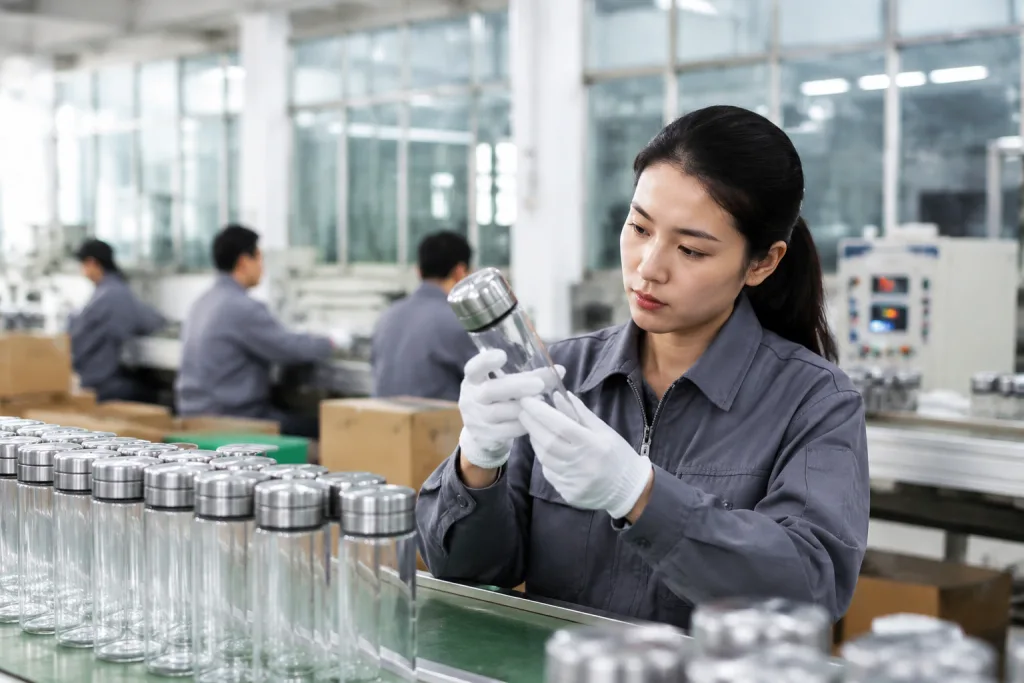
I’ll rewrite this section in-place, keep the HTML structure, and tighten the sales-engineer tone with concrete factory-floor details.Pre-shipment inspection is cheap insurance. For a tea bottle custom order, we ask for final random inspection on packed goods, not loose samples on a table. QC checks appearance, function, print alignment, carton drop resistance, and the full accessory count. A normal B2B quality plan runs AQL 2.5 for major defects and AQL 4.0 for minor defects; branded programs often cut that tighter. If the factory sells a premium custom drinkware finish, shine a 1000-lux lamp on the coating and look for pinholes, overspray, and color drift between lots.
When you buy from China, especially from a canteen factory in Zhejiang, check export marks, carton size, and loading efficiency before the truck books. A 500 ml bottle packed 24 pcs per carton can save cube cost versus 12 pcs, but only if the channel accepts the outer case. For canteen promo runs, bulk cartons work. For retail or Amazon, individual barcodes and clean inner packs matter more. We saw a buyer flag a PO typo on the carton length once, and the math did not work: the pallet plan failed by 38 mm. If the buyer is a canteen distributor or a growler channel, make sure the outer cartons hold up in cross-dock handling. Simple point: if you do not approve the carton spec, you are approving only half the shipment.
Pre-shipment is not the place to “see what arrives.” It is the place to catch the mistake before it boards the truck.
Plan for reorder economics
I’ll rewrite the section in place, keep the HTML tags untouched, and strip the AI-sounding phrasing while adding tighter factory-floor detail and concrete reorder numbers.The first order shows the real unit economics. After sell-through, check what the market picked: 500 ml or 750 ml, powder coat or brushed steel, laser logo or print, gift box or mailer. We had one buyer flag a PO typo on “750m” versus “750 ml”; QC caught it before sampling, and that saved a costly rerun. Use that data on the reorder. A canteen customized for your channel should follow sell-through, not the first sample table. If the 500 ml moved 38% faster, reorder that SKU deeper and cut the slow mover before it turns into dead stock.
Reorders are where the math starts to work. Once the mold, tooling, and artwork are approved, the factory can often cut USD 0.20–0.60 per unit, and on 5,000 pcs per SKU we usually see lead time land at 20–25 days, depending on coating and packaging. That matters if you ship into North America or Europe, where the buying window closes fast. We check defect rate, carton crush, and complaint notes on every lot. The wrong question is “can you make it prettier?” The right one is “which version sold, and why?” If a simpler lid outperforms a more complex customized growler, switch it and keep the line moving.
For brands that need a wider range, one canteen manufacturer can cover tea bottles, custom canteen, and customizable drinkware under one sourcing setup. That makes QA and freight easier, and it keeps artwork control clean when the same logo has to sit on tea bottle custom, custom growler, and canteen promotional items. We run a 3-point barcode check on mixed-SKU cartons for that reason. It is a practical setup, not a branding exercise. If the same order book keeps repeating, one supplier can manage it without turning your sourcing into three separate jobs.
Send your RFQ and get a real quote
Share your spec, logo, target price, and delivery port. We’ll return a production-ready quote with MOQ, lead time, and sample cost.
Frequently asked questions
What MOQ should I expect for tea bottle custom orders?
Most tea bottle custom projects start at 500–1,000 pcs per SKU. If you want multiple colors or special packaging, the practical MOQ can move to 1,500 pcs because the factory has to split materials, cartons, and decoration runs. A Zhejiang canteen factory with modern equipment may accept 300 pcs for a simple promotional run, but pricing usually jumps by 15%–30%. Always ask whether the MOQ is per design, per color, or per logo method.
How much does a sample cost from a canteen manufacturer?
For a standard tea bottle custom sample, expect USD 30–80 for sample production, plus express freight. If the order needs a new lid, infuser, or special finish, tooling or setup may add USD 50–200. Decorated samples with laser or multi-color print can cost more. If the supplier is in Zhejiang or elsewhere in China, ask for a pre-production sample and a decorated sample so you can check both structure and branding before bulk.
What lead time should I put on the PO?
For bulk tea bottles, a normal lead time is 25–35 days after sample approval and deposit. If the order includes new packaging, special coating, or a canteen customized with multiple colors, allow 35–45 days. Samples usually take 5–10 days. Add 7–12 days for ocean freight to many North America ports after vessel departure, longer if you need cargo consolidation. Always separate production time from transit time on the PO.
How do I choose between laser engraving and printing?
Laser engraving is durable, clean, and usually best for stainless custom drinkware where you want a premium permanent mark. Printing is better for color logos, gradients, and canteen promotional projects. For a tea bottle custom order, laser may cost USD 0.30–0.80 per unit, while single-color printing may be USD 0.15–0.40. If the bottle will be handled a lot or washed often, engraving usually holds up better than surface print.
Can one factory handle tea bottles and custom canteen lines together?
Yes, a capable canteen factory can usually manage tea bottle custom, custom canteen, and even custom growler or customizable drinkware programs in the same production system. The key is whether they have stable polishing, coating, assembly, and inspection lines. In Zhejiang, larger canteen manufacturers often produce 200,000 to 300,000 units per month across several categories. Ask for AQL details, REACH or food-contact documentation, and whether they can support distributor canteen packaging or retail barcodes at source.