Key Takeaways
- Tea bottle bulk orders usually start at 500-1,000 pcs per SKU, with FOB China pricing from USD 2.10-6.80 depending on material and lid.
- For hot tea, 304 stainless with 0.4-0.6 mm wall thickness and a removable filter is the safest commercial spec.
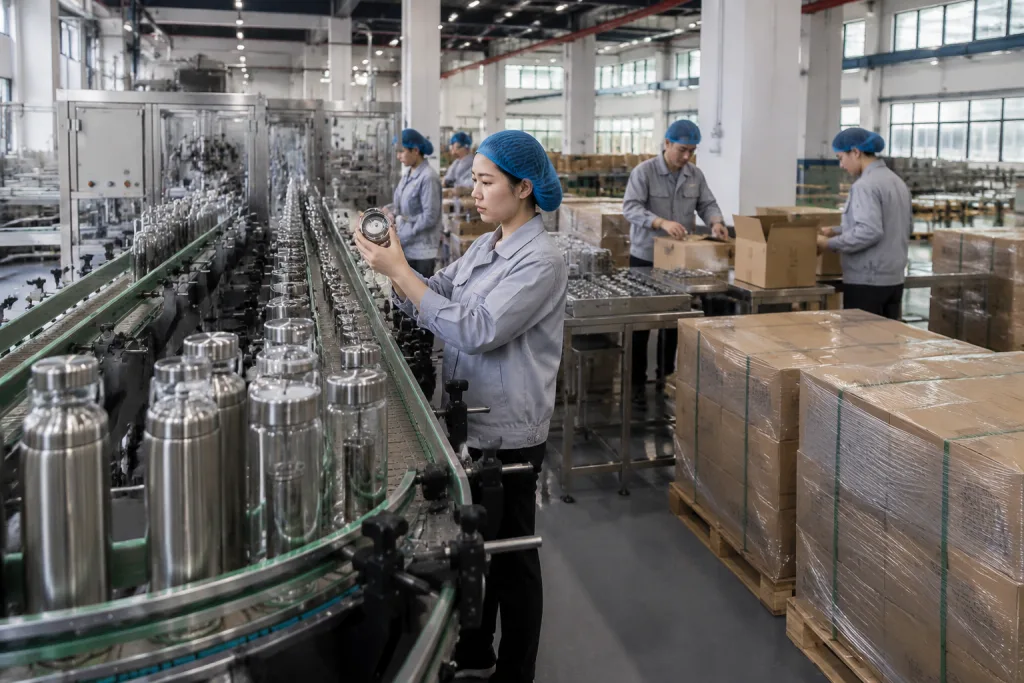
- A practical lead time is 25-35 days after sample approval; our Zhejiang line runs 80,000 units/month across thermal and infuser bottles.
- Choose by use case: commuter tea, gifting, outdoor travel, or retail bundles each need different lid, capacity, and decoration limits.
If you are buying tea bottle bulk for retail, promotions, or private label, the trap is simple: the sample passes, then the 5,000-unit run starts leaking at the cap, the mesh filter slows down after 20 pours, or the print rubs off in transit. We see this all the time on the line. Spec sheets beat brochure talk every time.
At our factory in Zhejiang, procurement teams often start with one tea bottle, then the buyer flags a flask-style SKU, a commuter tumbler, and sometimes a bulk drinkware set for the same market. That is normal. The wrong question is, “Which one looks best?” The better question is which format fits the drink, the cleaning routine, and the margin target before you ask for FOB pricing or sample sign-off.
Spec Table Before You Buy
I’ll keep the HTML structure intact and rewrite the copy to sound like a factory-side sales engineer, with a few concrete spec details and buyer pushback baked in.Do not start with colors or logo placement. Start with the spec table. That is how we separate a tea bottle bulk order from a bulk canteen, bulk drinkware, or a bulk growler program without mixing the use case. Tea bottles are not just smaller bottles. QC pulled a sample on the line last week, and the real check was filter flow, mouth size, insulation, and whether the customer can strip the parts and wash them fast.
| SKU type | Best use | Typical material | Capacity | FOB range | MOQ |
|---|---|---|---|---|---|
| Tea bottle | Loose-leaf tea, fruit infusion | 304 stainless / borosilicate glass | 350-500 ml | USD 2.10-6.80 | 500-1,000 pcs |
| Canteen wholesale | Gym, outdoor, school | 304/316 stainless, Tritan | 500-750 ml | USD 1.80-5.40 | 1,000 pcs |
| Growler wholesale | Beer, cold brew, share-size beverages | 304 stainless, glass | 1,000-2,000 ml | USD 4.80-12.50 | 500 pcs |
| Alcohol flask wholesale bulk | Gift sets, travel, bar promos | 304 stainless | 120-250 ml | USD 1.20-3.20 | 2,000 pcs |
If you need a best wholesale drink bottle for a tea line, the spec we run most often is 350-500 ml, a one-hand lid, and an infuser basket with 0.8-1.2 mm perforations. The buyer flagged a 40 mm mouth once and said it felt awkward in hand; he was right. Wider mouths clean faster, but the math does not work if heat loss jumps and the bottle turns into a hand warmer on day one. You still need enough room for tea leaves to open up, and the carton has to survive a 1.2 m drop test without the lid popping.
What matters most:
- Leak rate at 100 kPa pressure test
- Stainless gauge: 0.4-0.6 mm for most tea bottles
- Decoration area for screen print or laser mark
- Dishwasher durability if you sell in Europe or North America
Tea Bottle or Canteen
I’ll rewrite the section in place, keep the exact HTML structure, and tighten the copy so it reads like a factory-side sales engineer wrote it.Buyers often compare tea bottle bulk with canteen bulk or canteen wholesale because the shapes can look close. The function is different. A canteen is for plain hydration. A tea bottle is for steeping, filtering, and pouring without leaf bits in the cup. If the end user drinks black tea, herbal blends, or fruit tea on the subway, tea bottle wins. If the bottle is for water, sports drinks, or hiking, a canteen-style model is the straight answer.
For a tea bottle, the lid matters more than the shell. We usually run a two-stage lid: outer cap for sealing, inner infuser chamber for leaf control. QC pulled the sample on a 38 mm mouth, and that setup held up better than the fancy three-part lids. It keeps the line simple and still gives a premium feel. If you need drinkware wholesale pricing at scale, skip lids with too many silicone parts. Every extra gasket adds inspection time and pushes reject risk up 3-5%.
Use-case fit:
- Tea bottle bulk: office desks, commuter packs, gifting, lifestyle retail
- Wholesale canteen: gym bags, school use, travel, camping
- Wholesale drinkware: mixed-SKU programs with a wider catalog
If your buyer in Europe asks for REACH-compliant materials or your North American account wants BPA-free plastics, lock that in before sampling. The buyer flagged a PO typo on one job — “BPA frer” — and we lost two days because nobody caught it early. From China, especially Zhejiang suppliers, material declarations and test reports should sit in the quote, not show up after approval.
Infuser Build and Filtration
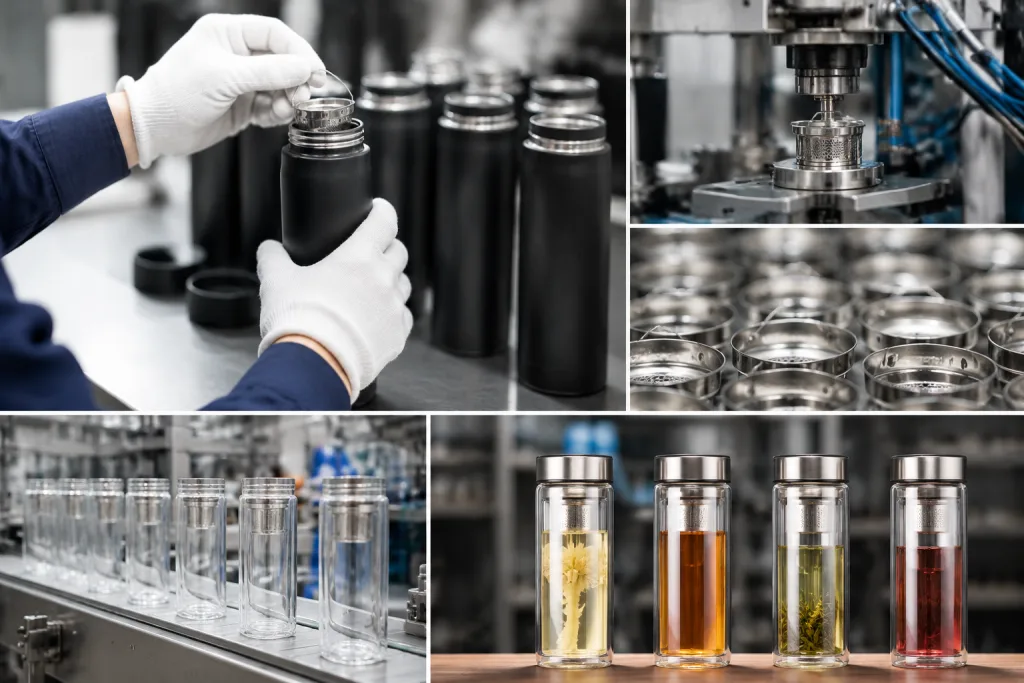
I’ll keep the HTML structure intact and rewrite the copy to sound like a real factory-side sales engineer, with tighter specs and a few floor-level details.Filtering is where a lot of tea bottles fail in real use. A nice-looking basket with wide holes looks premium on the sample table, then the buyer flags sludge in the first pour. For loose-leaf tea, the basket needs room for leaf expansion and still hold back fines. We usually see clean results with 0.8-1.2 mm perforations and a 45-70 mm basket depth on 350-500 ml bottles.
Glass tea bottles give the cleanest flavor read, but they take damage faster in carton drops and pallet shifts. Stainless tea bottles are the safer call if the route is rough, the bottle needs heat retention, or the channel is discount-heavy. If your catalog also includes growler bulk or beer growler bulk, you already know what one bad transit test does to glass. Same story here. For gift sets, glass works. For marketplace sales, stainless usually protects the margin.
Ask your factory to show three checks: basket retention after 500 opening cycles, seal performance after hot-fill cooling, and whether the mouth threads stay smooth after dishwasher runs. We run this on the line with a torque gauge and a 60°C soak, because the math does not work if the cap loosens at cycle 80. If you also sell beer growler wholesale or beer tumbler wholesale bulk, you can reuse decoration and carton structures, but the closure still needs to match tea, not beer. Tea holds heat, carries acid, and picks up odor faster than most buyers expect.
Practical rule: if the filter cannot come out with one hand after a hot rinse, your customer will complain inside a week.
Materials That Protect Margin
I’ll keep the tags intact and rewrite the prose with tighter, factory-floor language plus concrete numbers. No layout changes.Material choice is not a branding debate. It changes the defect rate, carton weight, and how many returns you eat later. For tea bottle bulk orders, we usually run 304 stainless body with a food-grade PP lid and a silicone seal. That stack keeps the line steady and the quote honest. If a buyer wants a premium SKU, 316 stainless works, but only when the channel can carry the price. We’ve seen that math fail fast.
For cold brew tea, borosilicate glass still has a place. It gives a clean look and does not hold smell. QC pulled the sample with a molded tray and a color box, and the packaging bill moved by USD 0.35-0.80 per set before freight. Fine for gift retail. Wrong for discount shelves. The buyer flagged it on the first round.
If you are sourcing in Zhejiang, ask for wall thickness and vacuum structure, not just capacity. A 0.45 mm inner wall and 0.5 mm outer wall is a normal commercial spec for vacuum tea bottles. Below that, the shell starts to get touchy on impact. Go thicker and you pay in weight, then freight bites back. On a 20,000-piece order, 40 extra grams per unit adds 800 kg to the shipment. That is not a small line item.
These material calls also shape alcohol flask bulk, alcohol flask in bulk, and alcohol flask wholesale bulk programs. The shape changes, the lid changes, but the export rule stays the same: lock the material first, check decoration second, and leave the marketing copy for last. We’ve seen buyers reverse that order and lose margin on the PO typo alone.
MOQ, Pricing, and Lead Time
I’ll rewrite just the prose inside the existing HTML, keep the tags and numbers intact, and make it sound like a real sourcing note from the factory floor.Procurement lives or dies on numbers. For a standard tea bottle bulk order, the usual MOQ is 500 pcs for a simple stainless model and 1,000 pcs for mixed colorways. If you want custom tooling, special lid molds, or a brand-new cup shape, expect 3,000 pcs or a mold charge of USD 1,500-4,500 depending on complexity. That is normal in China manufacturing. We’ve had buyers push for 300 pcs on a new shape; the math does not work, and the line slows down fast.
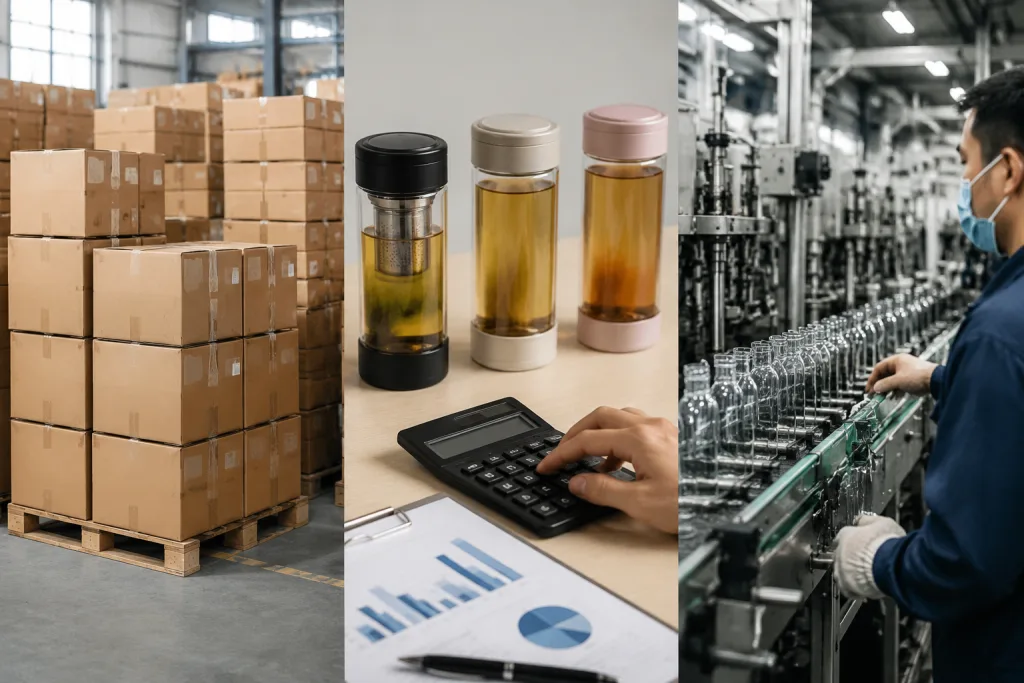
Lead time is usually 25-35 days after sample approval and deposit. Add custom packaging, test reports, or a tight launch window, and you should plan for 40-45 days. Our Zhejiang factory runs 80,000 units per month across tea bottles, thermal cups, and infuser bottles, so the bottleneck is usually artwork, packaging copy, and carton marks. QC pulled the sample twice last week because the buyer flagged a 2 mm logo shift.
For FOB budgeting, a useful range is:
- USD 2.10-3.20 for basic stainless tea bottle bulk
- USD 3.30-4.80 for upgraded lids, double-wall construction, or laser logo
- USD 4.90-6.80 for glass or premium gift-pack sets
Some buyers compare this to beer growler wholesale bulk or beer tumbler bulk because the unit prices look similar. That is the wrong question to ask. The real check is sell-through and reuse rate. Tea bottles usually get picked up again and again, while novelty flask items sit longer. A slightly higher landed cost can still leave you with better retail margin.
Decoration and Compliance Risks
I’ll rewrite the section in place, keep the HTML exactly as-is, and tighten the sales-engineer tone with concrete factory-floor detail in each paragraph.Decoration has to fit the channel. Screen print is the low-cost route and it handles 1- to 2-color logos well. Laser engraving stays cleaner on 304 stainless and is the usual pick for a premium line. If the buyer asks for a matte powder coat with a spot-gloss logo, we can run it, but we check abrasion first with a rub test before we sign off. A logo that looks good on day one and scuffs in carton transit is the wrong spec.
For Europe, ask for food-contact compliance and the REACH declarations that apply. For North America, buyers usually ask for BPA-free plastic confirmation and, in some cases, ASTM or FDA-related statements from the material supplier. On Amazon orders, the buyer flagged FNSKU labeling, carton marks, and a packaging spec that cuts damage claims; one typo on a PO can turn into a 2,000-carton headache. That matters on wholesale drinkware and drinkware wholesale runs where one outer carton may carry 3 SKUs.
Do not stack too many decoration methods in one launch unless the margin pays for it. We run cleaner with a simple split: laser for premium, silk screen for volume, CMYK wrap for gift sets. The line moves faster, and QC pulls fewer samples for rework. The same logic applies whether you are buying a tea bottle, a wholesale growler, or wholesale canteen stock. Less switching means fewer chargebacks.
If you need support for a China factory audit, ask for BSCI, ISO 9001, and recent AQL inspection records. Those papers do not close the deal by themselves, but they tell you whether the supplier can handle export work from Zhejiang without drama. We have seen this go sideways when the audit file is thin and the buyer only finds out after the first 5,000 units land.
Send your spec sheet for a fast quote
We can price your tea bottle bulk order by material, lid, and packaging, then confirm MOQ, lead time, and testing before sampling.
Frequently asked questions
Can I combine tea bottles with other drinkware wholesale SKUs in one order?
Yes, but only if the production methods align. A tea bottle bulk order can often be combined with other drinkware wholesale items like commuter tumblers or stainless flasks if the factory uses the same line for body forming or printing. However, mixing too many structures slows production and raises defect risk. A smart bundle might include tea bottles and a matching tumbler, not tea bottles plus glass growlers plus alcohol flask wholesale bulk items. Keep the technical family tight so you can control QA, packaging, and shipment timing.