Key Takeaways
- Set the channel first: retail, promotional, Amazon FBA, or distributor canteen programs need different specs
- A realistic MOQ for customized drinkware is 1,000-3,000 units per color for most vacuum bottles
- Ask for 6-12 hour heat retention test data, not only marketing claims
- FOB Ningbo or Shanghai pricing can shift 8-15% after packaging, accessories, and inspection rules
If you are searching for suppliers vacuum insulated bottle options, you are probably staring at 6 quotes that look close on paper and turn messy after sampling. One canteen supplier cuts the FOB by USD 0.18, another says artwork approval takes 2 days, and a third writes “premium 304 stainless steel” without listing wall thickness, inner grade, or test standard. Ask for the drawing first. Last month QC pulled a 750 ml sample with a 0.42 mm outer wall against the buyer’s 0.50 mm spec, and that small gap changed the hand feel, dent resistance, and carton weight.
At BottleForge Industrial in Hangzhou, Zhejiang, we see B2B buyers lose margin in 4 places: product positioning, decoration choice, inspection terms, and freight timing. The wrong question is “who is cheapest?” The math does not work if a logo peels after 30 dishwasher cycles or if the PO says matte black but the approved sample card reads Pantone Black 6 C. We run the line with AQL 2.5 checks, carton drop tests at 76 cm, and packing weights confirmed before booking space, because custom drinkware sourcing should be boring, predictable, and still leave room for profit.
Start With The Selling Channel
Your first decision is not bottle shape. It is the sales channel, and what a fail costs there. A regional retail program is not the same job as a one-shot canteen order for a software conference with 1,200 staff. We have seen buyers chase USD 0.30 savings on the lid gasket, then QC pulled the sample after a 1.2 m drop test because the cap cracked inside the kraft box. Bad math.
For retail shelves in Europe or North America, we run heavier packaging, tighter color control with a Pantone light box check, barcode checks, and repeatable production across 2 or 3 runs. For promotional campaigns, logo edge sharpness and lead time drive the order; the buyer flagged it last year when a laser logo shifted 3 mm off center on 800 pcs. For Amazon FBA, build the spec around FNSKU labels, 80 cm drop-test cartons, scannable outer marks, and fewer loose accessories. For a canteen distributor selling to schools or outdoor clubs, scratch resistance and spare lids matter more than a glossy gift box.
Put the channel on your RFQ before asking for price. A useful brief says: 500 ml or 750 ml, double-wall vacuum insulated, 18/8 inner steel, powder coating, laser logo, individual kraft box, AQL 2.5/4.0 inspection, FOB Ningbo, target retail USD 24.99, first order 3,000 units. That gives a canteen factory something real to cost. The line chief will check cup diameter with a digital caliper, not guess from a pretty rendering.
Trade-off: a universal SKU sounds efficient, but it often turns into a weak fit for every customer. We ship a distributor growler line with 1.9 L capacity and a welded handle; a custom canteen for corporate gifts may need a slimmer cup-holder diameter under 75 mm. Decide the buyer use case first, then let the supplier engineer around it. Ask for “one bottle for all channels” and we’ve seen this go sideways by the second PO, sometimes from something as small as “matte black” typed as “matt black” on the artwork file.
Choose Steel, Capacity, And Construction
Most suppliers vacuum insulated bottle quotes say “304 stainless steel,” but ask exactly where the 304 is. We run into this on RFQs every month: the inner wall is 304, then the outer shell quietly changes to 201 to hit a target price. A serious canteen manufacturer should state inner wall steel grade, outer wall steel grade, wall thickness, lid resin, gasket compound, and coating type on the spec sheet. For food-contact markets, the inner wall is where we do not bargain. Our usual build is 304 stainless steel on the inner wall, 0.4-0.5 mm inner wall thickness checked by micrometer, plus PP or Tritan lid parts with LFGB, FDA, or EU 10/2011 documentation matched to the destination market.
Capacity is not just a size choice. It decides shelf price, carton count, and whether the buyer complains about freight after seeing the PI. A 500 ml bottle fits offices and school bags; we usually pack 24 pcs per export carton for that size. A 750 ml customized canteen sells better for outdoor and gym channels because it feels more “serious” in hand without becoming bulky. A 1 L bottle works for distributor canteen programs, but the math gets tight when carton volume jumps 18-25% against a 750 ml model. A customizable growler, usually 1.2 L to 1.9 L, is a different product. It is heavier, needs stronger handle pull testing, and QC should check the handle screws or weld points before the line moves to packing.
Vacuum construction should be checked through test data, not pretty words like “premium insulation.” Ask for heat retention data at a defined room temperature. On our floor, QC pulled the sample, filled it with 95°C water, tightened the lid with the production gasket, and logged temperature after 6 hours at around 20°C ambient temperature. A decent 500-750 ml double-wall bottle should keep water above 60°C under that test. Better designs can reach 12 hours, but lid geometry and mouth diameter change the result fast. Wide-mouth products lose heat faster; they are easier to fill with ice and easier to clean. Narrow-mouth products retain heat better and pour with less splash. Asking “which one is best?” is the wrong question to ask; match the mouth design to the channel.
For powder-coated customized drinkware, confirm coating thickness and adhesion before approving mass production. We usually target 60-80 microns for powder coating, measured with a coating thickness gauge, then run cross-hatch adhesion before packing. Thin coating saves 3-5 cents per bottle and fails in real bags; we have seen buyer returns where keys scratched through the color after one week of use. Too thick coating can affect lid fit or cup-holder fit, and the buyer flagged this once when a 73 mm body became tight in a car holder. Engineering drawings should show tolerance in mm, not just attractive renderings.
Match Decoration To The Risk
I’ll rewrite the section in-place, keeping the HTML tags and structure intact while cutting the AI-ish phrasing and adding supplier-floor specifics.Decoration is where a lot of custom drinkware jobs go sideways. The right method depends on order size, logo line weight, color count, surface finish, and whether the buyer is coming back for round two. We run laser engraving on the line for clean stainless exposure, but it will not carry brand color. Silkscreen is cheaper for a simple one-color logo, though weak ink adhesion shows up fast in rub tests. Heat transfer and UV printing handle busy artwork, yet QC pulled the sample after abrasion because the print edge started to lift.
For a canteen customizable program, ask your supplier to break decoration out as its own line item. Then you can compare apples to apples. On our export quotes from China, laser logo usually adds USD 0.15-0.40 per unit, depending on size. One-color silkscreen lands around USD 0.08-0.25. Full-wrap heat transfer can add USD 0.45-1.20, and the setup has to stay tight or the first 200 pcs drift. Molded or custom lids cost more upfront; private tooling can run USD 1,500-8,000, and the math does not work if the buyer only wants a one-off run.
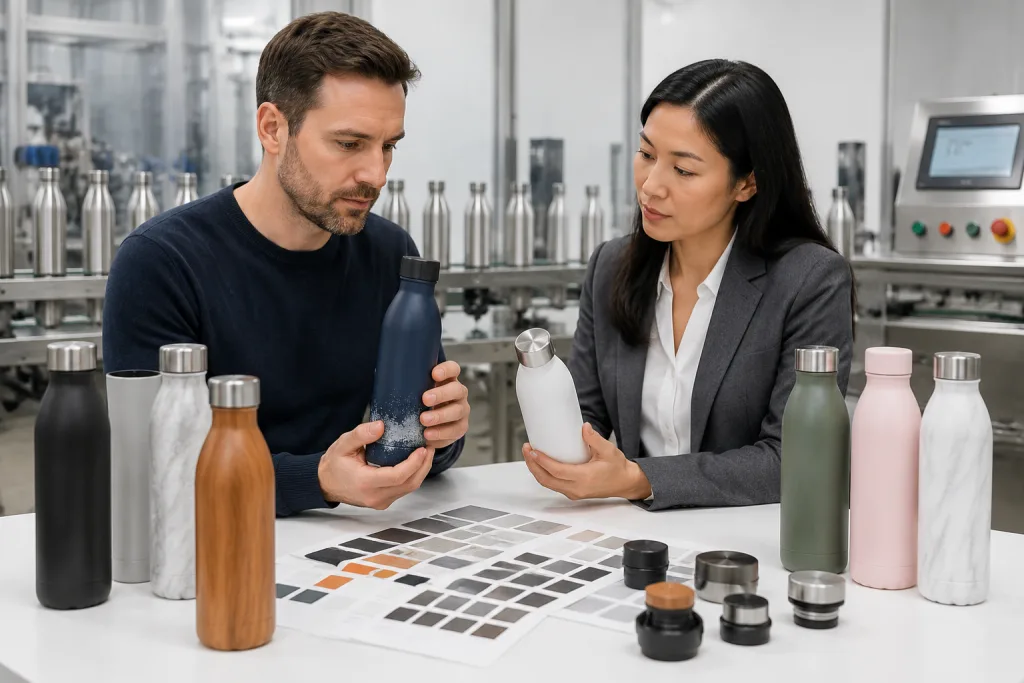
Do not approve decoration from a PDF alone. We have seen the buyer flag a file because the logo line was 0.3 mm too thin for engraving, and that mistake is expensive. You need a physical pre-production sample, especially for matte colors and metallic logos. Pantone on powder coating is not the same as Pantone on paper. Expect ΔE color tolerance around 1.5-2.5 for tighter programs, but some promotional orders accept wider variation if the buyer signs off.
If you are a canteen vendor serving several brands, keep one base bottle and change only the decoration and packaging. If you are building a premium customized growler line, spend on body tooling or a lid system that people can spot from 3 meters away. Standard bodies keep MOQ lower and lead time shorter; custom tooling protects the line, but it ties up cash and needs tighter inventory control. We’ve seen that choice go sideways when a buyer ordered 5,000 pcs with six artwork versions and no reorder plan.
Price The Whole Landed Product
I’ll rewrite this section in-place, keep the HTML exactly as-is, and tighten the pricing language so it sounds like a factory-side sales engineer wrote it.A low unit price only means something if the quote uses the same base. When we compare vacuum bottle suppliers in Zhejiang or anywhere else in China, we ask for a line-by-line quote: bottle, decoration, packaging, accessories, testing, inspection, and freight terms. FOB Ningbo and FOB Shanghai are standard for our side. EXW can look cheaper on paper, but then local trucking and export handling land on you or your forwarder.
For a 500 ml double-wall stainless vacuum bottle with powder coating and a simple logo, we usually see USD 3.20-5.20 FOB China at 3,000 units, depending on steel grade, lid type, coating thickness, and carton spec. A 750 ml custom bottle often comes in at USD 4.10-6.80. A custom growler with a handle and larger body can reach USD 8.00-14.00. Those are working numbers, not a promise. The buyer flagged a quote at USD 2.90 last month, and QC pulled the sample apart; the lid alone was wrong.
Packaging moves the total fast. A plain white box may add USD 0.12-0.25. A printed retail box can add USD 0.35-0.90. Molded pulp inserts, instruction cards, hangtags, spare straws, and polybag limits all hit cost. If your channel wants plastic-free packaging, say it early. We’ve seen this go sideways when the carton passed print check but failed the 60 cm drop test.
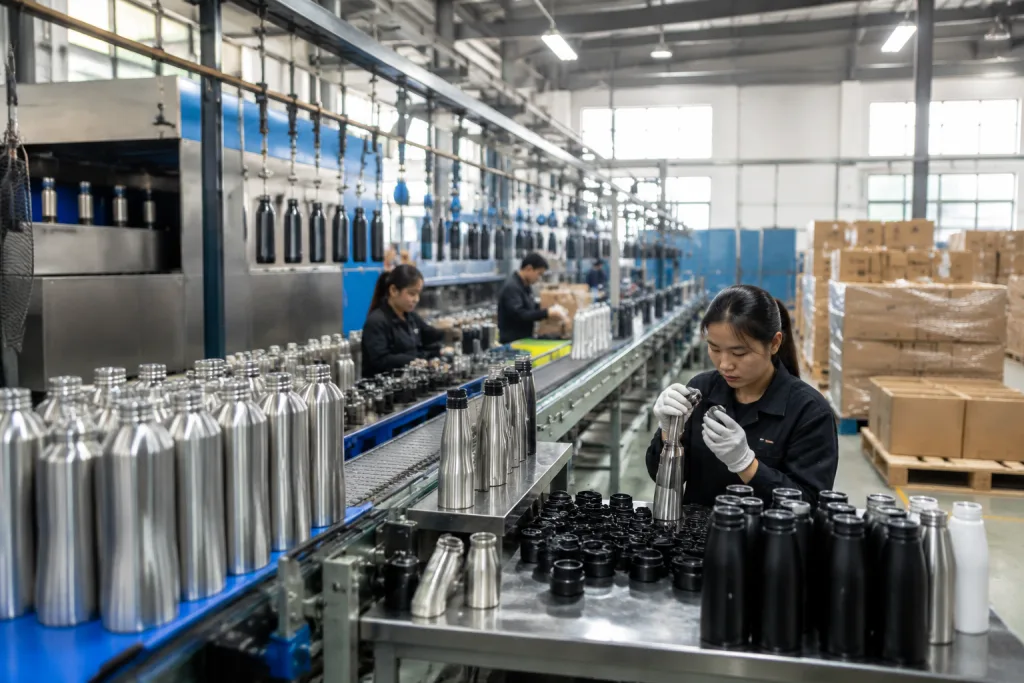
Our Hangzhou, Zhejiang line can run about 450,000 vacuum insulated units per month across standard models, with MOQ at 1,000 units per color for stock shapes and 3,000 units per color for deeper customization. Normal lead time is 25-35 days after sample approval and deposit. Before Chinese holidays, add 10-15 days. That’s the math. A PO typo on “750ml” versus “750 ml” once held a shipment for a day because the buyer’s carton mark and our packing list did not match.
Audit Quality Before Deposit
I’ll rewrite the section in place, keeping the HTML intact and tightening the sales-engineer tone with concrete factory details and cleaner compliance language.Quality control has to be set before the deposit, not argued after defects show up. A good canteen factory should show material certificates, internal inspection records, the production flow, and recent audit files such as BSCI, Sedex, or ISO 9001 where they apply. One project may only need two of those, but food-contact drinkware for Europe and North America still needs clean paperwork from day one.
Put AQL terms in the purchase order. For most distributor drinkware orders, AQL 2.5 for major defects and 4.0 for minor defects is a workable baseline. Critical defects stay zero tolerance. Define major defects in plain words: leaking lid, weak vacuum, rust, wrong logo position, sharp edge, unreadable barcode, carton short count. Minor defects cover small dust spots under coating or light box scuffing within agreed limits. The buyer flagged it on one PO where “good appearance” meant nothing at the line.
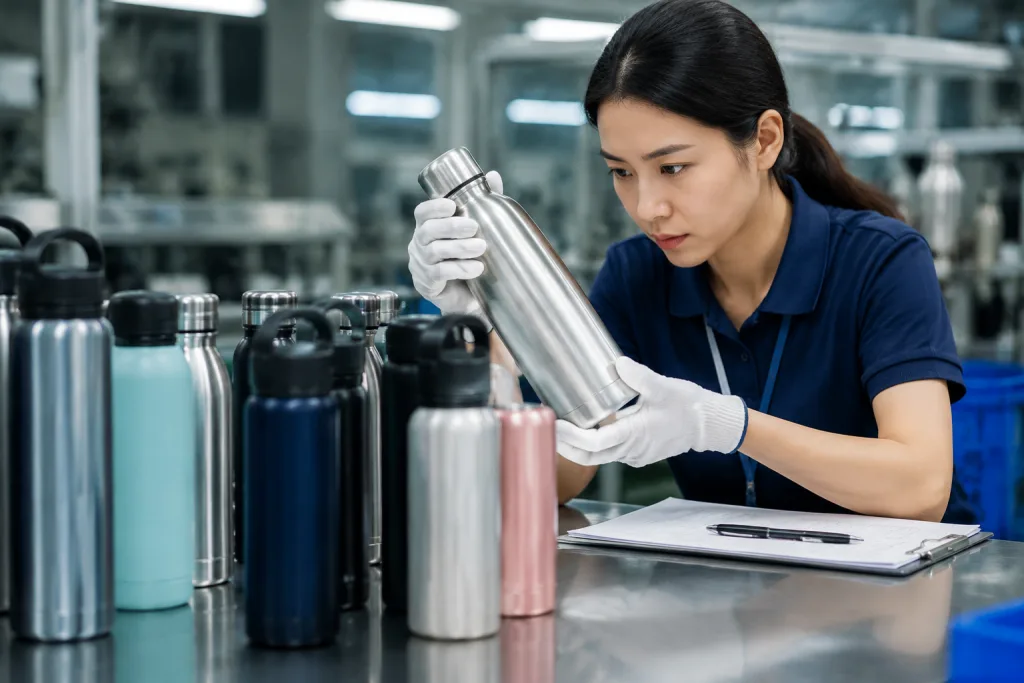
Insulation testing belongs in inspection, not only in the factory lab. We run random samples, fill them with hot water at a set temperature, check surface temperature for vacuum failure, then record heat retention after 6 hours. Leak testing should include inverted bottles and side placement. For straw lids, test air vent performance and gasket seating. QC pulled the sample on a 500 ml bottle once and found a slow seep after 12 minutes under side pressure—nice logo, bad bottle. That is the wrong question to skip.
Compliance depends on the market. For the EU, ask for LFGB, REACH, and food-contact declarations. For the US, FDA food-contact expectations and California Proposition 65 may apply. Kids products may need extra checks under ASTM or CPSIA, depending on design and age grading. Do not accept a generic “passed test” screenshot. Ask for the report number, tested item description, materials, date, and lab name. We’ve seen a typo on a PO turn “stainless steel” into “stainless stel,” and that sort of sloppiness never stays small.
Decide Supplier Role And Control
I’ll rewrite the section in place, keep the HTML untouched, and tighten the language so it reads like an experienced supplier-side sales engineer.Not every supplier should play the same role in your chain. A trading company works for mixed-category sourcing, but if your core line is vacuum insulated drinkware, you need a canteen manufacturer or a tightly managed manufacturing partner with engineering control. The gap shows up fast when the line slips: lid torque is off, coating chips after a 1.2 m drop test, carton compression fails at 120 kg, or your buyer asks for a 45-day reorder and the file is nowhere.
A direct canteen supplier should push back, not just nod. If you ask for a 42 mm mouth on a 350 ml bottle, the supplier should flag the heat-loss risk. If your logo has 0.2 mm lines on a rough powder coat, QC will tell you to widen the stroke or move to a smoother print zone. We’ve seen this go sideways when the buyer insisted on a bad spec and the first 500 pcs came back with blurred marks.
For canteen distributors and distributor canteen buyers, supply continuity beats the lowest first-order price. Ask whether the supplier keeps semi-finished bodies, lids, or cartons in stock. Ask how long they hold Pantone cards and artwork files. Ask what happens when a lid insert changes from 18 mm to 20 mm. A good canteen vendor keeps version control on the shelf; a weak vendor makes every reorder feel like a fresh PO from scratch.
The control level should match your order size. For 1,000 units of canteen promotional merchandise, use a standard mold, standard lid, and one signed color card. For 10,000-50,000 units of customized drinkware, lock golden samples, pre-shipment inspection, carton drop tests, and written defect limits into the file. For a private-label custom growler or customizable growler program, add tooling ownership and spare-parts planning to the contract. The math doesn’t work any other way.
Build A Cleaner RFQ
I’ll keep the tags intact and rewrite the prose so it sounds like a factory-side sales engineer wrote it. Next I’m tightening the RFQ language, adding concrete shop-floor detail, and trimming the vague buyer talk.A clean RFQ saves more time than a long supplier search. Send enough detail for the factory to quote the exact bottle you want, not a guess. We run quotes off the drawing, not vibes. At minimum, include capacity, body shape reference, mouth diameter, steel grade, lid type, coating finish, logo method, packaging, compliance market, order quantity by color, target ship date, and Incoterm. If you can take options, say which items can move.
Use a line like this: “750 ml double-wall vacuum bottle, 304 inner/201 outer, powder coated matte black and navy, laser logo 35 x 45 mm, leakproof screw lid, individual printed box, EU market, REACH and LFGB documents needed, AQL 2.5/4.0, 2,000 units per color, FOB Ningbo, sample needed in 10 days.” QC pulled the sample, checked the 35 x 45 mm logo area, and the quote was straight away. That is enough for a canteen factory in China to send a real price and a real lead time.
Skip words like premium, eco-friendly, best quality, or retail ready. The buyer flagged it when those terms reached the line, because each supplier reads them differently. If you need recycled stainless steel, state the percentage and the paper trail you want. If you need plastic-free packaging, list the allowed materials. If you need retail ready, spell out barcode, warning text, box thickness, hangtag, carton marks, and pallet requirements.
The best suppliers for vacuum insulated bottle programs are not won by squeezing the last USD 0.05 from five factories. That math does not work. They are won by locking product use, compliance, decoration, packaging, and inspection before mass production starts. We have seen it go sideways when a PO says “matte black” and the carton spec says “gloss black” — one typo can cost a week. It is not glamorous, but it keeps custom canteen and customized drinkware orders profitable after the first container ships.
Send Your Bottle RFQ For A Practical Factory Quote
Share capacity, logo, packaging, quantity, and target market. We will return realistic MOQ, FOB pricing, sample timing, and compliance options.
Frequently asked questions
What MOQ should I expect from suppliers vacuum insulated bottle factories?
For standard vacuum bottle shapes, expect 1,000 units per color as a workable MOQ from many China suppliers, especially if the logo is laser engraved or one-color printed. For custom colors, full-wrap artwork, or special lids, 3,000 units per color is more realistic. A fully customized canteen or private mold can require 5,000-10,000 units to make tooling and production setup sensible. If a supplier accepts 300 units with custom coating and retail packaging, check whether it is using stock inventory, digital printing, or subcontracted decoration. Low MOQ is not bad, but the unit cost, color control, and reorder consistency will usually be weaker.
How do I compare a canteen manufacturer and a trading company?
Ask who controls the engineering file, production schedule, and defect response. A real canteen manufacturer should know wall thickness, vacuum testing method, lid torque, coating process, and daily output without asking another party. A trading company may still be useful if you need mixed products, but it must provide transparent factory information and inspection access. For repeat distributor drinkware programs, direct factory control usually reduces surprises. You can also ask for a video audit, BSCI or ISO documents, and photos of semi-finished inventory. If the salesperson cannot explain why one lid costs USD 0.35 more than another, they are probably not close enough to production.
Which logo method is best for customized drinkware?
There is no single best method. Laser engraving is the safest for durability and works well on powder-coated stainless bottles, especially for corporate and outdoor programs. Silkscreen is economical for simple one- or two-color logos, usually adding about USD 0.08-0.25 per unit. UV printing and heat transfer handle gradients or full-color graphics, but they need abrasion and dishwasher-related expectation checks. For a canteen promotional order with a 30-day campaign, silkscreen may be enough. For a retail custom canteen expected to survive daily use for two years, laser or a well-tested transfer process is safer. Always approve a physical pre-production sample.
What compliance documents do European and North American buyers need?
For Europe, ask for LFGB or EU food-contact documentation, REACH screening where relevant, and material declarations for stainless steel, plastic, silicone, coatings, and inks. For the US, FDA food-contact expectations apply, and Proposition 65 may matter for California sales. Kids bottles may require ASTM or CPSIA-related checks depending on design and age claims. A canteen supplier should provide reports that match the actual material and product type, not a generic bottle from three years ago. Check the lab name, report number, tested components, and date. For large orders above 10,000 units, budgeting USD 300-1,200 for updated third-party testing is sensible.
How long does a custom vacuum bottle order take?
A normal order takes 25-35 days for mass production after sample approval and deposit, plus sample time and freight time. A simple laser-logo stock-shape canteen customized order may produce faster if bodies are already available. Custom powder coating, printed boxes, new lids, or a customized growler program can push production to 40-55 days. Sea freight to North America or Europe often adds 25-45 days port-to-port, not including customs and inland delivery. Before Chinese New Year or busy autumn export season in China, add a buffer of 10-15 days. If your launch date is fixed, approve artwork and packaging before negotiating small price differences.