Key Takeaways
- A realistic MOQ for custom stainless thermos production is 1,000-3,000 units per color, not 100 units
- FOB China pricing usually changes by USD 0.25-0.80 per unit when wall thickness, lid design, or coating changes
- Use AQL 2.5 for major defects and AQL 4.0 for minor defects before shipment
- Plan 35-50 days for mass production after sample approval and deposit
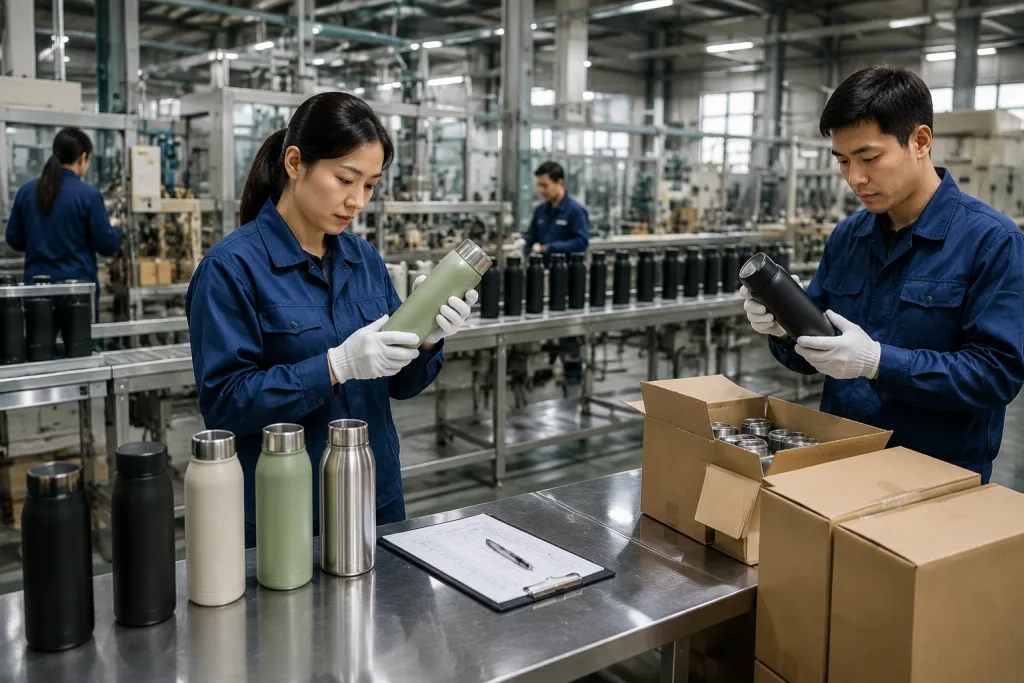
If you are searching for suppliers vacuum flask options, a catalogue screenshot will not solve much. You need a thermos your retail buyer, event client, or outdoor customer will not send back after 3 months. The easy part is getting 8 China factory thermos quotes by Friday. The hard part is spotting which quote survives a real sample check, including lid gap under 0.3 mm, cup weight on a digital scale, and a 95°C water test after lunch.
At BottleForge Industrial in Hangzhou, Zhejiang, we run into the same buying trap every week: a buyer lines up 6 custom thermos offers, all claiming 304 stainless steel, 12-hour heat retention, and fast delivery. Then QC pulled the sample and the story changed. One lid rocked on the thread, one powder coating showed pinholes near the shoulder, and one carton mark had the buyer’s logo misspelled by 1 letter from the PO. This is the wrong question to ask: “Who is cheapest?” The better question is whether the quote matches the steel grade, coating process, packing spec, and delivery date you can actually sell.
Start With The Real Use Case
Before you ask any suppliers vacuum flask company for a price, write one plain sentence about where the bottle will be used. A bank giveaway thermos and a 750 ml outdoor bottle for retail are not built the same, even if both look close in a PDF catalogue. We had one buyer send a screenshot from page 14 of our catalogue and ask for “same, cheapest”; QC later pulled the sample because the cap felt light at 38 g. Different job. Different cost.
For outdoor retailers, start with capacity, carry method, lid style, and the coating test you expect. A 500 ml commuter flask can run a narrow mouth and a lighter cap. A 1,000 ml hiking thermos needs deeper thread engagement, better drop resistance, and usually a cup lid; on our line we check thread fit with a go/no-go gauge before vacuuming. For promotional brands, logo size and carton packing often beat maximum thermal performance, especially when the buyer flags a hard event date like 12 days instead of a normal 18 days. The math doesn't work if you chase outdoor specs for a one-day giveaway.
Ask your thermos supplier to quote against a written brief, not a vague photo. A proper brief should include:
- Capacity: 350 ml, 500 ml, 750 ml, or 1,000 ml
- Steel grade: inner 304, outer 201 or 304, depending on market position
- Insulation target: for example, 65°C after 6 hours from 95°C start
- Logo method: laser engraving, silkscreen, heat transfer, or full-wrap powder coating
- Packaging: white box, kraft box, color box, or e-commerce mailer
- Compliance market: EU, UK, US, or Canada
A manufacturer thermos quote without these details is only a placeholder. In Zhejiang, China, a serious stainless steel line asks early because tooling, polishing, vacuuming, coating, and packing each move the final FOB price; we run different polishing wheels for a mirror body than for powder coating, and that alone changes labor time. If the vendor answers instantly with one price for everything, be careful. Fast replies are nice. Accurate replies are better.
What Should A Fair Quote Include
A fair custom thermos quote should show more than a unit price. It should spell out what is included, what is left out, and which change moves the cost. Last quarter, 14 buyers sent us a USD 3.20 offer and asked why our USD 3.85 price was not matching. Sometimes the cheaper quote is clean. More often, QC pulled the sample and found a 0.38 mm outer shell instead of 0.45 mm, a lighter lid thread, thinner powder coating, or an inspection plan softer than AQL 2.5. Cheap can be fine. Hidden changes are the problem.
For a 500 ml double-wall stainless thermos, a normal FOB Ningbo or Shanghai range can sit around USD 3.00-5.20 depending on shape, lid, coating, packaging, and order volume. A 750 ml customized thermos with powder coating and a retail color box may land closer to USD 4.60-7.20. These are not promises; stainless steel, exchange rate, and labor costs move. Still, the numbers help when a suppliers thermos quote looks too good. We had one buyer flag a USD 4.10 quote for a 750 ml bottle; after checking the BOM, the carton used 5-layer paper on paper but the sample box measured closer to weak 3-layer stock.
Ask the factory thermos team to break out the basics before you compare quotes side by side. The wrong question is “what is your best price?” Ask what spec that price buys. On our line, the difference between silk-screen logo and laser logo is checked at the sample desk with a Pantone book and a 3M tape test, not guessed from a sales sheet.
- MOQ: stock color with logo may start at 500-1,000 units; custom color usually starts at 1,000-3,000 units per color, with each color run checked against a signed color chip.
- Sample cost: USD 50-150 for logo samples, higher if new tooling is needed; a new lid mould can change the math fast.
- Sample lead time: 7-12 days for existing moulds, 20-30 days for new moulds, assuming the PO has no typo in logo size or Pantone code.
- Mass lead time: 35-50 days after deposit and approved sample; add time if the buyer changes carton artwork after the pre-production sample.
- Payment: commonly 30% deposit and 70% before shipment after inspection, with photos, packing list, and AQL 2.5 report matched before release.
Our Hangzhou, Zhejiang network supports about 300,000 stainless vacuum units per month across standard bottle and thermos lines. That capacity helps, but only if your order gets locked into the production board early. From September to November, the line gets tight because winter retail and holiday promotional thermos projects land at the same time. We have seen this go sideways: a buyer approved artwork 12 days late, then asked for the same ship date, and the only open slot was after the 18th instead of the 6th.
Checklist Before You Approve Samples
I’ll rewrite the section in-place, keep the HTML structure intact, and tighten the sales-engineer voice with concrete factory-floor details.Sample approval is where a lot of thermos custom projects go sideways. The sample looks clean in a meeting room, so the buyer signs off after checking the logo and color. Then 5,000 units land and the lid leaks when tilted, the carton crushes in transit, or the coating scuffs in warehouse handling. A sample is not a souvenir. It is a small inspection job.
Use this checklist before you sign the pre-production sample:
- Weight: compare the actual gram weight against the supplier thermos spec sheet. We’ve seen a 20-30 g gap point to thinner steel or a swapped part on the line.
- Wall construction: confirm double-wall vacuum insulation, not foam-filled or air-insulated construction. Ask QC to cut one bad sample if the buyer pushes back.
- Steel grade: request a material declaration for 304 inner wall. For EU orders, ask for LFGB or food-contact test reports where applicable; the wrong question is “does it look shiny?”
- Lid fit: open and close it at least 30 cycles. Threads should move smooth, not gritty or loose, and the cap should seat flat with no wobble.
- Leak test: fill with water, invert for 30 minutes, then shake horizontally for 20 seconds. If the seal ring is off by 0.5 mm, this is where it shows.
- Heat test: pour 95°C water, close the lid, measure after 6 hours. Set the target first; the math doesn’t work if the buyer changes the spec after we run samples.
- Logo durability: tape test for print adhesion; rub test for coated surfaces. We had one PO with a typo on the logo file, and the buyer flagged it only after the tape pulled ink.
- Carton strength: check export carton ply, gross weight, and drop-test expectation. One cracked corner at 1.2 m can turn into a warehouse claim.
For a customized thermos, keep one approved sample at your office and one sealed golden sample at the China factory. The production team should match both. If you buy for outdoor retail, I’d also run a backpack abuse check: toss the sample in with keys, carry it for a day, then inspect the coating. It is not an ASTM lab test, but it tells you something real. QC pulled the sample and the scratches showed up fast.
Logo And Finish Choices Matter
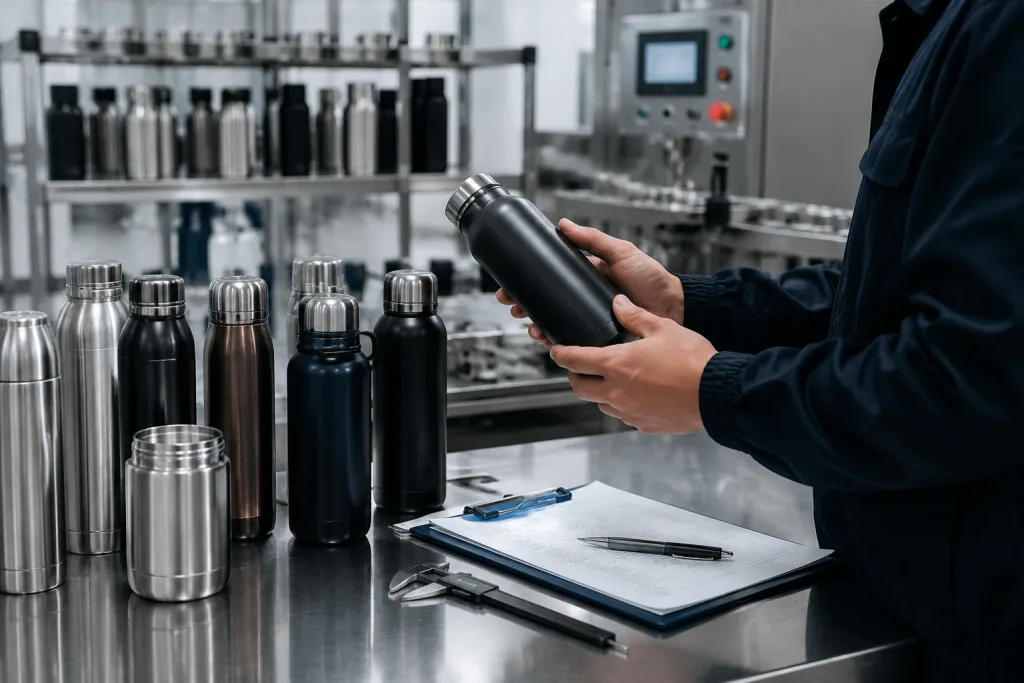
I’ll rewrite the section in-place, keeping the HTML tags intact and making the wording sound like a factory-side sales engineer wrote it.A custom thermos is not just a logo job. The decoration method changes the unit cost, the defect risk, and the lead time on the line. For outdoor retail, laser engraving on powder coating is the safest long-run pick. It does not peel, and it looks clean. For event orders, silkscreen or heat transfer works better when the artwork has 2 or 3 colors.
From the factory side, the trade-off is simple. Laser engraving is durable, but the logo tone comes from the layer under the coating. Silkscreen is a solid fit for one-color or two-color art on straight bodies or light curves. Heat transfer carries more detail, but QC pulled the sample and checked the film edge, because adhesion failures show up fast after washing. Full-wrap sublimation works on some coated bottles, though it is the wrong call for every stainless thermos shape.
Finish choice hits cost too. Basic spray paint is cheaper, while powder coating gives better grip and better scratch resistance. On a 500 ml promotional order, powder coating usually adds about USD 0.25-0.45 per unit versus basic spray paint, depending on color and yield. Metallics, gradients, rubberized finishes, and matte white all need tighter QC; a 0.3 mm dust point can pass on a dark gloss bottle and fail on white. We’ve seen that go sideways.
Do not approve a logo proof from a flat PDF only. Ask for a physical sample, or at least a production photo under normal light, not edited catalogue lighting.
If you buy thermos orders for several client brands, lock the decoration rules early. One logo size chart, one Pantone check method, and one carton label format will save more time than fighting over USD 0.05. The buyer flagged the wrong carton mark once, and the reprint cost more than the logo itself.
Quality Standards You Can Enforce
I’ll rewrite the section in-place, keep every HTML tag exactly as-is, and tighten the prose so it sounds like a factory-side sales engineer wrote it.Quality control has to be written into the purchase order. If it only lives in a call note, it gets soft the minute the shipment date moves up. For thermos suppliers in China, the deal works when the buyer and the factory both know the same rules—we run that way on the line every day.
Use AQL inspection for finished goods. A common setup is AQL 2.5 for major defects and AQL 4.0 for minor defects, with critical defects at 0. Major defects include leakage, wrong logo, poor lid assembly, coating damage beyond the agreed size, wrong capacity, and sharp edges that fail safety checks. Minor defects include small dust points, slight color shift inside tolerance, or carton scuffs. Put the list in writing before production starts. QC pulled the sample and the buyer flagged it on a 500 ml order; that saved a headache later.
The paperwork follows the market. EU buyers usually ask for LFGB food-contact testing, REACH for restricted substances, and packaging compliance. US buyers may ask for FDA food-contact statements, CPSIA if the product is for children, and sometimes ASTM performance requirements depending on the channel. If the product is for kids, tighten the rules on small parts, straw components, and coating tests. We’ve seen a PO typo turn “kids flask” into a general item, and the math does not work after customs review.
A good thermos factory should handle pre-production checks, during-production checks, and final random inspection. For orders above 5,000 units, I want a during-production inspection when 20-30% is finished. That is where coating color, logo position, and assembly drift show up before packing starts. Final inspection should happen when at least 80% is packed. If your supplier refuses third-party inspection, that is a red flag. We’ve seen that go sideways on a 12,000-unit run, and the buyer paid for it.
How To Compare Suppliers Honestly
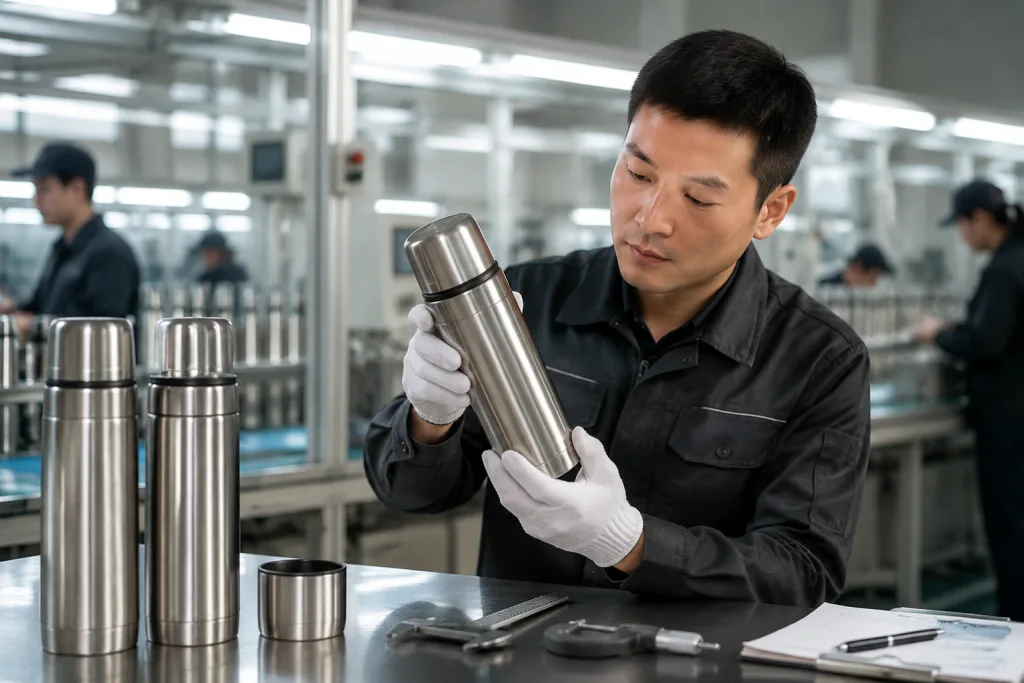
I’ll rewrite the section in-place, keeping the HTML structure unchanged and stripping the AI-ish phrasing. Then I’ll sanity-check that the tone reads like a shop-floor sales engineer.When you compare suppliers vacuum flask options, do not compare names. Compare control points. A trading company, a factory, and a hybrid manufacturer thermos partner can all be useful if they are transparent. The wrong partner is the one who hides the real plant, dodges defect questions, and keeps repeating low price.
Ask each thermos vendor the same questions and write the answers down:
- What is your monthly stainless thermos output per line?
- Which parts stay in-house, and which parts are outsourced?
- Can you show photos of polishing, vacuuming, coating, and packing areas?
- What is your normal defect rate before final inspection?
- Which audits do you have: BSCI, ISO 9001, SEDEX, or retailer-specific audits?
- Can you support Amazon FBA carton labels, FNSKU labeling, and drop-test packaging?
For thermos distributors and outdoor retailers, communication discipline matters as much as machinery. You want a suppliers thermos team that flags trouble early. We’ve seen Pantone-heavy powder coating jobs fall from 92% to 78% yield in one week; if the color is off, tell us before the vessel booking. If the lid mould needs a 0.3 mm tweak, send a new timeline, not silence.
China still has deep stainless drinkware capacity, especially in Zhejiang and the nearby supply chain. But cheap is the wrong filter. Ask for a clear specification sheet, signed golden sample, inspection plan, and a production schedule you can check against the line. A thermos supplier who agrees to those controls is usually the one that ships cleanly in repeat seasons.
Purchase Order Checklist For First Orders
I’ll rewrite the section in place, keeping the HTML tags and list structure unchanged, and I’ll tighten the wording to sound like a real factory-side sales engineer.Your purchase order should leave no room for guesswork. On a first thermos bulk order, “same as sample” is not enough unless you attach the sample number, artwork version, color code, and packing method. Once the line starts, everybody goes back to the PO.
Put these items on the PO or on an attached spec sheet:
- Model number, capacity, dimensions, and target net weight
- Material: 304 stainless steel inner wall, outer grade, silicone grade, lid plastic grade
- Finish: powder coating, spray paint, mirror polish, or brushed steel
- Pantone color and acceptable tolerance
- Logo file version, logo size in mm, position drawing, and decoration method
- Packaging artwork version, carton quantity, carton marks, barcode, and FNSKU if needed
- Inspection standard: AQL levels, defect definitions, and inspection timing
- Shipment term: FOB Ningbo, FOB Shanghai, EXW, or DDP if separately agreed
- Mass production lead time and latest acceptable shipment date
For a first order, keep the variants tight. Two colors and one logo method are manageable. Six colors, three lids, and four pack versions turn into rework fast. We’ve seen this go sideways on a 5,000-piece run, and the math does not work. After the first shipment passes, you can open up the range.
At BottleForge Industrial, we prefer buyers to push back on details before the deposit. It costs less to argue over a 0.4 mm logo shift on the drawing than to rework 3,000 packed units. QC pulled the sample twice on one job because the buyer flagged a typo in the carton mark, and that saved a full pallet. Good manufacturers thermos work is built on clean documents, not rescue work.
Send Your Thermos Brief For A Factory Quote
Share capacity, logo method, target quantity, and destination market. We will return practical MOQ, FOB pricing, sampling time, and inspection notes.
Frequently asked questions
What MOQ should I expect for a custom stainless thermos?
For a standard stainless thermos with your logo on an existing color, a realistic MOQ is usually 500-1,000 units. For a custom powder-coated color, expect 1,000-3,000 units per color because the coating line has setup loss and color-change cleaning time. For a fully customized thermos with new lid tooling or a new body shape, the MOQ may move to 5,000 units or more. Be careful with offers of 100 units for a custom color; those are often stock items relabeled as custom, or the supplier is absorbing setup cost into a high unit price.
How long does a bulk thermos order take from China?
For existing moulds, plan 7-12 days for a logo sample and 35-50 days for mass production after sample approval and deposit. Add 3-7 days for final inspection, booking, and customs documents. Sea freight to Europe or North America can add 25-45 days depending on port and season. Air freight is faster but often too expensive for thermos bulk orders because stainless bottles are heavy and bulky. If your delivery date is fixed for a campaign, lock the artwork, carton marks, and payment schedule early.
Which logo method is best for outdoor retail thermos products?
For outdoor retail, laser engraving on powder coating is usually the most durable and premium-looking option. It handles abrasion better than most printed logos and avoids peeling issues. For colorful promotional thermos projects, silkscreen is cheaper for 1-2 spot colors, while heat transfer works for more detailed artwork. The right choice depends on surface shape, logo size, and expected product life. Ask your thermos manufacturer for a physical logo sample and run a tape test and rub test before approval. A logo that looks sharp in a rendering may fail on a curved 750 ml bottle.
What quality checks should I require before shipment?
Use a final random inspection with AQL 2.5 for major defects and AQL 4.0 for minor defects. Critical defects, including unsafe sharp edges, serious leakage, contamination, or wrong material claims, should be set at 0. The inspection should check capacity, weight, logo position, coating defects, lid assembly, leak performance, heat retention, barcode scanning, carton markings, and packaging strength. For orders above 5,000 units, add a during-production inspection when 20-30% of units are completed. It is much easier to fix a coating or logo issue before the goods are packed.
Can one thermos supplier handle retail and promotional orders?
Yes, but only if the supplier understands the different priorities. Retail orders need stronger packaging, consistent color, durable coating, barcode control, and sometimes REACH, LFGB, FDA, or retailer audit support. Promotional orders usually need fast sampling, sharp logo execution, deadline control, and carton labeling by event or client. A good thermos suppliers partner should ask which channel the goods enter before quoting. At BottleForge Industrial in Zhejiang, China, we separate retail packing checks from promotional packing checks because a crushed color box may be acceptable for neither, but the risk points are different.