Key Takeaways
- Most Tritan bottle claims fail at the lid: ask for 100% leak tests on the full assembly, not just the bottle body.
- For export orders, a MOQ of 3,000–5,000 pcs is normal in Zhejiang; custom colors and packaging can add 7–15 days.
- Specify Tritan thickness at 1.6–2.2 mm, PP lid grade, and silicone gasket hardness before you approve samples.
- Use AQL 2.5 for critical defects and require drop, dishwasher, and torque tests on every production lot.
If you are sourcing suppliers tritan bottle options, the product looks simple until the first shipment starts failing on the road. Lids leak in transit, labels peel after dishwashing, bottles craze at the shoulder, and a quote that looked cheap turns expensive once you add inserts, Pantone matching, and replacement cartons. We’ve seen buyers in Europe learn that lesson after a 12-day shipment turned into 18 days of back-and-forth over a split cap seal.
The right way to buy from a canteen factory or canteen manufacturer in Zhejiang is to spec for failure, not for brochure copy. At BottleForge Industrial in Hangzhou, we run 300,000 units per month across custom drinkware lines, and the buyers who get clean results ask for wall thickness, gasket material, drop-test targets, and AQL numbers before they ask for a logo mockup. One PO typo on a 0.8 mm shoulder spec can change the whole run; that’s why we check the drawing against the sample on the line before we cut tooling.
Where Tritan Orders Break First
I’ll rewrite the section in place, keep the HTML intact, and make the wording sound like a factory-side sales engineer wrote it.Most orders fail before the bottle leaves the line. A buyer sees clear Tritan, a flip lid, and a tidy logo, then assumes the risk is low. It isn’t. Tritan holds up, but the assembly is where bad orders crack: threaded necks, warped lids, weak hinge pins, stress whitening at the shoulder, and gaskets that pass sample approval but shrink after heat. We have seen a 32 mm cap pass hand-fit and fail after 3 dishwasher runs. That’s the real problem.
If you are buying from a canteen supplier or canteen vendors in China, ask for the failure map first: molding defects, assembly defects, carton-drop damage, and what changes after dishwasher cycles. A solid factory in Zhejiang will answer with process controls, not talk. A weak one sends renderings and ducks the numbers. We run into this on PO notes too; one buyer once typed “leak proof” and left out the test method. That order went sideways fast.
Specifically, request:
- Body material: Eastman Tritan or equivalent copolyester, with food-contact declaration
- Wall thickness: 1.6–2.2 mm depending on volume and shape
- Lid cycle test: at least 3,000 open-close cycles for retail bottles
- Leak standard: inverted hold test for 2 hours at room temperature
If a supplier cannot name the failure point, you are not buying a controlled product. You are buying a guess.
The Lid Is Usually the Weak Link
I’ll rewrite just the prose inside the existing HTML, keep every tag and list structure intact, and make the copy sound like a factory-side sales engineer.The body gets the attention, but the lid drives the return rate. A Tritan bottle body can take impact, yet the closure still fails when the hinge pin is too soft, the thread pitch drifts by 0.3 mm, or the silicone gasket sits uneven. We saw this on a 24,000-piece run last quarter: QC pulled the sample, then the buyer flagged cap looseness after the first carton drop test. That is where a lot of custom canteen and customizable canteen orders go sideways, especially when one mold gets reused for three closure styles.
Ask your canteen manufacturer for the torque spec on the cap, not a marketing promise. On a 650–750 ml sports bottle, the cap should hold repeated hand tightening without stripping at low torque; if the cap needs 0.8 N·m and the threads still chew up, the math does not work. If the closure has a spout or straw, we run a side-pressure leak test too, because upright storage is the easy part. A bottle can pass the water tank and still leak when it sits in a backpack pocket or gets wedged in a pallet corner.
Good suppliers tritan bottle teams also control gasket material. Silicone is the usual pick, but grade and cure matter. Ask for:
- Food-contact certificate and REACH or FDA-compliant declaration where needed
- Compression set data after heat exposure
- Color stability if the gasket is pigmented
- Assembly SOP showing gasket placement and visual inspection
If you sell as a canteen distributor or distributor drinkware business, the lid is where warranty claims start. Treat it as a working part, not an accessory. We’ve seen this go sideways on a 5,000-unit PO because the buyer typed the wrong lid code, and the line built the matching cap without a second check.
Logos Fail When Decoration Is Wrong
I’ll rewrite the section in-place, keep the HTML exactly as-is, and tighten the sales-engineer voice with concrete factory details and cleaner claims.A lot of buyers treat decoration like the easy part. It is not. Tritan gives you a decent forming window, but the logo goes bad when the artwork is drawn for the wrong process. We’ve seen a screen print look perfect on a flat proof and then walk on a curved body; a laser mark can haze if the wall is too thin; a wrap label can lift when the surface energy is off or the carton gets warm at packing. QC pulled one sample at 1.2 mm wall thickness and the mark ghosted after the second rub. Simple fix? Match the decoration to the bottle, not the mockup.
If you need custom drinkware, the decoration method has to fit the use case. For corporate giveaways or canteen promotional runs, screen print is the workhorse for 1-2 spot colors. Laser engraving is cleaner on metal parts, but on clear Tritan the result is limited. If the buyer wants a fully customizable drinkware line, ask the factory for the real numbers: max print area, bleed allowance, cure temperature, and the scratch target. We had a PO once with “logo centered” typed three times and no mm callout; the buyer flagged it after the first pilot.
Useful controls include:
- Rub test: 50-100 cycles with cloth and detergent
- Dishwasher test: 20-50 cycles depending on your market claim
- Color delta: keep within agreed sample standard, especially for PMS matching
- Position tolerance: usually within 1.5-2.0 mm on cylindrical bodies
One mistake I see often in Zhejiang is selling decoration on a bottle with too much taper. That looks fine on a render and goes sideways on the line. We run into this on 28 mm and 32 mm bodies all the time. If you sell customized drinkware, confirm the printable zone before you place the order. The math does not work any other way.

Molding Defects Hide in Plain Sight
I’ll rewrite just the prose, keep the HTML structure intact, and tighten the factory-floor language so it reads like a supplier-side buyer note.The bottle body is where the real process work shows up. Tritan will expose sink marks, weld lines, swirl, haze, and gate vestige if the mold or settings are off. None of that looks dramatic on a screen, but it bites when you ship 10,000 or 50,000 pieces into retail or Amazon. We’ve seen a sample photo pass, then QC pulled random cartons and the buyer flagged every sidewall under store lights.
When you work with a canteen factory or canteen manufacturer, ask for the molding controls behind the sample. Don’t ask generic questions; ask cavity count, injection temperature range, cooling time, scrap rate, and target cycle time. On our line, a 0.3 mm base change or a 2 mm shoulder radius can stop stress whitening, and the math is what matters here. In Hangzhou and across Zhejiang, a plant that knows its process can explain that without hand-waving.
Do not skip these specs:
- Base thickness and anti-slip ring geometry
- Thread engagement length and tolerance
- Finish grade: glossy, matte, or frosted
- Opaque additive or pigment loading if you want a colored body
Rule of thumb: if you can feel the mold line sharply with a thumb, you will see it after the first bad review.
For buyers who also source a custom growler or customizable growler line, the same rule holds. Bigger bottles magnify molding flaws because the wall cooling gets less forgiving, and we’ve watched a 750 ml body pass sample approval then miss on base sink after the first 300 pieces.
Packaging Causes More Damage Than Buyers Expect
I’ll keep the tags and list structure, and rewrite the copy to sound like a factory-side sales engineer. First I’m checking for any repo instructions, then I’ll patch the section directly.Plan set: inspect instructions, rewrite the HTML in place, then do a quick pass for tag/structure safety.Freight damage is not always a freight issue. Most times it starts with the pack spec. Tritan bottles are light, so cartons get stacked too hard, and a thin pulp insert lets the bottle walk inside the box. If the lid comes pre-assembled and the bottle is tall, vibration starts chewing on the seal before the shipment leaves the origin port. We have seen this on canteen customized orders where the artwork was signed off, but nobody checked the pack-out on the line.
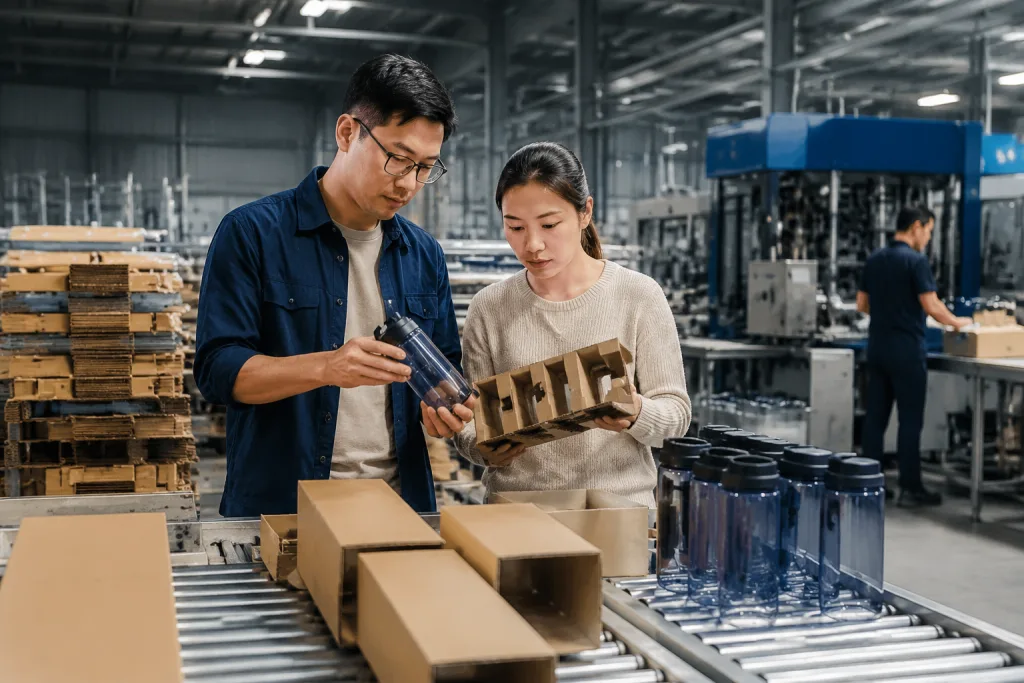
Ask your supplier for a ship-ready packing plan, not just a master carton count. The carton has to survive container pressure, not just sit neatly in the warehouse. For export, we usually spec 3-ply or 5-ply board based on bottle count, with inner partitions or polybags where the fit is loose. For Amazon or DTC, the buyer flagged the missing FNSKU more than once, and the math does not work if you add labels at the last minute. That extra step costs money, but skipping it costs product.
Watch these points:
- Drop test target: 80 cm to 100 cm for retail cartons
- Carton compression: verify top-load before sea shipment
- Moisture control: avoid paper inserts that warp in humid transit
- Label adhesion: check if your shipping labels survive condensation
China has plenty of canteen distributors and distributor canteen options, but only a few will build the packaging around your channel. We run into this with warehouse club orders all the time: the buyer wants shelf-ready packs, the line ships loose cartons, and QC pulls the sample because the outer box fails at the corner crush test. If you sell to Amazon, a retail chain, or a club store, the pack-out has to be built for that channel from day one.
QC Numbers Matter More Than Promises
I’ll rewrite the section in-place, keep the HTML exactly as-is, and tighten the language so it sounds like a factory-side sales engineer.Quality control is where a real supplier separates from a middleman. If you want stable delivery from suppliers tritan bottle production, do not accept “we check everything.” Ask for the inspection method, defect definition, and sampling plan. A proper factory in China should talk in AQL numbers, inspection points, and the difference between critical, major, and minor defects.
For most export programs, AQL 2.5 for major defects and 4.0 for minor defects is a normal starting point, while critical defects stay at zero tolerance. Leak, crack, wrong material, missing part, and logo shift all go into the critical bucket. If the order is for a food-contact item, ask for REACH, LFGB, or FDA documents that match your market. We see buyers get burned when a vendor waves this away with one generic line.
At minimum, your QC package should include:
- Incoming inspection for resin and gasket lots
- In-process checks on thread fit and wall thickness
- Final visual inspection under controlled light
- Random functional tests on sealed units
When you source from Zhejiang, you can often get faster response and stronger engineering support than from a trading-only channel. We run the same logic on the line: if defects are not tracked by lot, the correction plan is just talk. If a canteen supplier cannot show rejection rate by batch, you are buying blind.
How to Spec the Order Properly
I’ll rewrite the section in place, keep the HTML intact, and make the copy sound like a factory-side sales engineer wrote it.The fastest way to dodge production trouble is a clean spec sheet. Short and exact beats clever every time. Put the bottle volume, target market, use case, and closure style on page one. Then lock down decoration, pack-out, and the compliance standard. If you buy as a canteen vendor or canteen distributors business, this is where margin gets protected. One vague line turns into a chargeback later, and we have seen that go sideways after the PO was already signed.
A practical spec should include:
- Capacity: 650 ml, 750 ml, or 1 L
- Material: Tritan body, PP lid, silicone gasket
- Thickness: body 1.8 mm, lid as specified by mold
- Finish: clear, frosted, tinted, or opaque
- Decoration: one-color print, multi-color print, or molded logo
- Packaging: bulk pack, retail box, or e-commerce set
- Testing: leak, drop, dishwasher, and torque requirements
If you compare canteen supplier, canteen manufacturers, and canteen factory options, send the same spec to all three. That is the only fair math. Then compare USD price, lead time, sample turnaround, mold ownership, and whether they will sign a pre-production sample. We once had a buyer flag a PO typo on the cap color, and the line had to stop for 2 hours while QC pulled the sample. A solid factory can usually turn first samples in 7-12 days and mass production in 25-35 days after approval, depending on mold work and decoration. In Zhejiang, that is normal. The real test is whether they can keep the same promise after the order moves from the sample desk to the line.
Send your spec, get a real factory quote
Share your volume, lid style, and market requirements. We’ll quote from Hangzhou, Zhejiang with clear MOQ, lead time, and QC terms.
Frequently asked questions
What MOQ should I expect for suppliers tritan bottle orders?
For most custom Tritan bottle projects, a normal MOQ is 3,000-5,000 pcs per color or per design. If you need custom lids, special cartons, or multi-color print, the real MOQ may be higher because the supplier has to balance resin, molding, and decoration setup. Some Zhejiang factories will quote lower trial quantities, but you usually pay more per unit, often 15-30% above standard bulk pricing. If you are testing a new market, ask for one pilot run plus a full production run, so you can validate leak rate, print durability, and carton performance before you scale.
How much do custom Tritan bottles usually cost?
For plain custom drinkware, a basic Tritan bottle can start around USD 1.20-2.20 per piece at 3,000-5,000 pcs, depending on size and lid style. Add USD 0.10-0.35 for one-color print, more for multi-color decoration, and extra for retail packaging or barcoding. A complex closure, frosted body, or special gasket can push the price higher. If a quote looks much cheaper than that, check whether it excludes tooling, packaging inserts, or export carton upgrades. Low unit price often hides weak QC or thin packaging.
What tests should I require before shipment?
At minimum, require leak testing on 100% of assembled units or a documented sampling plan with zero critical defects. Then ask for drop testing, usually 80-100 cm depending on your channel, and dishwashing or heat-cycle testing if you will make those claims. For decorated bottles, add rub resistance and adhesion checks. For food-contact export, request compliance documents such as REACH, LFGB, or FDA-related declarations as needed. If your buyer base is retail or Amazon, also require carton compression and label adhesion checks so the product survives handling after packing.
Can a canteen factory handle custom logos and packaging together?
Yes, but only if they control both the molding and the finishing line. A strong canteen factory in Zhejiang should handle one-color or multi-color logo printing, retail boxes, barcode labels, and master carton setup without outsourcing everything. The danger is when the supplier prints at one site and packs at another, because that creates quality drift and delay. Ask who owns the artwork proof, who checks color, and who signs off on the pre-shipment sample. For export programs, you want the same team to control sample approval and mass production.
How do I choose between a canteen manufacturer and a trading company?
If you need stable specs, mold support, and recurring orders, a direct canteen manufacturer is usually the better choice. You get clearer control over tooling, QA, and lead time, and you can negotiate directly on sample revisions. A trading company may be fine for mixed categories or very small orders, but it often adds one more layer between you and the line. For buyers in Europe and North America, that extra layer can make problem-solving slower when a cap leaks or a logo shifts. If you need a custom canteen or customized growler line, ask who actually owns the mold and who performs final inspection.