Key Takeaways
- Vacuum retention should be tested at 95°C water fill and checked again after 6 hours
- For custom thermos orders, approve the exact lid gasket material and compression fit before mass production
- A realistic MOQ for stainless thermos custom color is usually 1,000-3,000 units per SKU
- Carton drop tests and barcode checks prevent expensive distributor thermos rework at arrival
If you are sourcing suppliers thermos flask for an outdoor retail line or a promotional thermos program, finding a China factory is the easy part. The hard part is catching the quiet defects before 8,000 units land in your warehouse: lids weeping at 45° tilt, powder coating chipped at the base ring, or a PO typo that says 500 ml while the carton mark says 520 ml.
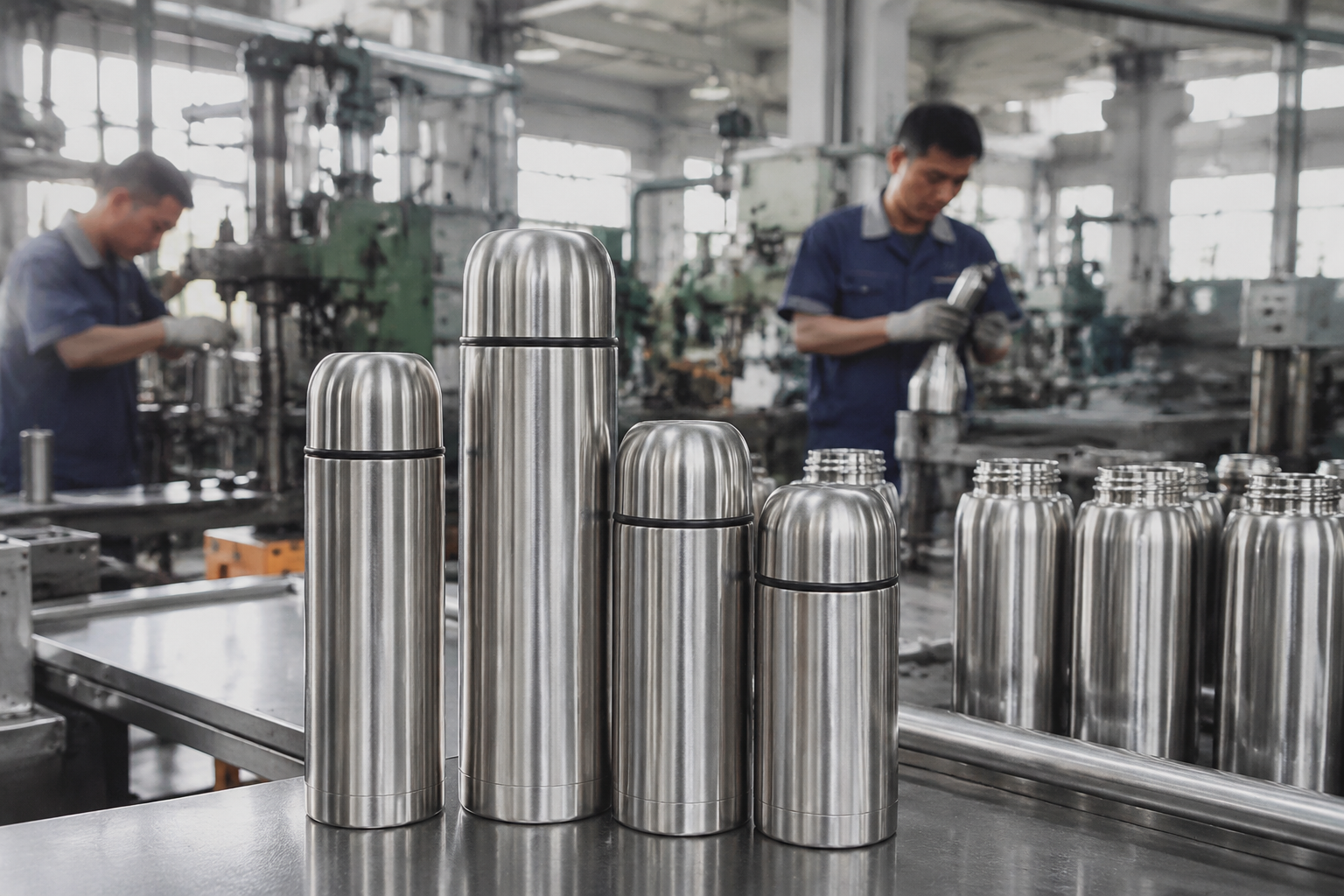
A stainless thermos looks simple: 304 stainless body, vacuum layer, lid, coating, logo, carton. On the line, each part has its own way to fail. We run leak testing with 90°C water, check vacuum loss after 24 hours, and let QC pull the sample before AQL inspection. From our Hangzhou, Zhejiang export floor, the safer orders are not the ones with the thickest spec sheet. They are the ones where the buyer names the failure modes before tooling and sampling start.
Vacuum Loss Starts Before Assembly
I’ll rewrite the section in-place, keep the HTML exactly as-is, and tighten the sales-engineer voice while preserving the technical numbers and structure.The most expensive defect in a bulk thermos order is not a scratch. It is a bottle that looks fine and still loses heat like a single-wall cup. Vacuum failure usually starts at weak welding, bad evacuation, or contamination at the inner and outer shell joint. QC pulled the sample under warehouse light, and the leak still showed up only after the thermal test.
For a stainless thermos flask, we normally suggest 304 stainless steel for the inner wall and either 304 or 201 for the outer wall, depending on target price. A common wall thickness is 0.4-0.5 mm for the inner shell and 0.5 mm for the outer shell. If a thermos manufacturer cuts steel to save USD 0.18 per unit, the body can dent during forming or shipping, and that dent can crack the vacuum seam. That math does not work.
Your purchase spec should define the retention test, not just say keeps drinks hot. A factory test we use is simple: fill with 95°C water, close the lid for 6 hours at 20°C room temperature, then measure the water temperature. For a 500 ml bottle, a lot of retail programs target 60°C or higher after 6 hours. Premium builds may target 68°C or higher, but that means better copper plating, tighter welding, and a higher unit cost.
Ask your thermos supplier how many units are vacuum tested in-line and how many are tested after packing. At BottleForge in Zhejiang, a normal stainless thermos line can output about 280,000 units/month, but we treat heat retention as process control, not a finish issue. If your suppliers thermos quote skips vacuum testing, the buyer flagged it for a reason, so ask again before you approve the PI.
Lids Leak When Specs Are Vague
I’ll rewrite this section with tighter sales-engineer language, keep the HTML exactly as-is, and avoid the AI-ish filler.Most end-user complaints start at the lid. We’ve seen a perfect stainless body get blamed because one silicone ring was off by 0.3 mm, and that turns into returns fast. Outdoor buyers feel it first; bottles get tossed into backpacks, side pockets, kayaks, and work trucks. Promo brands get hit too, because one drip at an event can hurt the campaign more than the unit price.
Three lid failures show up again and again. The gasket is too soft or too thin, so compression drops after a few days. The thread tolerance is loose, so the cap feels tight but never seats evenly. The drinking spout, push button, or flip lid has a small hinge or plug that passes the first water test and then gives up after repeated opening on the line.
For a custom thermos, photos are not enough. Ask for lid drawings or at least the key numbers: gasket diameter, gasket hardness, thread turns, and resin grade. Food-contact silicone should meet LFGB or FDA grade, depending on the market. For Europe, we run REACH checks and ask for the food-contact declaration before bulk starts. For North America, buyers usually want FDA-grade silicone and ASTM-related performance expectations for kids or outdoor use. If the supplier says “same as sample” but skips dimensions, that’s the wrong question to ask.
A leak test does not need fancy gear. Fill the thermos with room-temperature water, close the lid, invert it for 30 minutes, shake it 20 times, then inspect the seal. For travel mugs or straw lids, add pressure and cycle testing if the product is sold as leakproof. QC pulled the sample, found a slow drip at the hinge after the third open-close cycle, and that saved a shipment. If your thermos vendor says no problem but will not define the test method, the math does not work.
Coating Defects Hide Under Nice Samples
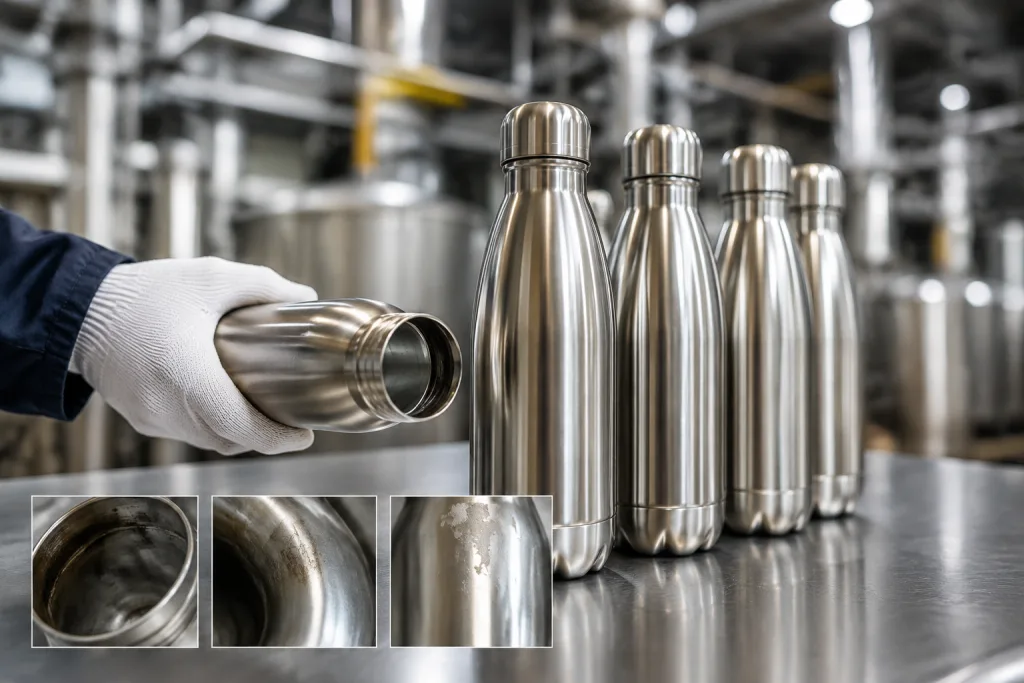
I’ll keep the HTML intact and rewrite the prose in a more factory-floor, sales-engineer voice. Next I’m checking the repo instructions, then I’ll patch the section directly.I’ve got the target section. Now I’m rewriting each paragraph to cut the AI filler, add specific production detail, and keep the coating message sharp.Powder coating and spray paint can make a custom thermos look ready for a showroom sample, and that is where the trouble starts. QC pulled the sample at 20 units and the buyer liked the color, then the line hit 20,000 pieces and we saw drift, orange peel, dust spots, weak adhesion, and a logo 2 mm off center. Do not wait for the carton to be on a truck. Lock the coating spec before the first batch.
For outdoor retail, powder coating is the better call than basic spray paint. It takes abrasion better and gives a firmer hand feel. On our line, 60-90 microns is the usual band; below that, the edge wears through fast, and above that, caps and accessories start to bind. If the buyer wants a promo flask on a tight budget, spray coating can work, but calling it heavy-duty without test data is the wrong question to ask.
Approve color with a physical master sample, not only a Pantone code in email. Pantone keeps everyone aligned, but the curve of the stainless body, the gloss level, and the oven setpoint all move the final shade. For a thermos custom program with 3 or 4 SKUs, we ask the thermos factory to keep one signed gold sample in China and send one to the buyer. We run from that same piece, or the buyer flags a mismatch later.
For logo work, pick the process by use. Laser engraving stays clean on powder-coated bottles and holds up in daily use. Silk screen printing is cheaper for a large simple logo, but it needs adhesion testing on the coating line. Heat transfer handles complex graphics, yet a weak topcoat will scratch in packing. A proper AQL plan should separate peeling coating, which is a hard fail, from a tiny dust point on the base, which is a minor defect.
Steel Claims Need Paper And Magnets
I’ll rewrite the section in-place, keep the HTML exactly as-is, and tighten the copy so it sounds like a factory-side sales engineer wrote it.Steel claims get fuzzy fast in thermos sourcing. A low quote may say 304 stainless steel, while the real build is 304 inner with 201 outer, or a wall that comes in 0.35 mm instead of the 0.5 mm the buyer expected. That is not always a scam. We have seen buyers approve a cheaper structure, then blame the factory when the PO never spelled out the split.
For any food-contact surface, 304 stainless steel is the default we run for most adult bottles. 316 stainless steel makes sense when the drink is salty, acidic, or tied to marine use, but the math adds up fast. For outer shells, 201 stainless steel can work in budget thermos bulk orders if the coating holds and the market knows it is a price play. We ship a lot of these, and the buyer usually flags it only when the product is sold as outdoor gear and the shell starts showing marks after a few weeks.
Your RFQ needs the full stack: inner steel grade, outer steel grade, wall thickness, lid plastic, gasket material, and finish. Ask for a material declaration, and if the order is going into EU retail, ask for REACH and food-contact files before the line starts. For larger lots, QC pulled the sample and sent it for PMI or chemical composition check on request. A magnet is not a full test, but it catches the bad swaps on the production floor when someone tries to pass off the wrong coil.
China has strong stainless thermos factories, including the Hangzhou-Zhejiang belt and nearby provinces, but written specs still decide the result. A supplier thermos quote without material details is a number, not a build plan.
Cartons Fail After The Bottle Passes
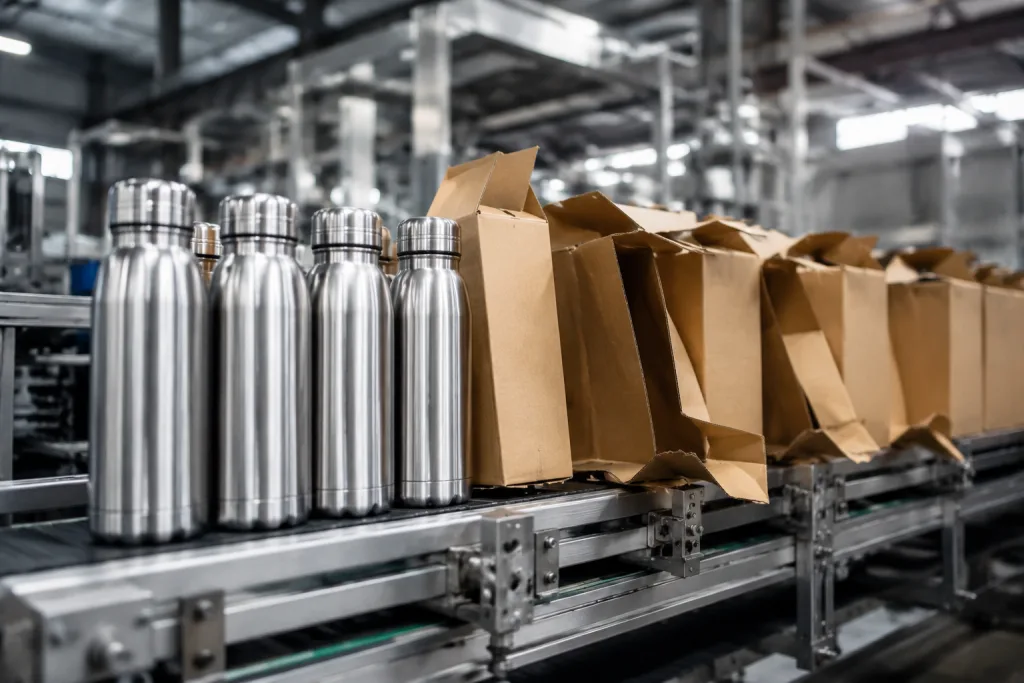
I’ll keep the HTML structure intact and rewrite the prose to sound like a factory-side export sales note, with tighter wording and more concrete packing detail.Most buyers stare at the bottle and forget export packing until the first container lands with smashed gift boxes. We see this a lot on distributor orders. The thermos passed QC, but the master carton was too soft, the dividers folded, or the gift box board cracked in ocean freight. If you sell to outdoor retailers, damaged cartons can still trigger chargebacks even when the flask is fine.
Start from the sales channel. For e-commerce, we run individual white boxes, polybags, FNSKU labels, and suffocation warnings where the marketplace asks for them. For wholesale, the spec can shift to stronger color boxes, retail barcodes, inner cartons, and a master carton kept under the buyer’s gross-weight limit. A common export carton for 500 ml stainless bottles holds 24 units, but the real count depends on bottle diameter, lid height, and the gift box insert.
Pick the carton board first. For heavier stainless thermos shipments, a 5-ply corrugated master carton holds up better than thin 3-ply. If the buyer gives an edge crush test requirement, ask for it in writing; the line needs a clear target before we cut samples. Drop tests should cover corners, edges, and faces from 76 cm on cartons under many retail programs, and this is the wrong question to guess on.
Labels are QC work too. We have had thermos distributor orders slip because carton marks, UPC codes, or a mixed-color ratio on the PO were off by one line. For a promo run, the delivery date is usually fixed by the event, so rework in the destination warehouse gets expensive fast. Treat packing approval like a production gate. That is how we ship on time.
Price Pressure Creates Hidden Tradeoffs
I’ll keep the tags exactly as-is and rewrite only the prose, with tighter buyer-language and a few concrete factory-floor details.Every buyer wants a sharp FOB China price. Fair enough. The trap starts when you ask five thermos factories for the lowest number and leave the build open. We’ve seen quotes that look the same on paper but aren’t: 201 vs 304 stainless, 0.35 mm wall thickness vs 0.40 mm, powder coat vs spray, push-button lid vs screw lid, plain carton vs mailer box, and different QC assumptions. A USD 0.35 saving disappears fast if the return rate moves from 1% to 4%.
For reference, a 500 ml double-wall stainless thermos with powder coating and one-color logo usually lands around USD 3.20-5.80 FOB, depending on steel, lid, coating, packaging, and order quantity. A basic promo bottle with spray finish and a simple carton can sit lower. A retail outdoor bottle with a premium lid, copper lining, custom mold details, and color box sits higher. If a thermos supplier is far below that band, the buyer flagged it for a reason, and the math usually does not work.
MOQ changes the whole quote. For stock color plus logo, 500-1,000 units is often workable. For custom powder color, 1,000-3,000 units per SKU is more realistic because the coating line needs setup time and every color change burns labor and powder. For a new lid mold or body shape, tooling can run from USD 1,200 to over USD 8,000, and sample lead time usually takes 15-25 days before mass production starts. We run that line every week, and the mold fee is where first-time buyers get surprised.
Lead time should be split by stage: pre-production sample, material purchase, mass production, inspection, and shipment. A normal customized thermos order usually needs 30-45 days after sample approval and deposit. Rush orders can work, but QC pulled the sample and found it leaves less room to catch a loose silicone ring, a wrong carton size, or a PO typo before the goods hit the pallet.
Inspection Must Match The Real Risk
I’ll rewrite this section in a more field-tested B2B style, keep the HTML exactly as-is, and tighten the language around real QC risk and factory-floor checks.AQL inspection only works when the checklist matches the real failure modes. A generic form will catch dents, scratches, and carton count. It will miss weak vacuum hold, lid fatigue, coating loss, barcode mismatch, or the wrong insert sheet. For a suppliers thermos flask order, QC has to be built around how the bottle fails after it leaves our line.
Set the defect grades first. Critical defects cover leakage, sharp edges, unsafe odor, wrong material, contamination, and a lid that does not lock. Major defects cover poor heat retention, coating peeling, wrong logo, wrong color, missing barcode, or crushed retail packaging. Minor defects cover small cosmetic marks within the agreed size limit. We usually see AQL 0 for critical, 2.5 for major, and 4.0 for minor, though some buyers run tighter numbers. That is the real question.
For functional checks, put in a measured heat retention test, leak test, coating cross-hatch or tape test, lid open-close cycling, weight check, capacity check, and carton drop test. On one 750 ml order, the buyer flagged a PO typo on the logo position and we caught it with a 1.5 mm template before packing started. For mixed-color orders, verify the ratio per carton and per shipment, not just on the sample.
The best suppliers thermos partners in China will accept a strict checklist if it is agreed before production. They will push back on impossible tolerances, and they should. QC pulled the sample on a 10,000-piece run when the tape test showed coating lift at the rim, and that saved a shipment fight later. A good thermos manufacturer wants measurable standards because the math does not work any other way.
Send your stainless thermos spec for a factory review
Share capacity, logo, packaging, target price, and destination market. We will flag production risks before you place the PO.
Frequently asked questions
What MOQ should I expect for a custom stainless thermos order?
For a stock-color stainless thermos with your logo, a practical MOQ is usually 500-1,000 units per design. For a custom powder-coated color, expect 1,000-3,000 units per SKU because the coating line needs setup time and material loss. For a fully customized thermos with a new lid or body mold, the MOQ may rise to 3,000-5,000 units, plus tooling cost. If you are testing a promotional thermos campaign, start with stock shape and custom logo first. If you are building an outdoor retail line, invest in a better lid and coating after the sales forecast is proven.
How do I compare quotes from different thermos suppliers fairly?
Compare the build, not just the FOB price. Ask each thermos supplier to quote the same capacity, inner steel grade, outer steel grade, wall thickness, lid material, gasket material, coating type, logo method, gift box, master carton, and AQL requirement. A USD 3.60 quote and a USD 4.10 quote may not be the same product. One may use 304 inner and 201 outer, while another uses 304 for both shells. One may include 5-ply cartons and barcode application; another may not. Put the specification into one RFQ sheet and make the thermos manufacturers answer line by line.
What lead time is realistic for bulk thermos production in China?
For a normal bulk thermos order using an existing mold, plan 7-12 days for sampling and 30-45 days for mass production after sample approval and deposit. Custom colors, retail packaging, complex logo artwork, or peak-season capacity can add 7-15 days. New mold work usually adds 15-25 days for prototype sampling before production timing starts. If you need sea freight to Europe or North America, add shipping time separately. A factory in Zhejiang or elsewhere in China can move fast, but rushing often means fewer checks on coating, lid fit, and packing.
Which logo method is best for a promotional thermos?
For a promotional thermos, the best logo method depends on budget, artwork, and expected use. Laser engraving is durable and works well on powder-coated stainless bottles, but it is usually best for single-color marks. Silk screen printing is cost-effective for simple logos on larger thermos bulk orders, but adhesion testing matters. Heat transfer or UV printing can handle more colors and gradients, though scratch resistance must be checked. For outdoor retailers, I usually prefer laser engraving or high-quality screen printing with a tape test. For event giveaways, screen printing may be enough if the campaign price target is tight.
Can one thermos factory handle both retail and distributor orders?
Yes, if the thermos factory has enough process control and packing flexibility. Retail outdoor orders need tighter cosmetic standards, stronger cartons, consistent color, barcode accuracy, and sometimes BSCI, ISO 9001, REACH, or food-contact documents. Distributor thermos orders may focus more on price, mixed cartons, and fast repeat supply. The risk is treating both channels the same. A retail-ready customized thermos may need AQL 2.5 major inspection, drop testing, and signed gold samples. A lower-cost distributor order can use a simpler spec, but leakage, unsafe materials, and wrong labels should never be treated as acceptable tradeoffs.