Key Takeaways
- A realistic MOQ for custom thermal bottles is usually 1,000-3,000 units per color and size
- 304 stainless steel is common, but 316L inner walls matter for acidic drinks and premium positioning
- Laser engraving is stable for 500-unit logo runs; full-wrap printing needs tighter artwork control
- A 30-45 day production lead time is normal after sample approval and deposit
If you are comparing suppliers thermal bottle options, the hard part is not finding a factory. On Alibaba alone, you can shortlist 60 factories before lunch. The hard part is finding the one that can hold a 0.3 mm tolerance on the cup mouth, protect your margin, and ship the third PO without turning the artwork file, carton mark, or payment term into a fresh argument.
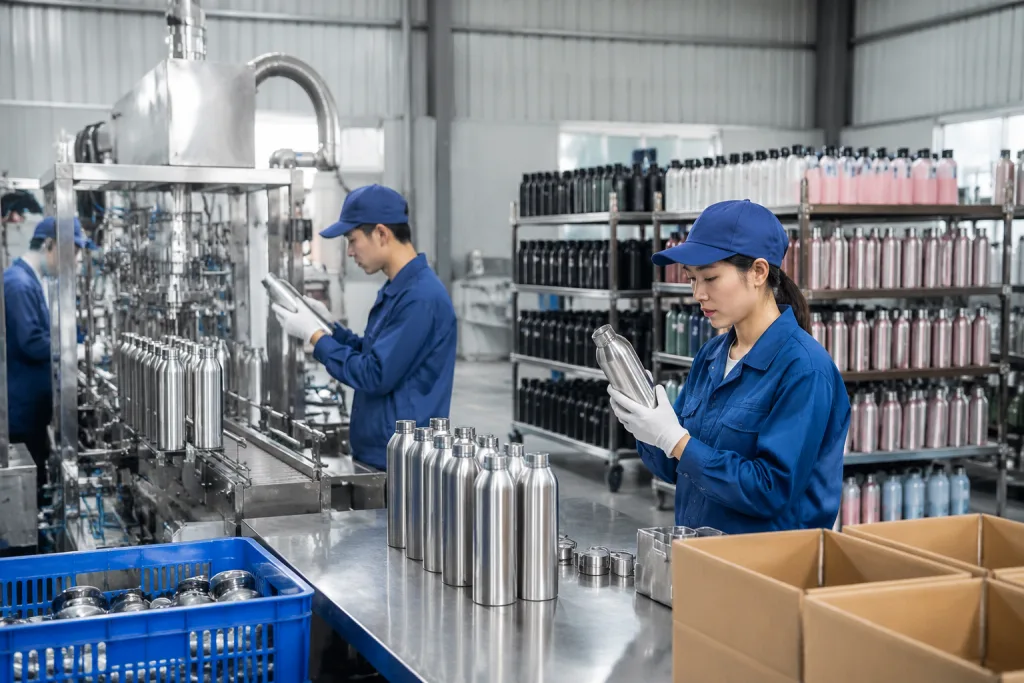
For B2B buyers, this is the wrong question to ask: “Which supplier is cheapest?” First lock the product structure, then check the line, decoration process, and landed cost. At BottleForge Industrial in Hangzhou, Zhejiang, we run this check every week: 304 stainless thickness with a digital caliper, powder coating adhesion after cross-cut tape test, and carton drop test before mass packing. Good buyers usually ask fewer soft questions and more measurable ones.
Start With Four Buying Decisions
Before you ask a canteen supplier for a price list, lock the job of the bottle. We see 7 out of 10 weak RFQs start with “500 ml bottle with logo,” then the buyer compares quotes for different lids, steel gauges, coatings, and carton specs. The math doesn't work. Last month QC pulled two “same size” samples from the line: one used a 58 mm screw cap, the other a 62 mm push-button lid, so the tooling and leak-test result were not comparable. A retail thermal bottle, a canteen promotional giveaway, and a distributor reorder program need different buying calls.
The first decision is insulation performance. For most B2B programs, double-wall vacuum construction with copper lining is enough. A common benchmark is 6 hours above 60°C for hot water and 12-18 hours cold retention, tested at room temperature around 20°C. If you demand 24 hours cold retention, wall thickness, vacuum quality, cap sealing, and unit cost all move upward. On our vacuum line, the buyer usually sees this in the sample report: 0.5 mm wall instead of 0.4 mm, tighter helium leak checks, and a cap gasket that QC measures with a digital caliper before assembly.
The second decision is material. The standard commercial build is 304 stainless steel inner and outer walls, usually 0.4-0.5 mm gauge. For a premium customized canteen or acidic beverage use, 316L inner wall is safer, but expect a higher FOB price and a China material lead time closer to 18 days vs 12 days for regular 304 stainless stock. We run PMI spot checks on incoming coil, and the buyer flagged it once when a PO had “316” typed in the email but “304 stainless” left in the spec table.
The third decision is branding method. Laser engraving is durable and low-risk. Silk screen works well for one or two colors when the logo has clean edges and the artwork file is not a 72 dpi screenshot. Heat transfer and water transfer can look strong, but they need tighter pre-production control, including tape tests after curing and a signed golden sample on the packing table. The fourth decision is channel packaging. A canteen distributor may need brown master cartons and UPC stickers, while an ecommerce buyer may need drop-test packaging, FNSKU labels, and carton weight below 15 kg. We’ve seen this go sideways when the bottle passed AQL 2.5 but Amazon rejected the carton because the FNSKU label was 6 mm too close to the seam.
Good sourcing starts when you define the bottle, not when the supplier sends the lowest FOB quote.
Match Supplier Type To Order Risk
Not every canteen factory fits the same buyer. We run into this on quote calls every week: one buyer wants a 20,000 pcs plain 304 stainless bottle with no gift box, while another wants 6 colors, laser logo, straw lid, and retail barcodes on a 3,000 pcs trial order. A trading-style canteen vendor can move fast on catalog SKUs, but they usually cannot show you the welding jig, the vacuum oven log, or the powder coating thickness report. The model is not the problem. Matching it to the risk is the part buyers get wrong.
If you are launching a new custom drinkware line, pick a manufacturer that can talk through tooling cost, vacuum failure rate, coating thickness in microns, and where QC checks the sample before mass production. At BottleForge Industrial in Zhejiang, our typical capacity is about 450,000 stainless steel units per month across thermal bottles, tumblers, and custom growler projects. On the line, QC pulled 32 pcs from a 1,200 pcs pre-shipment lot last month because the lid torque felt loose at 0.6 N·m. That scale matters when you need a reorder program that holds steady, not one nice sample shot under clean lighting.
If you are a distributor canteen buyer placing a 1,000-unit seasonal order, a canteen vendor can work if the design stays close to catalog and the compliance load is light. If your customer asks for REACH, LFGB, FDA food-contact declarations, BSCI audit support, or AQL inspection reports, go direct to a canteen manufacturer. The math does not work when a vendor has to chase 4 subcontractors for one missing LFGB annex. We have seen buyers lose 12 days vs 18 days on approval just because the PO said “matte black” while the artwork file said “sand black.”
Ask where the critical processes happen. Body forming, welding, vacuum pumping, powder coating, and leak testing should have names, rooms, and records attached. If a supplier answers “our partner factory” for every step, ask for the vacuum test sheet, coating thickness readings, and cap leak test standard before paying the deposit. For a canteen customized project, decoration defects and cap leakage create most claims; in our last internal review, those two items covered 7 of 10 complaint samples. You want the party quoting you to control both, not just forward photos from someone else’s line.
- Use a factory when specs, compliance files, repeat orders, and inspection control decide the risk.
- Use a vendor only when catalog speed matters and the order stays small, simple, and low-compliance.
- Use a hybrid supplier when one contact must manage bottles, tumblers, lids, boxes, and mixed-container packing with clear QC records.
Set Specifications That Suppliers Can Price
A tight RFQ saves 2 to 4 days. It also keeps suppliers thermal bottle quotes from drifting 8-15% after sampling. We need capacity, dimensions, lid style, steel grade, finish, decoration method, packaging, test items, target port, and annual forecast. Leave those out and the buyer gets a guess. The line usually prices the cheapest build.
For a custom canteen, capacity changes tooling and carton math. A 500 ml bottle often ships 24 pieces per master carton, while a 1,000 ml bottle may drop to 12 pieces and push ocean freight per unit. For a distributor growler or customized growler, 1.2 L, 1.8 L, and 2 L bodies need stronger handles and caps, so the math does not work if you compare them with standard water bottles on piece price alone.
Wall thickness needs a number. We run many commercial thermal bottles at 0.4 mm inner and 0.5 mm outer stainless steel. Moving to 0.6 mm outer wall improves dent resistance, but it adds weight and steel cost. Powder coating needs the same treatment: 60-80 μm thickness, cross-cut adhesion, and 3M tape pull after curing. QC pulled the sample at the spray booth once and the buyer flagged it for a thin edge on the base ring.
For decoration, send vector artwork, Pantone refs, logo size in mm, and placement. A canteen customizable run with five colors and three logo versions is a different job from one color and one logo. If you need retail packaging, send the dieline early. If you need Amazon carton labels, confirm FNSKU and suffocation warning text before mass packing starts. We once caught a PO typo on the label count, and that burned a day.
A good RFQ is not long for show. It is precise enough that a canteen suppliers shortlist can quote the same item and you can compare apples to apples.
Price Beyond The FOB Number
FOB Ningbo or FOB Shanghai is the first line on the quote, not the landed cost. We have seen a thermal bottle priced USD 0.20 lower lose USD 0.32 after logo rework, 5-layer cartons collapsing at 17 kg, a second PSI, and a vessel booking pushed from 12 days to 18 days. Zhejiang factories usually quote FOB Ningbo because the route from Hangzhou to Beilun is clean; our trucker sends the VGM sheet before noon if the container loads in the morning. If the supplier sits inland, ask where the domestic trucking sits. Hidden freight has burned more than one PO.
For reference, a standard 500 ml double-wall 304 stainless thermal bottle with powder coating and one-position laser logo may sit around USD 3.20-5.80 FOB depending on structure, cap, finish, order quantity, and market conditions. That range assumes a normal straight body, existing tooling, and a logo file our laser operator can read without redrawing the 0.18 mm lines. A custom growler with larger capacity and handle construction can run much higher, especially if the handle needs a welded bracket or thicker carton insert. Treat these numbers as a quote smell test, not a price list.
MOQ matters because setup costs are not fake. Our usual MOQ for a canteen customized color is 1,000 units, while fully custom mold projects normally start at 3,000-5,000 units. Last month a buyer asked for 300 units in six colors; the math does not work once the powder room changes color, cleans the gun, and runs 50 pcs just to stabilize the finish. It can work with stock bodies and existing colors. It will not price like a factory production run.
Price inspection and compliance before you compare suppliers. A third-party pre-shipment inspection under AQL 2.5 for major defects and 4.0 for minor defects is common, and QC pulled samples from 8 cartons on our last 2,400 pcs bottle order just to check coating rub and lid leakage. Lab testing for food contact, lead, cadmium, and migration can cost several hundred to over USD 1,000 depending on market requirements. If you are supplying EU retailers, REACH and LFGB may be requested. For North America, FDA food-contact compliance and ASTM-related packaging or children’s product requirements may apply depending on the product type.
The cheapest canteen manufacturers usually become expensive when the buyer discovers these items after the deposit is paid. We have seen this go sideways.
Control Samples Before Production
Sampling is where we catch mistakes while they still fit on one desk. Mass production is where the same mistake turns into 18,000 bottles with the wrong logo height. For customizable drinkware, we run a fixed sample path: existing sample, logo sample, pre-production sample, then mass production. Skipping the pre-production sample saves 5-7 days on the calendar, but we have seen it go sideways on a full 40HQ when the buyer approved “navy” by email and the line sprayed a color 2 Pantone steps too light.
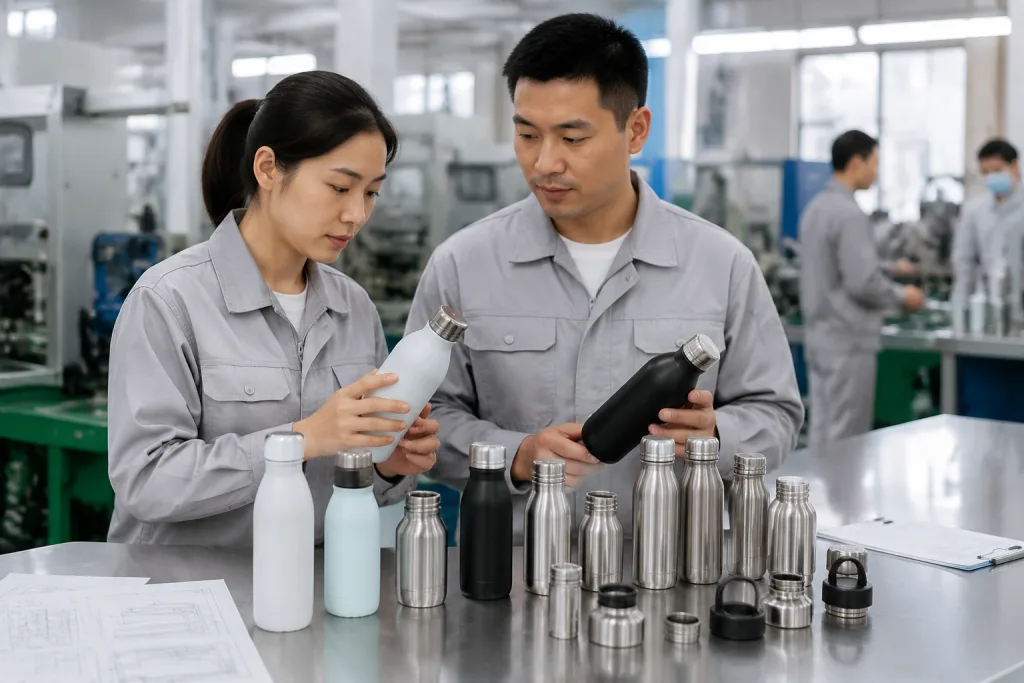
An existing sample confirms hand feel, capacity, lid function, and finish quality. A logo sample checks decoration only. A pre-production sample locks the exact materials, color, cap, packaging, and artwork that production will follow. Keep one signed sample at your office and one at the factory; our QC shelf uses a red “APPROVED” label with buyer name, PO number, and date. The Chinese production team should not work from email screenshots or a WhatsApp photo cropped at the lid.
Color needs discipline. Powder coating should be matched to Pantone or RAL, but stainless steel curves and coating texture change how the color reads under light. If brand color is strict, approve a physical color chip, not a PDF. For a canteen promotional campaign, ±5% visual tolerance may pass. For a retail customized drinkware program, ask for a formal approved limit sample; the buyer flagged one matte green order because the bottle body passed under D65 light but looked dull beside the printed gift box.
Functional tests should be basic and real. Fill the bottle with hot water, invert for 30 minutes, check cap leakage, and measure outer wall temperature with an infrared thermometer. A vacuum-insulated bottle with failed vacuum will feel warm outside fast; QC pulled one sample at 43°C on the outer wall after 12 minutes, and the math did not work. Drop testing also matters: 1.2 m drop on packaged units, especially for ecommerce or distributor drinkware channels where cartons get kicked, stacked, and re-taped in the warehouse.
Do not approve a sample only because the logo looks good. That is the wrong question to ask. Check thread smoothness, lid gasket fit, drinking comfort, coating adhesion, odor, and carton strength. We use 3M tape on coating checks and a simple torque feel check on lids before release; these boring checks prevent most claims.
Build A Repeatable Supplier Scorecard
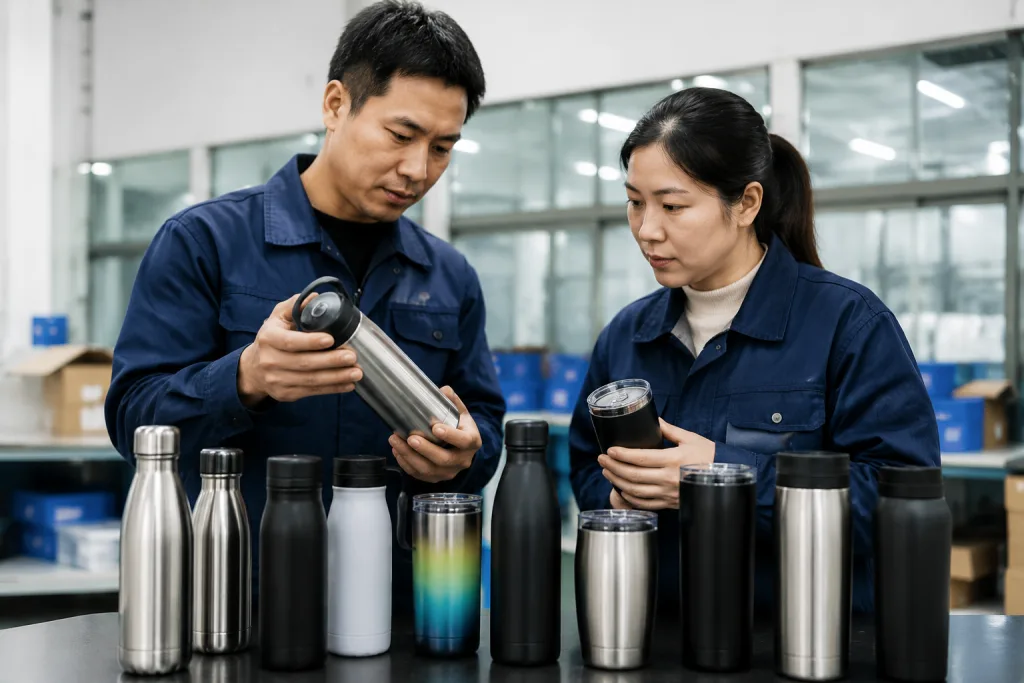
After you shortlist canteen distributors, canteen vendors, or direct factories, score each one on the same 100-point sheet. Keep it usable. The goal is to catch risk before the deposit, not build a 60-page audit that sits unread in a buyer folder. We use 6 buckets: bottle match, process control, compliance support, reply quality, price validity, and how they handle a failed sample. Last month QC pulled a 750ml sample with a 0.4mm lid gap; that kind of note belongs on the scorecard.
Product fit is the first filter: does the supplier already run the bottle you want on the line? A canteen manufacturer set up for single-wall aluminum bottles is a weak match for vacuum stainless thermal bottles. A customized growler supplier is also the wrong factory for kids’ straw bottles if they have no bite-valve tooling or small-part pull test record. Ask for current production photos with date stamps, not catalog renders. We usually ask for 3 photos: welding station, polishing line, and packed cartons with the shipping mark visible.
Process control should cover incoming steel checks, welding control, vacuum testing, leak testing, coating inspection, and final AQL inspection. At BottleForge in Hangzhou, Zhejiang, we normally plan 30-45 days for production after deposit and sample approval, depending on order complexity and season. If a supplier promises 12 days for a new canteen customizable project with custom color, custom logo, and retail box, push back hard. The math does not work unless they already have bodies in stock, lids in stock, and empty capacity on the coating line. Our vacuum tester holds bottles for 6 hours before QC signs off mass production.
Communication speed matters, but accuracy matters more. A supplier who replies in 10 minutes with messy answers can burn 2 days of email cleanup, while one who replies next morning with a 2D drawing, packing data, and test options saves the buyer time. For a distributor canteen program, you need stable reorder data: carton dimensions in cm, net weight and gross weight in kg, HS code guidance, plus lid and straw availability. We have seen this go sideways when a PO listed “mat black” instead of “matte black,” and the buyer flagged it only after the pre-production sample.
Finally, judge how the supplier handles problems. Every factory in China has occasional defects. The difference is whether they measure the defect rate, separate affected batches, and propose corrective action before shipment. On one 5,000pc thermal bottle order, QC found 37 lids with rough injection gates; we quarantined 3 cartons, reworked the lids, and sent photos before the buyer asked. That is the behavior you want from long-term canteen suppliers, not just a friendly first quote.
Send Your Thermal Bottle RFQ For Review
Share capacity, logo, packaging, MOQ, and destination market. We will check feasibility, pricing drivers, and production timing before you commit.
Frequently asked questions
What MOQ should I expect from suppliers thermal bottle factories?
For a standard stock-shape thermal bottle with one logo, expect 1,000 units per color as a realistic factory MOQ. Some suppliers can accept 500 units if the body color is in stock and decoration is simple, such as laser engraving. For a canteen customized program with custom powder coating, custom packaging, or several Pantone colors, 1,000-3,000 units is more normal. New mold development usually starts around 3,000-5,000 units because tooling, fixtures, and setup time need to be spread across enough volume. If a supplier accepts 100 units at a very low price, it is likely a trading-stock order, not a controlled production run.
How do I compare a canteen factory and a canteen vendor?
Compare control, not just price. A canteen factory should be able to show where welding, vacuum pumping, coating, leak testing, and packing happen. They should also provide production lead time, AQL plan, carton data, and material declarations. A canteen vendor may still be useful for small catalog orders, especially under 1,000 units, but you need to know who controls defects. For custom canteen and customizable growler orders, direct factory communication usually reduces risk because decoration, cap fit, and insulation performance need fast technical feedback. Ask both parties the same 10 specification questions. The one giving measurable answers is usually the safer partner.
What is a normal lead time for customized drinkware from China?
For customized drinkware from China, plan 7-10 days for sampling after artwork confirmation, then 30-45 days for mass production after sample approval and deposit. Add time for lab testing if required; food-contact or migration testing can add 5-12 working days depending on the lab and market. Peak season before summer and Q4 gifting can stretch production by another 7-15 days. Sea freight to Europe or North America may add 25-45 days port to port, plus customs and inland trucking. If you have a fixed retail launch date, count backward from the delivery date, not the factory ship date.
Which logo method is best for canteen promotional orders?
For canteen promotional orders, laser engraving is the safest method when you need durability, fast setup, and lower defect risk. It works well on powder-coated stainless steel and does not rub off under normal use. Silk screen is cheaper for simple one-color logos, but artwork size, curve distortion, and ink adhesion must be controlled. Heat transfer is better for full-color designs, yet it needs careful testing for scratch resistance and alignment. For 1,000-3,000 unit promotional runs, I usually recommend laser for premium corporate gifts and silk screen for budget events. Always approve a physical logo sample before mass production.
What compliance documents should canteen distributors request?
Canteen distributors should request material declarations for 304 or 316L stainless steel, food-contact test reports suitable for the destination market, and factory audit documents if selling to larger retailers. For Europe, REACH and LFGB are commonly requested. For North America, FDA food-contact compliance is often relevant, and children’s bottles may trigger additional testing. Ask for BSCI or similar social audit status if your customer requires responsible sourcing. Also request an AQL inspection report before shipment, with defect photos and carton count. Documents should match the product, material, and production batch. Old generic reports are better than nothing, but they are not enough for serious retail supply.