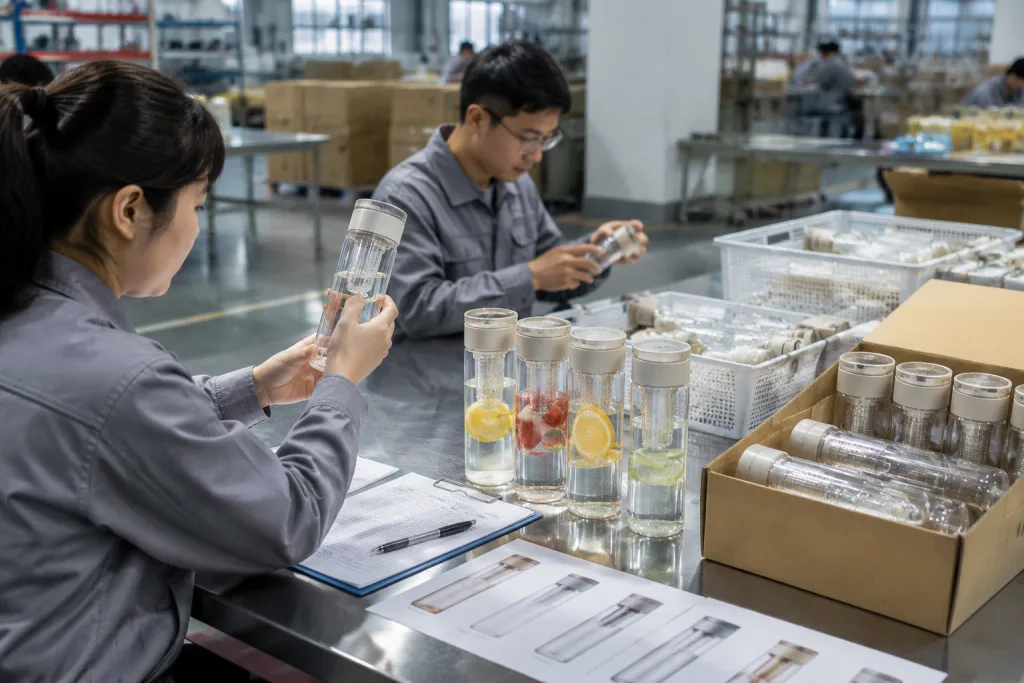
Key Takeaways
- A practical custom tea infuser bottle MOQ starts at 1,000 units per color for standard molds
- Tritan, borosilicate glass, and 304 stainless steel each change FOB price by USD 0.60-3.50
- Infuser basket mesh below 0.6 mm holes improves tea use but slows fruit infusion cleaning
- Plan 25-35 days for bulk production after sample approval in Zhejiang, China
If you are comparing suppliers tea infuser bottle quotes, the risky part is not the unit price. It is the blank line in the spec. A USD 2.40 bottle and a USD 3.10 bottle can look the same in a PDF, then fail in different ways after 6 weeks of tea acidity, lemon oil, 70°C dishwasher heat, and carton drops at the retailer’s DC. QC pulled one sample last month where the mesh basket sat 1.8 mm off-center; it brewed fine, but the buyer flagged the rattle before we even discussed price.
From our Hangzhou, Zhejiang export desk, we see 7 out of 10 wellness brands and hydration startups make the same early mistake: they ask for a custom infuser bottle before defining the bottle. This is the wrong question to ask. A decent China factory can run the line around your target price, but only if the spec sheet is clear on material, capacity, lid system, infuser mesh, decoration, testing, MOQ, and packing. We ship cleaner orders when the PO says “500 ml, 304 stainless mesh, laser logo, color box, AQL 2.5” instead of “same as sample,” because “same” is where the math goes sideways.
Capacity Is A Retail Decision
The first spec line is usually capacity: 450 ml, 550 ml, 650 ml, 750 ml, or 1,000 ml. Buyers call it a lifestyle choice. I’d push back on that. Capacity decides shelf price, carton cube, and how many units we can load before the forwarder starts complaining. A 450 ml customizable tea infuser bottle works for office tea, gift sets, and subscription boxes because the box stays under 70 mm wide. A 650 ml bottle is the safer wellness retail size; we run this size most often on the line. A 1,000 ml bulk fruit infuser bottle looks good for hydration challenges, but QC has seen more cap-impact cracks after the 1.2 m drop test, especially when the insert basket is loose.
For most startups, we advise 600-750 ml unless your channel gives you a clear reason to go smaller. In North America, retail buyers usually want 24 oz and 32 oz naming on the artwork. In Europe, metric labeling is accepted, but capacity tolerance still needs control. We check this with a graduated cylinder at the shoulder line, and a factory infuser bottle marked 700 ml cannot fill at 655 ml. The buyer flagged that exact gap on one PO last spring. Painful call.
The buyer impact is simple: every extra 100 ml adds resin, glass, or steel weight. On a Tritan custom made infuser bottle, moving from 650 ml to 800 ml may add USD 0.18-0.32 FOB. On glass, it may add USD 0.35-0.55 because wall thickness and protective packaging change too. The math doesn’t work if the retail price stays fixed at USD 14.99. We also need a larger EPE sleeve, and QC pulled samples where the taller glass body rubbed the inner carton after 18 hours of vibration testing.
- Best startup size: 650 ml for retail and DTC, with carton width usually kept near 75-80 mm.
- Best tea-only size: 450-550 ml with a shorter basket, because loose tea expands and blocks the lid if the basket is too deep.
- Best gym size: 750-1,000 ml with a stronger carry loop; we prefer testing the loop at 8 kg pull load before mass production.
If you are sourcing fruit infuser bottle bulk orders for distributors, confirm whether the quoted capacity is brimful capacity or practical drinking capacity. Those are not the same number. We’ve seen this go sideways when a supplier wrote “750 ml” on the PI, then the buyer’s warehouse measured only 690 ml to the usable fill line with the infuser basket installed.
Body Material Sets Your Risk
The body material line decides landed price, label claims, food-contact files, and the complaints your CS team will see 30 days after launch. For a custom fruit infuser bottle, we usually quote Tritan for clear fruit water bottles, PP for budget promos, borosilicate glass for tea retail, or stainless steel for insulation projects. None is automatically premium. QC pulled a 700 ml sample last month where the buyer asked for “glass look, plastic price”; the math did not work.
Tritan is the default material for a customized infuser bottle because it stays clear after drop testing and handles fruit water without the cloudy PP look. Buyers often sell it as BPA-free, but we still ask for LFGB or FDA food-contact documentation based on the destination market. A 650 ml Tritan factory direct infuser bottle typically lands around USD 2.10-3.20 FOB China before complex packaging. On the line, we check the body with a 0.02 mm caliper at the thread because a small shrinkage gap there becomes a leak claim fast.
Borosilicate glass looks cleaner for tea, especially for a customized tea infuser bottle sold through wellness shops and homeware shelves. Logistics is the pain point. You need silicone sleeves, molded pulp, or stronger inner boxes, and the buyer will flag the carton drop test if one corner crushes at 60 cm. Expect higher breakage control costs and a realistic FOB of USD 3.20-5.80 depending on lid and sleeve.
Stainless steel makes sense when the brief needs insulation or a distributor tea infuser bottle that survives heavier use. For tea infusion, 304 stainless steel is the baseline. For salty drinks or aggressive cleaning, 316 can be discussed, but most retail projects do not need it. Double-wall vacuum construction turns the job into thermos work, with leak testing closer to 18 days vs 12 days on a simple single-wall run, and MOQ discipline gets stricter because vacuum scrap is not cheap.
Do not approve a bulk infuser bottle quote unless the material grade is written into the PI: Tritan TX grade, borosilicate glass, PP, 304 stainless steel, or 316 stainless steel. We have seen a PO typo change “304” to “430,” and QC caught it before the deposit went to the wrong shell supplier.
Our Zhejiang facility can assemble about 280,000 plastic and glass infuser bottles per month across standard molds, but material allocation still matters during peak Q3 production in China. We run mold reservations by week, not by wish list, and a delayed color chip approval can push a 20,000 pcs order from Week 34 to Week 36.
Infuser Basket Details Matter
The basket is where 7 out of 10 suppliers tea infuser bottle problems start, but they do not show up in the quotation. The buyer sees a small insert. The user gets slow flow, weak tea, or fruit pulp stuck in the mesh after two washes. Your spec sheet should lock basket material, hole size, basket length, thread or bayonet connection, and whether the basket comes out from the top or bottom. On our line, QC checks this with a 0.5 mm pin gauge and a 1 kg pull test, because “looks OK” is how this part goes wrong.
For tea, 304 stainless steel mesh is still the safer choice. Hole diameter around 0.4-0.6 mm works for loose leaf tea without sending too much sediment into the drink. For fruit, the same fine mesh creates complaints because orange pulp and mint fibers stick after rinsing. We have had a German buyer flag this during sample review with lemon slices in cold water, not tea. A custom fruit infuser bottle usually works better with larger slots, around 1.5-2.5 mm, or a perforated tube instead of woven mesh.
If your product is marketed as a customizable infuser bottle for both tea and fruit, be careful. This is the wrong question to ask if the brief says “best for everything.” Dual-use designs are possible, but they are trade-offs. A long center basket gives better flavor extraction in cold water, especially on a 650 ml bottle. A short top basket is easier to clean and cuts cost, but the infusion gets weak when the bottle is half full. We run cold-brew checks for 4 hours, and QC pulled the sample twice last season because the top basket sat 38 mm above the water line.
Basket Fit And Rattle
Ask the factory tea infuser bottle supplier to check basket tolerance after heat cycling. Plastic lids can shrink slightly after hot water testing at 80°C for 30 minutes. Stainless baskets can rattle during shipping if the top thread is loose by even 0.2 mm. Not dangerous. It just feels cheap in retail unboxing, and we have seen buyers reject a carton after shaking one sample near the packing table.
- Tea basket: 304 stainless steel, 0.4-0.6 mm holes, checked with loose leaf tea instead of plain water.
- Fruit basket: PP or stainless tube, 1.5-2.5 mm slots, easier to rinse after citrus or berries.
- Premium option: removable full-length basket with silicone gasket, useful when the buyer wants less rattle and better cold infusion.
For bulk tea infuser bottle programs, approve the basket with real loose tea before mass production. We ship samples with a simple test note now: tea type, fill volume, brew time, and whether sediment passed the mesh. It saves 12 days vs 18 days when the buyer finds the problem after carton artwork is already confirmed.
Lid, Seal, And Leak Testing
The lid line in the spec sheet should not stop at “leakproof lid.” Too loose. Ask for lid material, gasket material, thread pitch, opening style, and the exact leak test we run on the line. In our QC records, cap issues account for about 7 out of 10 warranty photos on a custom logo infuser bottle, while bottle body cracks show up far less often. QC checks the first samples with a torque gauge before mass packing starts.
Plastic bottles usually take PP lids with food-grade silicone gaskets. Glass bottles often use bamboo-look lids, but 8 out of 10 “bamboo” lids we see are stainless steel or PP cores with a thin bamboo veneer. That is fine if the buyer knows it. QC pulled one lid last month and cut it open with a utility knife because the buyer flagged “solid bamboo” on the PO, while the sample was veneer over PP. Natural bamboo can swell, split, or hold tea odor if the inner structure is not sealed.
Write leak testing in shop-floor language. Example: fill to 90 percent capacity, close the cap to standard torque, invert for 30 minutes, then shake 20 cycles. We run this on a simple acrylic rack, not just by hand over a sink. For travel tumblers, we push harder, but this baseline works for most distributor infuser bottle orders. If you sell on marketplaces, this is the wrong place to save time. One leaking cap can cost more in return freight than the lid itself.
Pressure also matters. Fruit, hot water, and a sealed bottle can go sideways fast. A custom tea infuser bottle with a plastic body needs a printed temperature warning, usually on the insert card and the outer carton sticker. Tritan handles hot water better than cheap AS plastic, but boiling water inside a sealed plastic infuser is still a bad customer habit. Glass takes heat better, yet thermal shock still happens when cold glass meets boiling water; our line checks this with an IR thermometer during sample review.
A proper factory infuser bottle quote should list spare gasket availability. For distributors infuser bottle programs, we often pack 1 extra gasket per 50 units or supply a 1 percent gasket spare pack. The math works. A 6 mm silicone ring costs little, and the packing line can drop it into the polybag before the bottle goes into the white box. It prevents silly full-bottle replacements when the buyer only lost a gasket.
Logo And Surface Decoration
Brand owners often ask about the logo before they ask about the gasket. That is the wrong order. We first lock the bottle structure, leak test, and cap fit; then decoration becomes the next buyer-facing risk. For infuser bottles, we run two main paths: silk screen for simple solid logos, and UV or heat transfer for artwork with fine lines or gradients. On the line, QC checks the printed area with a 3M 600 tape pull and a 24-hour water soak before we approve bulk printing.
For a Tritan custom logo infuser bottle, one-color silk screen is the safe price point for most DTC launches. A 1-color logo may add USD 0.08-0.18 per unit at 1,000 units. Cheap enough. Multi-color artwork adds screen setup, drying time, and registration drift; we have seen a 0.6 mm logo offset get flagged by a buyer during pre-shipment photos. If your logo has gradients, UV printing or heat transfer is usually the better call, but do not approve it from a PDF mockup. Ask for adhesion results after water soak and tape pull.
For stainless steel lids or bodies, laser engraving gives the cleanest wear resistance. It will not always pop on light powder coating, so request one photo under daylight and one physical sample before signing the PP sample. QC pulled a matte white lid last month where the engraving passed durability, but the buyer flagged it because the logo looked weak from 1 meter away. For glass customized fruit infuser bottle designs, screen printing works, but firing temperature and ink chemistry must match the glass and compliance requirements.
Color customization has its own MOQ, and the math does not work below a certain volume. A standard clear body with custom print may start at 500-1,000 units. A custom Pantone body color normally requires 3,000 units or more because resin changeover, barrel cleaning, and color matching waste are real; one Tritan color trial can burn 18-25 kg of resin before the Delta E is acceptable. At BottleForge Industrial in Zhejiang, our standard MOQ for a custom infuser bottle using existing mold and one logo color is 1,000 units; custom body color is usually 3,000 units.
If you are selling to distributors tea infuser bottle channels, keep decoration simple for the first order. We ship cleaner on first runs when the PO says “1C black logo” instead of asking for metallic ink, sleeve art, and three retail colorways at once. Add the gift box or second colorway after 60-90 days of sell-through data proves demand.
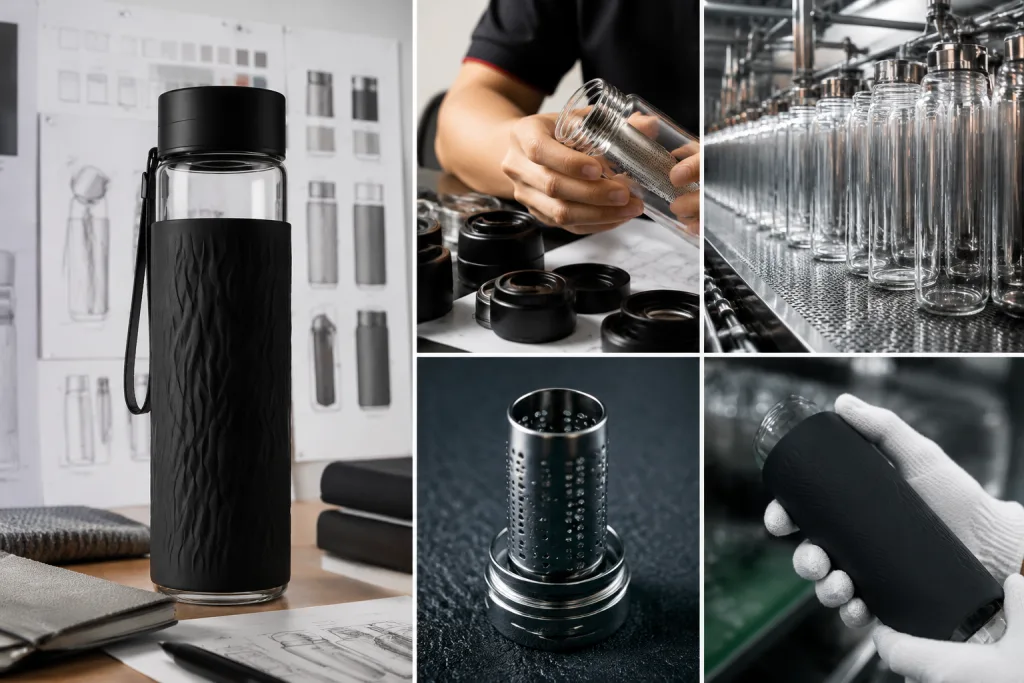
Compliance And Inspection Lines
Compliance is not glamorous, but it is where new buyers burn 7 to 14 days before shipment. For Europe, ask for LFGB, REACH, and the food-contact declaration before you approve the sample. For the United States, FDA food-contact compliance is the normal baseline. If the bottle goes into kids or school channels, put CPSIA and ASTM on the table at RFQ stage, not after the PO lands. We had one buyer flag “school bottle” only after the artwork was done, and QC had already pulled the PP sample from the line.
AQL inspection belongs in the order. Put it in writing. For a bulk infuser bottle, we usually run final inspection at AQL 2.5 for major defects and 4.0 for minor defects. Critical defects should be 0. Major defects include leakage, cracked body, wrong logo, sharp edge, missing gasket, or a basket that cannot lock after 10 open-close cycles. Minor defects include small cosmetic marks, slight color variation, or packaging scuffs inside the approved limit; our QC team checks these with a 30 cm viewing distance under the light box.
Do not rely only on a factory self-check when the order is new. For first production, use your own third-party inspector or ask the supplier for a QC report with photos of the 1.2 m drop test, 30-minute leak test, carton check, barcode scan, and random unit measurement with a digital caliper. China factories vary a lot in documentation quality. Good suppliers will not be offended by clear inspection terms. If they push back on photos, we’ve seen this go sideways.
For Amazon or 3PL fulfillment, add barcode and FNSKU rules to the packing spec. A distributor fruit infuser bottle order may use neutral cartons, while a DTC startup may need unit boxes, suffocation warning polybags, carton labels, and pallet height control under 1.6 m. The buyer flagged one 2024 order because the PO said “FNSKU on box,” but the artwork file showed EAN only. These are not small details when 120 cartons arrive at the warehouse.
The cleanest approach is to attach the compliance and inspection page to the proforma invoice. Chat records are weak. Under production pressure, the line follows the PI, the approved sample, and the packing spec; if the inspection page is not attached there, the math does not work.
MOQ, Pricing, And Lead Time
I’ll rewrite the section in place, keeping the HTML tags and the existing structure intact while making the prose sound like a real export-sales note.The commercial sheet should be plain and exact: MOQ, sample cost, sample lead time, mold status, production lead time, payment terms, FOB port, carton size, and gross weight. If a supplier ducks those numbers, the quote is not ready to compare.
For an existing mold customizable fruit infuser bottle, our normal MOQ is 1,000 units per logo design and per color. We have taken 500-unit orders before, but the unit price usually climbs 12-25 percent because setup labor gets spread too thin. For a custom made infuser bottle with a new mold, plan 45-60 days for mold development and USD 2,000-8,000 in tooling, depending on body thickness, lid parts, and the basket structure. QC pulled one sample last month and found the basket slot off by 0.8 mm; that kind of miss is why we do not treat tooling as a guess.
Sample timing is usually 5-7 days for plain stock samples, 7-12 days for logo samples, and 15-20 days when color matching or special packaging is involved. Bulk production after sample approval is usually 25-35 days in Zhejiang, China for standard models. Add 7-10 days before major holidays or when the gift box print needs extra proofing. One PO came in with the carton mark typo on the buyer’s side, and we had to stop the line for a reprint.
FOB Ningbo or FOB Shanghai are common for our Hangzhou location. A basic Tritan factory fruit infuser bottle may quote at USD 2.10-3.20 FOB. Glass with sleeve and box often sits around USD 3.20-5.80. Stainless insulated versions can move from USD 5.50 to over USD 9.00 depending on capacity and finish. These are planning ranges, not promises without a locked spec, and that is the wrong question to ask if the drawing is still open.
If you are a hydration startup, start with one hero SKU and one backup color. If you are a distributors fruit infuser bottle buyer, ask for tiered pricing at 1,000, 3,000, and 5,000 units. That is where the math shows whether the factory direct infuser bottle price improves with scale or only looks good in the first email.
Send your infuser bottle spec for factory review
Share target capacity, material, logo, MOQ, and market. We will return practical pricing, lead time, and risk notes.
Frequently asked questions
What MOQ should I expect from suppliers tea infuser bottle factories?
For existing molds, a realistic MOQ is 1,000 units per color and logo design. Some China suppliers accept 500 units, but you may pay 12-25 percent more because printing setup, carton setup, and QC labor do not shrink much. For custom body color, 3,000 units is more realistic. For a fully custom made infuser bottle with private mold, MOQ often starts at 5,000 units, plus tooling cost of about USD 2,000-8,000 depending on lid structure, body shape, and basket complexity.
Which material is best for a custom tea infuser bottle?
For hot tea positioning, borosilicate glass or 304 stainless steel is usually stronger than plastic. Glass gives good flavor neutrality and clear presentation, but needs better packaging and has breakage risk. Stainless steel is durable and better for insulated designs, but the user cannot see infusion color unless you add a window, which complicates production. Tritan works well for cold tea and fruit water, especially for a bulk tea infuser bottle, but you should avoid marketing it as suitable for sealed boiling-water use.
Can I use one bottle for both tea and fruit infusion?
Yes, but define the basket carefully. Tea needs fine holes around 0.4-0.6 mm to reduce loose leaf sediment. Fruit infusion works better with larger slots around 1.5-2.5 mm because pulp and seeds clog fine mesh. A dual-use customized infuser bottle normally uses a removable stainless basket or perforated tube. Before bulk production, test the sample with loose tea, lemon slices, berries, and mint for at least 3 cleaning cycles. A pretty sample that is hard to clean will create poor reviews.
How long does a custom logo infuser bottle order take?
For an existing mold, plan 5-7 days for plain samples, 7-12 days for logo samples, and 25-35 days for bulk production after sample approval. Gift boxes, Pantone body color, or special lids can add 7-15 days. Ocean shipping to Europe or North America is usually another 25-40 days depending on port and season. If you need goods for a launch date, approve artwork, barcode, carton marks, and testing requirements before paying the deposit, not after production has started.
What inspections should I require for fruit infuser bottle bulk orders?
Use final random inspection with AQL 2.5 for major defects and 4.0 for minor defects. Critical defects should be zero. Check leakage, cap torque, gasket presence, basket fit, logo position, capacity, sharp edges, carton drop condition, barcode readability, and packing quantity. For a first order over 3,000 units, third-party inspection is worth the cost. For repeat orders, a supplier QC report may be acceptable if it includes clear photos, measured data, and batch traceability.