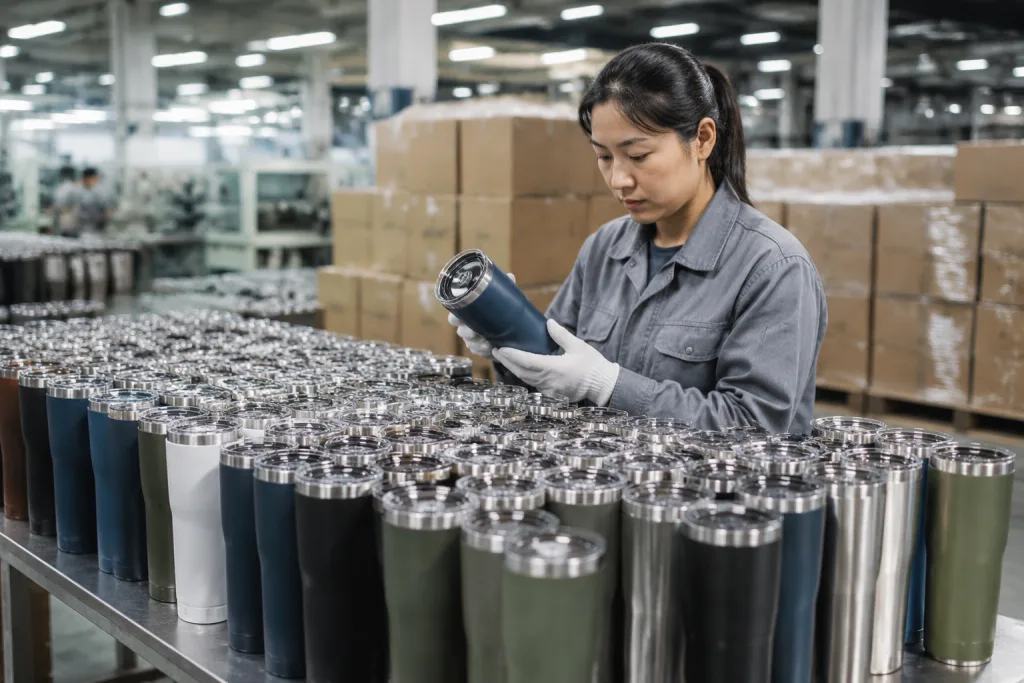
Key Takeaways
- Start with 304 stainless steel, 0.4-0.5 mm inner wall, and AQL 2.5/4.0 inspection terms
- A realistic custom drinkware MOQ is 1,000-3,000 pcs per color for powder coating
- Sampling usually takes 7-12 days; bulk lead time is normally 30-45 days after approval
- Confirm logo method, lid material, carton drop test, and FOB China terms before deposit
You search for suppliers stainless steel tumbler because a glossy catalog will not save a shipment. You need a factory that holds 0.50 mm wall thickness, prints the exact carton marks, clears AQL 2.5 inspection, and keeps the same PP lid resin after the first PO. We have seen this go sideways: QC pulled a 30 oz sample from the line, and the lid fit was 0.8 mm loose after the buyer approved a different sample set.
From our Hangzhou, Zhejiang factory desk, failed tumbler projects usually start with loose specs, rushed sampling, or buyers accepting answers like “food grade” and “high quality.” Wrong question. Ask for 304 stainless, liner thickness, lid material, coating test method, carton drop standard, and the MOQ tied to that finish. China has 200+ canteen and tumbler exporters, but the serious ones turn each promise into a measurable control before you pay the 30% deposit.
What supplier type do you need?
The first buyer question is not “what is your best price?” It is “what type of supplier am I speaking with?” For suppliers stainless steel tumbler projects, we usually see two workable choices: a trading company that buys finished goods from several shops, or a real canteen factory with deep drawing presses, laser welding, polishing wheels, powder coating, and packing under one roof. Different risk. Last month QC pulled 32 samples from a mixed-supplier order and found three lid gasket sizes in one carton, all called “standard” on the PO.
If you are a canteen distributor or distributor drinkware buyer with repeat orders, a factory relationship matters. You need stable mold access, spare lids, replacement gaskets, and the same powder coating color six months later. A broker can handle simple canteen promotional jobs, but the math doesn’t work when the buyer asks why a 600 ml tumbler costs USD 0.42 more than a 500 ml unit that looks almost the same from 1 meter away. We check this at the line with a digital caliper, wall thickness gauge, and vacuum tester before the goods reach packing.
Ask for practical proof, not slogans:
- Monthly output: BottleForge runs about 450,000 stainless drinkware units/month in Zhejiang, China during normal season, based on 8 production lines and two packing shifts.
- Core MOQ: 1,000 pcs for laser logo on stock colors; 3,000 pcs for custom powder coating, with a 60 mm x 80 mm logo area checked before mass print.
- Process scope: deep drawing with 300T presses, laser welding, vacuum insulation, polishing, coating, logo, and final packing under one QC file.
- Audit status: BSCI, ISO 9001, or retailer audit reports if your channel requires them; buyers often ask for the PDF before they release the deposit.
A good canteen supplier should also tell you what they do not make well. If you ask for a custom growler plus a ceramic-lined travel tumbler, one factory may not be the right source for both. We have seen this go sideways when the PO says “kids straw lid” but the approved sample uses a flip lid; that 1-line typo can cost 12 days in rework. Honest scope reduces surprises.
Which specifications must be locked?
For customizable drinkware, the drawing and spec sheet matter more than the hero photo. A photo will not show 304 stainless steel grade, vacuum loss after the heat tunnel, coating thickness in microns, or whether the lid is PP, Tritan, or AS resin. We run into this weekly: the buyer sends one glossy image, then QC pulls the sample and finds a 0.38 mm inner wall instead of the 0.45 mm written on the PO. Before you compare quotes from canteen suppliers, send the same spec sheet to each vendor.
For a stainless steel tumbler, lock these points early:
- Steel grade: 304 stainless steel for inner wall; 201 or 304 for outer wall depending on budget and market claim. Ask the factory to mark it on the material purchase sheet, not only in the quotation.
- Wall thickness: common range is 0.4-0.5 mm inner and 0.5 mm outer before forming. After stretching, the caliper reading at the shoulder can drop, so check the body and bottom separately.
- Capacity tolerance: normally +/-5% unless you require tighter marking accuracy. For printed fill lines, confirm the ml test with water on a digital scale.
- Thermal performance: 6 hours above 55°C for standard tumblers; better vacuum designs should state the test start temperature, room temperature, and result at 12 hours vs 18 hours.
- Lid material: BPA-free PP or Tritan; confirm silicone gasket hardness and spare gasket supply. We usually ask for Shore A 50-60 on the gasket before tooling sign-off.
- Surface finish: powder coating, spray painting, brushed steel, mirror polish, or rubberized paint. For powder coat, lock the color chip and target thickness, such as 60-80 microns, before mass production.
If you are developing a canteen custom or customized growler line, add handle strength, cap torque, leak testing angle, and mouth diameter to the spec. For an Amazon or retail program, define barcode placement and FNSKU label size, then add the suffocation warning if polybags are used and master carton weight under 15 kg when possible. Small stuff bites. We have seen a shipment held because the PO said “FNSK” instead of “FNSKU,” and the warehouse team would not relabel 1,200 cartons without buyer approval.
The uncomfortable truth: a supplier can cut USD 0.20-0.40 per tumbler by changing steel thickness, coating quality, or lid resin. If your RFQ does not lock those details, the cheapest quotation is not the same product. The math doesn't work. A 40HQ can hide 30,000 small shortcuts until AQL 2.5 inspection, when the buyer flagged weak coating on the cross-hatch tape test.
How should samples be approved?
I’ll rewrite the section in place, keep the HTML exactly as-is, and tighten the sales-engineer tone with concrete shop-floor details.Sampling is where buyers lose control. They approve a pretty pre-production sample and never pin down what “approved” means. For a stainless steel tumbler or canteen custom program, approval needs five items: the physical sample, written spec, color standard, packaging file, and inspection checklist. The sample is the reference, not a keepsake.
A normal sample path from our Zhejiang shop is simple. Stock sample without logo: 2-4 days. Logo sample with laser engraving or UV print: 5-8 days. Custom color or mold adjustment: 10-15 days, and a new lid tool can push it to 18 days. Sample fees usually run USD 50-150 for logo samples, while new mold work can start around USD 800 and climb fast when the lid has a special vent or flip mechanism.
Check the sample like your customer will:
- Fill it with boiling water and check the outer wall after 10 minutes; 42°C tells you the insulation is off.
- Leave water inside for 12 hours and check for metallic odor.
- Shake it upside down for 30 seconds if it is sold as leak-resistant.
- Scratch the coating lightly with a coin; weak coating shows fast.
- Run the logo through dish soap washing and a finger rub test.
For customized drinkware, sign and date a golden sample. Photograph the color under daylight and indoor light. If you use Pantone, still approve a physical panel; powder coating on curved stainless steel never matches paper exactly. We keep one approved sample by the production line and one in the QC room — if a buyer skips that step, we’ve seen the whole order drift on color and logo placement.

What price questions are fair?
I’ll keep the HTML structure intact and rewrite the prose to sound like a real export sales engineer, with cleaner pricing language and one factory-floor detail per paragraph.Price matters. Pretending it does not is lazy. A useful pricing talk has structure. When buyers ask suppliers stainless steel tumbler for FOB pricing, we need quantity, color count, logo method, packaging, lid type, and test scope. A quote for 1,000 pcs in one black color does not match 3,000 pcs split across six colors with individual kraft boxes. On our line, the buyer flagged a PO typo once: “3,000” became “3000/pcs,” and the quote had to be redone.
As a China export range, a 20 oz double-wall stainless tumbler usually lands around USD 3.20-5.20 FOB Ningbo or Shanghai, depending on steel grade, lid, coating, and packaging. A larger custom growler or customizable growler can run from USD 6.50-12.00 FOB. These are guardrails, not promises. If a quote comes in far below that, QC pulled the sample for a wall-thickness check and found the cup body at 0.35 mm instead of the 0.45 mm the buyer wanted. The math does not work.
Ask every canteen vendor to break out:
- Base product cost at 1,000 / 3,000 / 5,000 pcs.
- Logo cost for laser, silkscreen, heat transfer, UV, or embossing.
- Packaging cost for white box, kraft box, color box, insert card, or gift tube.
- Test cost for LFGB, REACH, FDA food contact, or ASTM-related checks.
- FOB port and whether inland trucking is included.
Do not push only for the lowest number if you need consistency. A USD 0.15 saving can vanish fast if the reject rate rises from 2% to 8%. We have seen that go sideways on a 5000 pcs reorder: one lid batch fit loose by 1.2 mm, and the buyer had to stop the line. For distributor growler and distributor canteen programs, repeatability beats a cheap first order.
Which compliance items matter?
I’ll rewrite the section in place, keeping the exact HTML tags and list structure, and tighten the compliance language so it reads like a factory-side sales engineer wrote it.Compliance depends on the market, not on where the tumbler is made. We run different specs for different buyers. A China factory can produce to several standards, but you have to tell us the destination country and the sales channel. EU buyers usually ask for LFGB, REACH, food contact declarations, and sometimes BSCI. North American buyers may require FDA food contact compliance, California Proposition 65 review, CPSIA for children’s items, and retailer-specific rules.
For stainless tumblers and custom canteen products, the weak points are not just the stainless body. Lids, coatings, silicone gaskets, inks, and color boxes can trigger a fail. If you order canteen promotional items with a bright printed logo, put the ink and coating in the test scope. QC pulled the sample on a 304 stainless cup last month, and the raw metal passed while the lid coating failed the finished-item check. A lab report on bare stainless does not prove the final tumbler is compliant.
Your PO should spell out inspection and compliance items in plain terms:
- AQL: final inspection at AQL 2.5 major / 4.0 minor, General Inspection Level II.
- Leak test: state the method, angle, time, and pass/fail limit.
- Vacuum test: use hot water or machine test based on the design.
- Coating check: run adhesion cross-cut or tape test on coated bodies.
- Carton test: drop test for export cartons, especially e-commerce packs.
If a canteen supplier says “we have all certificates,” ask for reports with item photos, material scope, test dates, and applicant name. The buyer flagged this on a 5000-piece PO before, and the report was for a different lid shape. Old or unrelated reports show up all the time. This is the wrong question to skip. A real manufacturer will send the paperwork without drama.
How do you reduce reorder risk?
I’ll rewrite the section in a more field-tested sales style, keep the HTML intact, and make sure the language feels specific and supplier-facing.The first order shows whether the supplier can ship once. The second and third orders tell you if they can keep your account steady. Reorder risk is where canteen distributors and brand owners get burned: color drift, lid swaps, carton changes, missing spare parts, or a factory that slows down when the line gets busy in peak season.
Put reorder control into the first PO. Lock the mold number, lid version, gasket color, coating code, logo position, carton size, and packing method. Ask the canteen manufacturer to keep production records for at least 12 months. For customized growler or custom canteen programs, we usually hold 1-2% spare lids and caps. If you sell through retail, keep 0.5-1% finished goods for warranty swaps. The math doesn't work if you wait until the next order to sort that out.
A practical reorder checklist:
- Keep one golden sample in your office and one at the factory.
- Request pre-production photos before each repeat order.
- Confirm no material or subcontractor change before deposit.
- Use the same Pantone or powder coating code, not “same as last time” only.
- Compare carton dimensions because freight cost can change your margin.
For distributor drinkware programs, ask about capacity before you promise seasonal launches. Our standard lead time is 30-45 days after sample approval and deposit, but Q3 can stretch when every buyer wants holiday stock. QC pulled the sample on a 320 ml stainless steel tumbler order once and found the lid tolerance was off by 0.8 mm; the buyer flagged it, we fixed it before repeat production, and that saved a messy claim later. A serious canteen vendor will tell you early instead of taking an impossible ship date.
Send your tumbler spec for a practical quote
Share capacity, quantity, logo, market, and packaging needs. We will respond with MOQ, FOB price, sample timing, and QC notes.
Frequently asked questions
What MOQ should I expect from suppliers stainless steel tumbler?
For stock stainless tumblers with laser logo, a workable MOQ is usually 1,000 pcs per model, sometimes 500 pcs if the color is already in production. For custom powder coating, expect 3,000 pcs per color because coating lines need setup time and material loss. For a new lid, custom growler, or customized canteen shape, MOQ often starts at 5,000-10,000 pcs after tooling. If a canteen supplier offers 100 pcs with full custom color at a very low price, check whether they are using local repainting, mixed stock, or a non-repeatable process.
How long does a custom drinkware order take from China?
A normal timeline is 7-12 days for logo or color samples, 3-5 days for buyer approval and file corrections, then 30-45 days for mass production after deposit. Sea freight to Europe or North America can add 25-40 days depending on port and season. If you need retail launch timing, plan backward from the shelf date, not the factory finish date. In Zhejiang and other China manufacturing areas, Q3 is busy for holiday orders, so confirm capacity before issuing a PO.
Which logo method is best for canteen promotional orders?
Laser engraving is durable and clean, with no ink risk, but it only shows the metal or coating contrast underneath. Silkscreen is economical for one or two colors on straight surfaces, usually best above 1,000 pcs. UV printing handles full-color artwork but needs good adhesion testing on powder coating. Heat transfer can look premium for larger wraps, but setup cost is higher. For canteen promotional programs, tell your canteen vendor the wash expectation: hand wash only, dishwasher exposure, or retail warranty claims. That changes the correct method.
Can one canteen manufacturer handle tumblers, bottles, and growlers?
Sometimes, but do not assume it. Many canteen manufacturers specialize by process and shape. A factory strong in 20 oz tumblers may also handle sports bottles, but large customized growler products need stronger handles, wider mouths, different welding control, and tougher leak testing. Ask for production photos of the exact category, not only catalog images. If you are a distributor growler buyer, request past carton specs, cap test method, and capacity samples. It is better to use one reliable manufacturer for three related SKUs than one weak vendor for ten unrelated items.
What should I check before paying the 30% deposit?
Before deposit, confirm the signed quotation, proforma invoice, specification sheet, artwork proof, sample approval, packaging file, inspection standard, and shipment term. For FOB orders, check the port, usually Ningbo or Shanghai for Zhejiang suppliers. Make sure the PI states steel grade, capacity, color, logo method, carton quantity, lead time, and payment balance terms. If compliance matters, add LFGB, REACH, FDA, or Prop 65 requirements before production starts. A deposit without these points is not a purchasing shortcut; it is an invitation for argument later.