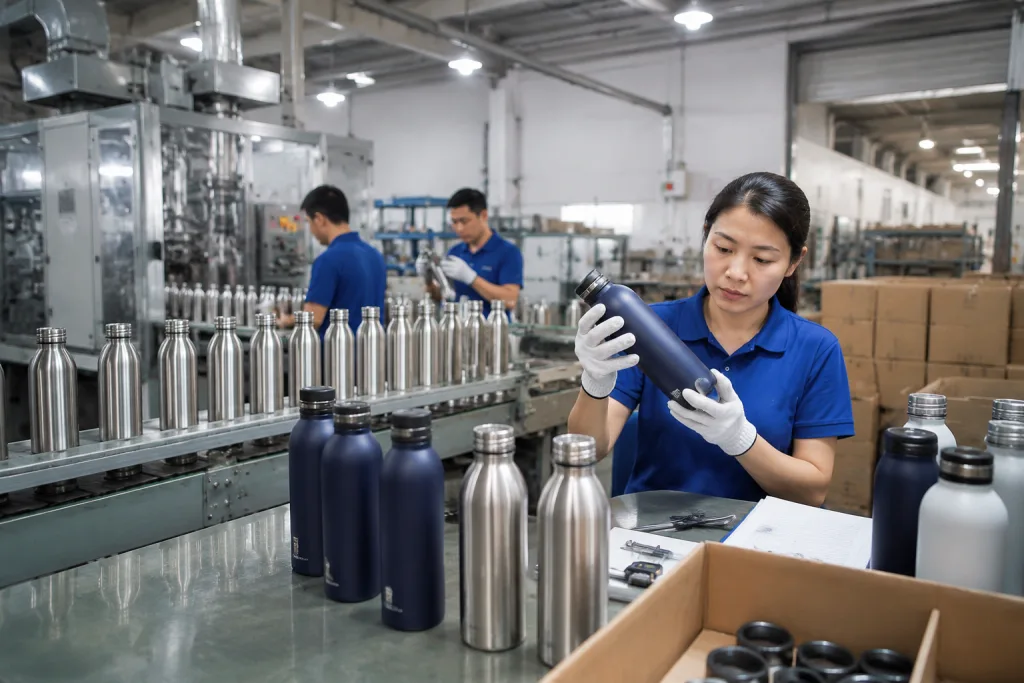
Key Takeaways
- For most bulk thermos projects, workable MOQ starts at 1,000 units per color and 3,000 units for new mold lid changes
- 304 stainless steel is standard for food-contact inner walls; 316 is useful for saltwater and premium outdoor positioning
- AQL 2.5/4.0 inspection should include vacuum retention, coating adhesion, leak testing, and carton drop checks
- FOB China pricing can shift 8-15% when you change coating, lid structure, wall thickness, or logo process
If you are comparing suppliers stainless steel bottle options for an outdoor retail line or promotional thermos program, don’t judge the quote by the catalog photo. Wrong question. Ask for the spec sheet first: 304 stainless steel grade, inner and outer wall thickness in mm, 6-hour insulation test data, PP or Tritan lid material, coating type, logo process, carton size, and AQL 2.5 inspection level. Last month QC pulled a 500 ml sample that looked fine in photos, but the inner wall measured 0.38 mm on the caliper instead of the quoted 0.45 mm.
At BottleForge Industrial in Hangzhou, Zhejiang, we see buyers lose 12 days vs 18 days when they ask for “a 500 ml custom thermos” without locking the measurable details on the PO. China can build strong stainless bottles, but the line needs a tight spec, not a mood board. Our Zhejiang production network runs about 650,000 units/month, with typical MOQ from 1,000 units per color and 30-45 day lead time after sample approval. We’ve seen this go sideways over small things, like a PO typo saying matte “black” while the approved sample card was PMS 426C.
Start With Steel Grade
The first line on a serious spec sheet should not be capacity. It should be material. On our line, we run SUS304 for the inner wall at 0.4-0.5 mm before drawing; QC checks it with a Mitutoyo thickness gauge before the shell goes to vacuum. The outer wall is often SUS304 too. Some promo programs ask for 201 stainless outside to save about USD 0.18-0.32 per 500 ml bottle, but we push back on that for outdoor retail. The math doesn't work after 3 months of salt air, scratches from carabiners, or one customer putting it through the dishwasher every week.
If your brand sells to hikers, fishing shops, marine clubs, ski resorts, or premium corporate gifting channels, ask the suppliers thermos team to quote 304 inner and 304 outer as the base. For coastal orders or heavy electrolyte drinks, 316 stainless inner wall is an option, but it normally adds USD 0.35-0.80 per unit on a 500-750 ml customized thermos, depending on market steel price. We shipped a 3,000 pcs yacht-club order this way after the buyer flagged rust complaints on a previous supplier's 201 outer body. That premium only makes sense when your shelf price can carry it.
Confirm the test standards behind the claim before you pay the deposit. For Europe, ask for LFGB or EU food-contact documentation, plus REACH for coatings and external plastic parts where applicable. For North America, FDA food-contact expectations and California Proposition 65 screening may matter. We have seen POs arrive with “S/S” written in the material column, and that is not enough; the material declaration should say 304 stainless or 316 stainless by part, including inner wall, outer wall, lid insert, and tea strainer if included.
Buyer impact: steel grade drives corrosion complaints more than first-sample appearance. Do not approve only by weight and shine; ask QC to pull the sample and verify the material sheet.
Capacity Is Not Just Volume
A 500 ml bottle from one thermos manufacturer can sit taller, wider, or heavier than a 500 ml bottle from another. Same volume, different headache. Capacity affects height, diameter, retail shelf fit, cupholder fit, carton cube, and freight cost. For outdoor retailers, 500 ml, 750 ml, and 1,000 ml are the working sizes we run most often. Promotional brands usually stay with 350 ml or 500 ml because the landed cost and shipping carton stay easier to control; last month one buyer flagged a 500 ml sample because the PO said “retail shelf under 235 mm,” but the lid-on height measured 241 mm with our Mitutoyo caliper.
Ask the factory thermos team for three dimensions, not one: full height with lid, body diameter, and mouth diameter. A 74 mm body fits most car cupholders we check on our test jig; an 82 mm body fails more often, especially in US pickup consoles. A 45-55 mm mouth is common for drinking and cleaning, while 58-68 mm wide-mouth designs take ice cubes better but need a stronger lid seal and larger cap tooling. QC pulled one 68 mm wide-mouth sample after the silicone ring showed a 0.4 mm gap under the compression gauge. Small gap. Big leak claim.
Wall construction matters too. Vacuum bottles are usually double-wall, with a copper-plated inner vacuum layer for improved heat retention. For a standard manufacturer thermos, you should expect hot retention around 6 hours above 60°C when filled with 95°C water and tested at 20°C ambient, depending on size and lid. Premium designs can reach 12 hours, but only if the vacuum process, lid insulation, and wall geometry support it. This is where “what capacity sells best?” is the wrong question to ask; on the line, a slim 500 ml body with 304 stainless can beat a wider 750 ml body if the vacuum oven cycle and lid foam are set right.
Carton math is where buyers get surprised. A 750 ml thermos bulk order may ship 24 pcs/carton at around 55 x 37 x 29 cm, while a bulky handle-lid model may drop to 12 pcs/carton. That can change ocean freight per unit by USD 0.08-0.22 on larger programs. We’ve seen this go sideways when a buyer approved the bottle shape but missed the master carton count; the sample room packed 12 pcs/carton, the quote sheet assumed 24 pcs/carton, and the math didn’t work once the forwarder weighed the 14.8 kg carton.
Lid Structure Drives Complaints
The lid is where 7 out of 10 stainless bottle complaints start. The steel body can pass vacuum testing at 95°C water fill, but a loose button, thin gasket, or rough thread still brings leak claims, bad reviews, and distributor returns in thermos channels. For a custom thermos, lock the lid type on the spec sheet line by line: screw cap, push-button cap, straw lid, cup lid, handle lid, or sports chug lid; last month QC pulled a pre-shipment sample where the PO said “cup lid” but the artwork file showed a flip lid.
Each structure has a price and risk point. A simple screw cap has fewer failure points and is usually best for promotional thermos projects under USD 5.00 FOB, especially when we run 10,000 pcs on a short gift order. A push-button cap looks retail-ready, but the spring, silicone gasket, and 3,000-cycle test need to be written into the order. A straw lid sells in outdoor and fitness channels; for hot drinks, this is the wrong question to ask unless the venting, warning label, and carton mark are clear.
Food-contact plastic should normally be PP, Tritan, or other declared materials depending on the part, and the resin name should match the BOM, not just the sales photo. Silicone gaskets should be removable, usually 50-60 Shore A hardness for a stable seal; we check this with a Shore durometer before mass packing. If you are buying thermos custom for kids or commute use, ask whether replacement gaskets can be supplied at 1% spare parts in the carton. A USD 0.03 gasket can prevent a USD 12 retail return. The math is simple.
- Leak test: filled bottle inverted for 30 minutes, then 20 hard shakes for sports lids; QC should record the finding by SKU.
- Torque check: cap should tighten consistently without thread slip, usually checked with a torque meter on 5 samples per color.
- Cycle test: push-button lids should survive at least 3,000 open-close cycles, not just 200 clicks at the sample room desk.
- Dishwasher position: state clearly if body or lid is hand-wash only; buyers flag this fast when the retail insert and carton icon disagree.
A serious thermos vendor will discuss lid risk before tooling and before the deposit PI is signed. A weak supplier thermos quote will hide behind “same as picture.” We’ve seen this go sideways when the line ships 18 days later because nobody approved the gasket drawing.
Coating And Logo Lines
I’ll rewrite the section in-place style, keep the HTML exactly as-is, and tune the prose to sound like a real factory sales engineer.For outdoor retail, powder coating is the safest finish we run. It gives grip, hides fingerprints, and keeps color stable when the coating line is under control. A normal powder layer sits around 60-90 microns. Go thinner and it chips; go thicker and threads, seams, or lid fit drift out of spec. For budget promo brands, spray paint or matte paint can work, but scratch resistance drops fast.
Ask for coating adhesion testing, not just a color swatch. A cross-hatch test to ISO 2409 or ASTM D3359 is standard. On higher-end customizable thermos programs, we also run a 3M tape pull test, a 24-hour water soak on coated samples, and a basic abrasion check. If the bottle is going out as outdoor gear, do not sign off on a perfect studio sample. We’ve seen that go sideways. Ask for a pre-production sample after the actual color batch is mixed; QC pulled one once that matched the chip card in daylight but failed after soaking.
Logo method changes both look and cost. Laser engraving stays clean on powder coating, and it usually adds USD 0.08-0.18 per position. Silk screen is cheaper for a single-color logo, about USD 0.05-0.12 per position at volume, but it scratches if the ink or curing is off. Heat transfer handles gradients and large artwork, but the line needs tight QC around seams and curves. Full-wrap sublimation works on some surfaces, but it is not the same as a powder-coated retail finish.
For a thermos promotional campaign, send vector artwork, Pantone codes, maximum logo size, and whether the logo should face the drink opening or the handle. That last point is not small. The buyer flagged it on a PO typo once, and we had to remake the layout. It is the difference between a retail-ready customized thermos and a sample that only looks right on your desk.
Price Lines Worth Challenging
I’ll rewrite the HTML in place, keep the tags and structure unchanged, and strip the AI-ish wording while adding a few factory-floor specifics.When you compare suppliers stainless steel bottle quotes, do not compare only the FOB unit price. Two quotes at USD 4.20 can be different products. One may include 304/304 steel, copper plating, powder coating, an individual kraft box, and AQL inspection support. Another may use a lighter body, a cheaper lid, thin paint, and no test record from QC.
A useful quotation for thermos manufacturers should break out at least these lines: capacity, steel grade, lid material, finish, logo method, packaging, MOQ, sample fee, sample lead time, mass lead time, Incoterm, and quote validity. Stainless steel prices move; 15-30 day quote validity is normal. We had a buyer flag a 90-day price on a June steel buy, and the math did not work after the coil price changed.
For a 500 ml powder-coated custom thermos with one laser logo and color box, a realistic FOB China range is often USD 3.80-6.20 depending on lid and order quantity. A 750 ml retail-grade bottle may sit around USD 5.20-8.50 FOB. These are sanity ranges, not fixed offers. If a supplier is 25% below the pack, ask where the saving comes from. Usually it is steel thickness, coating, lid quality, packaging, or QC time—nothing fancy, just the line items.
MOQ also needs context. We can often run 1,000 units per color for existing molds in Zhejiang, but special Pantone powder may require 2,000 units to avoid coating loss. New lid tooling can require USD 2,000-8,000 and 25-35 days before production samples. We run that schedule on the line all the time. Pretend it is 7 days and you invite late shipments.
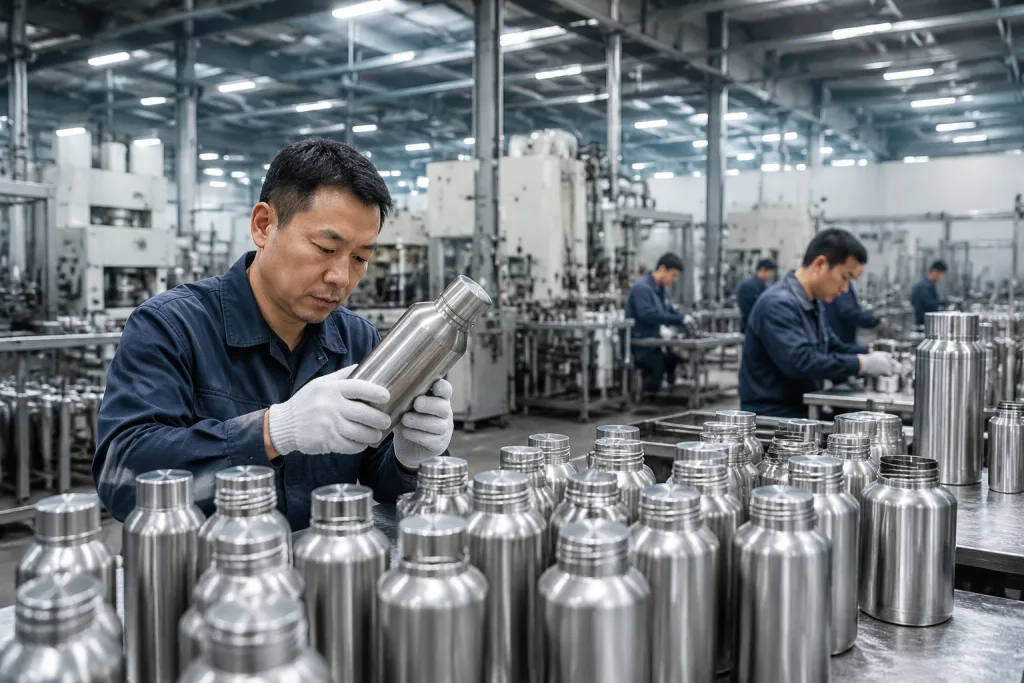
Inspection Before The Balance
I’ll rewrite the four paragraphs in place, keep the HTML exactly as-is, and make the copy sound like a real factory-side sales engineer. Next I’m patching the prose only, with concrete QC details and cleaner buyer-facing language.Do not leave QC as a line at the bottom of the PO. For a bulk thermos run, lock the inspection plan before the deposit goes in. We usually set pre-production sample approval, an inline check at 20-30% of production, and a final random check when 80-100% is packed. For most distributor thermos orders, we run AQL 2.5 for major defects and AQL 4.0 for minor defects. Critical defects stay at zero tolerance: leaks, unsafe burrs, wrong material, or mold contamination. QC pulled a leaked unit once at 48 hours, and that batch never made it out.
Your checklist needs numbers, not slogans. Check capacity, weight tolerance, wall finish, lid fit, gasket placement, leak test, vacuum performance, coating adhesion, logo position, barcode scan, carton drop, and packing count. For Amazon or retail cartons, add FNSKU or EAN scan checks on at least 32 units from different cartons. A buyer once flagged one carton with a wrong EAN on the line; the rework cost more than the bottle itself.
Vacuum performance has to come from retained mass-production samples, not just the golden sample. We test with 95°C water, measure after 6 hours at 20°C ambient, and log the result by batch number. For cold-retention claims, define the ice-to-water ratio and the test time in writing. “Keeps cold all day” is a marketing line, not a spec. The math does not work without a fixed test method.
Ask your thermos supplier for inspection photos and serial production records. If the order is above 5,000 units, a third-party inspection is usually worth the USD 250-350 in China. We have seen this go sideways on a PO typo for carton mark and finish code, and the container still had to be opened in port. It is cheaper than sorting defects after the ship lands in Rotterdam, Hamburg, Los Angeles, or Toronto.
Packaging And Channel Fit
I’ll rewrite the section in place, keep the HTML exactly as-is, and tune the prose to sound like a factory-side sales engineer wrote it. Then I’ll return only the rewritten HTML.Packaging is a channel spec, not decoration. Outdoor retailers usually want a clean color box, hang tag, recyclable claim support, and a barcode that scans in their warehouse system. We’ve had buyers flag a barcode that passed on the sample but failed on the DC scanner. Promotional brands may ask for individual white boxes, bulk master cartons, or gift boxes for corporate distribution. A thermos distributor handling 6 or 8 accounts often needs neutral packaging with account-specific stickers.
Set the packaging spec with numbers: box material, flute type, print colors, insert type, polybag requirement, carton quantity, carton gross weight, and pallet preference. A single-wall color box often uses 300-350 gsm paperboard, while heavier gift packaging can add USD 0.25-0.70 per unit. Removing the polybag sounds tidy, but the coating still has to survive box rub in transit. QC pulled a sample last month; the matte print scuffed after a 4-hour vibration test.
For Europe, your importer or compliance team should check packaging waste rules and recycling marks before release. For North America, retail customers may ask for country of origin marking, warning labels, or master carton routing labels. We once saw a PO typo on the carton mark, and the buyer held the lot for 12 days. If you are ordering thermos bulk for events, make sure carton marks match the delivery schedule and venue receiving rules.
At BottleForge Industrial in Hangzhou, Zhejiang, we review the sell-through channel before we quote final packaging. A mountain shop does not need the same box as a conference giveaway, and that is the wrong question to ask if you want clean landed cost. Good thermos suppliers should push back when the packaging plan raises freight, damage risk, or compliance trouble. We run this check with the line before release, because a 2 mm carton change can move the whole pack-out.
Send Us Your Thermos Spec Sheet
Share capacity, color, logo, packaging, and target price. We will return a practical FOB quote and point out risky spec gaps.
Frequently asked questions
What MOQ should I expect from suppliers stainless steel bottle factories?
For existing stainless thermos molds, a realistic MOQ is usually 1,000 units per color and 3,000 units per style for better FOB pricing. If you need a special Pantone powder coating, the coating line may require 2,000 units because powder loss is high on small runs. New lid tooling is a different case: expect 3,000-5,000 units MOQ, USD 2,000-8,000 tooling cost, and about 25-35 days for mold sampling. A supplier offering 200 units with full customization may be trading stock, not running factory production.
How long does a customized thermos order take from China?
For an existing mold with laser logo or silk screen printing, plan 7-10 days for sampling and 30-45 days for mass production after sample approval and deposit. Add 5-10 days if you need custom color matching, new packaging artwork, or compliance testing. New lid or body tooling can add 25-45 days before mass production starts. Ocean freight to Europe or North America commonly adds 25-40 days port to port, depending on route and season. Air freight is faster but often makes sense only for samples or urgent promotional thermos campaigns.
What should I check before approving a thermos factory sample?
Check more than the logo. Measure capacity, height, diameter, mouth opening, empty weight, lid torque, coating texture, color against Pantone, logo position, and packaging fit. Run a basic leak test by filling the bottle, closing it, inverting for 30 minutes, and shaking for 20 seconds. For insulation, fill with 95°C water and record temperature after 6 hours at 20°C ambient. Also inspect inside welds, rim smoothness, silicone gasket removal, and odor. If the sample passes visually but fails the leak or heat test, do not approve mass production.
Is laser engraving better than silk screen for a custom thermos?
Laser engraving is usually better for outdoor retailers because it is permanent and resists abrasion on powder coating. It typically adds USD 0.08-0.18 per logo position, depending on size and run speed. Silk screen is good for simple one-color promotional logos and may cost USD 0.05-0.12 per position at volume, but ink quality and curing must be controlled. For multi-color artwork, heat transfer may be cleaner, though it is less rugged than laser. If the bottle will be clipped to packs or used outdoors, choose durability over the lowest logo cost.
How do I compare two thermos supplier quotations fairly?
Build a side-by-side spec table before looking at the final price. Compare steel grade, wall thickness, vacuum layer, lid material, gasket quality, coating type, logo process, packaging, carton quantity, inspection standard, MOQ, and lead time. Ask both suppliers to quote FOB China under the same Incoterm and same artwork. A USD 4.10 bottle with thin paint and a weak lid is not cheaper if your return rate becomes 3-5%. For distributor thermos orders, a slightly higher unit cost often protects margin by reducing claims and late rework.