Key Takeaways
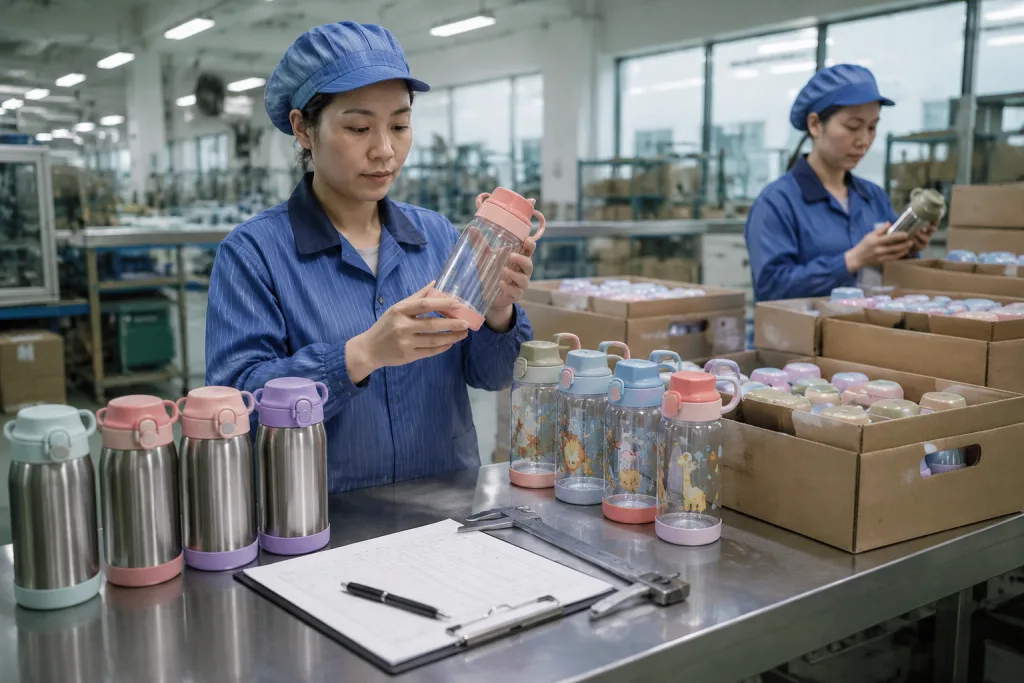
- Stainless kids bottles usually cost USD 3.20–5.80 FOB China at 3,000 units, depending on lid and coating
- Tritan is lighter for younger pupils, but it needs tighter drop testing around hinge pins and straw lids
- AQL 2.5/4.0 inspection should cover leaks, lid torque, coating adhesion, odor, and carton drop checks
- For school district programs, choose 350–500 ml capacity before arguing over logos or packaging
School bottle buying looks simple until the quotes hit your inbox. We see this every week: one children water bottle supplier prices 304 stainless steel at 350 ml, another quotes Tritan with a flip lid, and a third comes in lower with PP plus a soft straw. The math does not work until you pin down material grade, capacity, lid type, test standard, packing, and logo method. Last month a buyer flagged a USD 0.42 gap that was only a 0.6 mm wall thickness difference.
For school district buyers and kids-product importers, the wrong spec turns into returns fast: wet backpacks, cracked flip lids, paint chips, or REACH paperwork stuck at customs. QC pulled the sample. The silicone straw had a 1.8 mm burr at the cut edge, which is exactly the kind of small miss that parents complain about first. BottleForge Industrial in Hangzhou, Zhejiang works with bulk kids water bottle projects every season, with MOQs from 1,000 units per color and normal production lead time of 25–35 days after sample approval.
The Spec Table Buyers Actually Need
I’ll rewrite the prose to sound like a factory-side sales engineer, keep the HTML intact, and preserve all existing numbers and table structure. Then I’ll sanity-check that the tone is sharper, more specific, and less AI-like.If you ask five suppliers school water bottle quotes without a spec sheet, you will get five different products. We see this every week on the line. One children water bottle factory in China sends a 350 ml single-wall stainless bottle, another children water bottle manufacturer quotes a 500 ml vacuum bottle with powder coating and a silicone straw. Same phrase, different math. The landed cost and the failure risk are nowhere close.
Use this head-to-head table before you request pricing for a bulk school water bottle order. QC pulled a sample with a 0.8 mm wall last month, and the buyer flagged it on first check.
| Spec | Stainless vacuum | Tritan plastic | PP school bottle |
|---|---|---|---|
| Typical capacity | 350–500 ml | 400–600 ml | 350–500 ml |
| FOB China range | USD 3.20–5.80 | USD 1.80–3.20 | USD 1.10–2.10 |
| MOQ | 1,000–3,000 pcs/color | 2,000–5,000 pcs/color | 5,000 pcs/color |
| Best use | District premium programs | Retail and younger kids | Promotional giveaways |
| Main risk | Coating chips, dent claims | Hinge and straw wear | Odor and deformation |
For a children water bottle distributor, the stainless option gives the strongest shelf appeal and margin. For children water bottle promotional orders, PP keeps the budget tight. For a children water bottle custom retail line, Tritan usually wins because parents can see the water level and teachers can check whether pupils are drinking enough. We’ve seen the wrong bottle choice go sideways on a 20,000 pcs school order.
Do not approve a quote until the factory states wall thickness, lid material, silicone grade, test standard, packing method, and replacement spare rate. Ask for the PO to spell out every one of those points; a typo on one lid item can cost a week. We normally recommend 1% spare lids for school tenders and 0.5% spare straws for retail importers.
Stainless Versus Tritan Versus PP
I’ll rewrite the section in place, keeping the HTML tags and the original specs intact while making the prose sound like a factory sales engineer wrote it.The material call is not about “best.” It is about which problem you can live with. A 304 stainless custom kids bottle takes daily knocks, holds temperature better, and looks like a higher-end item on the shelf. For a 350 ml vacuum bottle, we usually run 0.4 mm inner wall and 0.5 mm outer wall. That is enough for most school use. Go thicker and you add weight and freight cost, but the lid still gets abused the same way.
Tritan sits in the middle for a bulk children water bottle program. It is BPA-free, clear, and lighter than stainless. A 450 ml Tritan bottle with a flip straw can stay under 120 g before packaging, which matters for pupils aged 5–8. The body is not the weak point. The hinge pin, button spring, and straw sealing plug are where we see trouble. QC pulled the sample on a 3,000 open-close cycle test and a 1.2 m drop test on six sides; that is the line you should ask for.
PP is cheap and works for short runs. If you are buying children water bottle wholesale for a summer camp, sports day, or sponsor giveaway, PP can be the right choice. We have seen this go sideways when resin quality slips: odor shows up, and thin walls deform under hot filling. Do not promise dishwasher safety unless the supplier has tested repeated cycles at 70°C. Otherwise the buyer will flag it after the first complaint.
For school district buyers, we usually narrow it to two options: 350–420 ml stainless vacuum for premium programs, or 450–500 ml Tritan for daily classroom use.
If a children water bottle vendor quotes 25% below market, check the lid spec, the straw material, and traceability on the resin batch. Food-grade PP in the lid, LFGB-grade silicone for the straw, and clear lot records are the basics. The math does not work any other way. That is where small children water bottle vendors hide the cost.
Lids Decide Most Complaints
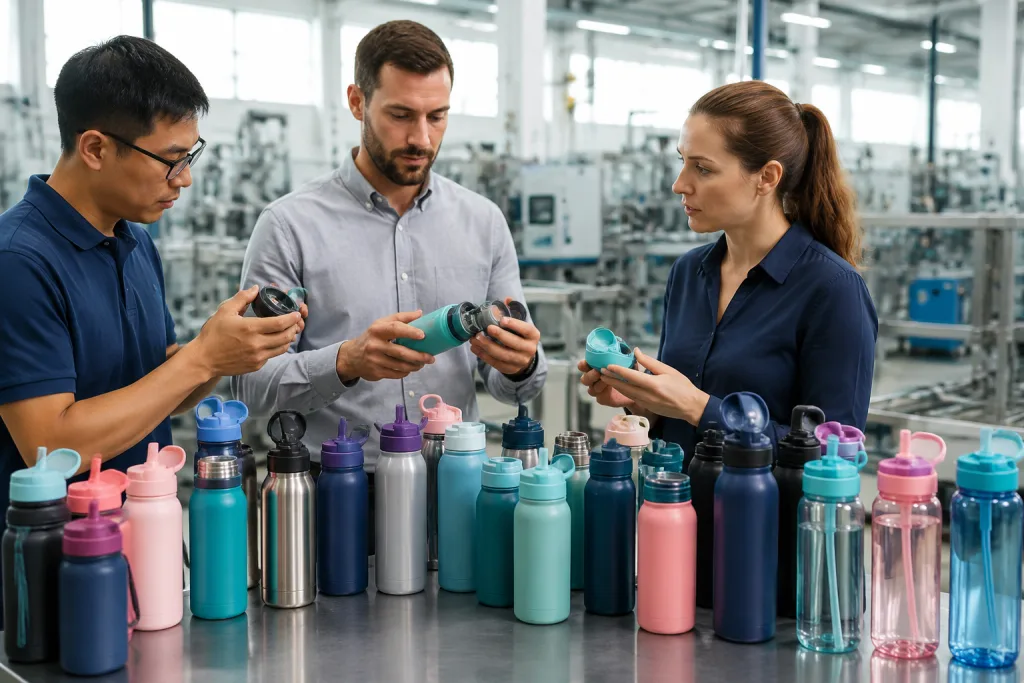
I’ll rewrite the section in place, keep the HTML structure intact, and tune the prose to sound like a factory-side sales engineer.The bottle body gets the drawing, but the lid drives most after-sales trouble. For a custom school water bottle, compare three lid styles side by side: screw cap, flip straw, and push-button spout.
A screw cap seals best and costs least to mold. It suits older pupils and lunch bags, but younger children drop caps all the time. A tether fixes part of that, yet it adds one silicone part and that piece still needs pull-force checks on the line. Flip straw lids are easier for kids and common in children water bottle customized retail programs. They leak when the straw slit, vent plug, or closure angle is off by even a small amount. Push-button lids feel premium, but the spring and latch need tighter inspection, and we have seen buyers flag a bad latch after 500 cycles.
For a custom logo kids bottle order, do not pick a lid just because the rendering looks clean. Ask for these checks on pre-production samples:
- Leak test: 30 minutes inverted after filling to 90% capacity.
- Drop test: 1.2 m onto plywood or concrete, depending on your market claim.
- Torque test: screw lid closure should stay consistent after repeated use.
- Small parts check: relevant for ASTM F963 and EN 71 risk review.
- Dishwasher claim: only if resin, print, and seals survive heat cycling.
In Zhejiang, we see importers over-spec the bottle body and under-spec the lid. That is the wrong question. If you sell to schools, leakage is not a minor defect. A wet textbook turns into a parent complaint, not just a return. On AQL inspection, we treat functional leakage as a major defect, often under AQL 2.5, and critical safety issues at zero tolerance. QC pulled the sample, shook it twice, and the cap still wept at the threads—that is the kind of miss that costs real money.
Branding Methods Side By Side
I’ll keep the HTML exactly as-is and tighten the prose so it sounds like a factory-side sales note, with more concrete numbers and shop-floor detail.A children water bottle customizable program needs branding that survives kid use. The right method depends on the material, order size, and whether the bottle is a school uniform item, retail SKU, or promotional gift. We run this choice against the line, not in a sales deck.
Silkscreen printing is the standard for simple school crests, mascot graphics, and one- or two-color logos. On stainless powder coating, it works well at 1,000 units and usually adds USD 0.08–0.18 per color per position. On Tritan, adhesion depends on surface treatment and ink selection. QC pulled the sample, and the tape test failed on one glossy panel, so we do not approve mass production until the rub test passes too.
Laser engraving is cleaner for stainless bottles. It will not peel, and it looks more premium, but it cannot produce full-color artwork. For district names, graduation years, or a simple mascot, engraving is the safer call. It often adds USD 0.15–0.35 per unit depending on the area and cycle time. The buyer flagged a PO typo on the logo file once, and engraving saved the run because there was no ink color to match.
Heat transfer gives full-color graphics and is common for children water bottle promotional campaigns. It looks sharp, but edge adhesion and scratch resistance still need checking. For children water bottle custom designs with cartoon art, we suggest testing 20 sample pieces through abrasion, hot water exposure, and tape pull before you sign off. We’ve seen this go sideways when the artwork had thin white borders and the dryer ran 12 days late.
For a custom made kids bottle with a shaped silicone boot, colored straw, and retail box, tooling and setup can matter more than unit price. New lid molds can cost USD 3,000–8,000. A custom silicone boot mold may cost USD 500–1,500. If you are only ordering 2,000 units, the math does not work to chase a fresh mold; use an existing mold and put the budget into better coating, stronger carton stock, or a second spare straw. The boot tool we checked last month was 0.3 mm off at the rim, and that small gap turned into a loose fit on the first trial.
Compliance Is Not Paperwork Decoration
I’ll rewrite the four paragraphs to sound like a factory-side sales engineer, keep the HTML intact, and make the compliance points more concrete without changing the headings or tags.Kids products need tighter paperwork than adult drinkware. If you are a children water bottle distributor selling into Europe or North America, ask for the exact compliance pack before you pay a deposit. “Food safe” in an email is not enough—we’ve seen that go sideways at customs.
For Europe, the usual ask is LFGB food contact testing, REACH screening for restricted substances, and EN 71 checks if the bottle has playful parts or is sold as a child-use article. For the United States, check FDA food contact expectations, CPSIA where applicable, and ASTM F963 risk points for small parts and parts a child can pull off. Canada may add checks under CCPSA expectations. One buyer once sent a PO with “FDA ok” typed in the remarks box; QC pulled the sample and the math did not work.
For stainless steel, confirm 304 or 316 grade with material declarations and migration tests. For Tritan and PP, get BPA-free proof and resin source traceability. For silicone straws and seals, ask for food-grade silicone testing and colorant coverage. A children water bottle supplier should not mix untested colored silicone into a kids product to save USD 0.03 per set; we run that cost through the line every day, and it is the wrong place to cut.
Factory audits matter too. BSCI, Sedex, or ISO 9001 do not guarantee a perfect bottle, but they do show the children water bottle factory has a real management structure. BottleForge Industrial works from Hangzhou, Zhejiang with partner lines that can produce about 300,000–500,000 drinkware units/month depending on season and product mix. For school tenders, we lock production slots 45–60 days before your ship date because August and September crush capacity across China. One PO typo on a cap color can cost a full week, so we check it twice before the line starts.
Use-Case Fit For Real Buyers
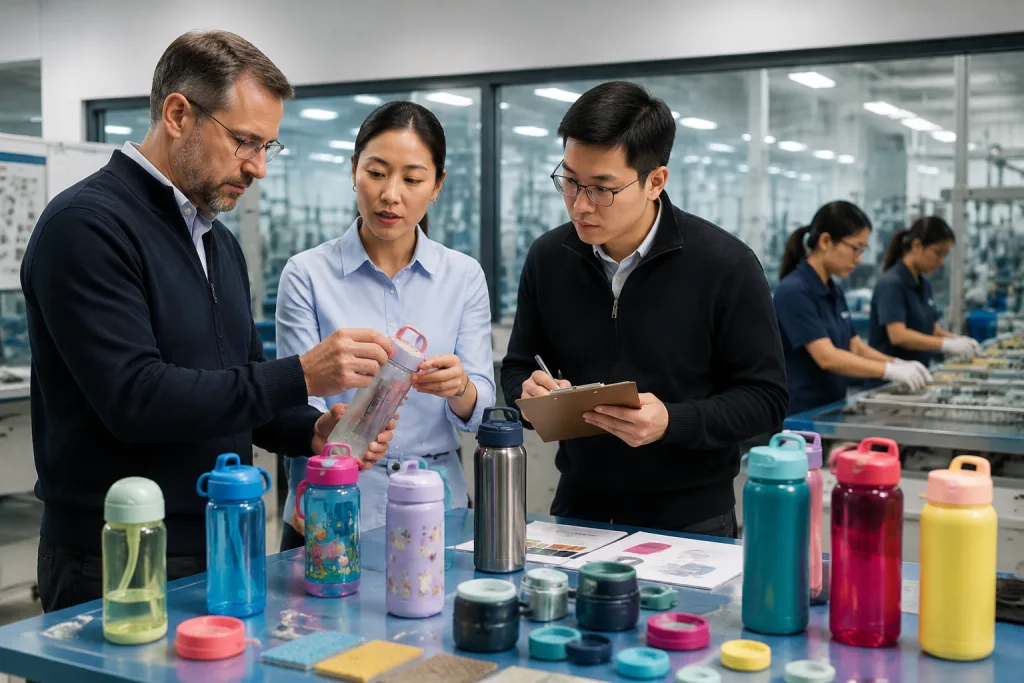
I’ll rewrite the section in-place, keeping the HTML tags and headings intact, and make the copy sound like a real export salesperson with tighter buyer-specific detail.Different buyers should not buy the same bottle. A school district buyer wants a low complaint rate, safe parts, and replenishment that lands on time. A kids-product importer wants shelf appeal, margin, and packaging that survives the truck. A children water bottle distributor may need both, but the channel decides the priority.
School district procurement
Choose 350–420 ml stainless vacuum or 450 ml Tritan with a lid we already run on the line. Keep the shape simple so it fits backpack side pockets and classroom cubbies. Skip oversized 650 ml bottles for younger pupils; once filled, the weight gets ugly. Use laser engraving or one-color silkscreen. Pack in plain white boxes or kraft boxes to cut cost. On a 5,000-unit bulk school water bottle order, FOB usually lands at USD 2.20–3.40 for Tritan and USD 3.80–5.20 for stainless.
Retail kids-product importers
Retail needs more shelf difference. Go with color-matched lids, silicone boots, hang tags, barcode labels, and inner display cartons. For FBA or marketplace channels, check FNSKU labeling, carton weight under 15 kg where practical, and master carton drop strength; QC pulled a sample last month and the 1.2 m drop cracked a cheap lid hinge, so this is not a box-only problem. A custom children water bottle for retail needs replacement parts planned before launch, not after the first warranty claim.
Promotional and event buyers
If the bottle is for a campaign, PP or single-wall stainless is enough. Keep artwork simple and avoid a messy lid stack. For children water bottle promotional orders on a tight budget, spend on leak testing, not a fancy box. Parents remember leaks. We’ve seen that go sideways fast.
When comparing children water bottle suppliers, ask each one to quote the same drawing, same material, same logo, same packing, same Incoterm, and same inspection level. Otherwise you are not comparing factories; you are comparing assumptions. The buyer flagged one PO with a missing “s” in carton spec, and that tiny typo changed the quote by USD 0.18 a unit.
Quoting Without Getting Trapped
I’ll rewrite this section in-place, keep the HTML exactly as-is, and make the prose sound like a factory-side sales engineer wrote it.A clean RFQ saves weeks. Send capacity, material, lid type, target age, logo file, packaging requirement, destination port, compliance market, and annual forecast. If you need children water bottle bulk pricing for 3 school districts, split the firm first order from the forecast. Factories price a real PO differently from “maybe 50,000 units later.” We run this check on every quote, and the math does not work any other way.
For a first custom kids water bottle project, we use a straight buying sequence: confirm the existing mold, approve 2–3 physical samples, run compliance review, lock artwork, approve the pre-production sample, inspect mass production under AQL, then release the balance. QC pulled the sample with a caliper on the line, and that 0.3 mm lid gap is the kind of thing that turns into a buyer flag later. Sampling usually takes 7–12 days for existing molds and 20–35 days if new tooling is involved. Mass production normally takes 25–35 days after approval, but peak season in China can add 7–10 days.
Payment terms for new buyers are commonly 30% deposit and 70% before shipment after inspection. FOB Ningbo or FOB Shanghai are common for Zhejiang factories. If you need DDP delivery, ask for duties, testing, and last-mile handling to be shown separately. We’ve seen a low DDP number hide weak insurance and a customs assumption that never clears. That is the wrong question to ask.
Keep one approved golden sample at the factory and one in your office. For children water bottle manufacturers, this cuts out arguments about color shade, lid feel, print position, and coating texture. The buyer flagged a PO typo on “pantone” once, and we fixed it against the golden sample before the line started. It gives you a hard reference when the next reorder starts 6 months later.
Send your school bottle spec for a factory quote
Share capacity, material, logo, quantity, and target market. We will reply with practical options, MOQ, FOB pricing, and lead time.
Frequently asked questions
What is the normal MOQ for a custom kids water bottle?
For existing molds, a practical MOQ is 1,000 pieces per color for stainless steel and 2,000–5,000 pieces per color for Tritan or PP. If you need a custom made kids bottle with a new lid, new body shape, or exclusive silicone boot, the MOQ often rises to 5,000–10,000 pieces because tooling and color setup must be spread across more units. For school tenders, we can sometimes combine two logo versions if the bottle color and packing stay the same, but each artwork still needs its own printing setup and inspection control.
Which bottle material is safest for elementary school pupils?
304 stainless steel, Tritan, and food-grade PP can all be safe if the raw material and lid components are tested correctly. The safer choice depends on age and use. For ages 5–8, Tritan is light and easy for teachers to monitor water intake. For ages 8–12, stainless vacuum bottles handle rougher daily use and give better perceived value. Ask for LFGB or FDA food-contact testing, BPA-free declarations for plastic parts, and silicone migration tests. For any children water bottle customized with bright colors, test colorants as well as the base material.
How much should I budget for bulk kids bottle orders?
At 3,000 units, FOB China pricing is commonly USD 3.20–5.80 for stainless vacuum kids bottles, USD 1.80–3.20 for Tritan flip-straw bottles, and USD 1.10–2.10 for PP promotional bottles. Logo method, lid complexity, carton strength, and testing can move the price by 10–25%. Do not compare a plain PP bottle against a powder-coated stainless bottle with laser engraving and retail box. If your landed budget is fixed, tell the factory your target retail or tender price first, then let engineering adjust material, capacity, and packing.
Can one supplier handle school districts and retail importers?
Yes, but you should check whether the children water bottle supplier understands both channels. School district buyers usually need durable products, simple packing, compliance files, and stable reorder colors. Retail importers need barcodes, FNSKU labels, display packaging, spare parts, and carton specs for warehouse handling. A capable children water bottle manufacturer should quote both versions from the same core mold if possible. For example, one 450 ml Tritan body can be packed in a plain school carton or a full-color retail box, saving tooling cost while serving two channels.
What inspection standard should we use before shipment?
Use third-party or buyer inspection under ANSI/ASQ Z1.4, commonly AQL 2.5 for major defects and 4.0 for minor defects, with critical safety defects at zero tolerance. For a bulk kids water bottle order, inspection should include leak testing, lid function, straw fit, odor, logo position, coating adhesion, carton drop condition, barcode scanning, and quantity count. For school programs, we recommend pulling extra samples for destructive drop testing because normal visual inspection will not reveal weak hinge pins or brittle lids. Inspection should happen before the 70% balance is released.