Key Takeaways
- A 0.5 mm wall-thickness miss can change weight, feel, and leak risk across 10,000 units.
- For imported custom drinkware, ask for AQL 2.5/4.0 inspection and carton drop testing before FOB shipment.
- Most print failures come from poor surface prep, not bad artwork; laser engraving is safer than soft coatings for high-wear use.
- A realistic MOQ for many canteen customizable programs is 500-1,000 units, but complex lids or molds can push it to 3,000+
Buying from suppliers refillable water bottle factories is simple on paper. Pick the wrong one, and the problems show up after the deposit: lids leak in transit, coatings fail carton rub tests, logos wash off after two dishwasher cycles, or a “sample-approved” bottle shifts wall thickness on the line. If you source for a brand, distributor, or retail program, that turns into chargebacks and slow emails fast.
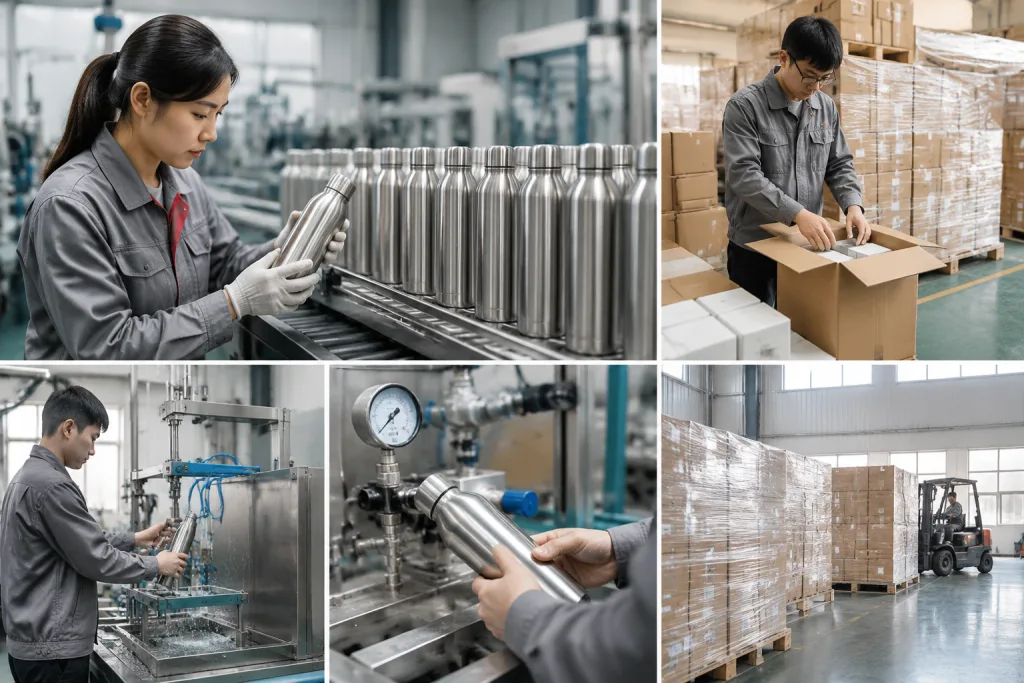
The better way is to buy backward from failure. At our Zhejiang factory in Hangzhou, we treat every canteen custom order as a risk list: material mix-up, tooling drift, print adhesion, drop test failure, packaging crush. That matters whether you need a canteen manufacturer for 3,000 units or a canteen supplier for 80,000 units. China has capacity; the real question is control. BottleForge runs about 650,000 units per month, MOQ starts at 500 pieces for many bottle models, and standard lead time stays around 25-35 days after sample approval.
Where Refills Fail First
I’ll rewrite the prose to sound like a supplier-side sales engineer, keep the HTML structure intact, and strip the AI-ish phrasing.The first failure is usually not the bottle body. It is the interface: cap seal, threading, gasket compression, or the way the spout sits under heat. We have seen a 24-hour leak check pass, then fail at 45°C because the gasket relaxes after the cap sits in a hot carton. If you are sourcing from canteen suppliers in China, ask how they test closure torque, drop impact, and thermal cycling. A serious canteen factory gives you the torque range in N·m, not a hand-wave.
For stainless steel and reusable plastic models, the weak points show up fast. One-piece lids crack at the hinge after 3,000 cycles. Soft-touch coatings scuff at 15-20 carton rub cycles. Threaded caps cross-thread when the pitch is too fine for glove-on handling. We run a 2.5 mm neck check on the line for mixed-SKU programs, because the buyer flagged a growler lid that would not seat on a standard sports cap. That mistake turns into returns.
Spec around the failure, not the sales pitch. If the vendor cannot name the weak point, they probably have not tested it.
If you need a canteen promotional item for events, do not chase unit cost only. The math does not work. Saving $0.18 on cap hardware means nothing if the leakage rate jumps from 0.3% to 2.0% in transit. We ship enough cartons to see this go sideways fast, and QC pulled the sample because the PO had a typo on the gasket code. That is how “cheap” custom drinkware becomes expensive inventory.
Material Choice Under Stress
I’ll rewrite the section in-place, keep the HTML structure untouched, and make the wording sound like a factory-side sales engineer wrote it.Most buyers ask for 18/8 stainless, Tritan, aluminum, or borosilicate glass as if the material alone decides success. It does not. Wall thickness, draw depth, weld quality, and the finish line decide how the bottle holds up. For a stainless bottle, 0.4-0.5 mm wall thickness is common in mid-market production; go thinner and denting climbs, go thicker and the unit price moves fast. We had one PO typo list “0.35” instead of “0.5 mm,” and the buyer only caught it after QC pulled the sample. In Zhejiang, we still see canteen factories quote “premium” without saying whether the inner wall is 304, 316, or recycled blend content.
For a custom canteen or customizable canteen used in sports, check odor retention, taste neutrality, and dishwasher tolerance. For a custom growler, neck geometry matters because carbonation pressure and repeated filling put stress at the shoulder. If your buyers include outdoor distributors, ask for ASTM or ISO references tied to the actual material, not a generic “food grade” claim. The same goes for reusable plastic: REACH compliance is necessary, but it does not tell you if the cap will warp at 60°C during container unloading in summer. We’ve seen that go sideways on a 12-day sea lane into a 40°C yard.
A canteen vendor worth using will give you a material spec sheet with alloy grade, thickness tolerance, and coating stack. If they cannot, you are buying a sample, not a production standard. That is the wrong question to ask the line with only a brochure in hand.
Decoration That Survives Use
I’ll rewrite the section in place, keep the HTML tags intact, and tighten the sales-engineer voice with concrete factory details and fewer AI-ish transitions.Printing is where a lot of canteen distributors get burned. A logo can look clean on the pre-production sample and still fail after 50 hand washes if the surface was not etched, flame-treated, or primed the right way. On powder-coated bottles, screen print can chip at the edges when the curing window is too short. On glossy stainless, pad print can smear if polishing leaves oil behind. For a canteen promotional run, ask for the adhesion test method on paper, not just the color count.
Be practical when you compare custom drinkware decoration methods. Laser engraving is tough and clean, but it does not fit every full-color brief. Silk screen works well for one or two Pantone colors. UV print gives more graphic range, but QC has to keep the surface clean; we run alcohol wipe checks on the line before print. If you want canteen customizable products for retail, ask for a 48-hour adhesive tape test and a 10-cycle dishwasher check on one decorated sample. We use those tests because buyers return bottles, not artwork.
For distributor drinkware orders, insist on a signed artwork proof with exact placement in mm, because “centered by eye” is how repeat orders drift. QC pulled a sample last month where the logo sat 2.8 mm off on a 500 ml bottle, and the buyer flagged it immediately. Good factories in China document print tolerance at ±1.5 mm. That is the line between a clean shelf program and a messy one.
Tooling and MOQ Reality
I’ll keep the HTML tags unchanged and rewrite the three paragraphs with tighter, more natural buyer-language, while preserving the numbers and production logic.Tooling is where quotes stop being clean. Ask a canteen manufacturer for a custom body shape, a flip lid, and a new straw system, and you are paying for engineering hours, mold steel, and trial scrap. We ran this on one line last quarter: MOQ moved from 500 pieces to 3,000, then 5,000 when the buyer changed the lid twice. That is not a tactic. It is the math of changeovers.
Ask the canteen factory one straight question: is the shape on existing tooling, or do we need new tooling? Existing tooling usually means a lower MOQ and 7-10 days faster sampling. New molds add cost, but they also lock the design in, so the supplier cannot swap the lid profile after PO. We had a buyer flag a 0.3 mm rim mismatch on pre-production samples; QC pulled the sample off the table, and that saved a bad batch. If you are a canteen distributor or brand owner, build the spec around which parts are standard and which are custom. That beats trying to shave $0.22 per unit at the wrong stage.
For Zhejiang factories, the usual lead time is 25-35 days for decorated orders, 15-20 days for plain stock, and 35-50 days if new tooling is required. A good supplier can tell you those days without blinking. If they say “fast” but leave the calendar blank, the math does not work.
Testing the Shipment, Not the Sample
I’m rewriting the section in place and keeping the HTML structure unchanged. I’ll tighten the sales-engineer tone, add a few shop-floor specifics, and strip the AI-ish filler.A sample can pass and the shipment can still fail. We see that split all the time. One operator over-tightens the cap, one gasket lot runs softer, one carton comes in 3 mm under spec, and the line turns a clean sample into a rejected lot. The fix is a pre-shipment inspection with AQL, not another polite email. For drinking vessels, AQL 2.5 for critical defects and 4.0 for major defects is a workable baseline when the program is commercial, not life-or-death.
Ask for batch photos, leak-test records, and random carton counts. If you import custom drinkware into North America, the carton label, barcode position, and FNSKU handling need to be locked before the cargo leaves China. For a distributor growler or custom canteen run, we also push transit tests: top-load, drop, and vibration. QC pulled one sample last month with a bent lid after a 12-day run on weak pallet wrap, while the same pack held fine at 18 days with corner boards.
A reliable supplier refillable water bottle program should ship 1% extra spares for caps, seals, or straws. The math works; reopening a sea freight claim does not. We run that number because a buyer once flagged a PO typo on seal size, and the spare kit saved the whole order. In Zhejiang, the factories that handle export well treat packaging as product quality, not a side job.
How to Specify Like a Buyer
I’ll rewrite the three paragraphs in-place, keeping the HTML tags intact and tightening the copy so it sounds like a buyer-side factory spec note.Your spec sheet should read like a production instruction, not a wish list. Put capacity in ml and oz, wall thickness, finish, lid type, gasket material, logo method, carton count, and test method on the page. A canteen custom order without those points invites substitutions. If you want a customizable growler, say if it must fit a cup holder, if it is cold-fill only, and if the closure must survive carbonated drinks. We’ve seen that last one go sideways on a 48-hour pressure check. A canteen distributor selling to retail chains should lock carton dimensions too, because a 2 cm change can upset pallet count and freight in one shot.
Good specs include accepted tolerances. Write capacity ±3%, print position ±1.5 mm, lid fit no leak after 24-hour inversion, and coating adhesion pass after cross-hatch test. If you want custom canteen or customized canteen units for premium channels, ask for a signed sample kept by the factory and by you. QC pulled the sample on our line after one buyer flagged a 2 mm logo shift; that is how you stop sample drift on repeat orders. The best factories in China do not push back on strict specs. They want them, because fewer arguments hit the PO later.
When you compare canteen vendor options, do not ask only for unit price. Ask for price at 1,000, 5,000, and 20,000 units, sample lead time, freight-ready carton spec, and whether the same line can run future custom drinkware without new tooling. On one PO, the buyer wrote “5,00 units” instead of “5,000,” and the math did not work until we confirmed the order by email. That is how you buy once and reorder cleanly.
Send your spec sheet for a factory review
We’ll check MOQ, lead time, decoration method, and packaging risk before you place the first order from China or Zhejiang.
Frequently asked questions
What MOQ should I expect for suppliers refillable water bottle orders?
For standard stock molds, MOQ often starts at 500-1,000 units in Zhejiang factories. If you need new tooling, a special lid, or a custom shape, MOQ can move to 3,000-5,000 units. The driver is not marketing; it is setup loss, mold amortization, and line changeover time. If a supplier quotes 200 pieces for a fully customized canteen, ask how they handle print setup, packing, and defect allowance. A realistic MOQ should also match the decoration method: laser engraving may stay low, but multi-color UV print or custom packaging usually raises the minimum.
How do I reduce leak risk in a custom canteen program?
Start with the closure system, not the bottle body. Ask for gasket material, cap torque range, and a 24-hour inversion leak test. For reusable bottles, use food-grade silicone gaskets with documented compression set performance. In production, ask for random pull tests at AQL 2.5 critical. If the bottle will be filled hot, specify thermal cycling from 5°C to 60°C. For distributor drinkware, add transit checks too, because many leaks happen after carton shock, not during factory inspection.
What certifications matter for canteen suppliers in China?
For Europe and North America, ask for REACH, FDA-related material declarations where relevant, and basic material traceability. If you need retail compliance, ask whether the canteen manufacturer holds BSCI or similar social audit results. Certifications do not replace testing, but they help you clear customs and retailer onboarding. For stainless steel, request the alloy spec and finish process. For coatings, ask about heavy metal limits and migration testing. A good supplier in Zhejiang will provide documents without drama if the production system is real.
Should I choose laser engraving or printed branding?
If the item will be washed often or sold as premium custom drinkware, laser engraving is the most durable. It will not peel, and it typically survives abrasion better than silk print. If you need Pantone color or a more promotional look, screen print or UV print can work, but you should test adhesion and dishwasher exposure. For canteen promotional programs, I usually recommend engraving for high-use SKUs and print for short-run seasonal campaigns. The unit cost gap is often only $0.10-$0.35, but the lifetime durability difference is much bigger.
How long does production usually take in Zhejiang?
For standard decorated bottles, lead time is usually 25-35 days after sample approval and deposit. Plain stock can be 15-20 days. If you need new tooling or a new lid structure, expect 35-50 days, sometimes longer if you request multiple sample rounds. Freight planning matters too: sea freight to Europe or North America often adds 20-35 days depending on port and routing. A supplier that promises everything in 7 days is probably talking about a stock sample, not a commercial order.