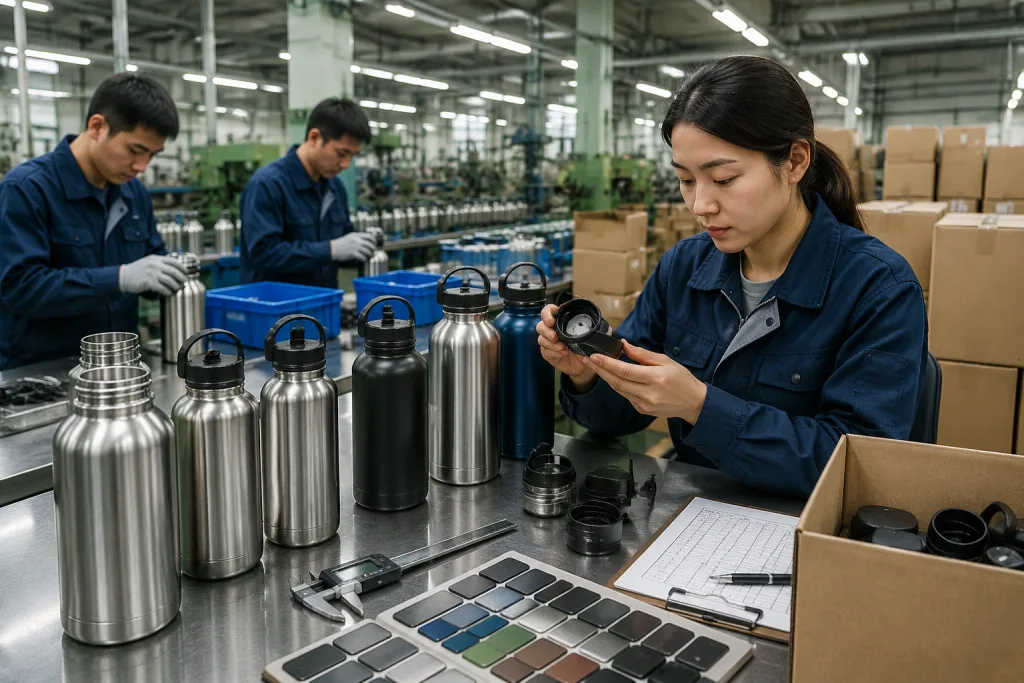
Key Takeaways
- 304 stainless steel at 0.45-0.55 mm wall thickness is the normal starting point for outdoor canteens
- A safe first MOQ is 1,000 pcs per color, with custom tooling usually from 3,000-5,000 pcs
- Powder coating adds roughly USD 0.25-0.55 per unit but improves grip and shelf appeal
- Use AQL 2.5 major / 4.0 minor inspection before shipment, not only factory photos
If you search for suppliers outdoor canteen, you do not need another shiny PDF. You need to know which spec line moves cost, drop strength, carton weight, FDA/LFGB risk, and ship date. A 750 ml canteen custom order can look clean on a quotation, then fail at the cap thread, powder coating, or logo cure. We have seen QC pull 32 samples because the silicone gasket sat 0.6 mm proud after hot-water testing.
We manufacture custom drinkware in Hangzhou, Zhejiang, and we see the same buying mistakes from canteen distributors in Europe and North America. China has 200+ factories willing to quote a canteen, but only a smaller group understands outdoor retail packs and distributor replenishment. Ask for the real spec sheet before you approve the sample. The buyer once flagged a PO typo changing “matte black” to “match black”; the line stopped for 6 hours because coating powder had already been weighed.
Capacity line changes everything
The first spec line on a suppliers outdoor canteen quote is usually capacity: 500 ml, 750 ml, 1 L, or 1.2 L. This is the wrong place to “just pick the popular one.” Capacity changes body diameter, packing cube, carton gross weight, 304 stainless usage, and the buyer profile. A 500 ml customized canteen works for school trips and light hiking, but buyers for hunting, camping, or emergency kits have pushed back on it as “toy size.” A 1 L outdoor canteen sells better for real field use, but once filled it goes over 1.2 kg; QC pulled one sample at 1.28 kg with cap and strap, and the buyer had missed that in the first PO.
For retail and distributor canteen programs, we usually run 750 ml as the safer size. It gives enough volume for outdoor use while the body still sits cleanly in a side pocket. Typical dimensions are around 85-95 mm diameter and 180-220 mm height, depending on whether the shoulder is round or flat; our caliper check on the last flat-shoulder sample showed 91.6 mm at the widest point. If you sell through e-commerce, ask your canteen supplier for master carton dimensions before you confirm the design. Small changes bite. A 3 mm diameter increase can move a carton from 24 pcs to 20 pcs, and the freight math stops working fast.
For promotional orders, capacity tolerance matters too. Stainless bodies are made by deep drawing and welding, not by magic. A declared 750 ml canteen may hold 730-770 ml depending on body geometry and the fill line. If your market requires exact net capacity marking, write the tolerance into the purchase order; we have seen this go sideways when a PO said “750ML” but the artwork file said “25OZ.” Good canteen suppliers in China will confirm practical capacity with water testing during pre-production, using a digital scale and a marked fill line. Weak canteen vendors just copy the number from the old catalog mold.
Material grade is not decoration
I’ll rewrite the section in-place, keep the HTML exactly as-is, and strip the AI-ish phrasing while adding concrete factory-floor detail and tighter buyer language.The material line is where low quotes hide the cut corners. For a custom canteen built for outdoor use, 304 stainless steel is the standard pick for the inner contact surface and often the outer shell too. We run into buyers asking why one quote is USD 0.20-0.45 lower per piece; the answer is usually 201 stainless steel, and the math does not work for serious export programs. 201 has less nickel and weaker corrosion resistance. It can pass for a dry-storage promo item, but I would not send it to Europe or North America as a real outdoor canteen.
Wall thickness needs to be on the PO, not left to guesswork. For single-wall canteens, 0.45-0.55 mm is the normal range. Once you drop below 0.40 mm, denting goes up fast, especially after a 1 m drop test onto a steel plate. Push above 0.60 mm and the body gets stiffer, but weight and cost climb with it. On a military-style customized canteen with a flatter body, this matters even more because flat panels show every hit; QC pulled one sample last month with a 0.38 mm side wall, and the buyer flagged it immediately.
If the canteen is double-wall insulated, ask straight out whether both walls are 304 stainless steel and whether the vacuum chamber is copper-plated. A vacuum canteen manufacturer may use 0.40 mm for the outer wall and 0.30-0.35 mm for the inner wall, depending on the shape and the tooling. For a custom growler or customizable growler, larger capacity raises vacuum failure risk if the welding line is sloppy. We ship 1.0 L units all the time, and pressure testing plus vacuum retention testing is what catches the bad ones before carton packing.
Compliance is not a side note. For EU buyers, ask for LFGB or EU 1935/2004 food-contact test reports on the actual material and coating system, not a generic certificate file. For North America, check FDA food-contact suitability and, where it applies, California Proposition 65 screening. REACH still matters for coatings, straps, silicone, and printed inks. We had a PO once with the word “stailess” typed wrong, and that kind of sloppy order usually comes with sloppy compliance too; a Zhejiang factory that ships regularly should know these documents without a sales lecture.
Cap and seal decide returns
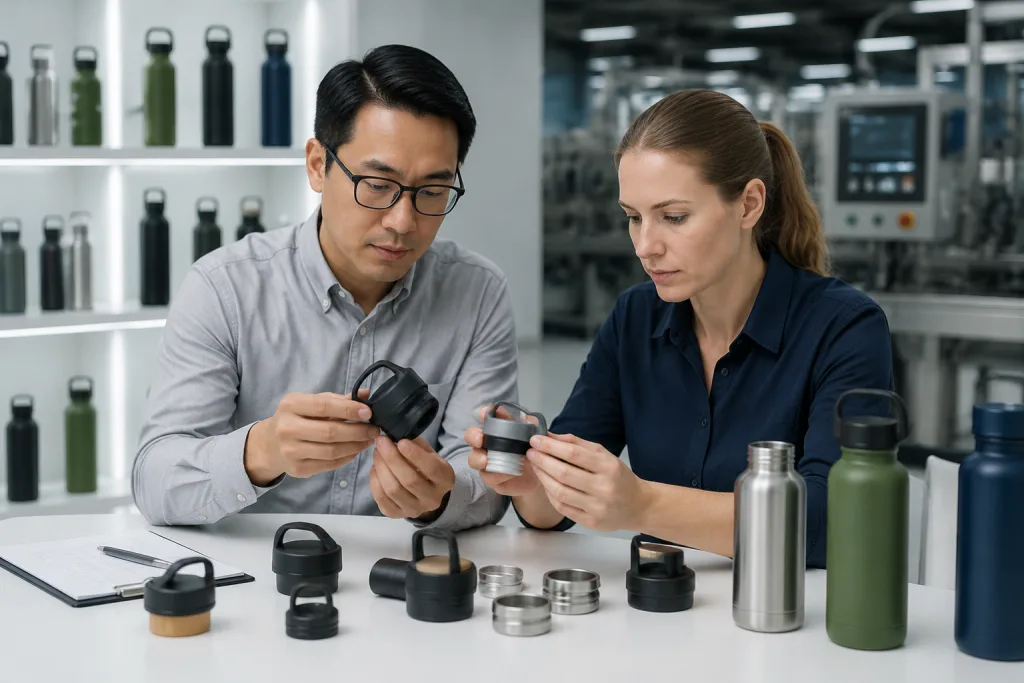
I’ll rewrite the section in place, keep the HTML untouched, and tighten the sales-engineering tone with specific factory detail and cleaner buyer language.Most field complaints on outdoor canteens are not about the steel body. They start at the cap. A canteen customizable project can use a screw cap, bayonet cap, flip cap, sport spout, or tethered cap. On paper they all look fine. On the line, the buyer flags different problems. A screw cap with a silicone gasket is still the safest leakproof option. A flip cap is quicker to sip from, but it has more moving parts and it gives up earlier in sand, mud, or freezing weather.
Spell out the gasket material. Food-grade silicone is the better call because it holds temperature better and has lower odor risk than cheap rubber. For outdoor canteens, we usually run silicone hardness at 50-60 Shore A. Softer than that and it crushes after repeated tightening; harder than that and it can miss the seal when cap threads vary by a small amount. If the canteen customized order includes a metal chain or carabiner, check the attachment point for coating rub marks after transit. We’ve seen a 2 mm scratch turn into a rejection note.
Thread design matters too. A wide-mouth opening, usually 45-55 mm, is easier to clean and takes ice cubes. A narrow mouth, around 30-38 mm, drinks better while walking but is harder to wash. If you sell to canteen distributors serving outdoor retailers, wide mouth usually wins because buyers now expect cleaning access. For canteen promotional giveaways, narrow mouth is cheaper and lighter. That’s the tradeoff, plain and simple. The math works that way.
Your purchase order should state the leak test method, not just the word “leakproof.” We fill to 100 percent with water, tighten the cap to the agreed torque, turn the unit upside down for 30 minutes, then shake it for 30 seconds. During production, we test at least 32 pcs per lot under AQL sampling. At BottleForge Industrial in Hangzhou, Zhejiang, QC pulled the sample before packing because a clean logo does not cover a cap that drips in a backpack.
Finish affects grip and shelf
I’ll rewrite the section in-place, keep the HTML tags untouched, and tighten the copy so it sounds like a factory-side sales engineer.The finish changes both grip and return rate. Bare stainless is durable and easy to clean, but it prints fingerprints fast and looks plain for a canteen promo line. Powder coating adds cost, usually USD 0.25-0.55 per unit depending on color, coverage, and order volume, yet it gives a better hand feel and a more outdoor-ready look. Spray paint is cheaper, but if pre-treatment is weak, the line starts chipping after a few knocks. For retail, powder coat usually wins.
Ask for coating thickness. On drinkware, we usually run 60-90 microns for powder coat. Too thin, and the color goes weak on edges. Too thick, and threads, grooves, or cap fit can bind; QC pulled one sample last month where the lid torque was off after a heavy coat. If your customizable drinkware line uses matte black, olive green, sand, or navy, lock the shade with Pantone or RAL and approve a physical chip. A screen image is not enough. Sunlight shifts outdoor colors, and the buyer flagged it on the second shipment for a reason.
Match the logo method to the finish. Laser engraving works well on powder coat because it burns through to the stainless steel underneath and does not peel. Silk screen printing is the lower-cost route for one-color artwork and holds up on smooth painted surfaces. Heat transfer and water transfer fit full-wrap graphics, but they need adhesion checks before you sign off. If you need a canteen customized with a large mountain graphic, run cross-hatch adhesion and a 3M tape pull before mass production. The math does not work if you skip that step.
Do not skip abrasion testing. A buyer-side check is 50 dry rubs and 50 wet rubs on the logo, plus a 1 m drop test onto plywood or a rubber mat. For retail-grade customized drinkware, ask the canteen manufacturer to run coating adhesion and dishwasher guidance tests. We ship a lot of outdoor canteens as hand-wash only, especially when the build uses powder coating, printed logos, wood lids, or leather straps. That is the safer call.
Branding line drives MOQ
I’ll rewrite the HTML in place, keeping the tags and structure unchanged while tightening the sales language and adding a few concrete factory details.The branding line is where a quote for canteen custom work can jump from simple to expensive. A small laser logo on an existing body shape is a clean job. A new cap shape, embossed side panel, custom molded silicone sleeve, or full-color retail box is a different order. Separate “custom logo” from “custom tooling” when you ask a canteen vendor for pricing; we see buyers mix those up on the first PO, and then the math falls apart.
For existing molds, a practical MOQ is often 500-1,000 pcs per color for laser engraving or one-color silk screen. For powder-coated colors matched to your Pantone, 1,000 pcs per color is the safer number because the coating line has setup loss and QC will pull samples for adhesion checks. For a new body mold or special cap, expect 3,000-5,000 pcs and tooling charges from roughly USD 800 to USD 3,500 depending on complexity. A canteen manufacturer that says 200 pcs with new tooling and no fee is usually burying the cost in the unit price or pretending a near-match mold is a custom part.
Retail packaging changes MOQ too. A plain white box is low risk. A custom color box with barcode, multilingual warnings, recycling marks, and lifestyle graphics usually needs 1,000-2,000 pcs to print at a sane cost. If you are a canteen distributor selling to several accounts, use a neutral master carton and account-specific stickers instead of printing five box versions; we’ve seen that go sideways fast when one buyer flags a PO typo on the carton label. For Amazon or marketplace orders, you may need FNSKU labels, suffocation warnings for polybags, and carton labels with exact weight and dimensions.
Our China production line can handle about 450,000 stainless drinkware units per month across bottles, tumblers, canteens, and growlers. That capacity helps, but it does not erase setup logic. Small runs need simpler decoration. Big distributor drinkware programs can justify more tooling because the cost spreads across repeat orders. The wrong question is “can you customize it?” The better one is “which part of this customization still makes sense at my order volume?”

Inspection terms protect your margin
I’ll rewrite the section in-place, keep the HTML structure intact, and tighten the sales-engineer tone with concrete inspection details and numbers.A suppliers outdoor canteen order should have inspection terms on paper before the deposit moves. Wait until the goods are packed, and every defect gets harder to price back. Use one AQL table both sides sign off on. For drinkware, we run AQL 2.5 for major defects and AQL 4.0 for minor defects. Sharp edges, contamination, serious leakage, or unsafe materials need zero tolerance.
Define major defects in plain terms. A leaking cap, wrong capacity, poor vacuum retention, rust spots, broken strap, logo size off by 2 mm, or a barcode that will not scan should all land in major. Minor defects can cover a speck of coating dust, a small color shift inside the approved limit, or carton scuffs that do not break the box. If you buy from 3 canteen suppliers at once, use one defect sheet for all 3. Otherwise the comparison gets messy fast.
Functional testing has to match the product. For single-wall canteens, we check leak testing, coating adhesion, odor, capacity, and drop resistance. For insulated canteens or a custom growler, add thermal retention testing: fill with 95°C water, record the temperature after 6 hours and 12 hours, then compare it with the signed sample. QC pulled a sample once and the vacuum failed at 8 hours; that was a costly claim because the buyer flagged it only after retail launch.
Pre-shipment inspection has to cover cartons too. Master carton 5-ply K=A or K=K paper is standard for export drinkware. Weak cartons send dented units into the warehouse even when the line runs clean. For FOB Ningbo or FOB Shanghai shipments from Zhejiang, moisture protection matters during the rainy season in China. Ask for inner polybags or tissue wrap, carton drop test results, and a palletization plan if your warehouse needs pallets. A good canteen factory won’t fight clear inspection rules; it ships faster when the terms are tight, and the math works.
Pricing should expose assumptions
I’ll rewrite this section to sound like a real factory-side sales engineer, keep the HTML untouched, and make the assumptions explicit with sharper numbers and a few line-floor details.A useful quotation is not just a unit price. It should spell out material grade, capacity, finish, decoration method, packaging, MOQ, sample time, mass production lead time, Incoterm, and payment terms. If a canteen supplier sends only “USD 3.20 each,” we still do not have a quote. We have a number with no basis. Last week QC pulled a laser-marked sample off the bench because the logo shifted 1.2 mm; that kind of miss is exactly why the assumptions must sit in the quote.
For reference, a 750 ml single-wall 304 stainless custom canteen with powder coating and one laser logo usually lands around USD 3.20-5.20 FOB China at 1,000-3,000 pcs, depending on cap, packaging, and finish. A basic 201 stainless promo version can come in lower. A double-wall insulated canteen or customized growler can move into USD 6.50-12.00 or more. These are working ranges, not promises. The buyer flagged a PO typo on “7500 ml” once, and the math did not work at all.
Lead time should be split. A pre-production sample usually takes 7-12 days after artwork approval if we use existing molds. Mass production is commonly 25-40 days after sample approval and deposit. Custom tooling can add 15-30 days. If you need stock in hand before a seasonal outdoor campaign, count backward from warehouse arrival, not factory ship date. Sea freight to North America or Europe can add 30-45 days port to port, plus inland transit and customs clearance. We ship to that calendar, not the optimistic one.
Payment terms for new buyers are often 30 percent deposit and 70 percent balance before shipment after inspection. Larger repeat canteen distributors may negotiate different terms after several clean orders. Do not trust a vendor who accepts every term on the first reply. That is the wrong question to ask. On our side, the line plans stainless blanks, cap assembly, and carton space around cash flow and capacity, not wishful thinking. The most reliable partner is the one who shows the assumptions before you sign.
Send your canteen spec sheet for factory review
We will check capacity, steel grade, cap, finish, MOQ, packaging, and lead time before you lock the order.
Frequently asked questions
What MOQ should I expect for a custom outdoor canteen?
For an existing mold with a simple laser logo, 500 pcs may be possible, but 1,000 pcs per color is a more stable MOQ for pricing and production control. If you want a custom powder-coated Pantone color, plan on 1,000 pcs per color because coating setup and color change create waste. For a new body shape, special cap, molded sleeve, or embossed panel, most canteen manufacturers will ask for 3,000-5,000 pcs plus tooling. If your test order is only 300 pcs, keep the specification simple: stock color, stock cap, laser logo, and plain box.
Is 304 stainless steel always necessary for canteens?
For outdoor retail, distributor canteen programs, and reusable drinkware sold in Europe or North America, 304 stainless steel is the safer default. It has better corrosion resistance than 201 stainless steel and reduces the risk of rust complaints after acidic drinks, salt exposure, or poor drying. 201 stainless can work for low-cost canteen promotional orders, but you should be honest about the positioning. The cost saving may be around USD 0.20-0.45 per unit, depending on weight and market price of steel. If the canteen contacts food or drink, request current food-contact test reports and do not rely on verbal claims.
How long does a canteen customized project take?
For an existing canteen body with logo decoration, expect 7-12 days for a pre-production sample after artwork confirmation, then 25-40 days for mass production after approval and deposit. Powder coating, full-wrap printing, retail box printing, or multiple colors can push the schedule toward the longer end. New tooling usually adds 15-30 days before sample approval. Shipping time is separate. Sea freight from China to Europe or North America can take 30-45 days port to port, and longer during peak season. If you have a fixed launch date, confirm the final sample at least 75-90 days before required warehouse arrival.
What tests should I require before shipment?
At minimum, require capacity check, leak test, coating adhesion, logo rub test, odor check, visual inspection, carton drop test, and barcode scan test if retail packaging is used. For insulated canteens or a customized growler, add thermal retention testing at 6 hours and 12 hours. Use AQL 2.5 major and 4.0 minor for pre-shipment inspection, with zero tolerance for critical defects such as sharp edges, contamination, or serious leakage. Ask the factory to keep approved samples on the production line. A third-party inspection usually costs less than one pallet of unsellable drinkware.
Can one supplier handle canteens, growlers, and tumblers?
Yes, if the factory has the right forming, welding, polishing, coating, and assembly capability. Many drinkware factories in Zhejiang and wider China produce canteens, bottles, travel tumblers, and custom growler lines in the same production system. The key is not the catalog size; it is whether the canteen manufacturer controls the process or outsources too many steps. Ask for monthly capacity, in-house coating status, vacuum testing equipment, BSCI or ISO audit documents, and examples of export packaging. A real distributor growler or distributor drinkware program needs repeatable quality across several SKUs, not just one attractive sample.