Key Takeaways
- Plan 45-60 days from approved artwork to FOB China shipment for most custom kids water bottle orders
- Use 304 stainless steel at 0.4-0.5 mm body thickness for school-grade durability
- Set AQL 2.5 for major defects and AQL 4.0 for minor defects before production starts
- Ask for 2%-3% spare lids or straws when buying bulk school water bottle programs
Buying a kids bottle for a school program is a different job from adult promo drinkware. Small hands matter. So do 8 kg backpacks, crooked name-label stickers, parent emails about BPA, and a delivery date locked to the school calendar. If a flip lid leaks in week two, the buyer flagged it before lunch; we have seen QC pull 12 samples from one carton just to check the silicone plug fit in mm.
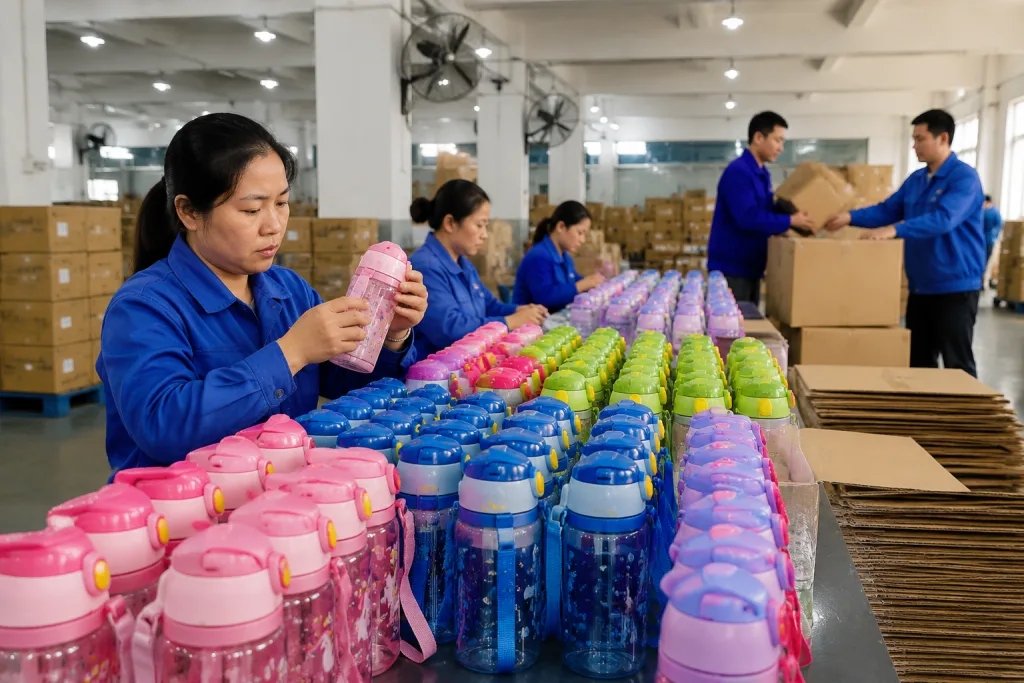
As a Hangzhou, Zhejiang drinkware factory in China, we see buyers burn 12 days chasing the lowest unit price, then spend 18 days fixing cap, carton, or logo problems. The math doesn't work. A useful RFQ asks about materials, cap cycle testing, carton drop strength, logo rub resistance, spare parts, and inspection terms. Our kids bottle line runs about 180,000 units/month, with custom MOQ from 1,000 units per color for common models, and we run pre-production checks with a torque tester, caliper, and AQL sample table before the line starts.
What should you ask first?
Search suppliers kids water bottle and you will see 200 plus quotes that look the same once they land in Excel. The wrong first question is, “What is your cheapest bottle?” Ask this instead: “Which model has already shipped for children, and what age group was it built for?” A 350 ml bottle for a five-year-old and a 600 ml bottle for a middle-school student need different grip diameter, lid opening force, straw cut length, and carton count. Last month QC pulled a 400 ml sample from the line; the push button needed 2.8 kg of force, fine for adults, not fine for grade 1 kids.
For school district buyers, we ask for a short use-case note: grade range, daily backpack use or event giveaway, dishwasher expectation, logo position, delivery date, and whether the bottles ship direct to students or first to a warehouse. For kids-product importers, add target retail price, compliance market, and packaging style. A serious children water bottle supplier should reply with a recommended mold, material sheet, sample photos, and a lead time like 12 days for samples and 28 days for mass production, not just a unit price. We have seen this go sideways when a PO says “blue lid” but the approved sample has a navy Pantone cap; the buyer flagged it at pre-shipment, and nobody enjoyed that call.
Here is the checklist we run when a new buyer asks for a bulk kids water bottle quote. It saves two rounds of sampling.
- Capacity: 350 ml, 400 ml, 500 ml, or 600 ml, with target carton weight under 12 kg if schools need easy handling
- Material: 304 stainless steel, Tritan, PP, silicone, or borosilicate glass with sleeve, matched to FDA or LFGB test needs
- Lid type: straw, flip, screw, push button, or leak-lock cap, with the sample checked on a torque meter and 30-minute inversion test
- Age range: 3-5, 6-9, 10-13, or teen, because hand size changes the bottle body and carry loop design
- Logo process: silk screen, heat transfer, UV print, laser engraving, or full wrap, with artwork checked at 1:1 scale before film output
- Testing market: EU, UK, US, Canada, or mixed shipment, so the lab booking matches the destination label on the carton
If a children water bottle vendor cannot confirm these basics in writing, the low price usually gets expensive later. Zhejiang factories can move fast. Speed only works when the spec is locked before sampling, down to straw length in mm and MOQ by color. We ship faster when the line is not guessing.
Which bottle type fits schools?
I’ll rewrite the section in-place, keep the HTML structure unchanged, and make the sales language sound like a real factory-side guide.Most school programs choose between stainless steel and BPA-free plastic. Both work, but they solve different problems. A custom kids bottle in stainless steel feels tougher, carries better value, and fits fundraising, private label retail, and district wellness orders. A plastic bulk children water bottle is lighter and cheaper, which matters when you are shipping 20,000 units for one semester.
For stainless steel, we usually run single-wall 304 stainless or double-wall vacuum insulated 304 stainless. A single-wall 400 ml bottle often lands around USD 2.20-3.10 FOB China, depending on the lid and logo setup. Double-wall insulated 350-500 ml styles usually sit around USD 4.20-6.80 FOB China for normal custom logo kids bottle orders. Wall thickness is where the trouble starts: 0.35 mm dents fast in a backpack, while 0.4-0.5 mm holds up better on the line and in school bags.
For plastic, Tritan is the usual pick for a clearer, tougher children water bottle custom project. PP costs less, but the bottle looks basic. A 500 ml Tritan bottle with a flip straw lid may be around USD 1.80-2.80 FOB China at 5,000 units, depending on cap complexity. We’ve seen buyers push for PP on a repeat SKU, then complain when the bottle haze shows up after a few washes. If you need a children water bottle promotional item for a short campaign, PP is fine. If you are a children water bottle distributor building a repeat SKU, Tritan or stainless steel is the safer call.
Do not pick the bottle only by unit price. Pick it by the failure mode you can live with: dents, leaks, scratches, broken straws, or parent complaints.
For younger children, avoid lids with too many small detachable parts. For older students, choose a larger carry loop and a lid that can be opened with one hand. QC pulled the sample on a school order last month because the lid opened too stiffly; that is the kind of thing buyers flag fast. For custom school water bottle programs, simple and tough beats clever and fragile.
What safety documents matter?
I’ll keep the HTML tags intact and rewrite the copy in a more grounded factory-sales voice, with concrete compliance details and a bit of shop-floor realism.Kids products bring more paperwork than adult drinkware, and this is where plenty of children water bottle manufacturers fall short. If you sell into Europe, ask for LFGB food contact testing, REACH, and the migration reports for plastic, silicone, coating, and ink. For the United States, request FDA food-contact compliance, CPSIA where it applies, lead and cadmium data for surface coatings, plus ASTM checks on physical safety. For Canada, pin down the importer’s food-contact and labeling rules before you run the first 3,000 pcs. We’ve seen POs stall over a missing label line.
Do not treat “BPA free” as a full compliance file. It is one claim, nothing more. You need the exact resin, colorant, silicone grade, 304 stainless steel, and coating system. On a children water bottle customized with cartoon artwork, the ink can matter as much as the body. If the logo lands where a child mouths the surface, ask the lab whether the decoration needs its own migration test or heavy-metal check. QC pulled one sample at 72 hours last month for that exact issue.
Factory audits belong in the same conversation. Buyers ask for BSCI, Sedex, ISO 9001, or at least a fresh factory profile with production photos, and the math does not work if you wait until after tooling. BottleForge Industrial is in Hangzhou, Zhejiang, and our supplier network in China is used to export inspections, but we still push buyers to lock the document list before pricing is final. A missing report found after production costs 12 days, not 2. That gap hurts.
Compliance checklist for RFQ
- Material declaration for bottle body, lid, straw, gasket, and coating
- Food-contact test reports less than 24 months old where possible
- Artwork ink and coating test plan for custom children water bottle orders
- Age grading and warning label review
- Factory audit documents if required by your school board or retailer
A good children water bottle manufacturer will not promise every certificate on day one. A straight one will tell you what is already on file, what needs a new lab run, and how many days that adds. We run into this every week on the line, and the buyer flagged it again yesterday.
How custom can it be?
I’ll rewrite the section in-place, keep the HTML structure untouched, and tune the copy so it reads like a factory-side sales note with concrete numbers and shop-floor details.The word “custom” covers a wide range. A children water bottle with a one-color logo is a different job from a custom made kids bottle with a new mold, a unique cap, a custom silicone boot, and a retail gift box. We separate decoration work from structural work because the cost, MOQ, and lead time do not line up. On the line, that difference shows up fast.
For decoration, silk screen is solid for simple school logos in one to three colors. Laser engraving works on stainless steel and will not peel, but it gives no color. Heat transfer and UV printing suit full-color mascots, gradients, and wraparound artwork. A full-wrap children water bottle custom design needs a curved-surface proof, and QC pulled the sample twice when the art drifted 1.5 mm at the seam.
Typical MOQs are practical, not magical. For an existing stainless kids bottle model, we usually discuss 1,000 units per color for logo customization. For Pantone body color, expect 3,000 units or more because powder coating setup and color loss are real. For a new cap mold, MOQ can jump to 10,000 to 30,000 units, with tooling from USD 2,000 to USD 8,000 depending on part complexity. The math does not work any other way.
School buyers often need names, classroom colors, or grade-level sorting. Individual student names are possible, but they slow the line and cost more unless you use laser marking or digital print with a clean data file. If you need 8,000 bottles across 12 school names, do not split into 12 tiny runs. Use one bottle color, one lid color, and change the logo panel or belly band. That keeps the bulk school water bottle cost sane. We saw a PO typo once that turned one school into “Schoool,” and the buyer flagged it before packing.
- Lowest-risk custom option: one-color school logo on a stock bottle
- Best retail option: custom logo plus printed color box
- Best district option: shared bottle body with school-specific logo batches
- Highest-risk option: new cap design without enough time for cycle testing
A practical children water bottle factory will push back when the design adds cost but no useful value. That is not negativity; it is export experience. We have seen this go sideways when a buyer insists on a 12 mm cap change for a 5% style gain.
What price is realistic?
I’ll rewrite the section in place, keep the HTML exactly as-is, and tune the copy to sound like a factory-side sales engineer.Price comes down to material, lid parts, order quantity, packaging, testing, and payment terms. If two children water bottle suppliers quote the same drawing and one is 25% lower, we check wall thickness, 304 stainless grade, lid resin, coating bite, carton count, and whether the price includes logo, inner box, and export carton. QC pulled a sample once and the buyer flagged a 0.3 mm wall gap. Low quotes usually mean something is missing.
For budget work, we split a bulk kids bottle project into bands. A simple PP bottle for promo use can land around USD 0.90-1.60 FOB China at 10,000 units. A Tritan flip straw bottle often runs USD 1.80-3.20. A single-wall stainless 400-500 ml kids bottle may sit at USD 2.20-3.50. A double-wall insulated custom kids water bottle usually lands at USD 4.20-7.50, depending on cap build, powder coating, and pack-out. These are not promises. They are the numbers we use before a buyer sends us a PO with the wrong lid code.
Packaging can move landed cost more than buyers expect. A white box may add USD 0.10-0.25 per unit. A printed color box may add USD 0.25-0.60. Individual polybags are cheap, but schools that care about waste often push back. If you are supplying children water bottle wholesale to districts, ask if bulk master carton packing is acceptable. It cuts packing cost and waste, but the warehouse has to sort units, and that is the wrong question to skip.
Freight is the other trap. A 500 ml bottle is light, but it eats volume. Sea freight is the right move for 5,000+ units when the school calendar gives you 12 weeks instead of 6. Air freight can save a late order, but it can add USD 1.00-3.00 per unit depending on carton size and destination. For importers shipping to Amazon or a 3PL, carton dimensions, barcode labels, and FNSKU placement need to be set before packing starts. We have seen this go sideways on a PO with one missing digit in the carton size.
How do you control quality?
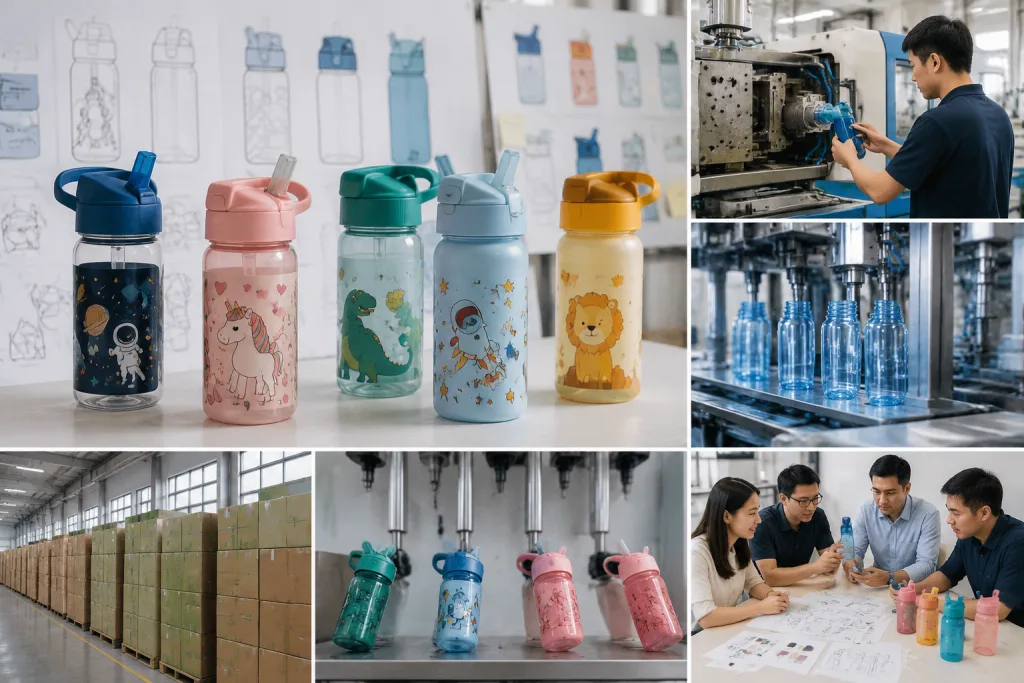
I’ll rewrite the section in-place, keep the HTML structure intact, and tighten the sales-engineer voice with concrete factory details and fewer AI-ish transitions.Quality control starts before mass production. For kids bottles, we run one approved pre-production sample and sign off on color, logo size, lid function, straw length, gasket fit, packaging, and carton marks. Do not approve only a photo if your order is above 3,000 units. Get a physical sample, open it, wash it, drop it, and let a child try the lid. Children are better lid testers than adults because they twist, chew, pull, and over-tighten everything.
For production inspection, put AQL terms in the purchase order. A common setup is AQL 2.5 for major defects and AQL 4.0 for minor defects, with critical defects not accepted. Major defects include leakage, broken lid mechanism, wrong material, sharp edges, severe coating damage, wrong logo, or carton label error. Minor defects include small dust marks, light print shift within tolerance, or slight color variation inside the approved range. QC pulled the sample, and the buyer flagged a 2 mm logo shift on the carton — that is the kind of miss that turns into a claim later.
Useful kids bottle tests include leak testing, lid open-close cycle testing, straw pull testing, coating adhesion cross-hatch test, salt spray for metal parts if relevant, carton drop test, and dishwasher simulation if you claim dishwasher safe. For stainless insulated bottles, add vacuum performance checks. For plastic bottles, check stress cracking around hinge pins and carry loops. On our line, we also check the hinge pin after 500 cycles; if the math does not work there, it will not work at the customer's warehouse.
Buyer-side inspection checklist
- Confirm random sample size under ANSI/ASQ Z1.4 or ISO 2859-1
- Open 20-50 lids during inspection, not just 3
- Fill and invert bottles for at least 30 minutes for leak screening
- Check logo position against approved artwork in millimeters
- Verify carton weight, carton drop result, and shipping marks
If you are choosing between children water bottle vendors, ask them to send a past inspection checklist with customer names removed. You will learn more from that document than from a polished brochure. We ship this kind of file all the time, and the buyer can see straight away whether the factory has real QC discipline or just a good sales deck.
How should you schedule orders?
I’ll rewrite the prose to sound like a factory-side sales engineer, keep the HTML exactly as-is, and tighten the timeline language with concrete order-planning details.School calendars do not wait. If the bottles must land before orientation, wellness week, summer camp, or back-to-school handout, count backward from the delivery date, not from the PO date. For a normal children water bottle bulk order on an existing mold, we run 5-7 days for quotation and artwork check, 7-10 days for sample making, 3-5 days for sample courier, 25-35 days for mass production, and 25-40 days for ocean freight to North America or Europe, depending on port and season.
That puts 45-60 days from approved sample to FOB China shipment in the normal range, and 80-110 days door-to-door is the safer number for school district planning. Chinese New Year can shut down clean capacity for 3-5 weeks, and October Golden Week slows both sample sign-off and booking space. We have seen buyers assume a “fast reorder” can beat the calendar. It cannot. Coating cure time, lab checks, and vessel schedules still run on their own clock.
If you are a children water bottle distributor handling repeat programs, send a forecast instead of a last-minute fire drill. A 3-month forecast lets the factory lock stainless steel, caps, silicone gaskets, and carton stock. For custom logo kids bottle orders, even a month-by-month forecast helps us avoid color drift on the lid and a packaging delay at the line.
Use this ordering checklist before you send a deposit:
- Final approved artwork in AI, PDF, or high-resolution vector file
- Pantone color codes for body, lid, logo, and packaging
- Confirmed compliance market and lab test responsibility
- Approved sample or signed sample waiver
- Purchase order with AQL, Incoterms, payment terms, and delivery date
- Carton marks, pallet rules, barcode, and warehouse routing guide
A solid bulk kids water bottle order is never rushed at the end. We had a buyer flag a PO typo once—delivery week changed the whole booking—and that mistake cost 12 days. The math does not work when planning starts late.
Send your kids bottle RFQ for factory review
Share capacity, quantity, market, artwork, and deadline. We will suggest a practical model, MOQ, testing path, and FOB China price range.
Frequently asked questions
What MOQ should I expect from suppliers kids water bottle factories?
For an existing kids bottle mold, 1,000 units per color is a realistic starting MOQ for basic logo work. If you need Pantone powder coating, expect 3,000 units because coating setup and color loss add cost. For a custom cap, molded handle, or new silicone boot, MOQ often moves to 10,000-30,000 units. A children water bottle factory may accept fewer units, but the unit price can rise 15%-40% and sample costs may not be refundable.
Can we order mixed colors for a school district program?
Yes, but mixed colors need planning. For example, 5,000 units split into five body colors is easier if the bottle uses stock colors and the same logo. If each color also has a different school logo, setup time and inspection work increase. For a custom school water bottle order, we usually recommend one body color with different printed logos, or two body colors maximum below 10,000 units. This keeps cost, color matching, and packing accuracy under control.
Which is better for children, stainless steel or Tritan?
Stainless steel is better for durability, perceived value, and insulated bottle programs. A 304 stainless double-wall bottle can keep drinks cold for 12-18 hours depending on design. Tritan is lighter, transparent, and often cheaper, which is useful for a bulk children water bottle giveaway. For younger students, weight matters; a full 500 ml stainless bottle can feel heavy. For retail importers, stainless usually gives higher margin. For district-wide low-budget programs, Tritan can be the practical choice.
How long does a children water bottle custom order take?
For an existing model, plan 7-10 days for sampling after artwork confirmation and 25-35 days for mass production after sample approval and deposit. Sea freight to Europe or North America commonly adds 25-40 days port-to-port, plus customs and inland delivery. If new lab testing is required, add 7-15 working days. For back-to-school programs, start the RFQ 90-120 days before the handout date. Waiting until summer usually forces air freight or fewer customization options.
What defects should we reject during inspection?
Reject critical issues such as sharp edges, wrong material, unsafe loose parts, severe odor, failed leak test, or incorrect compliance labeling. Major defects include broken lids, missing gaskets, wrong logo, poor coating adhesion, dented bottles, barcode errors, and cartons packed with the wrong quantity. Minor defects may include small dust marks or logo shift within an agreed 1-2 mm tolerance. Put AQL 2.5 major and AQL 4.0 minor in the purchase order so the children water bottle supplier knows the standard before production.