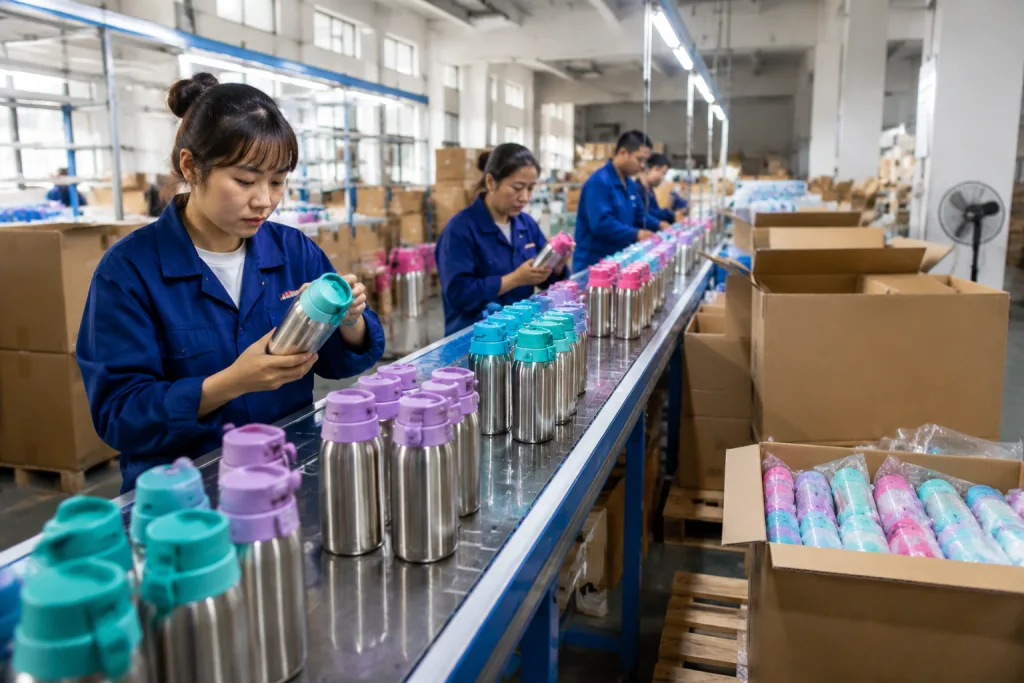
Key Takeaways
- A realistic MOQ for custom kids bottles is 3,000 pcs per color for stainless steel and 5,000 pcs for molded plastic lids
- Ask for LFGB, REACH, CPSIA, ASTM F963, and FDA food-contact declarations based on your market
- Plan 35-45 days for mass production after approved pre-production sample and deposit
- Bottle leaks usually come from cap gasket tolerance, not from the stainless body
Buying a kids drink bottle is a different job from buying a standard adult tumbler. Small hands need a slimmer grip, school bags crush caps, children chew straws, and parents will ask hard questions about plastics, silicone, and paint safety. We have seen a USD 0.08 cheaper cap turn into a 3% leak rate after QC ran the 45-degree tilt test on 80 samples. Cheap is the wrong question to ask. If you are comparing suppliers kids drink bottle options from China, lids that seep, artwork that rubs off after 20 tape pulls, or cartons that split in a 76 cm drop test will eat the saving fast.
We manufacture custom drinkware in Hangzhou, Zhejiang, and the same buying errors come across our desk every season: 350 ml written on the RFQ but 420 ml shown in the drawing, a flip lid with 6 parts when 3 would do, no AQL plan, and packaging picked after the line is already running. QC pulled one pre-shipment sample last May where the PO even had the straw length typed as 12 mm instead of 120 mm. That sort of typo stops production. A workable supplier brief should fix the bottle body, cap system, decoration method, compliance target, MOQ, and inspection plan before anyone quotes FOB Ningbo.
Start with the real use case
I’ll keep the HTML structure unchanged and rewrite the prose to sound like a real sales engineer, with tighter buyer language and a few factory-floor specifics.Your first question should not be “What is your cheapest kids bottle?” Ask where the child will actually use it, and what failure will make the parent complain. A bottle for a school lunch bag needs a different cap and seal than a giveaway for a summer camp, and we’ve seen that mix-up sink a quote. A supermarket program usually needs barcode-ready retail boxes; a canteen buyer may care more about carabiner caps and spare lids.
For kids, 350 ml to 500 ml is the practical range. Below 350 ml, parents complain about refilling. Above 500 ml, the filled weight starts to bother children under 8 years old. For stainless steel, we usually quote 304 inner steel with 201 or 304 outer shell, depending on target price. For plastic, Tritan, PP, and food-grade silicone are common, but the math does not work unless migration testing and colorant files are already in order. QC pulled the sample on a 500 ml PP bottle last week because the colorant declaration was missing.
Here is the buyer checklist we use before quoting:
- Age range: 3-6, 6-10, or teen use changes the lid, straw length, and grip size.
- Channel: retail, school program, canteen vendors, online marketplace, or corporate gift.
- Leak tolerance: backpack-safe needs a locking lid; desk use can take a simpler flip straw.
- Decoration: one-color logo, full-wrap print, laser engraving, or a name panel.
- Packaging: bulk carton, color box, hang tag, or FNSKU label for fulfillment.
If your brief says only “kids water bottle, 500 ml, logo,” every supplier will fill the gaps in a different way. You’ll get ten quotes and none of them line up. A better RFQ gives the material, cap type, test market, carton spec, and target landed cost. We had one PO typo on “carton 24 pcs” that should have been “carton 12 pcs,” and that single line doubled the shipping headache.
What should suppliers quote clearly
I’ll rewrite the section in place, keeping the HTML structure intact and tightening the quote language so it reads like a factory-side sales engineer.A proper quote from a canteen factory should break out the bottle body, lid, decoration, packaging, testing, and freight terms. If a supplier throws all of that into one unit price, you lose the numbers the moment you switch from silkscreen to heat-transfer print, or from bulk packing to a retail color box. We see first-time buyers lose control right there.
For a typical 400 ml stainless kids bottle from Zhejiang, China, a usable FOB Ningbo range is USD 2.40-4.20, depending on steel grade, lid complexity, coating, and packaging. A simple PP sports bottle often lands at USD 1.10-2.20 FOB, but the tooling file and compliance papers need a closer look. A custom growler or customizable growler is another job entirely: larger, heavier, and wrong for younger children. Do not let a supplier drag that into a kids bottle quote unless you are building a family outdoor range.
Ask each canteen vendor to state:
- MOQ by SKU: per color, per logo, and per lid color.
- Sample cost: existing sample, logo sample, and pre-production sample.
- Lead time: sample days, production days, and peak-season capacity.
- Incoterm: FOB Ningbo or Shanghai is common for Zhejiang factories.
- Carton data: units per carton, gross weight, carton size, and drop-test status.
- Spare parts: extra straws, gaskets, and lids priced separately.
BottleForge Industrial runs about 420,000 stainless drinkware units per month across standard and customized drinkware lines, with a normal kids bottle MOQ at 3,000 pcs per color. That still does not mean every canteen manufacturer can swallow rush orders. In August through November, Christmas and back-to-school jobs fight for coating lines and packaging labor. We have seen buyers assume a 7-day move-in, then the line shows 12 days because the buyer changed the lid color after QC pulled the sample.
Which materials pass buyer scrutiny
I’ll rewrite the section in-place, keep the HTML untouched, and tighten the language so it sounds like a factory-side buyer guide with concrete sourcing details.Material choice is where procurement should stay boring and strict. For stainless kids bottles, 304 stainless steel on food-contact surfaces is the safe default. On our line, the inner wall usually runs 0.4 mm to 0.5 mm and the outer shell 0.5 mm to 0.6 mm, depending on insulation target and dent resistance. Go thinner and the math stops working: school bags, lunchroom drops, and a few hard knocks will turn into dents and complaint emails fast.
Plastic lids need a clear spec sheet, not a guess. We usually run PP for the main cap, silicone for gaskets and straw parts, and Tritan for transparent flip pieces. One buyer once flagged a PO typo that swapped PP for PS, and QC pulled the sample before it hit packing. If you sell into the EU, ask for LFGB food-contact reports and REACH declarations. For the United States, request FDA food-contact compliance, CPSIA for children’s products, and ASTM F963 where the item is treated as child-related merchandise. California Proposition 65 review may also be required, depending on the channel.
Do not accept “BPA free” as the only safety statement. That is a marketing line, not a compliance file. A proper canteen supplier should hand over material declarations, recent third-party test reports, and batch traceability. Reports older than 24 months are not worthless, but most retailers and importers want current reports tied to the same material family and the same resin source. We have seen this go sideways when a factory swaps pellets and keeps the old paperwork.
For coatings, powder coating usually gives better grip than glossy spray paint. For kids, we prefer matte or semi-matte powder coating with cross-hatch adhesion testing and boiling-water checks. On one 500 ml sample, the scratch test passed, but the lid print failed after the first coin-rub run, so we changed the artwork spec. If you choose a canteen customized with a cartoon pattern, confirm whether the artwork is silkscreen, heat transfer, water transfer, or UV print. Each method brings different scratch resistance and setup cost.
Practical rule: if a child can bite, twist, drop, or pry it loose, treat that part as a compliance and durability risk, not just an accessory.
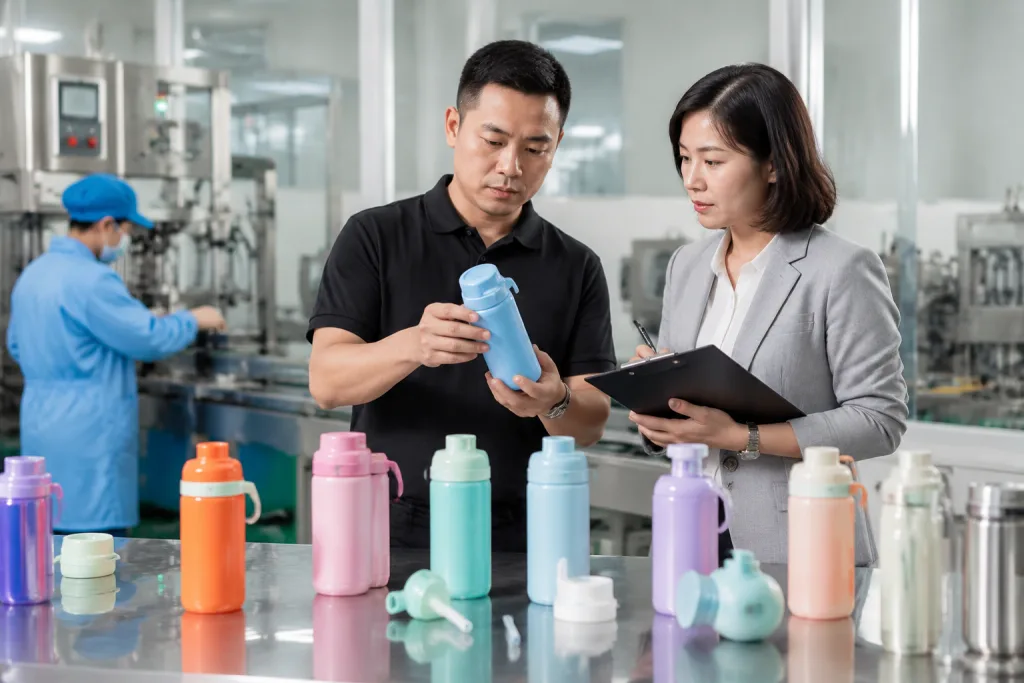
How much customization is sensible
I’ll rewrite this section in place, keep the HTML untouched, and tighten the language so it sounds like a factory-side sales engineer.Custom drinkware gets messy fast when you over-spec it. Every extra color, logo spot, lid insert, straw color, and retail box version adds one more check on the line. For a first order, keep the custom points tight: one bottle body, two colors, one lid structure, one decoration process. We’ve seen a 3,000 pcs pilot slip a week because the buyer changed the lid insert after QC pulled the sample. Expand after you have sell-through and complaint data.
For logo work, silkscreen is the practical choice for simple one- or two-color graphics, with a setup charge around USD 50-120 per color depending on artwork size. Laser engraving holds up on stainless steel, but on coated surfaces the buyer has to accept lower contrast unless the finish is planned from the start. Heat-transfer printing suits full-color characters and wraparound art, but the defect rate climbs when the artwork crosses a curve, a seam, or a tapered wall. For a promotional canteen order, one logo position is enough. For retail, parents usually want a cleaner visual hit and a clear name label area. That is the right question to ask, not how many effects we can stack.
A new lid mold changes the math. A simple injection mold for a custom cap part may cost USD 3,000-8,000, while a flip-lock straw lid can run higher. Tooling lead time is often 20-35 days before production sampling. Unless your annual volume is above 20,000-30,000 pcs, the better move is usually to keep the existing lid structure and change only the color. We’ve had buyers push for a full new cap at 8,000 pcs a year; it looked good on paper, then the unit cost ate the margin.
Use customization where it improves the commercial offer:
- Brand recognition: logo, color palette, and retail packaging.
- Child usability: carry loop, easy-open button, and clear straw angle.
- Channel fit: FNSKU label for online, hang tag for retail, bulk pack for institutions.
- Reorder stability: repeatable Pantone colors and locked artwork files.
A good canteen vendor should push back when your design creates leakage risk or assembly trouble. We do that on purpose. The buyer flagged a typo on a PO once, and we caught it before print; same idea here. That is engineering, not attitude.
Factory audit and QC questions
I’ll rewrite the section in-place, keep the HTML exactly as-is, and tune the prose to sound like a factory-side sales engineer.Before you pick between canteen suppliers, ask questions that show real process control. A clean showroom means nothing if the gasket tolerance drifts 0.3 mm on the line. Ask about incoming material inspection, lid assembly checks, vacuum testing for insulated bottles, coating adhesion, print curing, packing inspection, and final AQL sampling.
For children’s drinkware, we run AQL 2.5 for major defects and AQL 4.0 for minor defects unless your retailer sets tighter limits. Critical defects are zero tolerance. That means sharp edges, loose small parts, contamination inside the bottle, strong odor, or a cap that pops open during a leak test. For leak testing, we fill the samples, invert them, shake them, then leave them on absorbent paper for 30 minutes. “We checked by eye” is the wrong answer for a straw lid.
Useful supplier questions include:
- Do you perform a 100% vacuum test on insulated stainless bottles?
- What torque or pull test do you use for lid components?
- Can you provide BSCI, ISO 9001, or retailer audit documents?
- How do you separate failed parts during assembly?
- Can your carton pass ISTA-style drop handling for export?
- What percentage of spare lids and gaskets do you recommend?
For our China export orders, we usually suggest 1%-2% spare straws or gaskets when the lid uses removable parts. The math works. A 30,000-unit distributor program will trigger replacement requests even when production is clean, and we have seen that go sideways fast if there is no spare stock. Keep the extras ready and your service team stays out of trouble.
If you compare a canteen manufacturer in Zhejiang with one in another China province, do not choose on unit price alone. Check the distance to port, coating capacity, packaging subcontractors, and how fast the factory can remake a bad lid when QC pulls the sample and flags it.
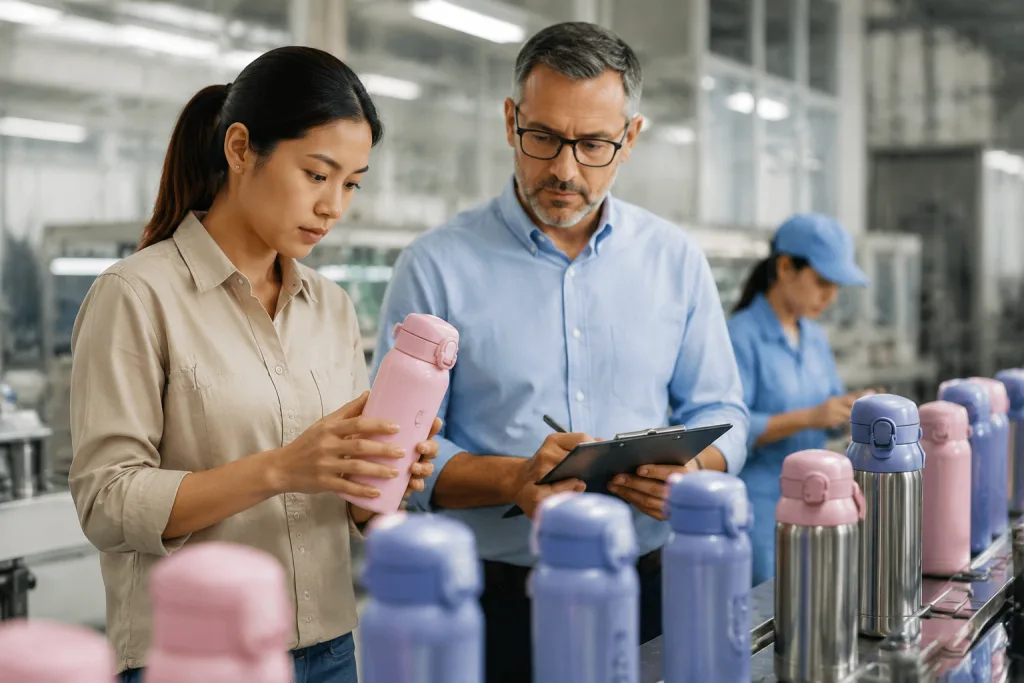
MOQ, tooling, and reorder math
I’ll rewrite this section in place, keep the HTML exactly as-is, and tune the prose to sound like a factory sales engineer.MOQ is where material buying, line setup, printing, and packing stop being messy and start running smoothly. For kids stainless bottles, 3,000 pcs per color is a normal entry MOQ in our Hangzhou, Zhejiang shop. For a canteen with custom plastic lid colors, MOQ can move to 5,000 pcs because resin tinting and injection setup need a minimum batch. We had a buyer push for 1,200 pcs across four colors; the math did not work once the line changed over three times. For a new mold, look at annual volume, not first-order excitement.
Here is a cost stack buyers should model before they approve the project:
- Unit price: bottle, lid, decoration, and standard packing.
- One-time costs: mold, print screen, artwork plate, or color matching fee.
- Testing: USD 300-1,500 depending on LFGB, CPSIA, REACH, or retailer protocol.
- Inspection: third-party final inspection often USD 250-400 per man-day in China.
- Freight: sea freight for planned orders; air freight only for samples or urgent top-ups.
If you are a canteen distributor or growler buyer adding kids bottles as a new category, start with fewer SKUs and a clean reorder plan. We usually tell buyers to take 3,000 pcs blue and 3,000 pcs pink instead of six colors at 1,000 pcs each. QC pulled the sample once after a split-color order because the coating shift showed up on one lot, and the buyer flagged it on arrival. Factories may accept split colors on paper, but the line pays for every color change.
Reorders go smoother when you lock a specification sheet. That sheet should include steel grade, capacity by brim and usable fill, bottle weight tolerance, lid material, gasket hardness if available, Pantone color, print position, carton layout, and approved sample photos. We once saw a PO typo change a 350 ml bottle to 500 ml on the repeat order, and nobody caught it until cartons were already printed. Without a locked spec, a six-month reorder can drift fast, especially if the canteen maker swaps a lid sub-supplier or coating powder.
Pre-shipment checklist buyers can use
I’ll keep the HTML structure fixed and rewrite the prose to sound like a buyer-side sales engineer, with sharper factory-floor detail and fewer generic phrases.Do not wait until the cartons are packed to decide what “acceptable” means. Send the pre-shipment checklist with the purchase order. Keep it short enough that the line actually uses it, but tight enough to catch the defects that cost money. This matters on customized canteen and customized drinkware jobs: the bottle can work fine and still be a miss if the logo shade, retail box, or barcode is off.
Before shipment, check these points:
- Approved sample match: compare mass production against the signed pre-production sample.
- Capacity: verify actual usable fill, not only advertised brim capacity.
- Leak test: test filled bottles in upright, inverted, and side positions.
- Odor: inspect silicone straws, gaskets, and plastic lids after carton storage.
- Print adhesion: run tape test and basic rub test on decorated areas.
- Carton strength: confirm 5-ply export cartons for heavy stainless orders.
- Labeling: SKU, barcode, FNSKU, age warning, and country-of-origin marks.
For North America, country-of-origin marking needs to be clear. For the EU, packaging waste and language rules change by destination country. If the buyer wants FSC packaging, recycled content claims, or plastic-free packaging, put that in the RFQ, not after PO. We’ve seen a box printed with “eco” and no proof behind it; QC pulled the sample, and the buyer flagged it the same day.
The honest supplier conversation is about trade-offs. A canteen factory can run a low-cost school bottle, a premium insulated bottle, a custom canteen set, or a canteen promotional item, but the math does not work if you ask for all four at one spec and one price. Tell us the sales channel, target retail price, compliance market, and failure tolerance, and you’ll get a quote that matches the job. I’d rather push back early than sort it out after a typo on the PO or a failed inspection.
Send your kids bottle RFQ for a practical review
Share capacity, market, logo, packaging, and target price. Our Zhejiang team will check feasibility before quoting.
Frequently asked questions
What MOQ should I expect from suppliers kids drink bottle factories?
For stainless steel kids bottles, expect 3,000 pcs per color for a normal custom logo order. If you need a special powder-coated Pantone color, some factories may ask for 5,000 pcs to reduce coating waste. For plastic bottles or exclusive lid colors, MOQ is often 5,000-10,000 pcs because injection molding and resin color matching need larger batches. If a canteen supplier accepts 500 pcs with full customization, check whether it is using stock goods, manual decoration, or a trading inventory. That can be fine for a test, but repeat color consistency may be weaker.
How long does a custom kids drink bottle order take?
A normal timeline is 5-7 days for existing samples, 10-15 days for logo samples, and 35-45 days for mass production after deposit and sample approval. New lid tooling can add 20-35 days before you even approve production samples. Peak season in China, especially before back-to-school and holiday shipments, can stretch coating and packaging schedules. For sea freight to Europe or North America, add roughly 25-40 days port-to-port depending on routing. If your launch date is fixed, approve artwork and compliance requirements before negotiating the final USD 0.05.
Which tests are most important for kids drink bottles?
For Europe, ask for LFGB food-contact testing and REACH documentation. For the United States, ask about FDA food-contact compliance, CPSIA, and ASTM F963 if the design is child-focused or has toy-like features. For any market, run leak testing, odor checks, coating adhesion tests, and small-parts risk review. If the bottle has a straw, gasket, button, hinge, or carry loop, those parts deserve extra inspection. AQL 2.5 for major defects and AQL 4.0 for minor defects is a common starting point, with zero tolerance for sharp edges or contamination.
Should I choose stainless steel or plastic for kids bottles?
Choose stainless steel if you need better durability, insulation, and a higher retail price point. A 350-500 ml insulated stainless bottle usually lands in a higher FOB range but feels more premium and handles daily school use better. Choose plastic if your target is a lightweight canteen promotional product, sports program, or low retail price. Plastic is not automatically unsafe, but you need stronger control of resin grade, colorants, odor, and migration reports. For younger children, lid usability and leak resistance often matter more than the body material.
Can one supplier handle kids bottles, canteens, and growlers?
Sometimes, but check whether the factory actually produces all categories or outsources part of the order. A canteen manufacturer strong in stainless bottles may also handle custom growler, customized growler, and distributor growler projects, but kids lids require different tooling and compliance focus. Ask for production photos, audit documents, and recent test reports for the exact product family. If your order combines kids bottles and adult customizable canteen items, keep separate specifications, inspections, and packaging checks. Mixing categories under one loose PO increases mistakes.