Key Takeaways
- A practical MOQ for a custom children water bottle is usually 3,000–5,000 pcs, with sample lead time of 7–12 days.
- For school buyers, a leak test target of 24 hours at room temperature is a minimum, not a bonus.
- A typical China factory can ship 200,000–500,000 kids bottles per month when tooling and print are stable.
- Budget around USD 0.95–2.60 per unit FOB for a simple bulk kids bottle, depending on material, lid, and decoration.
You are not buying a cute bottle. You are buying a repeatable program: the right cap, the right print, the right carton count, and a product that survives a school backpack for 9 months. If you are sourcing from China or Zhejiang, the first mistake is treating children’s drinkware like a generic promotional item. A children water bottle wholesale order needs tighter QC than a standard tumbler because the user is rough, the buyer is strict, and the margin disappears fast when a lid leaks in one classroom. We run this on the line every week, and QC pulled the sample on a 650 ml order when the cap torque came in loose by 0.3 N·m.
When a school district buyer or importer asks us for suppliers kids bottle options, we start with use case, not decoration. Will it go to ages 4–7 or 8–12? Is it for cold water only, or does it need to handle warm drinks? Do you need a custom kids bottle with a carry loop, a straw, or a wide-mouth lid? In Zhejiang and across China, the better factories can handle printing and compliance, but you still have to write the order cleanly or you will burn two weeks on samples and rework. We had a buyer flag a PO typo on the lid color once; that small mistake turned into a full carton relabel.
Start with the buyer brief
I’ll rewrite the section in place, keeping the HTML tags and list structure exactly as-is while making the prose sound like a factory sales engineer wrote it.We start every kids bottle program with a hard brief. Not “we need a water bottle for kids,” but age band, capacity, decoration method, and destination market. A school district order for 8,000 units in the U.S. is a different job from a retail pack for a European distributor. Say whether you need a bulk school water bottle at 450 ml, a 550 ml stainless option, or a light plastic bottle for primary-school students. Skip that, and a children water bottle supplier will quote you something that looks fine and ships wrong.
For school use, cap style beats color every time. A flip-top with a silicone straw can work for younger children, but we still check the hinge and seal on the line with a simple open-close test. A screw lid is easier on a bulk children water bottle order, but it slows drinking in a classroom. If you want a children water bottle customizable program, decide early whether the logo is one-color silk screen, wrap print, laser on steel, or a full CMYK sleeve. Each choice changes cost, setup time, and approval flow. Last month QC pulled the sample on a 0.6 mm print shift, so this is the wrong question to leave open. In Zhejiang, factories ask for the same core data because it cuts out most of the back-and-forth.
- Age group: 3–5, 6–8, or 9–12
- Capacity: 350 ml, 450 ml, 500 ml, or 650 ml
- Material: Tritan, PP, stainless steel, or glass
- Decoration: print, laser, label, or embossed logo
- Compliance: FDA, LFGB, REACH, CPSIA, or CA Prop 65
Choose the right material
I’ll rewrite the prose in-place, keep the tags untouched, and tighten the language so it reads like a factory-side sales engineer.If you are comparing a children water bottle manufacturer in China, material choice is where your cost and scrap rate get decided. Tritan is the cleanest pick for a clear bottle, but it costs more than PP. Stainless steel takes abuse better, yet the wall build and inner liner need real attention if you want to avoid dents on the line. For a custom kids water bottle in the school channel, we usually point buyers to Tritan for visibility and stainless steel for premium resale or insulated use. A simple PP bottle works for giveaway runs, but it is the wrong call if you expect daily classroom punishment.
Wall thickness is not marketing talk. We run PP bodies around 1.0–1.2 mm for light-use promo bottles, while Tritan often lands around 1.5–2.0 mm depending on the shape. For stainless steel, a budget bottle usually sits at 0.4–0.5 mm on the outer and inner shells, and that only works with proper bead design and dent control. A cheap-looking bottle is one problem; a cracked neck or a warped thread will sink the order. We’ve seen the buyer flag a 0.3 mm thread mismatch and stop approval on the spot. If you need children water bottle manufacturers that can hold tolerances, ask for material spec sheets, not just sample photos. A real children water bottle factory in Zhejiang should hand over resin grade, food-contact declaration, and test records without back-and-forth.
For school programs, consistency beats novelty. A bottle that is easy to clean and hard to misassemble will beat a flashy design every time.
Verify the factory before sampling
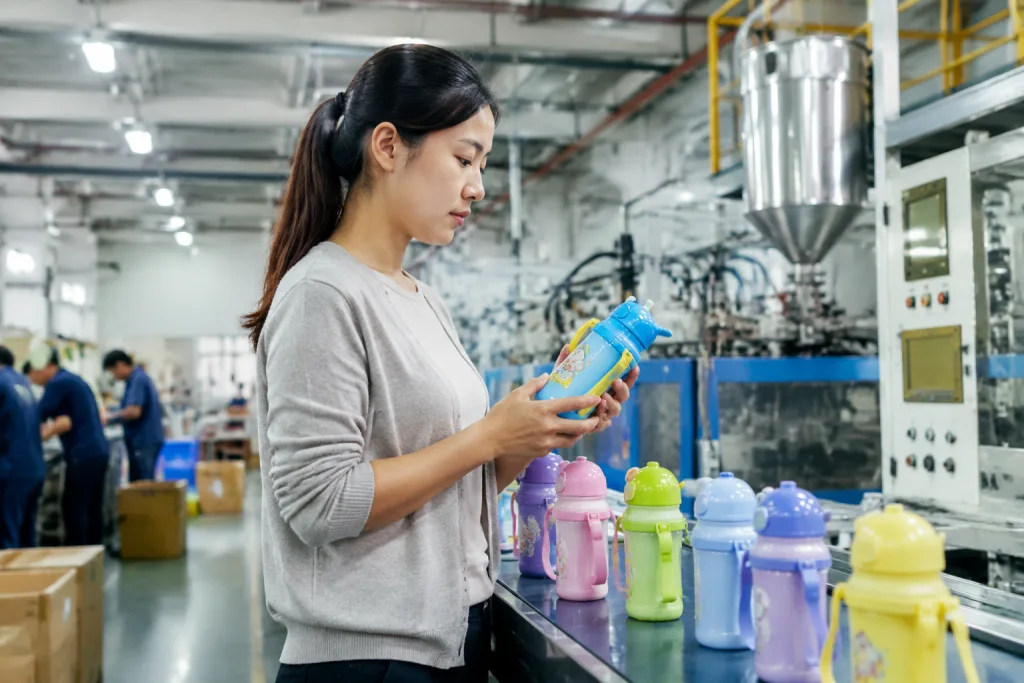
I’ll rewrite the section in-place, keep the HTML structure intact, and tune the tone so it reads like a factory-side sales engineer. Then I’ll sanity-check that the tags and list structure stayed unchanged.Don’t start with color swatches. Start with factory capability. A serious children water bottle distributor or direct importer should check whether the supplier is a real children water bottle manufacturer, what they ship per month, and how they control incoming parts. We run a Zhejiang line that does 300,000–500,000 units a month across kids bottles, travel tumblers, and sports bottles, and that kind of volume needs a different QC rhythm. A factory that owns molding, printing, assembly, and packing behaves one way; a trading desk that outsources half the job behaves another.
Ask for BSCI, ISO 9001, and the latest audit date. If you sell into Europe, REACH paperwork is not a nice-to-have. If you ship to the U.S., CPSIA and lead-content compliance are the line you do not cross. For a children water bottle promotional run for a school campaign, we ask for a pre-production approval sheet with logo position, lid color, bottle Pantone, and carton count; QC pulled the sample once after a buyer typed the wrong Pantone on the PO, and that mistake cost 2 days. A real supplier should quote FOB. If the price looks too low, ask what is missing: mold fee, printing setup, individual box, polybag, or export carton mark. The math does not work when those are all “included.”
- Factory capacity: ask for units/month by SKU
- Audit status: BSCI, ISO 9001, Sedex if available
- Compliance pack: REACH, FDA, LFGB, CPSIA as needed
- Production ownership: molding, print, assembly, packing
Sample like a skeptic
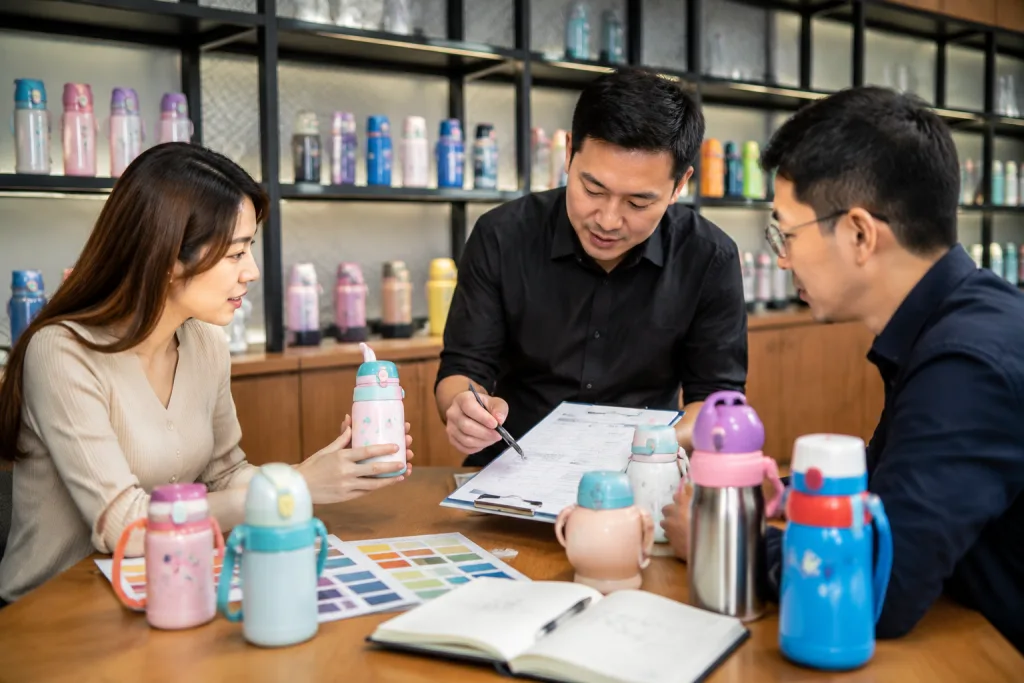
I’ll rewrite the prose only, keep the HTML exactly as-is, and make it read like a factory-side sales engineer wrote it.One sample is not enough. For a custom children water bottle program, we ask for two rounds: one working sample and one decorated pre-production sample. The first one checks lid feel, straw draw, leak resistance, and whether the bottle stands steady on the bench. The second one checks the logo, Pantone, and print position after the line setup. If you are buying from children water bottle suppliers in China, this is normal. It is cheaper to lose 10 days now than to scrap 3,000 units later.
Be specific in the sample checklist. Fill the bottle with 60°C water if the design allows warm use, turn it upside down for 24 hours, and look for seepage around the gasket. Drop-test it from 80 cm onto a flat surface if the bottle is for primary-school use. Open and close the lid 200 times if the hinge is a wear point. For a bulk kids bottle order, ask the factory to mark each sample with the date, cavity number, and operator code. That sounds fussy until a batch drifts and QC pulls the sample back to the source. On export lines in Zhejiang, this is standard work for larger programs.
If you want a custom logo kids bottle, make the artwork approval match the real print area, not a clean mockup on a screen. A logo that looks centered in Photoshop can land 3–5 mm off on curved plastic, and that is enough to trigger a buyer complaint. We have seen this go sideways on school orders and retail POs. The buyer flags it fast.
Price the order correctly
I’ll rewrite the two paragraphs in place, keep the HTML exactly as-is, and tighten the copy so it reads like a factory-side sales engineer wrote it.Price for a kids bottle comes down to material, decoration, lid structure, and packing. A plain PP bottle for a children water bottle wholesale order usually lands around USD 0.95–1.30 FOB. Tritan with a better lid and one-color print is more like USD 1.60–2.20. Stainless insulated models can go to USD 2.40–4.80 and up, depending on capacity and vacuum performance. If you are buying a bulk kids water bottle run for a school network, unit price alone is the wrong question. We had one buyer focus on that, then the carton count and breakage rate blew up the math on arrival.
The usual MOQ for a stock-shaped custom order is 3,000 pcs, and 5,000 pcs is common once you ask for a specific Pantone color or custom lid. A fresh mold for a true custom made kids bottle can push MOQ higher, and tooling can add USD 4,000–15,000 depending on the part count. Lead time for a standard decorated order is often 25–35 days after sample approval; molded custom parts add 15–25 days. Our line checks these dates against the bottleneck at the cap injection machine, not guesswork. If the order is going to a distributor warehouse or Amazon prep center, FNSKU application and relabeling can add another 3–7 days.
QC the packing and shipping
I’ll rewrite this section in a more supplier-side voice, keep the HTML exactly as-is, and preserve the list structure and any existing numbers/codes.Packing is where a lot of kids water bottle orders go wrong without making noise. The bottle passes leak tests, then the outer carton shows up crushed, the straw is missing, or the retail pack has no barcode. If you buy for a school district, the carton spec is often plain: 24 or 36 pcs per export carton, one inner polybag per unit. If you buy for retail, you may need a printed box, hang tag, barcode label, and master carton marks that match the PO line by line. A children water bottle vendor that knows export should ask for these details before the line starts running.
For QC, we use AQL 2.5 for major defects and 4.0 for minor defects as the base on standard orders, then we tighten it for higher-value retail programs. Check leak proofing, logo position, thread engagement, odor, and surface scratches. We had one buyer flag a 0.8 mm print shift on a 12,000-piece order; that’s the kind of thing QC will catch if you inspect samples, not just cartons. A shipment of 20,000 units from a children water bottle factory in Zhejiang should not leave on a quick glance. Ask for packed carton photos, pallet count, and the container loading plan. If the buyer is a distributor serving several schools or chain stores, keeping 2%–3% extra stock for transit damage and late replacements is normal. The math works. That is service stock.
- Use AQL 2.5 major / 4.0 minor as a starting point
- Verify barcode format, carton marks, and unit count
- Request pre-shipment photos of packed pallets and labels
- Keep 2%–3% spare stock for replacements
Match the order to the channel
I’ll rewrite just the prose in place, keep the HTML unchanged, and tune it to sound like a buyer-facing sales engineer with concrete channel details.The right bottle for schools is not the right bottle for distributors. A custom school water bottle usually needs drop resistance, food-safe materials, and quick refill time more than a fancy finish. A retail-ready children water bottle customized program wants stronger shelf appeal, brighter PMS colors, and packaging that can sit on a hook display for 6 to 8 weeks. Promo orders can run with a simpler lid and a cheaper print method, but only if the buyer accepts a shorter service life. Define the channel before you ask for samples. We’ve seen the wrong spec waste a whole round of sampling.
For school district tenders, we usually run one SKU, one lid color, and one print position. That keeps procurement simple and spare stock easy to manage. For importers and children water bottle distributors, a two-SKU program often works better: one 450 ml standard bottle and one premium insulated version. The goal is faster reorders, not a wall of variants. If your children water bottle supplier can repeat the same spec after 8 months without changing gasket hardness or print tone, that is a usable supply chain. QC pulled one sample at 52 Shore A and the buyer flagged it immediately. That kind of repeatability is what you buy, not the prettiest sample on the table.
In Zhejiang and across China, the factories that keep programs alive are the ones that hold spec, answer fast, and say straight when a request will cause trouble. A PO typo on lid color once sent us back to the line for a full recheck. The math does not work if the quote is cheap but the rework rate keeps climbing. That honesty beats a lower price by a mile.
Send your kids bottle spec today
We can quote a custom school or retail order fast, with clear MOQ, samples, and QC steps from Zhejiang.
Frequently asked questions
What MOQ should I expect for a custom kids bottle order?
For a standard custom kids bottle, expect 3,000–5,000 pcs MOQ if the body shape already exists. If you need a new lid or new mold, MOQ can rise to 8,000–10,000 pcs, and tooling may add USD 4,000–15,000. A reliable children water bottle manufacturer in China should state MOQ by SKU, not hide it until sample approval. For school programs, it is often smarter to consolidate one capacity and one print position so you can meet MOQ without overbuying.
How long does production usually take?
A normal decorated order from a children water bottle factory in Zhejiang takes about 25–35 days after sample approval. If you are making a new molded part, add 15–25 days for tooling and first-off checks. Shipping time depends on route: 18–30 days by ocean to North America, a bit shorter to Europe depending on port. If you need retail packing, barcode labels, or FNSKU stickers, build in another 3–7 days for pre-warehouse prep. Fast orders are possible, but only if you approve artwork and spec on time.
Which material is best for school use?
For younger children, Tritan is a strong choice because it is clear, light, and less brittle than basic plastic. For older students or premium orders, stainless steel works well if the bottle needs better durability. PP can be fine for a low-cost bulk school water bottle, but it usually looks and feels more promotional than retail. If the order is for a children water bottle promotional campaign, PP may be acceptable. If the buyer expects repeated daily use, ask for better lids, thicker walls, and proper leak testing.
What compliance documents should I request?
For Europe, ask for REACH and food-contact declarations; for the U.S., ask for FDA-related food contact evidence and CPSIA where applicable. If your children water bottle supplier also claims audit compliance, request BSCI or ISO 9001. For premium orders, ask for test reports covering lead, phthalates, and migration where relevant. A serious supplier should give you current documents, not a PDF from three years ago. If the bottle uses paint or print inks, confirm that the decoration process also matches the compliance scope.
How do I reduce defects in bulk kids bottle shipments?
Use a written spec sheet, approved golden sample, and AQL inspection before shipment. For a bulk kids bottle order, inspect leak performance, logo location, lid fit, odor, and carton count. AQL 2.5 major and 4.0 minor is a practical baseline for standard orders, though stricter retail programs may need tighter limits. Also ask for packed-carton photos and pallet counts before loading. If you are shipping 10,000–20,000 units, keep 2%–3% spare units for replacements and returns.