Key Takeaways
- A 1.0 mm 304 shell with 0.35 mm inner wall is common; thinner walls raise dent and vacuum risk fast.
- For promotional thermos runs, specify leak testing at 100% on the first 2,000 units, then AQL 2.5 for ongoing production.
- Typical MOQ from a Zhejiang thermos factory is 1,000-3,000 pcs per color, with 25-35 day lead time after sample approval.
- A real custom thermos program should lock lid torque, drop test, and coating adhesion before mass production, not after.
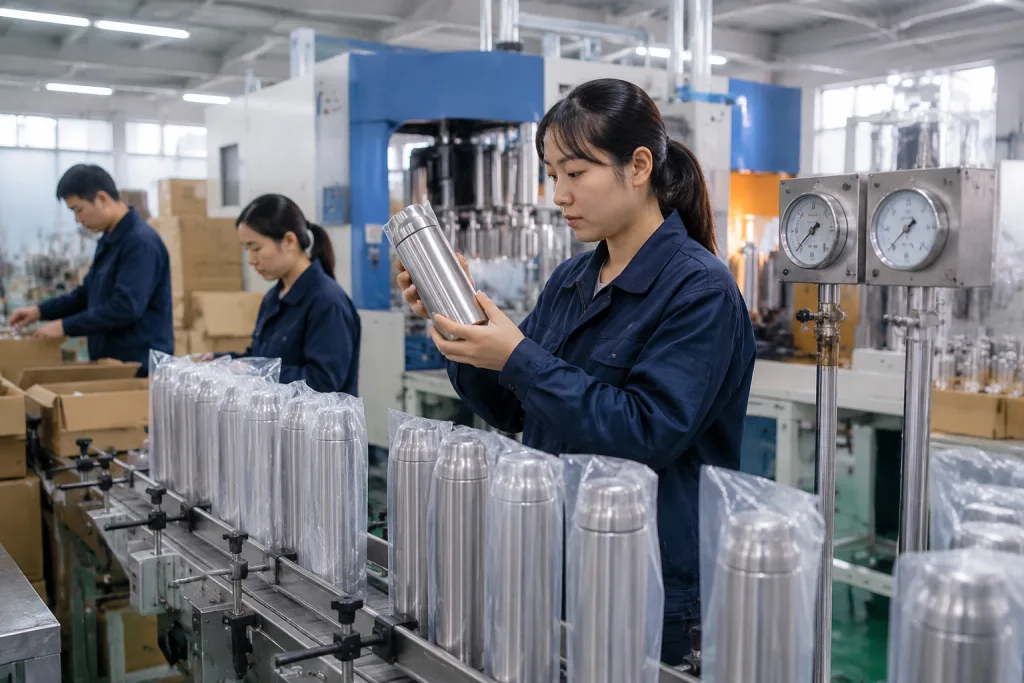
Most bad thermos orders do not fail in marketing. They fail on the factory line, and you usually spot it after cartons land in your warehouse: a 1.0 mm wall that feels flimsy in hand, a vacuum that leaks after 24 hours, a coating that scuffs in transit, or a lid that passed sample sign-off and then drips when the line runs at 3,000 units. We have seen buyers approve a clean pre-production sample, then the buyer flagged a loose cap torque on the first full run. If you buy for outdoor retail or promotions, the wrong question is “which supplier looks best?” The real question is which failure you can afford.
In Zhejiang and across China, the better stainless thermos plants do not sell perfection. We run risk down with tooling, process checks, and a tight MOQ, then we ship against the spec that matters. A manufacturer thermos partner moving 200,000 units a month can still miss a cap torque spec if you leave it vague; QC pulled the sample, checked the torque meter, and found the gap in 10 minutes. Lock the weak points first, then the cosmetic points. That is the difference between a custom thermos that sells and a thermos bulk order that turns into a claims file.
The first failure is the wall
I’ll rewrite the section in-place, keep every HTML tag and list structure, and tighten the wording so it sounds like a factory-side sales engineer.Thin stainless is where a lot of suppliers insulated water bottle jobs quietly fail. Buyers see a lower FOB and think the line is efficient. It is the wrong question to ask. A shell that runs too thin dents in transit, pulls out of shape during neck welding, and raises vacuum loss on the draw line. For a standard 500 ml stainless thermos, we usually hold 18/8 stainless on the inner cup, outer wall thickness around 0.35-0.45 mm, and a body gauge that still passes a 1.2 m drop test. Go lighter and you may save 6-8 cents a piece, but the reject pile gets bigger fast.
The spec is more than steel grade. Ask the thermos manufacturer to show the forming sequence, weld seam control, and whether the bottle is preheated before vacuum brazing. On one Zhejiang thermos line, QC pulled the sample and found seam ripple and 0.8 mm neck ovality before the shiny catalog photos ever mattered. If you are buying custom thermos or thermos custom SKUs for outdoor retail, lock in a neck concentricity tolerance and a dent-resistance check on packed cartons. We have seen this go sideways: the pallet looked clean, then the top layer came off with flat spots and a buyer flagged it the same day.
- Specify 304/18-8 inner steel for food contact
- Ask for wall-thickness inspection at first article and IQC
- Require drop-test data on packed master cartons
- Reject visible neck ovality before vacuum sealing
Vacuum loss is the silent killer
I’ll rewrite the prose in place, keep the HTML exactly as-is, and make it sound like a shop-floor sales engineer wrote it.If a thermos cannot hold temperature, nobody cares how clean the logo print looks. Vacuum loss is one of the costliest failures because it often shows up only after cartons leave the factory. We usually see three causes: weak seam welding, dirt in the brazing zone, or unstable evacuation time. A real thermos factory should quote thermal retention in hours, not float vague promises. For a 500 ml model, 6-12 hours hot retention is the normal target depending on lid structure and insulation method, and the test sheet should state fill level, ambient temperature, and start temperature. QC pulled one 500 ml sample at 95°C last week; it dropped to 61°C too fast, and the buyer flagged it before shipment.
For suppliers thermos programs, ask for the leak test method used on the line, not the one printed in a brochure. Helium leak testing is the cleanest check, but most SKUs do not justify that cost; pressure-hold or hot-water immersion is what we run more often. The math does not work if you skip verification. If a distributor thermos order will carry your brand, require one vacuum-retention sample from pre-production and one from mass production. We’ve seen this go sideways when a PO typo changed the lid code from `T-07` to `T-70`, and nobody caught the mismatch until cartons were packed. Plants that last in China treat process control as margin protection, not lab theater.
Cold-looking stainless can hide a dead vacuum. You do not find it in a spec sheet; you find it when the end user says the bottle is warm by lunchtime.
Lid leaks cause most complaints
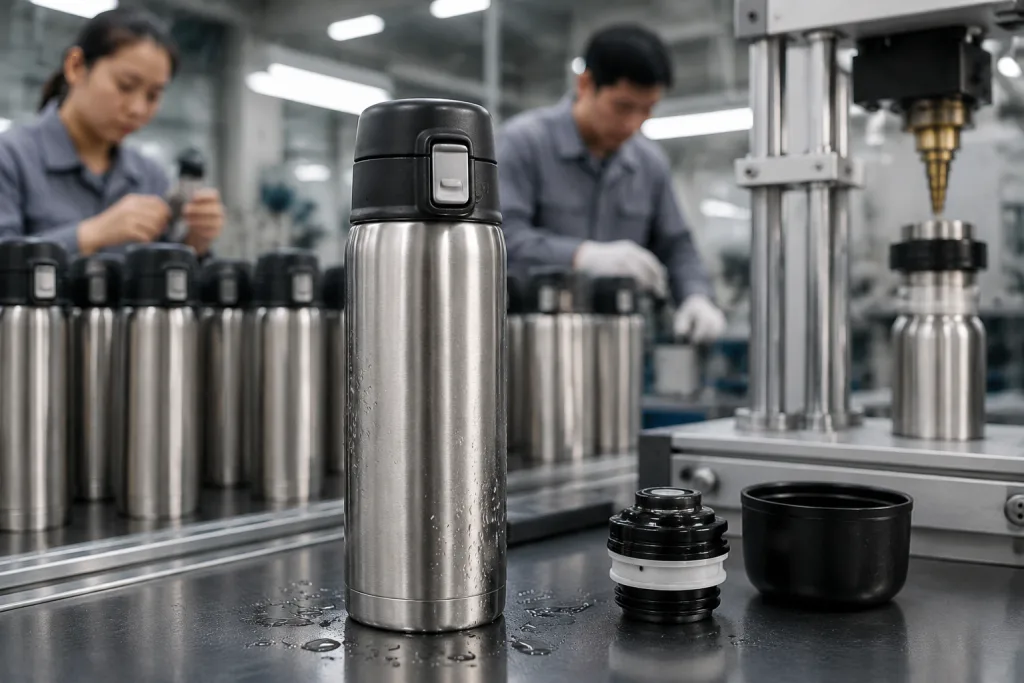
I’ll rewrite the section in place, keep the HTML exactly intact, and tighten the copy so it sounds like a factory sales engineer wrote it.The lid is where most thermos complaints start. The body can pass every check, then one bad gasket or loose thread pitch turns into a leak after a buyer throws the bottle in a backpack. We see this on the line. Most buyers stare at the logo and skip the sealing stack: silicone ring hardness, cap thread engagement, vent path, and mouth finish. For a promotional thermos order, the lid is a working part, not an add-on.
Ask your thermos supplier for the seal drawing and the gasket material grade. A silicone ring around Shore A 50-60 is common; if it is too soft, it twists on closing and the lid starts weeping. If the lid uses a push-button or straw insert, we run 3,000 open-close cycles on the test jig. For bulk custom thermos orders, lock in a torque spec for the lid and a 100% leak test on the first production run. QC pulled one sample at 1.2 N·m last month and the buyer flagged it, so this is the wrong place to guess. It matters even more when the bottle goes to hikers, cyclists, or trade-show teams who carry it sideways in a bag. One lid fault can sink an otherwise solid thermos bulk program.
- Confirm silicone gasket hardness and fit
- Set lid torque and cycle-life requirements
- Test every unit early in production
- Check thread smoothness after printing or coating
Coating failure ruins the shelf appeal
I’ve got the section and constraints. I’ll rewrite just the prose inside the existing `` tags, keep the HTML intact, and tune the copy to sound like a factory-side sales engineer.
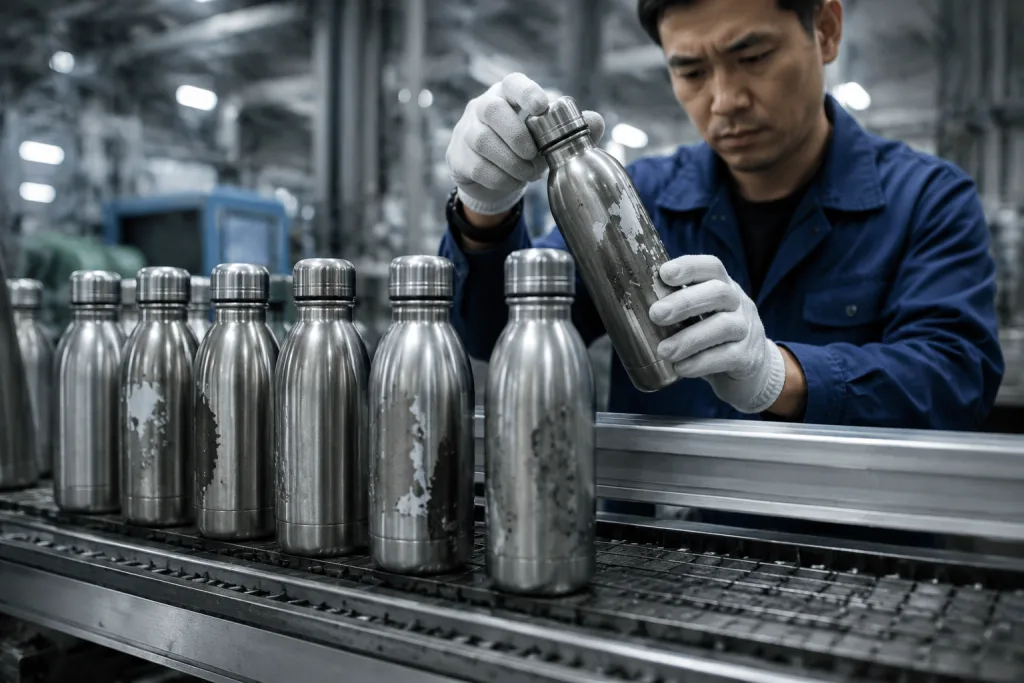
Coating is where a thermos customization job turns into a warehouse headache if the finish does not match the handling route. Powder coat, spray paint, and UV print fail in different ways. Powder coat chips at the rim; spray paint scratches when cartons rub; some matte finishes show fingerprints under retail lights. If you are buying from a thermos factory in Zhejiang, ask what pretreatment runs before coating: degreasing, sandblasting, phosphating, or direct spray. That step decides whether the finish survives a 1 m drop and a week of cross-border freight vibration.
For distributor thermos programs, the real problem is not only the coating, but how the coating and decoration work together. Laser marking on a dark matte bottle holds up; large color logos on soft-touch paint can flake if the curing cycle gets rushed. A good manufacturer thermos partner will let you choose decoration by wear, not by looks alone. If your order is a custom thermos run for outdoor retail, ask for abrasion testing with a rub test or tape test, and request carton-in/carton-out photos. We have seen this go sideways: the bottle passed QC, then picked up scuff marks after 6 hours of friction inside the box.
Decoration can fail before the bottle does
I’ll rewrite the section in a more supplier-side voice, keep the HTML exactly intact, and swap in concrete factory details without changing the structure.Logo failure is a buyer problem because it turns a working bottle into a brand risk. Screen printing, pad printing, laser engraving, and heat transfer behave differently on stainless steel; we see it on the line all the time. If you are sourcing a thermos custom job, pick decoration by use case, not by taste. Screen print works for a 30-day promo run; laser holds up after dishwasher cycles and scuffing. On curved bodies, a 2 mm seam shift can move the logo off center even when the artwork file is clean.
When you talk to a thermos manufacturer or thermos vendor, ask for an artwork wrap template with the exact printable area, not a generic PDF. We had a buyer flag a PO once because the word mark sat 4 mm too low on a 750 ml bottle, and the whole batch had to be held for rework. In a China production line, one wrong template can scrap 500 units before QC pulls the sample and sees the image walking toward the seam. For thermos customizable sets, lock Pantone reference, print tolerance, and curing temperature before mass run. If the item is a promotional thermos for events, price decoration as a risk line item. The math does not work any other way, and we have seen 5,000 bottles go sideways because the finish was approved from a flat proof.
Use the right decoration for the job
- Laser for wear resistance and easy cleaning
- Screen print for simple 1-color campaigns
- Check seam position against logo placement
- Approve a pre-production sample under retail lighting
Packaging failures create avoidable claims
I’ll rewrite the section in-place, keeping the HTML tags and structure unchanged, and tighten the language so it reads like a factory-side sales engineer wrote it.Most claims come from packaging, not the bottle. A stainless thermos can pass leak tests and lid torque checks, then show up dented, scuffed, or with the lid sitting off-center because the insert tray was loose or the master carton spec was weak. If you buy thermos bulk for warehouse dispatch, packaging is part of the product. Lock down export carton strength, inner box fit, and drop resistance before the PO is confirmed. We’ve seen 3 mm of spare space turn into bottle-on-bottle damage after a 30-day sea leg.
Ask the supplier insulated water bottle factory for carton dimensions, units per master carton, and gross weight in kg. For e-commerce or retail replenishment, a molded pulp tray or a tighter inner box often beats paying claims later. One buyer pushed back on a 5 mm tray change; QC pulled the sample, dropped it from 80 cm, and the bottle still shifted. If you ship to Amazon-style fulfillment, add FNSKU labeling, barcode position, and a scan check at packing. Ignore packaging and you hand the warehouse a problem at the door. The math does not work.
Most export damage is not dramatic. It starts with 1 mm of movement in the carton and ends 30 days later with a claim sheet.
Specs that protect your margin
I’ll rewrite the two paragraphs in-place, keep the HTML exactly as-is, and tighten the copy so it sounds like a factory-side sales engineer wrote it.The cleanest way to protect margin is to write the spec like the factory will look for ways to cut cost, because some will. That is procurement. For a stainless thermos project, lock down the material grade, wall thickness, lid type, coating, decoration method, carton spec, and test regime on one sheet. Put AQL targets on appearance and function, and give the first 300-500 pcs their own acceptance bar instead of using mass-production rules. We’ve seen a buyer lose a week because the PO said “304” but skipped wall thickness; the line assumed 0.4 mm, the client expected 0.6 mm, and the math did not work. If this is a private-label custom thermos line, you are deciding whether you are buying a one-off or setting up a repeat program.
A Zhejiang thermos supplier with steady capacity should handle 1,000-3,000 pcs MOQ per style, with lead times around 25-35 days after sample sign-off, and 200,000 units a month once the line is running. QC pulled the sample on one job and found a 1.2 mm lid gasket spec had been typed as 12 mm on the PO; that typo would have blown the fit. That does not promise quality. It does tell you the factory thermos process is stable enough for repeat orders without guesswork. For outdoor retailers and promo brands, the best thermos supplier is the one that tells you straight when your design is too thin, too busy, or too costly to scale. That honesty saves margin.
Request a tighter thermos spec today
Send your target size, logo method, and packaging needs. We’ll help you spec a stable China-made stainless thermos with fewer production surprises.
Frequently asked questions
What MOQ should I expect from suppliers insulated water bottle factories?
For a standard stainless thermos, a realistic MOQ is 1,000-3,000 pcs per style and color. If you want multi-color coating, special lid tooling, or custom packaging, some manufacturers thermos lines will push that to 5,000 pcs. In Zhejiang, many factory thermos operations prefer repeat orders because setup time is where cost sits. If a quote looks unusually low at 500 pcs, check whether it is using stock tooling, stock lids, or simplified decoration. Lower MOQ is possible, but you usually pay with fewer finish options or a higher USD unit price.
How do I check if a custom thermos will leak in production?
Do not rely on one sample. Ask for a first article, a pilot run, and a line leak test on early production. For a proper custom thermos order, the factory should show the leak test method: inversion test, pressure hold, or hot-water immersion. On promotional thermos projects, I would ask for 100% leak testing on the first 2,000 units, then move to AQL 2.5 once the line is stable. Also check lid torque, gasket fit, and thread finish. Most leaks come from the lid stack, not the stainless body itself.
What price range is normal for thermos bulk orders?
For a 500 ml stainless thermos with basic single-color print, you may see FOB China pricing around USD 2.30-4.80 depending on coating, lid, and packaging. Add more for laser engraving, premium powder coat, or gift packaging. A thermos bulk order with better insulation, matte finish, and retail carton can move above USD 5.00. If a thermos manufacturer is quoting far below that, check the steel grade, wall thickness, and whether the lid is a standard part. Cheap pricing often hides thin walls or weak packaging.
What testing standards should I ask for?
For export, ask for food-contact compliance such as REACH where relevant, and document internal QC with AQL 2.5 for major defects and 4.0 for minor defects unless your program needs tighter limits. You should also ask for drop testing, thermal retention testing, and adhesion or rub testing on coated finishes. If your market needs it, add ASTM-style material checks or retailer-specific packaging tests. A good thermos supplier will state the test conditions clearly: fill level, ambient temperature, drop height, and number of cycles. Vague test claims are not useful.
Can I sell custom thermos products through Amazon or retail chains?
Yes, but the packaging and labeling have to be tighter. For Amazon-style fulfillment, you may need FNSKU labels, barcode placement, and carton dimensions that fit inbound requirements. Retail chains may ask for master carton specs, drop-test evidence, and consistent UPC placement. If you are sourcing from a thermos factory in China, confirm whether they can label, polybag, or pack to your distribution spec. A distributor thermos program fails fast when boxes are too big, labels are crooked, or the finish is damaged in transit.