Key Takeaways
- A clean RFQ should list 8 items: volume, material, finish, logo method, lid, packing, destination, and target price.
- Sample approval usually takes 5-7 days; bulk lead time is often 25-35 days at MOQ 500 pcs.
- Use AQL 2.5 for major defects and lock carton counts, spare parts, and over/under tolerance in the PO.
- A Zhejiang canteen factory with 200,000 units/month is useful only if the spec is stable and the test plan is written.
If you are chasing suppliers hydration flask options and keep getting vague prices, you are not alone. We see this every week. Most bad sourcing starts with a loose RFQ and ends with a sample that looks fine in photos but leaks in carton or ruins the logo after 20 wash cycles. A buyer in Europe or North America should not ask for a quote and guess. Put the flask spec, lid type, finish, leak test, logo method, and carton pack on one sheet before anyone talks money.
That is the straight way to buy custom drinkware from China or Zhejiang. On our line, a 500 ml flask and a 750 ml flask are not the same job, and the MOQ changes fast once you switch lids or coating. Whether you need a canteen custom program, a customizable canteen for retail, or a canteen promotional run for distributors, every step needs a written gate. If you want a canteen manufacturer to act like a factory instead of a canteen vendor, move from RFQ to sample to PO with numbers attached; the math does not work any other way.
Write the RFQ buyers can quote
I’ll keep the HTML structure intact and rewrite the prose with sharper buyer language, concrete factory details, and fewer filler phrases. Then I’ll return only the rewritten HTML.If you want real numbers from suppliers hydration flask inquiries, stop sending a one-line email that says "need quote for flask." A serious canteen supplier can price fast when you give the same data your own team uses to buy it. We run quotes off capacity, material, wall thickness, finish, lid structure, logo area, target market, packing, and destination port. For custom drinkware, the RFQ is the first QC gate, not admin noise.
Use a format like this:
- Capacity: 500 ml, 750 ml, or 1 L
- Material: 18/8 stainless steel, single wall, or insulated double wall
- Finish: powder coat, matte paint, brushed steel, or printed
- Logo: silk screen, laser engraving, or full-wrap print
- Packing: color box, mailer, or gift set
- Incoterm: FOB Ningbo, FOB Shanghai, or DDP if you insist
If you are comparing canteen manufacturers, ask for separate pricing on tool-free samples, mold-based samples, and repeat orders. We’ve seen buyers compare a 500-piece sample run with a 5,000-piece repeat order and then say the factory is expensive. The math doesn’t work. A growler-style flask, a canteen promotional item, and a premium retail bottle all carry different setup costs, and QC pulled the sample with 1.2 mm wall thickness on one line while another line was running 0.8 mm. That is the wrong question to ask.
RFQ line items to insist on: unit price at 1,000 / 3,000 / 5,000 pcs, sample cost, artwork charge, carton spec, spare lid cost, and production lead time in calendar days.
Approve samples like a production gate
I’ll rewrite the section in place, keep the HTML exactly as-is, and tighten the copy so it sounds like a real factory-side sales engineer.A sample is not a freebie. It is a production promise. When a canteen factory sends over a canteen custom prototype, we test the same points your customer will hit later: leak resistance, coating adhesion, lid fit, odor, and print wear. We’ve seen one weak sample kill a whole season for a retail buyer.
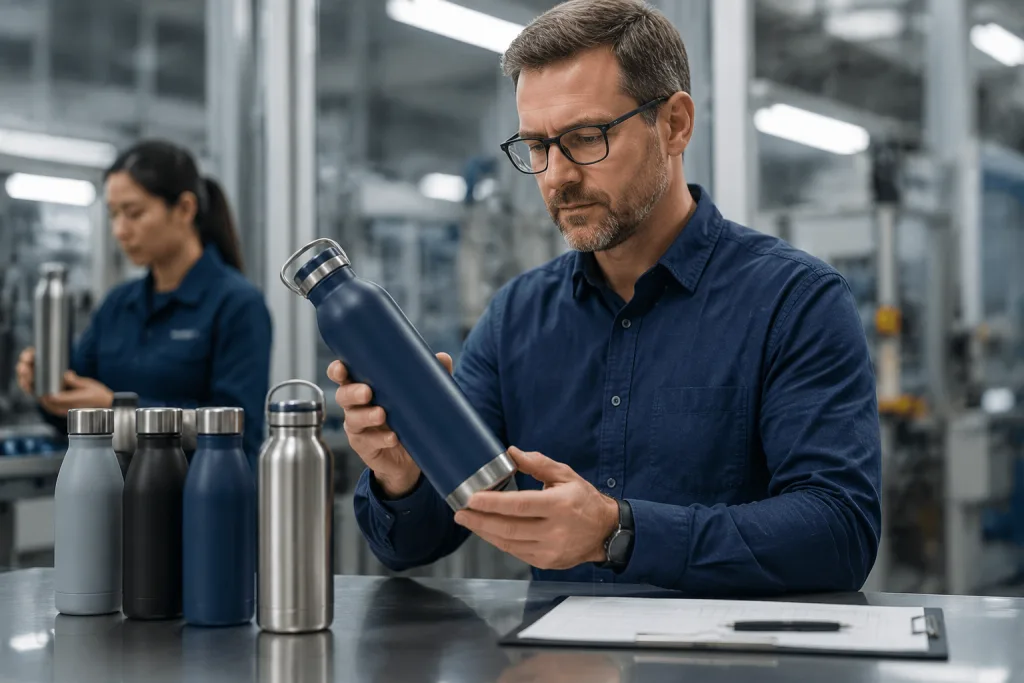
Do not approve from photos alone. Ask for three physical samples: one for shelf look, one for abuse checks, and one untouched as the golden sample. For a customized canteen or customized growler, check the weld line, base flatness, and cap thread engagement with a caliper and a torque cap. If you need 0.6 mm or 0.8 mm steel gauge, write it on the sample sheet; do not assume the canteen vendor will read your mind. The buyer flagged this on a PO once, and the line still ran the wrong gauge.
Practical sample checklist: 24-hour water hold test, 1-meter drop test, logo rub test at 50 cycles, and lid open-close test at 200 cycles.
Keep the sample PO short and explicit: sample fee, courier account, lead time of 5-7 days, artwork confirmation, revision limit, and the exact delivery address. Put the typo risk on the table too; we once shipped to a city name written one letter off. If the factory cannot follow a sample PO, the bulk PO will go sideways. That is the wrong question to ask in Zhejiang or Guangdong.
Turn approval into a clean PO
I’ll rewrite the section in place, keeping the HTML structure unchanged and tightening the sales-engineer tone. Then I’ll do a quick pass for the banned phrasing and make sure the concrete factory details are still there.Once the sample is approved, the bulk PO needs to read like a production file, not a buying note. We see canteen distributors slip here all the time. They send a quantity line and skip the parts that trigger claims later. On our side, QC pulled the approved sample card and matched it against the PO before we release the line. For a canteen manufacturer, the PO should lock the product revision, artwork version, carton spec, test standard, and delivery window.
Use PO line items such as:
- Product code and revision: one code per size and color
- Quantity: 3,000 pcs with ±3% tolerance only if agreed
- Unit price: tiered pricing by volume, in USD
- Inspection: AQL 2.5 for major defects, 4.0 for minor defects
- Packing: 1 pc/polybag, 24 pcs/carton, carton drop-test requirement
- Spare parts: 1% extra lids or seals included in bulk
If you are buying a custom growler or customizable growler program, state whether the closure uses a replaceable gasket. If you are buying a canteen promotional run, write the color limit as Delta E 2.0 or tighter. The buyer flagged one PO last quarter because the lid gasket note was missing, and that became a 12-day delay. This is where supplier hydration flask quoting turns into factory discipline. No PO detail, no leverage.
For repeat orders, push for a second-run lead time of 20-25 days if the tooling is already stable. A new order from a clean file should not slip because sales forgot to pass revision B to the workshop. We run into that on the packing table when the carton spec changes by 5 mm and nobody updates the file.
Read the factory, not the brochure
I’ll rewrite the section in a more field-tested factory-sales voice, keep the HTML structure intact, and make sure the wording feels like someone who runs the line is speaking.You should judge the canteen factory by capacity, process control, and paperwork, not by a polished homepage. In Zhejiang, a real canteen factory can run 200,000 units per month, but that number means little if QC cannot hold color within ΔE 1.5, keep welds clean, or ship cartons that match the PO. The better sign is a team that can explain why one SKU has a 500 pcs MOQ and another starts at 2,000 pcs. That is line economics, plain and simple.
Ask direct questions. Are they a canteen manufacturer with in-house forming and coating, or a canteen supplier pushing half the job to subcontractors? Do they hold BSCI or ISO 9001? Can they support REACH for Europe and give material declarations for North America? If you need a custom canteen with food-contact materials, ask for third-party test reports, not a sales note. We’ve seen buyers skip that step, then the lab file comes back wrong on heavy metals. The math does not work.
Do not mix up a canteen vendor, canteen vendors, canteen distributor, and canteen distributors with a factory. A distributor drinkware team can help with stock or mixed-SKU sourcing, but they usually cannot control tooling, coating line scheduling, or a carton print typo on a 20-foot order. If your project needs exact branding, a canteen promotional order, or a customized canteen on a hard deadline, go straight to the canteen manufacturer or a factory-linked sales team. Otherwise, you will spend days chasing approvals while the line waits.
Good factory signals: written QC flow, sample archive, batch traceability, and a visit that shows one production line from forming press to packing table.
Ship without customs or claim surprises
I’ll keep the HTML structure intact and rewrite only the prose, with tighter buyer-language, concrete logistics detail, and no AI-ish filler.The last step is where margin disappears. We’ve seen a clean bulk order turn into a claim because the carton marks were off by one line or the labels were mixed. If you sell on Amazon or into retail, tell the supplier exactly how to print the outer carton marks, and keep FNSKU labels separate from the shipping carton labels. For Europe, check REACH, LFGB where relevant, and the local packaging rules before you book freight. For North America, the broker should not be guessing from a messy file.
Write the logistics line in the PO with the same care as the product line: incoterm, port, palletization, carton count, gross weight, net weight, and whether the seller books at FOB Ningbo or FOB Shanghai. We run into trouble when a buyer leaves that blank and expects the factory to “know.” A canteen suppliers list only matters if the partner can hand over compliant paperwork on time. Ask for the commercial invoice, packing list, test report, and the declaration of conformity if your market needs it. That is not extra. That is the job.
For a canteen customized retail launch, add one line for spare seals or caps at 1-2% of order quantity. It costs little and saves a claim later. QC pulled the sample on one order and found the cap gasket was fine, but the buyer flagged the missing spares on receipt and the issue became a warehouse headache anyway. If the order includes a customizable growler or custom growler format, confirm whether the cap is food-safe and whether the valve or gasket needs replacement after 6 to 12 months. The math does not work if you ignore that.
When the shipment lands, measure fill rate, carton damage, and sample pull rate from the first 2% of cases. If the first lot is clean, keep the same file and do not “improve” it. We ship a lot of custom drinkware this way because repeatability beats heroics. That is how a serious buyer uses suppliers hydration flask relationships to build steady supply instead of chasing one-off deals.
Send your RFQ and get a real factory quote
Share your size, material, artwork, and target price. We will turn it into a production-ready canteen custom spec with clear MOQs and lead times.
Frequently asked questions
What MOQ should I expect from suppliers hydration flask?
For a standard stainless steel flask, a realistic MOQ is 500 pcs per SKU if the design is simple and the finish already exists. If you want a new color, new lid, or custom mold, 1,000-3,000 pcs is more realistic. A true canteen factory in Zhejiang may quote lower on paper, but the landed price usually gets worse below 500 pcs because setup cost is spread too thin. For custom drinkware with full branding, expect separate MOQs by color and print version. If the seller is a canteen distributor rather than a factory, they may offer mixed-SKU flexibility, but you will usually pay more and lose control over the production spec.
How long does sample approval usually take?
A normal sample cycle takes 5-7 days for a simple canteen custom request if the factory already has the core body and lid. If a new mold, special coating, or printed gift box is involved, plan on 10-15 days. You should ask for three samples: one visual approval piece, one test piece, and one archive sample. That is better than approving from photos. For customized drinkware or a customized canteen, the sample PO should list the exact artwork file, courier account, and revision limit. If the supplier cannot ship a sample in that window, do not assume bulk will be faster.
Which standards matter for Europe and North America?
For Europe, REACH is the baseline many buyers ask for, and LFGB may matter for food-contact confidence depending on the product and market. For North America, you still need material declarations, traceability, and sensible test reports from the factory. Ask for stainless steel grade, coating composition, and any third-party test result, not just a verbal promise. A canteen manufacturer in China that works with export accounts should be able to provide those documents without drama. If you buy a custom growler or customizable growler, check lid material and gasket safety too. The bottle body is only half the compliance story.
What should be on the bulk PO line items?
A good bulk PO should include product code, revision number, quantity, unit price, lead time, incoterm, packing spec, carton count, artwork version, inspection standard, and spare parts. For most drinkware orders, use AQL 2.5 for major defects and 4.0 for minor ones. If your order includes canteen promotional packaging, state the exact print proof and box dimensions. If the supplier is a canteen supplier or canteen vendor, the PO should still read like a manufacturing document. That is the difference between a clean shipment and a dispute over "what was agreed."
How do I judge whether a factory is real capacity or just sales talk?
Ask for monthly output, in-house process steps, QC flow, and a recent production video with timestamps. A credible Zhejiang plant can usually explain how it handles coating, welding, inspection, and packing. If a canteen factory says it makes 200,000 units per month, ask how many lines that means and what the actual shift pattern is. Also ask whether they hold BSCI or ISO 9001 and whether they can support repeat orders with a 20-25 day lead time. A canteen manufacturer that answers in numbers is usually safer than a canteen distributor that only sends catalog PDFs.