Key Takeaways
- Ask for MOQ by decoration method: 1,000 pcs for stock color laser, 3,000 pcs for custom powder coating
- 304 stainless steel at 0.40-0.50 mm wall thickness is typical for mid-market hydration bottles
- Use AQL 2.5 for major defects and AQL 4.0 for minor defects on finished drinkware
- Plan 35-45 days production after sample approval, plus 28-35 days ocean freight to North America
You are not just buying bottles. You are buying cartons that stack square at 15 kg, logos that land within 0.5 mm, lids that pass a 24-hour leak check, audit files, and a ship date your sales team already put on a PO. Catalog photos do not show that. We saw one buyer flag a nice-looking hydration bottle sample last March because the straw lid clicked well, then leaked after QC pulled the sample from a 1.2 m drop test.
From our factory base in Hangzhou, Zhejiang, we see the same mistake about 9 times a month: buyers compare FOB prices before they check steel grade, coating scratch results, packing drop tests, or AQL terms. The math does not work if a USD 0.18 cheaper bottle needs rework on 3,000 lids. China can ship strong custom drinkware, but your RFQ has to force clear answers early, down to 304 stainless, powder coating spec, carton size, and whether the PO says “matte black” or the typo we once got, “mate black.”
What Are You Really Sourcing?
Search “suppliers hydration bottle” and you are probably mixing 6 buying jobs into one line on the RFQ: sports bottles, vacuum bottles, canteen custom programs, retail tumblers, school bottles, and sometimes a custom growler. On our floor, those do not share the same route. The Tritan bottle goes to injection molding; the vacuum bottle goes through tube cutting, welding, vacuum testing, and powder coating. Different line. Different risk.
A single-wall plastic sports bottle may use Tritan, PP, or PE and run at 5,000-10,000 pcs per color. A double-wall stainless bottle usually uses 304 inner steel, 201 or 304 outer steel, copper coating for insulation, and vacuum sealing. A customized growler needs a stronger lid seal because beer, kombucha, and carbonated drinks increase pressure risk; QC pulled one 64 oz sample at 0.35 MPa because the gasket rolled 1.2 mm out of the groove. Do not send one RFQ saying “water bottle” and expect comparable quotes. The math doesn't work.
Use this basic buying checklist before contacting a canteen supplier. We see 7 out of 10 quote delays start here, often because the PO says “750ml bottle” but the artwork file is named “32oz-final.ai”:
- Product type: hydration bottle for gym channels, custom canteen for promotion, travel tumbler for coffee use, kids bottle with bite-safe parts, or distributor growler with pressure-rated closure.
- Capacity: common export sizes are 500 ml, 750 ml, 1,000 ml, 32 oz, and 64 oz; confirm brim-full capacity or usable capacity before tooling.
- Material: 304 stainless steel, Tritan, borosilicate glass, PP lid, silicone gasket; tell the supplier if the buyer needs food-contact test reports by material.
- Use case: retail shelf with color box, corporate gift with logo, Amazon FBA with drop-test packing, outdoor club, school program, or distributor drinkware line.
- Compliance market: EU, UK, USA, Canada, or mixed export; do not mix LFGB and FDA assumptions on one quote sheet.
In Zhejiang, a serious canteen manufacturer will separate mold cost, unit price, decoration charge, and packing cost. We run quotes this way because a 0.18 USD silk-screen logo, a 0.42 USD color box, and a new lid mold can change the landed price fast. If a canteen vendor gives one flat price with no breakdown, you are not negotiating; you are guessing what was removed.
Factory Or Trading Company?
I’ll rewrite the section in place, keeping the HTML intact and tightening the sales-engineer tone with concrete factory details.This question matters, but not the lazy version buyers usually ask. A trading company is not automatically a problem, and a factory is not automatically organized. What matters is control over the points that create defects: steel forming, welding, vacuum testing, coating, printing, assembly, packing, and final inspection.
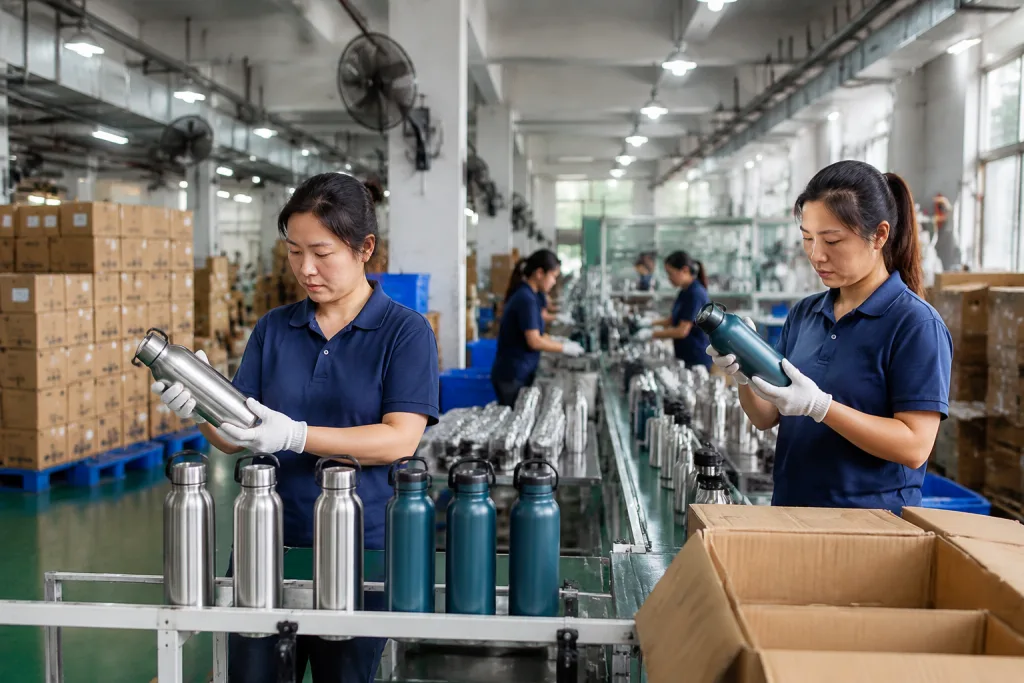
At BottleForge Industrial in Hangzhou, Zhejiang, we run stainless lines for export programs, not local wholesale. Monthly output sits around 450,000 stainless drinkware units, with MOQ at 1,000 pcs for stock models and 3,000 pcs per custom color. That scale keeps a hydration bottle program moving without pushing your order to the back of the line.
Ask your canteen suppliers direct questions:
- Do you own the vacuum tester, or do you buy finished bodies from outside?
- Can you show BSCI, ISO 9001, or social audit documents under the same company name as the invoice?
- Is powder coating done on your line, or at a subcontractor 40 km away?
- Who signs the pre-shipment inspection report?
- Can you share production photos from steel forming, coating, printing, and packing?
For a distributor canteen program, continuity is the real issue. If the first order sells, the next one needs the same lid, the same coating texture, the same carton strength, and the same color tolerance six months later. We’ve seen this go sideways when a seller quotes low by buying bodies from whoever is cheapest that week. That saves USD 0.15 now and turns into warranty noise later.
Good sourcing is not finding the lowest canteen manufacturer. It is finding the supplier whose process stays boring after the deposit is paid.
What Should The RFQ Include?
I’ll rewrite just the prose inside the existing tags, keep the HTML structure intact, and make the RFQ sound like it came from a factory-side sales engineer.Your RFQ should make weak suppliers show their hand. A good suppliers hydration bottle RFQ stays short, but every line has a number or a spec. If you send only a photo and ask for “best price,” we all know what comes back: one quote on 0.5 mm steel, another on 0.35 mm, and a third that quietly drops the lid test or carton standard.
For stainless hydration bottles, list target capacity, exact bottle height if it has to fit a shelf, mouth diameter, lid type, carry handle requirement, coating finish, logo size, logo method, carton drop requirement, and shipping destination. For a canteen customizable project, add Pantone color, artwork file format, placement tolerance, and whether you accept Delta E less than 2.0 or 3.0. QC pulled the sample on one job and the buyer flagged the color at 3.4; the new order had to be reworked. That is the wrong question to leave open.
A workable RFQ line looks like this: 20 oz double-wall 304 stainless hydration bottle, 0.45 mm inner wall, powder coated Pantone 296C, one-color silk screen logo 45 x 60 mm, individual kraft box, 24 pcs master carton, EU REACH and LFGB food-contact test required, AQL 2.5/4.0, FOB Ningbo, 3,000 pcs, delivery 40 days after PP sample approval.
For customized drinkware in China, ask for these separate prices:
- Blank bottle unit cost.
- Custom color or coating surcharge.
- Logo cost by method.
- Gift box, insert card, barcode, or FNSKU labeling cost.
- Tooling or mold cost for a customized canteen lid.
- Sample cost and courier cost.
This setup lets you compare a canteen supplier and a canteen vendor on the same sheet. We have seen this go sideways when a buyer approved artwork first and checked pricing later; the math does not work. Ask for the split upfront, and the price stays honest.

Which Custom Options Are Safe?
I’m rewriting the section in-place, keeping the HTML exactly as-is and tightening the sales-engineer tone. I’ll preserve the list structure and weave in a few factory-floor details so it reads like we’ve actually run these jobs.Customization sells, but some options create more risk than value. For most B2B custom drinkware programs, the safe bets are laser engraving on stainless steel, single-color silk screen on powder coat, heat-transfer printing for larger graphics, and debossed silicone parts when the order justifies tooling. Full-wrap artwork can look sharp, but it needs extra sampling and tighter QC; we’ve seen that go sideways on the line when the buyer approved a mockup and missed the seam.
Laser engraving is durable and clean. It fits a canteen promotional order with a simple logo, and the defect rate stays low because the marking head does not depend on ink adhesion. Silk screen is the cheaper call for one or two colors, usually around USD 0.08-0.18 per position depending on size, and our print table runs it fast once the mesh is set. Heat transfer can run USD 0.35-0.80 per bottle and needs tape test checks after curing. UV printing gives strong color detail, but if the coating and ink system are mismatched, the buyer flags it after the first rub test.
For a customizable growler, decoration should not block grip, lid threads, or pressure warnings. A growler for breweries often needs a bigger logo area, but legal text and care text still need room. This is the wrong place to get cute. We had a PO last month with the bottom stamp covered by artwork, and QC pulled the sample before packing because the importer needed traceability.
Use this decoration checklist:
- Laser engraving: best for simple logos, low MOQ, and long wear.
- Silk screen: best for flat artwork under 2 colors.
- Heat transfer: best for multi-color retail graphics.
- Powder coating: better grip and perceived value than spray paint.
- Custom mold: only sensible when volume is usually 10,000 pcs or more.
A canteen customized with too many features gets harder to reorder. Keep the first buy practical, then upgrade after you have sell-through data. That’s the cleaner math.
How Do Prices Really Move?
I’ll rewrite the section in-place, keep the HTML structure untouched, and tighten the sales-engineer tone with more concrete factory detail.For suppliers hydration bottle programs, price moves come from material, capacity, coating, lid complexity, packaging, and inspection calls. The bottle body is only part of the math. A 750 ml double-wall stainless bottle may quote FOB Ningbo around USD 3.20-4.80 at 3,000 pcs, depending on steel gauge, lid build, coating, and carton spec. A 64 oz customized growler usually lands around USD 6.50-9.50 before premium packaging. We have seen a buyer push back on a USD 0.22 carton upgrade, then lose the inner tray in transit. That is the wrong place to save.
MOQ is not a punishment; it is line economics. Powder coating needs wash-down, color changeover, hanging hooks, and curing time in the oven. If you ask for 300 pcs in six colors, the line spends more time resetting than shipping. That is why many canteen manufacturers prefer 3,000 pcs per color for custom coating, while laser engraving on stock black or white can start from 1,000 pcs. QC pulled the sample, checked the 0.35 mm wall, and the math still said no.
Watch these price levers:
- Steel thickness: 0.35 mm feels light; 0.45 mm is a better mid-market target.
- Lid: straw lids and flip lids cost more than screw caps and add more QC checks.
- Coating: powder coating costs more than basic spray paint but cuts complaint risk.
- Packaging: a color box can add USD 0.18-0.45; molded pulp inserts add more.
- Testing: LFGB, REACH, FDA, or ASTM testing should sit in the budget, not as an afterthought.
China export pricing also moves with the RMB exchange rate and stainless steel cost. If a canteen distributor needs a price hold beyond 30 days, say it early. We ship a lot of these, and a 12-day steel swing can wipe out the margin on a small order. A professional canteen manufacturer will tell you what can be locked and what cannot.
What Quality Checks Matter?
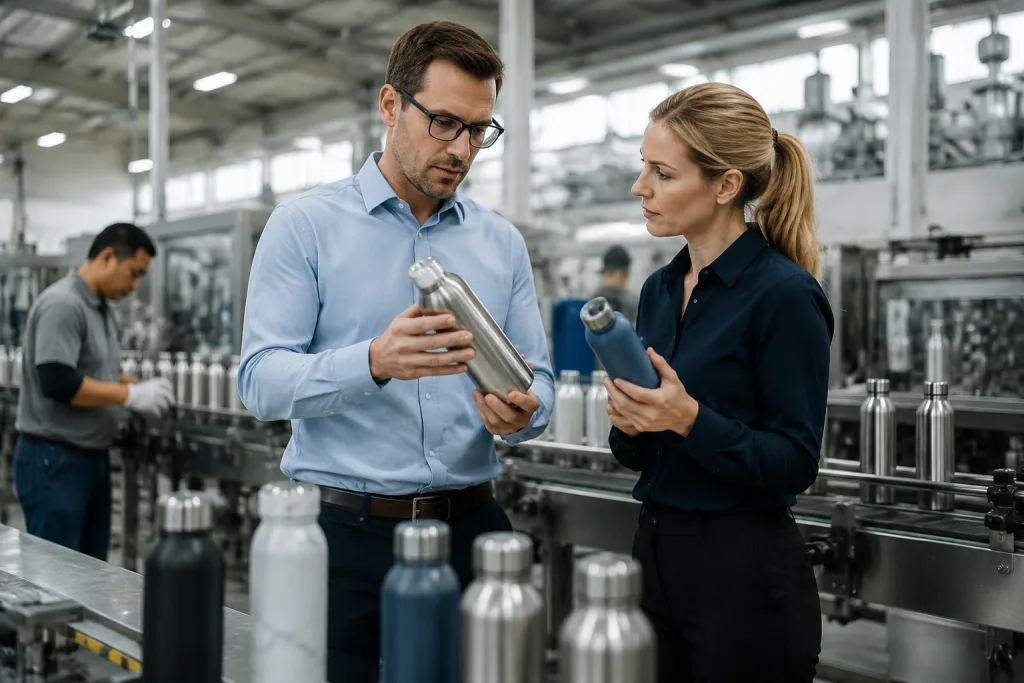
I’ll rewrite the section in-place, keep the HTML structure untouched, and tighten the language so it reads like a factory-side QC note with real inspection detail.Pretty samples are easy. Stable mass production is the hard part. For custom canteen orders, the QC plan starts before the deposit, not after the cartons are sealed. The purchase order needs the inspection standard, defect grading, approved sample number, and who pays rework if the lot fails. We’ve seen buyers skip that line and then argue over a 2,000-piece return.
For most distributor drinkware orders, we run ANSI/ASQ Z1.4 with AQL 2.5 for major defects and AQL 4.0 for minor defects. Critical defects stay at zero tolerance. Major defects cover leaking lids, failed vacuum insulation, sharp edges, wrong logo, coating peel, wrong capacity, and a barcode that won’t scan on the line. Minor defects cover small dust spots, slight color drift within the approved range, or a carton print shift of 2-3 mm. The math does not work any other way.
Factory checks should include:
- Vacuum insulation test, often 95°C water for 6 hours with temperature drop recorded.
- Leak test with the bottle inverted for at least 30 minutes.
- Cross-hatch or tape test for coating and logo adhesion.
- Carton drop test based on ISTA-style handling expectations.
- Capacity check with a water fill, not just the catalog claim.
- Needle detector or magnet checks where stainless grade is questioned.
For North America, ASTM-related checks may apply to kids products, especially if small parts are involved. For Europe, REACH, LFGB, and food-contact declarations matter. If one canteen supplier quotes without compliance and another includes it, the cheaper offer is usually just incomplete. We ship plenty of good units out of Zhejiang, but QC still needs written limits, a signed sample, and one person on the buyer side who will actually hold the spec.
How Should You Place The Order?
I’ll rewrite the section in-place, keep the HTML tags exactly, and tighten the copy so it sounds like a supplier-side sales engineer wrote it.Once you lock a canteen supplier, slow down for one day and clean up the purchase order. Most disputes start with fuzzy specs: “matte black” with no Pantone code, “logo as sample” with no signed reference, “ship ASAP” with no ex-factory date, or “Amazon labels” with no FNSKU placement note. We’ve seen a buyer flag a PO typo on carton size and the whole line had to stop for a recheck.
A clean order flow is straightforward. First, approve the quotation with Incoterm, usually FOB Ningbo or FOB Shanghai for Zhejiang production. Second, confirm artwork in vector format, preferably AI, EPS, or PDF with outlined fonts. Third, pay the sample fee and sign off on a pre-production sample. Fourth, place the 30% deposit. Fifth, get production updates at material arrival, coating, assembly, and packing. Sixth, inspect before paying the 70% balance. Seventh, release the shipping documents. QC pulled the sample at the 3rd step, not the 10th. That’s the right sequence.
For canteen distributors, add reorder controls. Keep one golden sample at your office and one at the China factory. Record Pantone, logo coordinates, lid version, gasket hardness, carton dimensions, gross weight, and HS code. For Amazon FBA or retail DC shipments, specify barcode grade, carton label size, pallet height, and whether master cartons must stay under 15 kg. We run into this all the time: a buyer wants “same as last time,” then the lid revision from V2 to V3 changes the fit and the math doesn’t work.
Typical timing is 7-10 days for a decorated sample, 35-45 days for mass production after approval, and 28-35 days ocean transit to the US West Coast, longer to inland warehouses. Air freight can save a launch, but it can also wipe out margin on a 5,000-piece order. A practical buyer builds the calendar backward from the retail date and books inspection at least 5 days before vessel cut-off.
Send Your Bottle RFQ For A Practical Factory Review
Share capacity, material, logo, packing, quantity, and target market. We will flag cost risks before you commit to sampling.
Frequently asked questions
What MOQ should I expect from suppliers hydration bottle factories?
For existing molds and stock colors, a China factory may accept 1,000 pcs with laser engraving or one-color silk screen. For custom powder coating, plan on 3,000 pcs per color because coating line changeover has real labor and material loss. For a custom canteen lid, new handle, or special mold, 10,000 pcs is a more realistic starting point. If a canteen vendor accepts 300 pcs in a custom color, check whether they are using spray paint, mixed surplus bodies, or a local workshop. Small trial orders are possible, but the unit price and defect risk usually rise.
How do I compare a canteen manufacturer and a trading company fairly?
Ask both for the same technical quote sheet: material grade, wall thickness, lid material, gasket material, coating method, logo method, carton packing, test standard, MOQ, lead time, and Incoterm. Then ask who performs vacuum testing, coating, and final AQL inspection. A canteen manufacturer should be able to show production photos and equipment. A trading company should prove supplier control and inspection process. The better partner is the one with clearer accountability, not just the one claiming to be a factory. For distributor canteen programs, repeatability over 2-3 reorders matters more than a USD 0.10 first-order saving.
Which compliance documents do I need for customized drinkware?
For the EU, ask for LFGB or EU food-contact testing where applicable, plus REACH for coatings and restricted substances. For the USA, FDA food-contact expectations apply, and kids items may require CPSIA and ASTM-related checks if designed for children. Canada and the UK can have their own importer requirements. Do not accept old test reports without checking model, material, color, and issuing lab. A report for a plain stainless bottle does not automatically cover a painted customized canteen with a new plastic lid. Budget USD 300-1,200 for common lab tests depending on scope.
What is the safest logo method for canteen promotional orders?
Laser engraving is usually the safest for stainless bottles because it does not peel, has low setup risk, and works well at 1,000 pcs or more on stock colors. Silk screen is cost-effective for simple one-color logos, but you should require an adhesion tape test and a signed pre-production sample. Heat transfer and UV printing are useful for colorful artwork, but they need more QC attention around scratches, edge lift, and color shift. For a canteen promotional order with a tight event deadline, choose a stock bottle, stock color, and laser or simple silk screen. Complexity is where delays hide.
How much time should I allow from China order to warehouse?
A realistic schedule is 7-10 days for sample production, 2-3 days for your approval, 35-45 days for mass production, 3-5 days for inspection and export loading, then 28-35 days by ocean to the US West Coast or 35-45 days to many European ports. Add inland trucking and customs clearance. From Zhejiang, FOB Ningbo is common and efficient, but peak season can still add delay. If you need retail delivery on a fixed date, start the project 90-110 days ahead. Air freight is possible for urgent cartons, but hydration bottles are bulky and freight cost climbs fast.