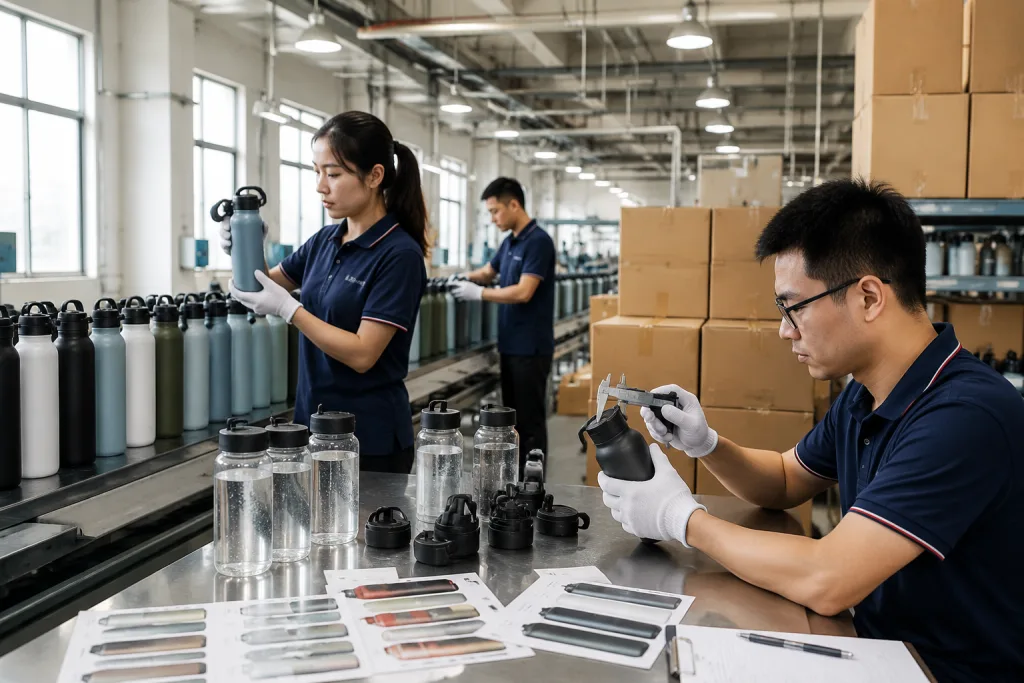
Key Takeaways
- Start with a 6,000-12,000 unit forecast before choosing mold, material, and decoration method
- A practical MOQ is 3,000 pcs per color for most custom sports water bottle projects
- Plan 7-10 days for sampling and 25-35 days for mass production after deposit
- Use AQL 2.5/4.0 plus leak, logo adhesion, drop, odor, and carton checks before shipment
You are opening 35 gyms across the Midwest, or refreshing merch for a fitness app with 200,000 paid users. The bottle looks simple until procurement asks for Tritan or PP, 700 ml or 1,000 ml, leak test data, logo rub resistance, carton drop tests, and whether we can ship mixed colors on one PO. We run these jobs every week, and the first typo usually shows up on the PO, not on the line.
For suppliers gym water bottle orders, the hard part is not finding a factory in China. The hard part is locking the right spec, approving a sample that can take daily gym use, then finding out the weak point after 12,000 units land. QC pulled the sample on our bench last month and the cap failed after 18 drops from 1.2 meters. This is the wrong question to ask: “Can you make it?” The real question is whether the bottle survives the whole run, from mold to carton to store shelf. Here is how we would walk a fitness brand or gym chain through one order from brief to QC release in Zhejiang.
Start with the use case
I’ll rewrite this section in-place, keep the HTML exactly as-is, and tune the copy to sound like a factory-side sales engineer.Use a real buyer case. You run a mid-size gym chain with 48 locations and need a custom gym water bottle for new member kits, retail shelves, and trainer giveaways. The first-year plan is 30,000 pcs, but you do not want to lock all of it into one PO. Fair call. A first order of 6,000 to 12,000 pcs lets you test sell-through without forcing the factory into ugly small-batch pricing.
The first decision is use case, not color or logo. A member carrying pre-workout powder needs a different bottle from a runner grabbing water between classes. For a bulk shaker bottle, we run a mixing ball, a powder compartment, 600-800 ml capacity, and PP that holds up to repeated dishwasher cycles. For a bulk sports water bottle used on treadmills and bikes, one-hand opening, a flip straw, and a 700-1,000 ml body matter more. QC pulled the sample after the lid hinge test at 300 cycles, and that told us where the weak point was.
If you ask three factories for “custom sports water bottle, best price,” you get three unrelated quotes. One may price 0.55 mm wall thickness PP, another 0.75 mm Tritan, and a third may hide a cheap cap gasket that cracks after 300 openings. The buyer flagged a PO typo like “1,0000 ml,” and that kind of sloppiness changes the quote fast. Your RFQ should state the selling channel, target retail price, region, volume, color count, logo process, packaging, and compliance market.
For fitness brands and gym chains, I normally suggest one hero bottle first. Do not launch five SKUs unless your distributor sports water bottle channel already has demand. Pick 750 ml or 1,000 ml, two body colors, one lid color, and one decoration method. The math does not work on a first run if you spread the line across too many molds, and the changeover time eats margin.
Choose material before design
I’ll rewrite the section in-place, keep the HTML intact, and tune the prose to sound like a factory-side sales engineer.Material drives cost, weight, clarity, odor risk, and compliance. For North America or Europe, a custom fitness water bottle usually runs on Tritan, PP, PE, stainless steel, or glass. Each one has a job. Tritan looks clean on shelf and takes print well, but the resin bill is higher. PP is the normal pick for a custom shaker bottle because it stays light, cuts freight weight, and holds up in gym bags. Stainless steel is tougher and gives better margin, but it is the wrong choice if the buyer wants to see the powder mix.
For this gym-chain order, I would start with an 800 ml Tritan body, PP lid, silicone seal ring, flip straw, 0.8-1.0 mm wall thickness, and a wide mouth for ice. That spec has shipped well for us. If the brief is a custom made shaker bottle, switch to food-grade PP body, 700 ml capacity, screw lid, leak-proof gasket, and a 304 stainless mixing ball. QC pulled the sample on the line at 10,000 pcs, and the buyer flagged a loose hinge before we locked the tool. That is the right place to catch it.
Ask for material papers early. For EU distribution, REACH and LFGB food-contact testing may be requested. For the US, FDA food-contact suitability and sometimes California Proposition 65 declarations come up. If kids or school programs are involved, ASTM-related requirements can appear, but for adult gym retail the usual checks are food contact, BPA-free claims, odor, and colorant safety. A PO typo on “Tritan” versus “tritanium” once cost us a day of back-and-forth; the supplier had to resend the spec sheet.
Price spread is real. A simple PP customized shaker bottle may FOB Ningbo at USD 0.75-1.20 at 10,000 pcs, depending on lid structure and printing. A Tritan customized sports water bottle with straw lid may sit around USD 1.45-2.40. Stainless vacuum bottles move higher again. The lowest quote usually hides thinner material, a cap that feels sloppy, or recycled-content claims with no paper trail. The math does not work any other way. In China sourcing, treat a big price gap as an engineering question, not a bargaining win.
Turn branding into production specs
I’ll rewrite the four paragraphs in-place, keep the HTML untouched, and tighten the copy so it reads like a factory-side spec note with concrete production details.Your marketing team will say “matte black bottle, white logo, premium look.” We need numbers on the drawing. For a custom logo shaker bottle, send vector files in AI, PDF, or CDR, Pantone codes, print size in millimeters, distance from the bottom edge, and the maximum logo distortion on curved walls. A 45 mm logo prints clean on a flat shaker panel, then shifts on a round 1,000 ml sports bottle. QC pulled that sample before, and the buyer flagged the logo creeping 2 mm off center.
For most gym programs, decoration comes in four routes. Silk screen fits one or two colors and runs well on PP and Tritan. Heat transfer gives more color detail, but we still test adhesion on the line. Laser engraving works on stainless steel, not plastic. Full-wrap printing looks strong, but setup cost goes up and reject risk climbs if the registration is off by even 1 mm. The math doesn’t work if the artwork is vague.
If you need a customizable sports water bottle program for distributors gym water bottle orders, keep the base bottle fixed and change the logo or sleeve art. That lets us pool raw material and cap parts. One 20,000 pcs run can split into four logos of 5,000 pcs each if we plan the print setup first. If every distributor gym water bottle order changes body color, lid color, packaging, and logo process, we cannot run it as one batch. We’ve seen that go sideways on a 7-day line schedule.
Packaging belongs in the spec, not at the end. A retail box may add USD 0.12-0.35 per unit, depending on paper thickness and print. A polybag plus master carton is cheaper for welcome kits. For Amazon or DTC fulfillment, you may need barcode labels, FNSKU labels, suffocation warnings for polybags, and carton sizes below the carrier oversize limit. Put packaging drawings into pre-production sample approval. We had a PO typo once—“48 pcs” became “480 pcs”—and that mistake sat in carton marking until the buyer caught it.
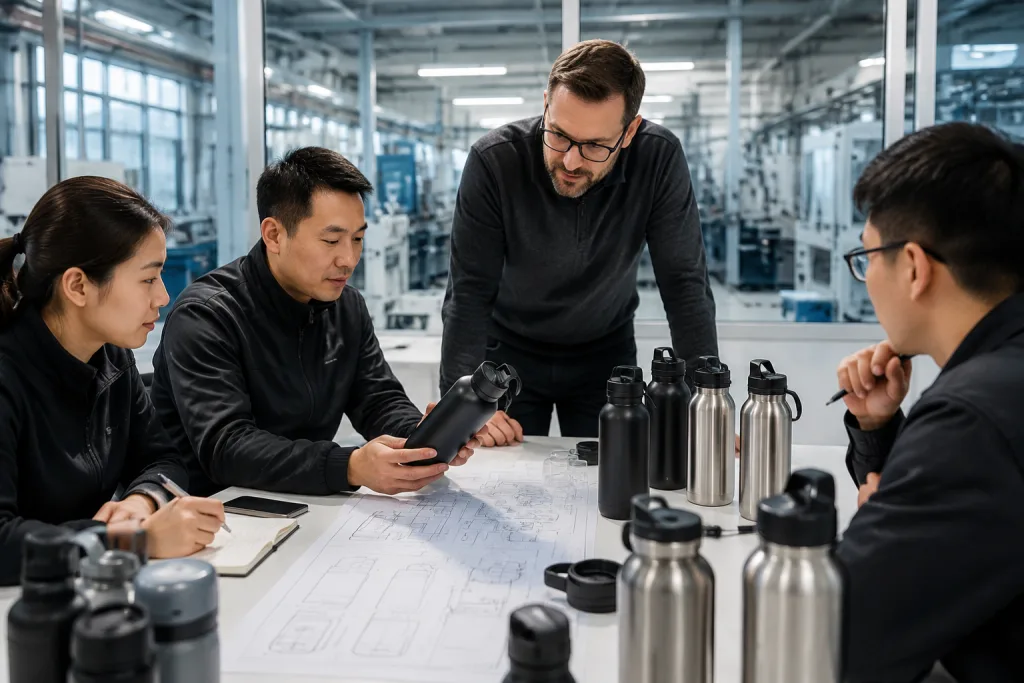
Price the order honestly
I’ll rewrite the section in a more natural factory-sales voice, keep the HTML exactly as-is, and preserve the stated numbers and structure.Factories in Zhejiang and the nearby provinces can make a lot of drinkware, but the math still has to work. Bottle cost comes from resin or steel weight, cap structure, gasket grade, print passes, packaging, inspection, and freight terms. If a supplier quotes before asking for those points, they are either guessing or planning to fix the price later.
For this case, a realistic first order is 12,000 pcs of an 800 ml customized gym water bottle, two body colors, one-color silk screen logo, individual polybag, 24 pcs per export carton. At BottleForge Industrial in Hangzhou, Zhejiang, our normal MOQ for this bulk gym water bottle is 3,000 pcs per color, with total order quantity starting at 6,000 pcs. We run the sports bottle line at about 450,000 plastic bottle units per month, depending on cap assembly mix and QC pull frequency.
A clean quotation should show FOB port, usually Ningbo or Shanghai, sample cost, mold cost if there is one, unit price by quantity tier, carton size, gross weight, payment terms, production lead time, and quote validity. If you need DDP to a US warehouse or EU distributor, freight should stay on a separate line. We’ve seen buyers hide freight in unit price, then the reorder comparison gets messy on day one.
For a bulk fitness water bottle order, the usual payment setup is 30% deposit and 70% before shipment after QC approval. A few long-term distributor accounts move to better terms, but not on the first PO. If your finance team needs net terms, say it before sampling. The line prices risk differently, and that is the wrong question to ask after the sample is approved.
Also watch the change cost. Adding a second print color may add USD 0.03-0.08. A custom body color can require 3,000 pcs per Pantone, and a new lid mold can run from USD 2,000 to USD 8,000 depending on structure. We had one PO typo where the buyer wrote 8,000 pcs and later swore they meant 18,000 pcs; the tooling quote did not care. A “small change” in a design meeting can turn into a real bill fast.
Approve samples like an inspector
I’ll rewrite just the HTML prose, keep the tags intact, and sharpen it to sound like a factory-side sales engineer.Sampling is where good sourcing teams slow down. For a customizable shaker bottle or customizable fitness water bottle, I run three steps if the schedule allows: blank sample, printed sample, and pre-production sample. The blank sample checks shape, capacity, lid feel, drinking flow, and grip. The printed sample checks logo size, color, placement, and adhesion. The pre-production sample locks the exact material, color masterbatch, gasket, packaging, and carton marking before the line buys full batch materials.
Do not approve a sample under office lighting only. Fill it with water, shake it for 30 seconds, leave it upside down for 2 hours, open and close the lid 100 times, and throw it in a gym bag with a towel. For a customized shaker bottle, mix protein powder and see whether residue sits in the lid thread or strainer. Odor matters. We once had a buyer flag a bottle that smelled like warm plastic after soaking; the document pack was clean, but that product would have come back.
Ask for measured capacity to the brim and recommended fill capacity. A bottle sold as 800 ml may hold 820 ml to the brim but only 760 ml in normal use with the lid inserted. That is not a trick, but your packaging claim has to match the real fill line. We prefer working capacity on gym bottles. The math does not work any other way.
For logo approval, use a 3M tape test or an equivalent cross-hatch adhesion check after 24 hours of curing. Rub the print with a wet cloth, then with 75% alcohol for 20 cycles if the bottle will sit near sanitizer at gym counters. Some inks pass day one and fail after sweat, disinfectant, and bottle cages. QC pulled one sample that looked fine at first glance, then the logo lifted on the second tape pull. Better to reject 3 samples in China than 3,000 units in your warehouse.
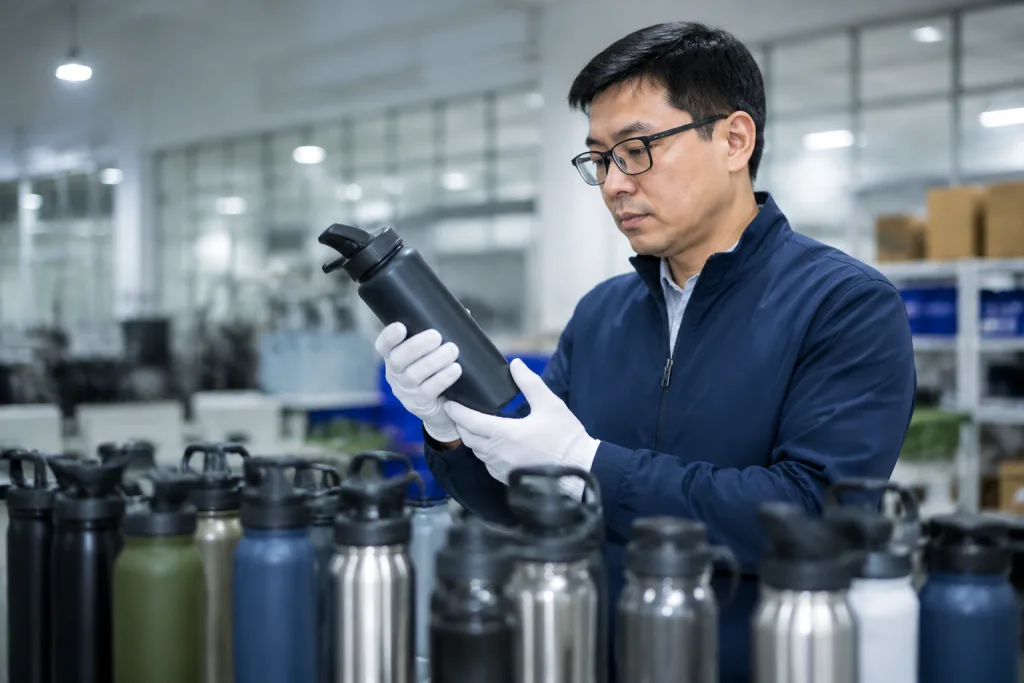
Run production with checkpoints
I’ll rewrite the section in-place, keep the HTML structure untouched, and tighten the prose so it sounds like a factory-side sales engineer.Once the deposit lands and the pre-production sample is signed off, the line starts moving. For a normal custom sports water bottle order in China, plan 25-35 days after sample approval for 6,000-20,000 pcs. Add 7-10 days if the color masterbatch is odd, the lid needs a new mold, or the packaging calls for printed retail boxes. Peak season before January fitness campaigns can push that out by another week, because everyone wants cartons out before New Year promos.
Use checkpoints. At raw material arrival, confirm resin grade, color masterbatch, and gasket material. On the injection or blow-molding side, check body weight, wall thickness, flash, scratches, and cap fit. For printing, QC pulled the first 20-50 pieces before the full run. During assembly, check gasket placement and straw length. At packing, verify carton marks, barcode labels, and the mixed-color ratio. The math gets ugly fast if you skip one of these.
A distributor shaker bottle order often goes sideways because color splits are not controlled. We saw a PO that said 4,000 black, 4,000 blue, 4,000 clear, but the packing team still needed a loading plan and carton labels that made counts obvious. If cartons are mixed, spell out the exact mix per carton. If cartons are single-color, label all four sides with SKU, color, quantity, PO number, and country of origin.
For a custom sports water bottle going to Europe or North America, ask for production photos and short videos, but do not mistake them for inspection. Photos show activity, not quality. If the order is above USD 10,000, a third-party or factory-hosted final inspection is money well spent. Our Hangzhou team normally schedules final QC when 100% of goods are produced and at least 80% are packed, so inspectors can open finished cartons and still leave room for rework if something is off.
QC before the container leaves
I’ll keep the tags intact and rewrite the prose to sound like a factory-side QC note, with concrete details and less generic phrasing.Final inspection should be dull. If QC is chasing surprises, the problem started earlier. For a bulk sports water bottle shipment, we run AQL sampling, usually AQL 2.5 for major defects and 4.0 for minor defects unless your brand book says tighter. Critical defects stay at zero: sharp edges, contamination, heavy leakage, wrong resin, or a bad odor from the bottle or gasket.
The checklist needs real numbers, not a vague yes-or-no. Check appearance, dimensions, capacity, weight, color, logo position, print adhesion, cap torque, leak test, straw function, gasket presence, carton drop resistance, barcode scan, and packing count. For leak testing, fill random bottles to working capacity, close the cap, invert them for 30 minutes, then shake by hand. On a custom shaker bottle, we also run a shake test with water and inspect the thread after repeated opening; the buyer flagged a thread issue once after 200 cycles, and that told us the mold had drifted.
Cartons deserve the same attention. A bottle can pass QC and still arrive smashed if the outer box is weak. For export, we prefer 5-ply corrugated cartons for heavier stainless bottles and strong 3-ply or 5-ply for plastic, depending on carton weight. Keep gross weight under about 15 kg where possible for manual handling. If the cartons go into e-commerce fulfillment, we run a basic drop test from 76 cm on faces, edges, and corners; the line knows this is where weak flutes show up fast.
If inspection fails, do not take a discount and call it solved unless the defect is harmless. A 3% credit does nothing when members post leaking bottles online. Ask for sorting, rework, reinspection, or replacement. Good suppliers gym water bottle programs run on repeatable QC, not hero fixes after the container leaves Ningbo. The right factory will accept a hard inspection standard because it saves both sides from chargebacks and bad reviews.
Send your gym bottle brief for factory review
Share capacity, material, logo, quantity, and target market. We will return a practical MOQ, FOB price range, and QC plan.
Frequently asked questions
What MOQ should a gym chain expect for custom gym bottles?
For most custom gym water bottle and customized fitness water bottle orders, a practical MOQ is 3,000 pcs per color and 6,000 pcs total. If you use an existing mold, one-color printing, and standard packaging, some suppliers may accept 2,000 pcs, but the unit price will rise. For custom color bodies, Pantone-matched lids, or retail boxes, 3,000-5,000 pcs per SKU is more realistic. A custom made shaker bottle with a new lid or compartment may require tooling and a higher first run, often 10,000 pcs, because the factory needs stable injection molding time to control cost.
How long does a custom sports bottle order take from China?
For an existing mold, plan 7-10 days for samples and 25-35 days for mass production after deposit and sample approval. Sea freight then adds roughly 25-40 days to North America and 30-45 days to many European ports, depending on routing and season. Air freight is possible for urgent launch quantities, but it can cost more than the bottle on low-priced plastic items. If you need goods for a January gym membership campaign, place the PO by early October, especially if your customized sports water bottle needs retail packaging or multiple color splits.
Should we choose Tritan, PP, or stainless steel for fitness retail?
Choose based on the user, not just price. PP is best for a bulk shaker bottle because it is light, cost-effective, and practical for powder mixing. Tritan works well for a transparent custom fitness water bottle where retail appearance matters and the buyer wants a BPA-free claim. Stainless steel is better for premium retail and insulation, but it is heavier and not ideal for visible powder mixing. For a gym welcome kit under USD 5 landed cost, PP or Tritan usually makes more sense. For a paid merchandise item above USD 15 retail, stainless may justify the higher FOB price.
Can distributors order different logos in one production run?
Yes, if the base bottle, color, packaging, and delivery schedule are aligned. For distributor fitness water bottle or distributor shaker bottle programs, we often keep the same bottle body and cap, then change the logo by customer. A practical setup is 20,000 pcs total split into four logos of 5,000 pcs each. The factory still needs separate print screens, setup time, and QC records for each logo. If every distributor also wants a different body color and box design, the order becomes multiple SKUs, and MOQ plus lead time should be calculated separately.
What quality checks matter most for gym water bottles?
Leak testing, odor checks, logo adhesion, cap durability, and carton strength matter most. For a customizable gym water bottle, fill samples to working capacity, invert for 30 minutes, and shake by hand. Open and close the cap at least 100 cycles during sample review. For printed logos, use tape testing and alcohol rub testing because gym environments involve sweat, sanitizer, and abrasion. During final QC, use AQL 2.5/4.0 sampling and treat severe leakage, sharp edges, contamination, or wrong material as critical defects. A cheap bottle that leaks after two workouts is expensive brand damage.