Key Takeaways
- Use borosilicate glass with 2.0-2.5 mm wall thickness for most retail bottles
- A realistic MOQ is 1,000-3,000 units per color or logo for custom runs
- Plan 7-10 days for samples and 30-45 days for mass production after approval
- Specify AQL 2.5 major / 4.0 minor and at least 5 carton drop points
Glass bottles look easy on a shelf. The PO is not. You are buying clarity, wall thickness, lid fit, print wear, carton survival, and a supplier who can hit the same result after the first sample passes. We’ve seen buyers lose margin because the spec sheet leaves too much open.
If you are comparing suppliers glass water bottle options from China, read every line before you talk price. Our Hangzhou, Zhejiang team sees the same miss every season: the buyer asks for a custom glass water bottle, but the RFQ skips glass grade, capacity tolerance, sleeve material, AQL 2.5, or the carton drop test. QC pulled one sample at 480 ml against a 500 ml PO last month. That is the wrong question to ask.
Glass grade defines the product
I’ll rewrite the section in a sales-engineer voice, keep the HTML structure intact, and preserve the technical specs and standards already named.The spec sheet should not stop at “glass bottle.” It should call out soda-lime glass or borosilicate glass, and for wellness retail we usually start with borosilicate. A borosilicate glass bottle manufacturer works with glass that handles thermal shock better, around 120°C temperature difference under controlled use. It is not shatterproof. It just cracks less when a buyer pours warm tea into a bottle that came straight from a cold rinse tank.
For a borosilicate glass bottle bulk order, ask for the glass composition statement and the food contact declaration. For Europe, request LFGB or EU 1935/2004 documents where they apply. For the U.S., ask for FDA food-contact compliance on glass-contact parts and confirm the lids, seals, coatings, inks, and sleeves too. We have seen a painted lid pass the glass check and fail REACH, and the buyer flags it only after samples land. That is the wrong place to find out.
The retail sizes we run most often are 350 ml, 500 ml, 550 ml, 650 ml, and 750 ml. Write capacity as nominal fill volume, not brimful volume. If the label says 500 ml and the brimful capacity is 500 ml, the customer has no headspace and the bottle will spill in normal use. We normally set the brimful capacity 8-12% above the declared drinking volume; on the line, that gap saves a lot of complaints.
If you are talking with borosilicate glass bottle suppliers in Zhejiang or any China production cluster, keep the brief tight: “We need food-grade high borosilicate glass, 2.2 mm target wall, 500 ml usable volume, clear body, no visible bubbles over 1.0 mm in the front display area.” QC pulled the sample against light at 300 lux and the tiny bubbles showed up fast. One clean sentence does more than a mood board. We ship faster when the buyer is this specific.
Wall thickness changes breakage math
I’ll rewrite the section in place, keeping the HTML tags and the heading intact, then do a quick pass to make sure the tone sounds like a factory-side sales engineer.Wall thickness is where price and damage claims meet. A 1.6 mm bottle ships lighter and costs less, but it gives you less margin in parcel drops and retail backroom handling. For a customizable glass water bottle sold through wellness shops, yoga studios, or sustainable retail chains, 2.0-2.5 mm is the safer range. A 750 ml bottle often needs 2.5-2.8 mm, depending on the body shape and shoulder angle.
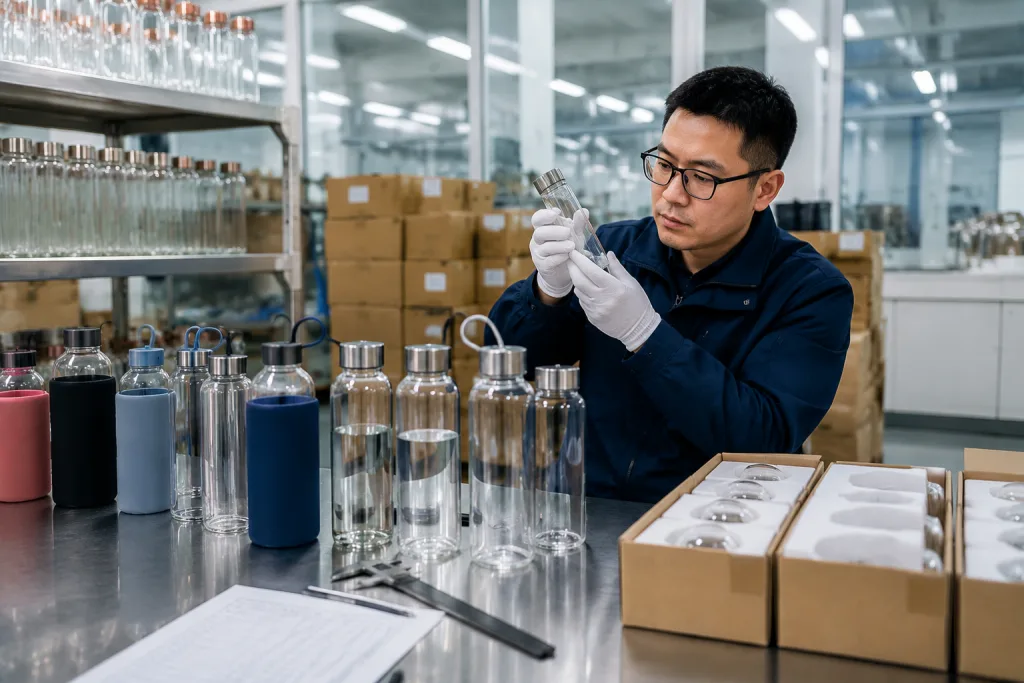
Do not specify only average wall thickness. Tell the borosilicate glass bottle factory to lock down the shoulder, base push-up, thread area, and the body-to-neck transition. We’ve seen a bottle average 2.2 mm and still carry a 1.3 mm thin spot near the shoulder after forming. That is where the crack starts. QC pulled the sample and the gauge made it obvious.
Weight hits freight too. A 500 ml borosilicate bottle with bamboo lid and silicone sleeve often lands around 280-360 g per unit before the retail box. If your distributor glass water bottle program ships launch stock by air, an extra 60 g per unit turns into real money fast. For sea freight, the math shifts to carton count, pallet loading, and the breakage reserve. One buyer once asked us to “just make it thicker”; the freight bill said no.
On our Zhejiang inspection line, we check appearance, capacity, lid fit, leak test, print adhesion, and carton packing before shipment. For repeat orders above 10,000 units, ask your borosilicate glass bottle supplier for wall-thickness records from at least 20 pieces across the run, not just the golden sample. We run that check with a caliper at the shoulder and base. This is not a luxury ask; it is the cheap way to avoid claims later.
Capacity and shape affect tooling
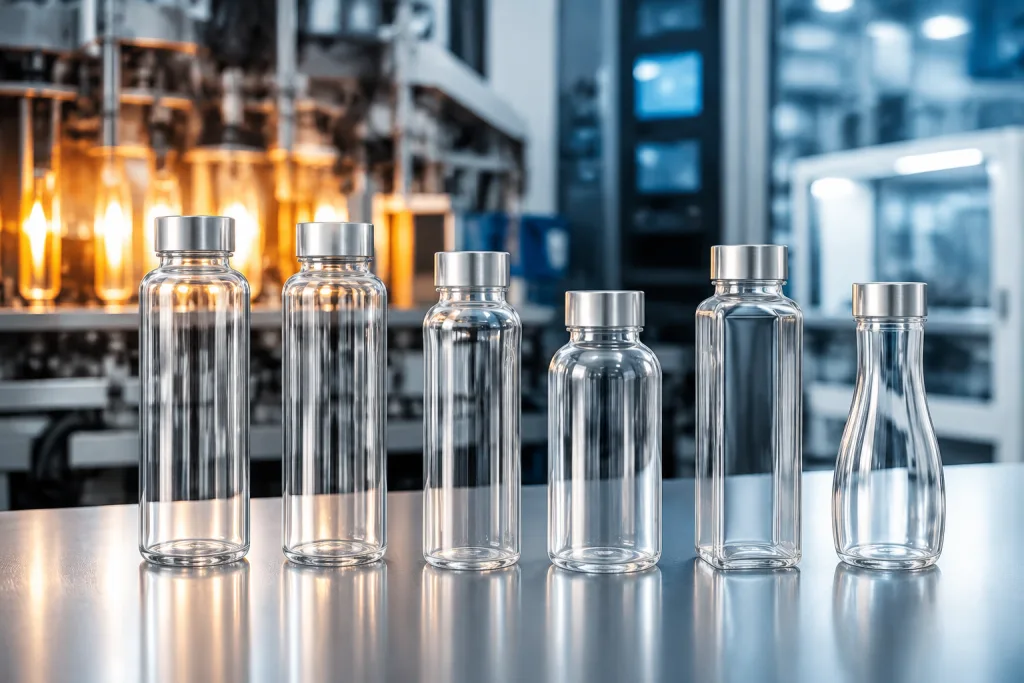
I’ll rewrite the four paragraphs in a more lived-in sales-engineer voice, keep the HTML intact, and preserve the technical numbers and structure.Shape is not just branding. On our line, straight cylinder bottles print cleaner, take sleeves without fighting the film, wash faster, and load tighter in cartons. Tapered bottles look softer on shelf, but we’ve seen sleeve slip, logos land off-center by 2-3 mm, and carton yield drop. If you want a borosilicate glass bottle custom shape, budget for tooling and a longer approval path.
For most custom borosilicate glass bottle programs, an existing mold is the smarter first move. We still get product differentiation from lid material, sleeve color, logo process, packaging, and insert card. A new glass mold may cost USD 800-2,500 depending on complexity, with 20-30 days added for mold opening and trial production; QC pulled the sample three times before the neck finish passed. For a wellness brand testing retail demand, this is the wrong place to burn cash — spend it on packaging and photography first.
Thread design is the spec-sheet line buyers skip, then the buyer flags it after samples land. Confirm whether the mouth is narrow, wide, or tea-infuser compatible. A 45-55 mm wide mouth is easier to clean and works better for fruit infusions, but the lid costs more and the neck area becomes more vulnerable if annealing is off by even a small margin. A narrow mouth drinks cleaner, though it limits ice and brush access.
If your plan is borosilicate glass bottle wholesale through multiple retailers, keep the silhouette stable for at least 12 months. Changing the bottle body after the first season creates packaging mismatch, barcode confusion, replacement-lid problems, and a pile of service emails no sales team wants. We’ve seen this go sideways when a buyer changed the PO by one digit on the neck spec, then every carton had to be rechecked by hand. A good borosilicate glass bottle vendor will push back when a pretty shape creates operational pain.
Lids, seals, and sleeves decide usability
I’ll rewrite the four paragraphs in place, keeping the HTML tags intact and making the copy sound like a factory-side sales engineer wrote it. Next I’m tightening the language, adding concrete shop-floor details, and stripping the AI filler.The bottle body is glass, but the complaints usually start at the lid. We run bamboo lids on the line every week, and the same issue comes up: grain shift, color drift, and swelling after moisture exposure. Stainless steel lids are easier to hold on spec and color match. PP lids cut cost, but on a premium customized glass water bottle they make the order look cheap.
Put the sealing structure in writing: silicone ring thickness, ring hardness, lid insert material, and whether spare seals are packed in the carton. For a 500 ml bottle, we ask for an inverted leak test of 30 minutes minimum. For travel claims, that is too light. QC pulled the sample, filled it, closed the lid, stored it inverted and on its side for 2 hours, then checked for seepage. The buyer flagged a missing spec once; the PO said “silicon ring,” and that typo cost a week.
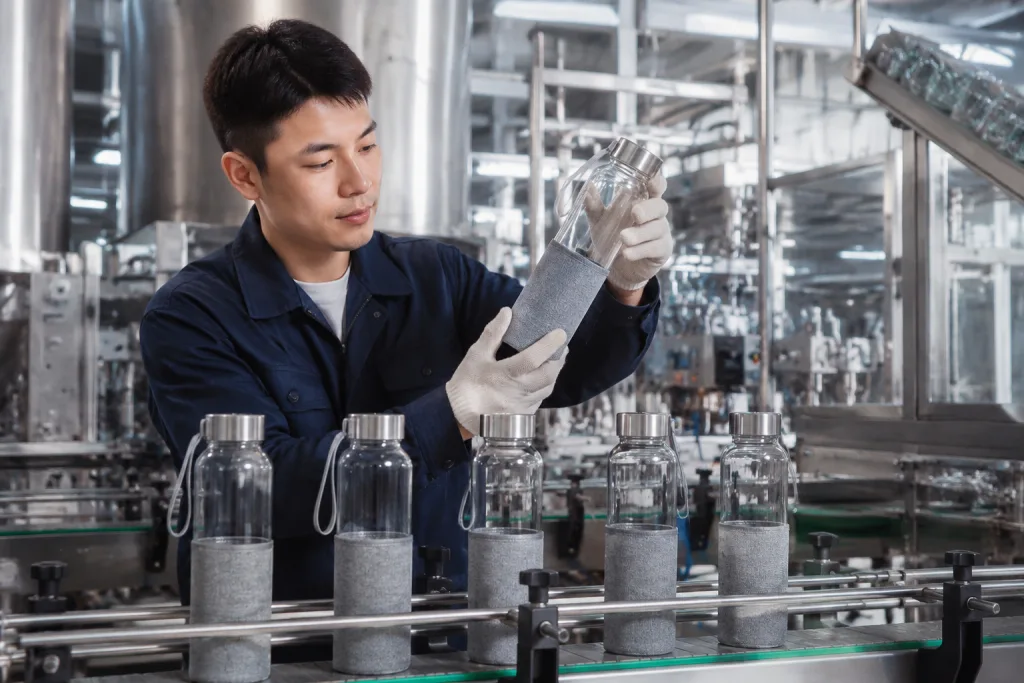
Sleeves are not decoration only. Silicone sleeves give grip and take the edge off small drops, but a tacky finish turns into dust pickup fast. Neoprene sleeves add insulation and print space, yet they hide the glass and can hold odor after shipping. Cork sleeves look natural, but the edge needs cleaner trimming. A borosilicate glass bottle customizable program should lock down sleeve material, thickness, Pantone code, odor limit, and fit tolerance in mm.
For promotional buyers, a borosilicate glass bottle promotional order often puts logo size ahead of retail durability. That is the wrong question to ask if the bottles go into North America or Europe. We’ve seen one leaking batch turn into chargebacks that wiped out the savings from cheaper silicone rings by USD 0.08 per unit. The math does not work.
Decoration must survive handling
I’ll rewrite the section in place, keep the HTML tags untouched, and make the copy sound like a factory-side sales engineer wrote it. Then I’ll do a quick pass to trim any AI phrasing and keep the handling details concrete.Pick the logo method by use case, not by the lowest quote. Silk screen printing fits clean one- to three-color logos and usually lands around USD 0.08-0.25 per position, with the final number tied to size and color count. Heat transfer can carry gradients, but it needs abrasion testing on the line. Laser engraving suits stainless lids or coated surfaces, not clear glass if you want the logo to read well at retail.
For a borosilicate glass bottle customized with a silicone sleeve, print on the sleeve when you can. That print stays away from the hard glass body, so the decoration takes less abuse in packing and daily use. If the bottle has no sleeve, ask for cross-hatch adhesion testing and a wet rub test. We’ve seen the math go sideways when a buyer skipped that step. On dishwasher-safe claims, be careful: a lot of decorative inks hold up to hand washing but start fading after 20-50 dishwasher cycles. Do not print “dishwasher safe” unless the decorated product passed the test as a full set.
Color control should follow Pantone numbers, but do not expect the same shade on silicone, kraft box, bamboo, and printed ink. The buyer flagged it once on a 400 g sample because the sleeve looked warmer than the box. That happens. Your approved sample should show every visible surface: glass tint, sleeve, lid, logo, box, insert, and barcode label.
If you are comparing borosilicate glass bottle vendors, ask for pre-production photos under neutral light and a signed pre-production sample for orders above 3,000 units. A solid China factory will send both without drama; QC pulled the sample before we packed one 5,000-unit run last month. I would not approve mass production from a digital mockup alone, especially for a customized borosilicate glass bottle with retail packaging.
Packaging specs prevent retailer headaches
I’ll rewrite the section in place, keep every HTML tag intact, and tighten the sales-engineering tone with concrete packaging details and fewer filler phrases.Glass bottle packaging is not where you win on the cheapest quote. We’ve seen a bulk glass water bottle order look fine on FOB, then bleed money through breakage, crushed cartons, relabeling, and retailer deductions. Start with a white box or kraft retail box on 350-450 gsm paperboard for a single bottle. If the bottle is heavy, tall, or going into e-commerce, add an inner corrugated insert. QC pulled one sample that slipped 28 mm in the drop test, and the outer box failed before the glass did.
For Amazon or retailer distribution, lock down barcode placement, FNSKU or SKU label size, country-of-origin marking, suffocation warning if polybags are used, and master carton markings. The buyer flagged a PO typo once—“FNSU” instead of FNSKU—and the whole carton label run had to be redone. If you sell into the EU, packaging waste rules and importer details may apply. If you sell in California or another strict market, check Prop 65 exposure risk for paints, coatings, and metal accessories. This is the wrong question to ask after packing starts.
Carton testing should stay practical. We run 5-point or 6-point drop checks based on carton weight, usually from 60-80 cm for export cartons under normal handling assumptions. If one carton carries 24 glass bottles, use dividers or individual boxes with enough compression strength. A 24-bottle master carton that looks compact on paper can still get rejected at the warehouse because the line crew hates lifting awkward boxes.
For borosilicate glass bottle distributors, pallet setup matters. Ask for units per carton, carton dimensions, gross weight, CBM, and units per 20GP/40HQ before you place the PO. Our Hangzhou, Zhejiang export team usually quotes MOQ from 1,000 units for stocked shapes and 3,000 units for custom color or packaging, with monthly output around 300,000 glass bottles across standard lines. We ship faster when the pallet math works on day one.
Price should match the risk
I’ll rewrite this section in place, keep the HTML exactly as-is, and tighten the sales-engineer voice with more concrete sourcing details.A fair FOB China price for a standard 500 ml borosilicate bottle with bamboo lid, silicone sleeve, one-color logo, and retail box usually lands at USD 1.80-3.20, depending on order size, packaging, testing, and decoration. We run the line on a sample PO all the time, and the low quote almost always hides one cut: thinner glass, a softer box, low-grade silicone, loose inspection, or no compliance file.
For a borosilicate glass bottle manufacturer, send the same spec sheet to every plant. Put glass thickness, lid type, sleeve material, print method, retail box grade, carton quantity, AQL level, sample fee, mold fee, lead time, Incoterm, and payment terms on one page. Otherwise you are not comparing suppliers glass water bottle offers; you are comparing guesses. That is the wrong question to ask.
Normal lead time runs 7-10 days for sampling and 30-45 days for mass production after deposit and sample approval. New mold work, custom sleeve tooling, or third-party testing can add 10-25 days. QC pulled the sample on a 500 ml run last month and found a 1.2 mm wall variation at the shoulder, which is exactly why first orders need buffer time. Do not book a retail launch with zero slack.
If you need a distributor borosilicate glass bottle program with repeat shipments, price is not the only number that matters. Lock the approved sample, keep a signed specification sheet, require pre-shipment inspection under AQL 2.5 major / 4.0 minor, and confirm spare lids or seals. We have seen this go sideways when a buyer skipped spares and the PO had a simple typo on carton count. A bulk borosilicate glass bottle program only works when the same spec ships every time.
Send your glass bottle spec sheet for review
We will check wall thickness, lid structure, MOQ, packaging, and FOB pricing before you commit to a production order.
Frequently asked questions
What MOQ should I expect for a custom glass water bottle?
For existing bottle molds, a realistic MOQ is 1,000 units for a simple logo and standard packaging. If you need a custom silicone sleeve color, retail box, or lid finish, expect 3,000 units. A fully custom borosilicate glass bottle with new mold tooling often needs 5,000-10,000 units to make the mold cost sensible. Some suppliers will quote 500 units, but the unit price is usually high and customization choices are limited. For wellness brands testing a new SKU, I usually recommend starting with a stocked 500 ml or 650 ml shape, then upgrading tooling after reorder data proves demand.
Is borosilicate glass always better than soda-lime glass?
Not always, but it is usually better for reusable drinkware. Borosilicate glass handles thermal shock better, so it is safer for warm tea, cold water, and daily cleaning routines. Soda-lime glass can be cheaper and works for some juice or tableware products, but it is less forgiving when temperature changes quickly. For a borosilicate glass bottle wholesale program, expect a higher unit price, often USD 0.20-0.60 more than basic soda-lime depending on shape and weight. If your brand positioning is wellness, clean hydration, or sustainable retail, borosilicate usually supports the story and reduces cracking complaints.
Can you make a borosilicate glass bottle custom with my logo and packaging?
Yes. The normal path is logo first, then sleeve or lid color, then retail box, then custom mold if volume justifies it. A borosilicate glass bottle custom order can use silk screen printing, heat transfer, sleeve printing, lid engraving, or printed insert cards. Sampling usually takes 7-10 days after artwork confirmation. For packaging, provide dielines, barcode files, warning text, and importer details before sample approval. If you need exact Pantone matching, approve physical materials, not only a PDF mockup. MOQ is usually 1,000 units for basic logo work and 3,000 units for deeper customization.
What quality tests should a borosilicate glass bottle supplier run?
At minimum, ask for appearance inspection, capacity check, lid torque or fit check, 30-minute inverted leak test, print adhesion test, sleeve fit check, and carton drop test. For export retail, use AQL 2.5 for major defects and 4.0 for minor defects. If you make thermal claims, request thermal shock testing under defined temperatures, such as moving from 20°C to 90°C water under controlled conditions. For compliance, check LFGB or EU food-contact rules, FDA food-contact expectations, REACH for coatings and accessories, and Prop 65 if selling in California.
How do I compare borosilicate glass bottle manufacturers fairly?
Give every supplier the same spec sheet and force itemized pricing. Ask for glass grade, wall thickness, capacity, lid material, seal material, sleeve thickness, logo method, box grade, units per carton, FOB port, sample time, mass lead time, payment terms, and inspection standard. A borosilicate glass bottle manufacturer quoting USD 1.65 may not include the same packaging or testing as another quoting USD 2.20. Also ask where production and final inspection happen in China, whether third-party inspection is accepted, and whether the factory can repeat the same SKU for 12 months without changing components.