Key Takeaways
- Set infuser basket fit tolerance at ±0.3 mm to reduce rattling and lid interference
- Use AQL 2.5 for major defects and AQL 4.0 for minor cosmetic defects
- Plan 30-45 days for custom logo infuser bottle production after sample approval
- Ask for material test reports covering LFGB, FDA, REACH, or BPA-free claims
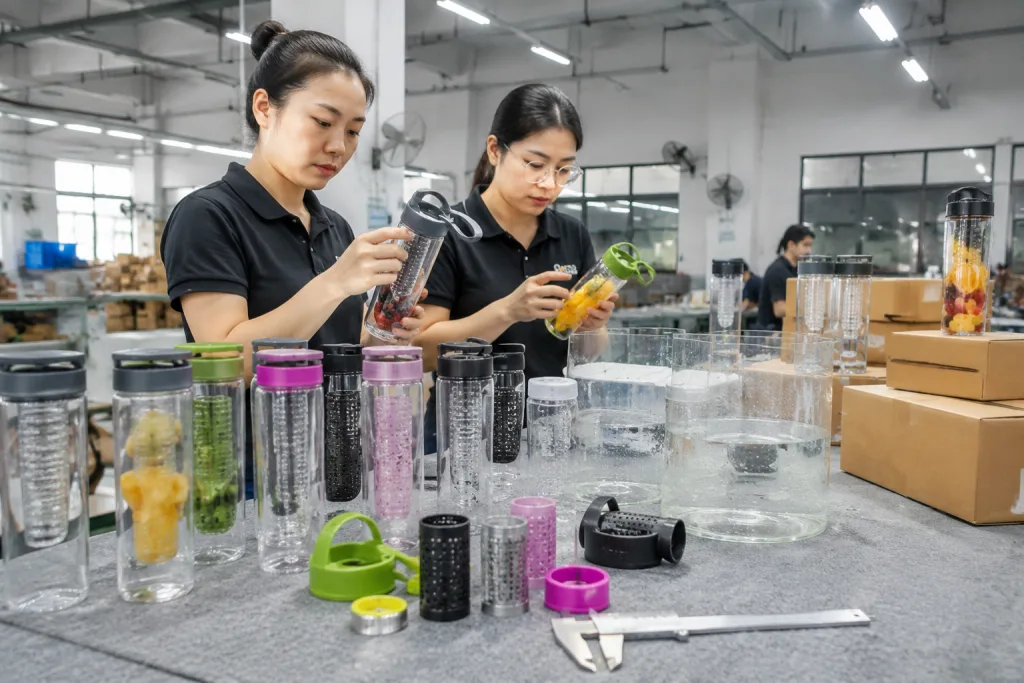
A fruit infuser bottle looks simple until the first carton lands with cloudy plastic, a loose basket, leaking lids, or a logo that rubs off after 200 washes. We’ve seen that happen on the line. The loss is not just replacement cost. It hits reviews, launch timing, and the stock a distributor sends back.
If you are comparing suppliers fruit infuser bottle options in China, start with failure points, not catalog photos. Our Hangzhou, Zhejiang team keeps seeing the same problems: weak material specs, vague drawings, rushed mold changes, and QC that checks only the outside. A custom infuser bottle order works when the buyer gives numbers, for example wall thickness, basket mesh size, and leak-test pressure, not guesswork.
Failure one: vague material choices
I’ll rewrite the section in-place, keep the HTML exactly as-is, and strip the AI-style phrasing while adding a few factory-floor specifics.The first failure usually shows up before the line starts. A buyer asks for a custom fruit infuser bottle, gets a clean render, and signs off without locking the resin grade, wall thickness, gasket material, or test standard. Then the bottles go soft, haze up, or carry a plastic smell after hot filling. We’ve seen that go sideways more than once.
For a factory fruit infuser bottle project, call out the body material by grade, not by sales wording. Tritan copolyester is common for premium cold-water bottles because it stays clear and takes impact well. Food-grade PP works for lids and infuser baskets. 304 stainless steel is fine for tea strainers, but the mesh gauge and weld bead need checking on the bench, not just on paper. Borosilicate glass fits a custom tea infuser bottle, but breakage risk and carton cost climb fast.
Use plain specs: 2.0-2.5 mm body wall thickness for Tritan sports-style bottles, 1.5-2.0 mm for PP lids depending on the rib design, and silicone gaskets at 50-60 Shore A. If the bottle goes to the EU, ask for LFGB or EU 10/2011 documents. For North America, FDA food-contact compliance and BPA-free test reports are standard. REACH comes up on larger distributor infuser bottle programs, especially when colorants or coatings enter the job. QC pulled the sample with a 0.3 mm thin spot at the shoulder last week, and that would have failed a real launch.
Do not accept “food grade” as a full material specification. It is a claim, not a control document.
At BottleForge Industrial in Zhejiang, China, we check resin batch records before mass production, because blended material saves money on the shop floor and costs you later. If you are buying fruit infuser bottle bulk for a launch, lock in clarity and odor at pre-production sample sign-off; do not wait for final inspection to catch a bad batch. One PO even came in with “BPA free” typed as “BAP free” — the buyer flagged it, and we stopped the job before the tooling slot was lost.
Failure two: leaking lid geometry
I’ll rewrite this section in-place, keep the HTML unchanged, and make the copy read like a factory-side sales engineer wrote it.Leakage kills repeat orders fast. Buyers miss it because the approval sample passes on day one. The trouble shows up after 50 lid openings, when the basket goes in a bit off-center, or after cartons sit in a hot warehouse for 3 weeks. We’ve seen that go sideways on the line more than once.
A customizable fruit infuser bottle has three parts working together: bottle mouth, threaded lid, and infuser basket. If one dimension drifts, the gasket loads unevenly. For a 700 ml or 800 ml bottle, we usually hold thread fit tolerance at ±0.2-0.3 mm and gasket compression at 15-25%. Too little compression leaks. Too much compression makes the lid stiff and the seal takes a set. QC pulled the sample with a caliper on a 0.01 mm scale, and that’s where the gap shows up.
Ask your factory infuser bottle supplier to run three checks before shipment. First, invert the bottle for 30 minutes at 95% fill. Second, shake it for 60 seconds with the basket installed. Third, run at least 100 open-close cycles on mass-production samples, not just the golden sample. If it is a bulk tea infuser bottle for hot water, add a 5°C to 80°C temperature cycle, 3-5 rounds depending on material. The math doesn’t work if you skip this and hope the gasket will save you.
There is a user problem too: fruit pieces press against the basket and stop the lid from sealing. The basket needs clearance from the cap interior, usually 1.5-2.0 mm minimum, even with normal assembly variation. For customized infuser bottle programs, ask for a 2D drawing with basket height, mouth inner diameter, and thread details. A catalog bottle can pass for a small promo run, but it is the wrong choice for a distributor fruit infuser bottle line that needs stable reorder quality. We ship to that spec, not to guesswork.
Failure three: baskets that break
I’ll keep the HTML structure intact and rewrite the four paragraphs in a more supplier-side, factory-floor tone. Then I’ll do a quick pass to make sure the wording stays tight and the technical details remain concrete.The infuser basket is where cheap engineering shows up first. Thin PP ribs crack, stainless mesh pulls away from the ring, and long baskets go out of shape during hot filling. We’ve had a line sample pass outer-bottle QC and still fail at the basket. The bottle looks premium. The infuser part does not.
For a custom made infuser bottle, decide up front whether the basket is for fruit, tea, or both. Fruit infusion needs larger perforations, usually 2.0-3.0 mm, because pulp and seeds clog smaller holes fast. Tea infusion needs finer mesh, often 80-120 mesh stainless steel, or a PP basket with tighter slots. If you want one bottle to work as a custom tea infuser bottle and a custom fruit infuser bottle, the math does not work with one generic basket; we usually quote two options or a hybrid with a clear trade-off.
Basket pull strength needs a real test. We like to see the handle or top ring hold 5 kg for 10 seconds without tearing. Drop test it with the basket installed, because internal impact can split the basket even when the outer bottle is fine. QC pulled the sample, and if it came from a hand-finished prototype instead of actual injection tooling, we don’t trust the result. Gate position, cooling time, and wall thickness all move the warpage.
For factory direct infuser bottle sourcing, do not let the supplier change the basket after sample approval. We’ve seen this go sideways when a factory cuts cycle time or trims resin weight on the line. Lock the basket weight in grams, the key dimensions, and the material color in the PO. On a 750 ml bulk infuser bottle, even a 1.5 g reduction can make the ribs weaker. It seems tiny. Across 20,000 units, it is enough resin savings to tempt a sloppy plant if the paperwork is vague.
Failure four: decoration that cannot survive
I’ll rewrite only the prose inside the existing `` tags, keep the HTML structure intact, and make the copy sound like a factory-side sales engineer wrote it.
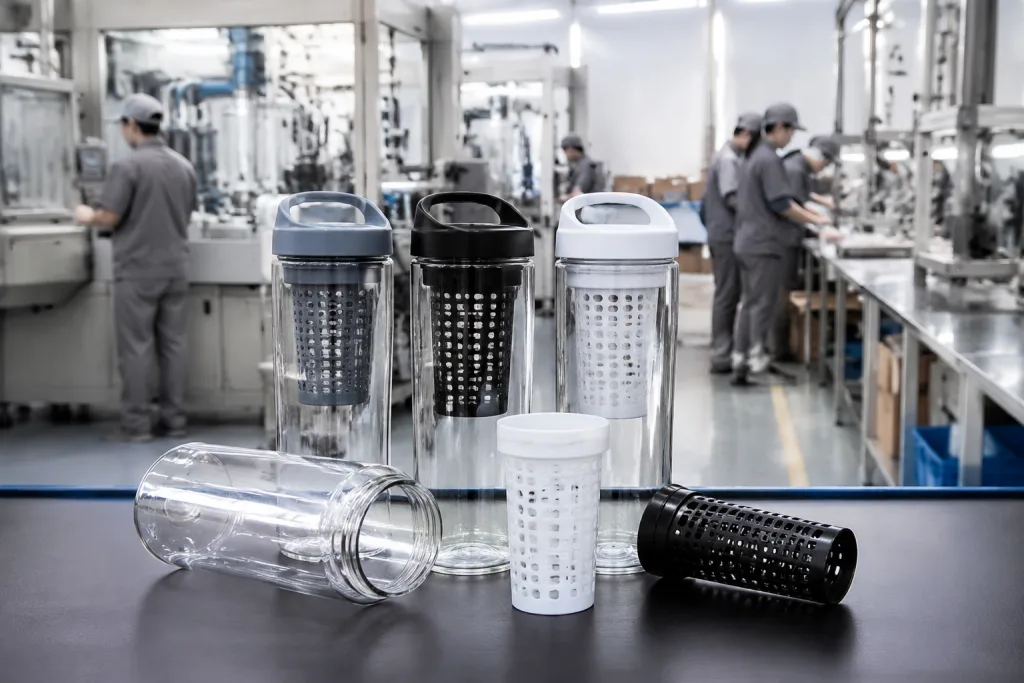
Hydration startups usually chase the logo first. Fair enough; the bottle is half product, half shelf space. Decoration is where we see the first scrap pile. Silk screen ink gets scratched in transit, heat-transfer film starts lifting at curved shoulders, laser engraving goes faint on the wrong coating, and batch-to-batch color drift shows up once QC pulls the sample under daylight.
For a custom logo infuser bottle, match the decoration to the surface and the use case. Silk screen printing works for one or two colors on flat or mildly curved panels, and the MOQ is often 1,000-3,000 units per design. UV printing handles gradients and small text, but it costs more and needs adhesion testing. Laser engraving suits powder-coated stainless parts; it does not read well on clear Tritan bodies. For a customized fruit infuser bottle with a translucent body, molded-in color plus a simple one-color print usually holds up better than a full-wrap design. That is the wrong question to ask if the buyer only wants “the strongest logo” without checking the substrate.
Give the supplier Pantone codes, logo vector files, print size in millimeters, and a placement point measured from the bottle base or lid seam. “Put it in the center” is not a production instruction. For retail programs, ask for tape adhesion testing with 3M 600 or equivalent, plus a rub test of at least 100 cycles with a wet cloth. If the bottle is sold as dishwasher safe, decoration has to survive 10-20 dishwasher cycles, not just a sales promise. We have seen this go sideways when a PO typo moved the logo 8 mm to the left and the buyer flagged it only after sampling.
Our Zhejiang production partners can turn out about 300,000 drinkware units per month across plastic, glass, and stainless lines, but decoration often becomes the choke point. A bulk fruit infuser bottle order with four colors and three logo positions may need 5-7 extra working days versus a plain stock bottle. One recent line check on a 5,000-unit run showed the print jig drifting 2 mm after the second shift, so we stopped the job and reset it. Fast production is possible in China, but unstable artwork approval still burns more launch time than the molding does.
Failure five: packaging ignored too late
I’ll rewrite just the prose, keep the HTML tags intact, and tighten the sales-engineer tone with concrete packaging details and fewer filler phrases.Packaging gets treated like an afterthought. That is the wrong move. Infuser bottles have loose inner parts, clear surfaces that pick up scuffs fast, and lids that can split if the carton gets crushed in transit. If you only lock down the bottle spec, you may ship product that looks fine at the factory and turns unsellable after 30 days on the water.
For distributor infuser bottle shipments, the inner pack has to match the channel. For ecommerce, we run a polybag or paper wrap, a color box or kraft box per unit, and a corrugated master carton built for stacking. For retail distributors tea infuser bottle programs, artwork, barcode placement, warning text, and recycling marks need sign-off before the line starts. For Amazon-style fulfillment, add FNSKU labels, carton labels, suffocation warnings on polybags, and keep the master carton under 15 kg so one person can move it without drama.
A basic carton drop test follows ISTA-style logic: 1 corner, 3 edges, and 6 faces from 76 cm for lighter cartons, then adjust by gross weight. If the bottle has a glass body or a long infuser basket, QC pulled the sample after vibration and checked for internal movement. Clear Tritan scratches are a real complaint. A 0.03 USD sleeve or paper insert can save you from the 3% return rate we’ve seen when buyers skip it.
When buying from suppliers fruit infuser bottle programs, ask for the packaging BOM on the first quote. It should list box paper weight, carton flute type, carton size, units per carton, gross weight, and pallet plan if the shipment needs one. FOB Ningbo or FOB Shanghai should split product cost from packaging upgrades. We’ve seen a buyer flag a 0.28 USD add-on only after the PO was typed with the wrong carton size, and the math stopped working immediately.
Failure six: QC only checks appearance
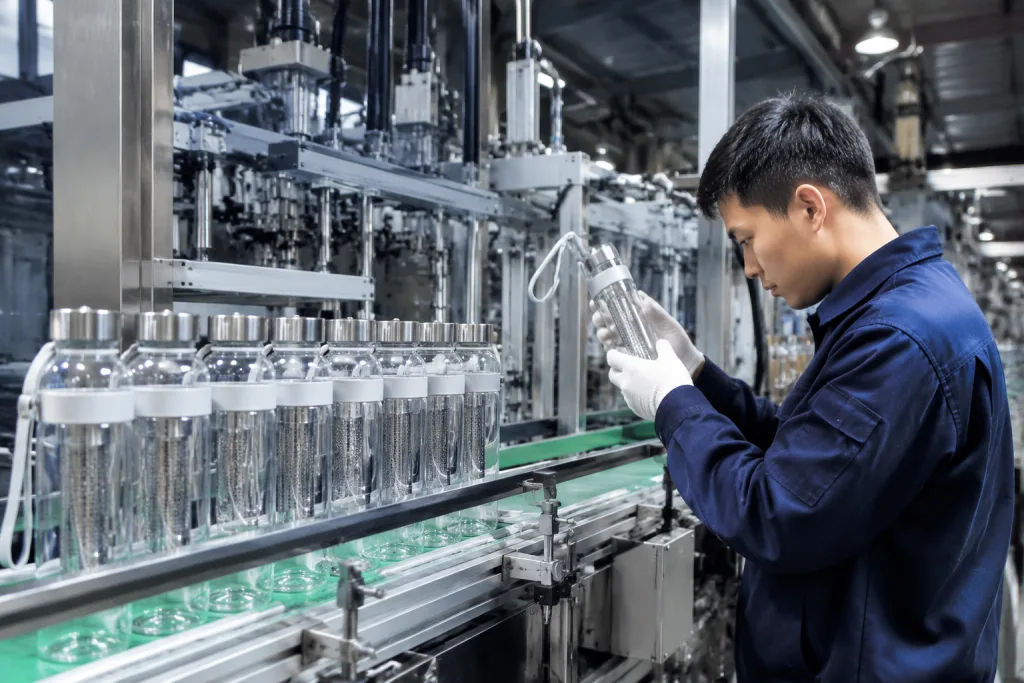
I’ll rewrite the section in-place, keep the HTML tags untouched, and strip the AI-ish phrasing while adding factory-floor specifics and a sharper buyer voice.A final check that only looks for scratches and missing logos misses the real risk. A customizable infuser bottle can fail on leaking, odor, cap fit, basket fit, capacity shortfall, sharp edges, print adhesion, carton strength, and barcode accuracy. If the QC sheet is thin, you are paying for a photo session, not an inspection. We run this every week, and the buyer flags it fast when a 28 mm cap does not seat cleanly.
For most bulk infuser bottle orders, use AQL sampling. A common setup is Critical 0, Major 2.5, Minor 4.0. Critical defects include unsafe sharp edges, wrong material, contamination, or chemical test failures. Major defects include leaking, broken baskets, wrong logo, incorrect capacity, poor cap assembly, or barcode scanning failure. Minor defects include small scratches, slight color variation within tolerance, or minor packaging marks. QC pulled the sample on the line before lunch, and that is where the bad basket clips showed up.
The inspection should include measured checks. Capacity can be verified by filling to the intended usable line; a 750 ml claim should not measure 710 ml unless your artwork clearly states otherwise. Bottle height and diameter should be checked against approved drawings with a caliper. Logo position can be controlled within ±1.5 mm for many projects. Carton quantity should be counted, not assumed from labels. The math does not work if the PO says 5,000 and the outer cartons add up to 4,960 because someone typed the wrong pack count.
Pre-shipment inspection timing also matters. If inspection happens when only 50% of goods are packed, the result is weak. We prefer inspection when 100% of production is finished and at least 80% is packed. For new factory tea infuser bottle or factory fruit infuser bottle orders, add an inline inspection around 20-30% production completion. It catches molding, printing, and assembly issues before 20,000 bad units are already in cartons. We’ve seen this go sideways on a 24-hour shift when one mold cavity started flashing at 0.3 mm.
Failure seven: buying only the price
I’ll rewrite just the prose, keep the HTML tags intact, and tighten it into a more natural supplier-side voice with concrete factory details.Price matters. Anyone who says otherwise has not sat through a margin review. But for a custom infuser bottle, the lowest quote often hides missing work: no compliance testing, thinner walls, weak cartons, poor inspection, or slow replies after deposit. We’ve seen that go sideways on the line.
Compare quotes on the same spec sheet. Ask for MOQ, sample cost, tooling cost if any, unit price at 1,000, 3,000, and 10,000 units, lead time, Incoterm, packaging details, and which compliance documents are included. At BottleForge Industrial, a typical MOQ for a custom logo infuser bottle starts around 1,000 units for stock molds and 3,000-5,000 units for deeper customization. Standard production lead time is usually 30-45 days after deposit and approved sample. New mold development can add 25-40 days. QC pulled the sample at 1.2 mm wall thickness, and that number matters more than a slick sales reply.
For a basic plastic factory direct infuser bottle, FOB China pricing may range from about 1.20-2.80 USD depending on capacity, material, basket design, decoration, and packaging. A glass or stainless custom tea infuser bottle can sit higher, often 3.50-7.00 USD. These are reference ranges, not a promise. If a quote lands far below them, the math usually does not work, and the buyer ends up paying later.
If you are a distributor tea infuser bottle buyer or a wellness startup planning a hero SKU, ask the supplier how they handle reorders. Can they keep the same Pantone color for 12 months? Do they archive your approved sample? What is their normal defect claim process? A reliable customized tea infuser bottle supplier in China should answer without drama. The buyer flagged a PO typo on the first run once; that tiny mistake turned into a 3-day delay. If every answer is “no problem” but nobody gives numbers, keep looking.
Send your infuser bottle spec for review
We will check material, decoration, MOQ, packaging, and QC risks before you commit deposit money to production.
Frequently asked questions
What MOQ should I expect for a custom fruit infuser bottle?
For stock molds with a custom logo, MOQ is commonly 1,000 units per color or design. If you need a custom made infuser bottle with a new body shape, special lid, or unique basket, MOQ usually moves to 3,000-5,000 units because tooling setup, resin color matching, and QC time are higher. For fruit infuser bottle bulk orders using standard packaging, sampling can take 7-12 days and mass production usually needs 30-45 days after sample approval. If you require retail boxes, barcodes, FNSKU labels, or multi-color printing, add 5-10 working days for artwork confirmation and packaging production.
Which material is best for a bulk tea infuser bottle?
For tea, heat resistance is more important than it is for fruit water. Borosilicate glass with a 304 stainless steel strainer is a strong option for premium customized tea infuser bottle projects, but it requires better packaging and has higher breakage risk. Tritan can work for warm water depending on the grade, but you should avoid positioning it for boiling water unless the material test supports that use. PP is common for lids and baskets. For EU sales, ask for LFGB or EU 10/2011 test reports. For North America, FDA food-contact compliance is the normal baseline.
How do I compare suppliers fruit infuser bottle quotes fairly?
Put every supplier on the same spec sheet. Include capacity, body material and thickness, lid material, gasket hardness, basket design, logo method, packaging type, AQL level, compliance documents, MOQ, lead time, and Incoterm such as FOB Ningbo or FOB Shanghai. A 0.18 USD cheaper quote may exclude a retail box, use thinner carton board, or skip chemical testing. Ask for unit prices at 1,000, 3,000, and 10,000 units. Also ask whether the quote includes pre-production samples and whether the supplier archives a signed golden sample for reorder control.
Can one bottle work for both fruit and tea infusion?
Yes, but you need to define the compromise. Fruit infusion needs larger holes or slots, often 2.0-3.0 mm, so water can circulate around fruit pieces. Tea needs finer filtration, often stainless mesh around 80-120 mesh, to keep leaves out of the drink. A customizable tea infuser bottle can include a removable fine mesh insert, while the same body accepts a larger fruit basket. This is cleaner than forcing one basket to do both jobs badly. If you sell the product as dual-use, test it with lemon, berries, loose tea, and tea bags before approving mass production.
What inspections should distributors fruit infuser bottle buyers require?
Use AQL sampling with Critical 0, Major 2.5, and Minor 4.0 for most orders. The checklist should include leak testing, capacity measurement, odor check, cap torque or closure feel, basket fit, print adhesion, barcode scanning, carton drop condition, and quantity count. For a new distributor infuser bottle program, add an inline inspection at 20-30% production completion and a final inspection when 100% of goods are produced and at least 80% packed. Keep approved samples in both your office and the China factory so disputes are based on the same reference.