Key Takeaways
- MOQ for a custom bulk coffee mug often starts at 1,000 pcs, but full custom colorways usually need 3,000 pcs
- FOB China prices for a basic bulk coffee travel mug can start around USD 2.10 to 3.80, depending on steel grade and lid
- AQL 2.5 is common for appearance and functional checks, but lid leakage should be tested at 100% on critical runs
- REACH, LFGB, FDA, and BPA-free claims need to match the exact material, coating, and lid resin used
If you are sourcing suppliers coffee travel mug products for a coffee brand or a corporate gift program, do not treat every tumbler like a commodity. It is not. A 350 ml stainless steel mug with a press lid, a 500 ml powder-coated travel tumbler, and a promotional plastic cup behave differently on unit price, lead time, leak risk, and the way buyers read your brand.
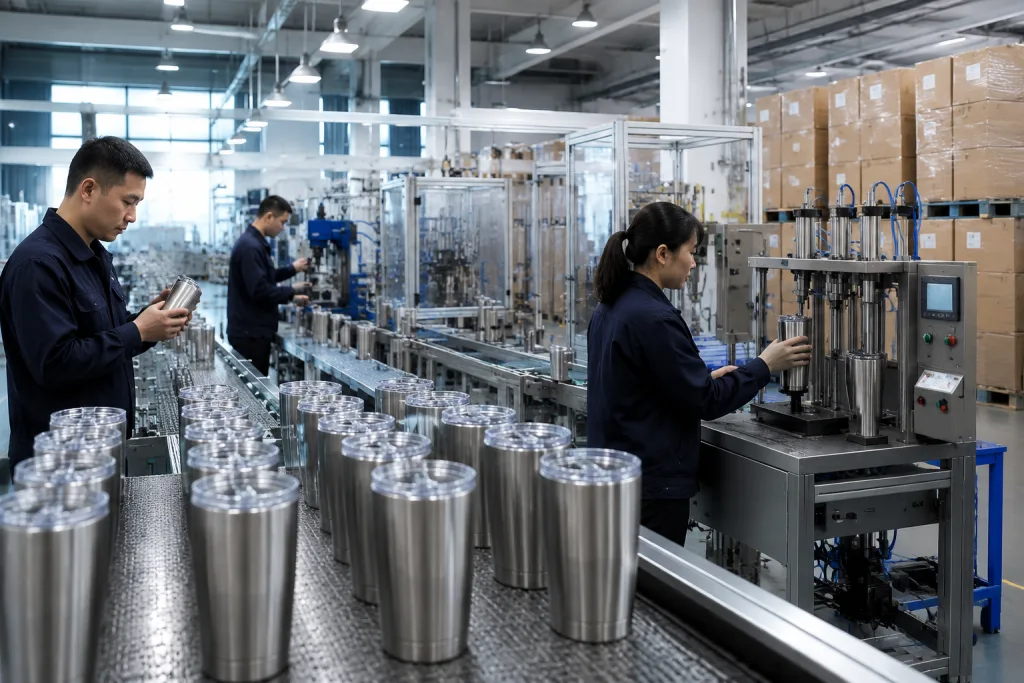
The clean way to buy is to lock four points early: how the mug feels in hand, how it seals, how your logo goes on, and which compliance route you need for Europe or North America. At our Zhejiang factory in China, we run about 600,000 units per month, and the line normally keeps MOQ at 1,000 pcs for stocked structures or 3,000 pcs for full custom colors. That is the number that matters when you want factory direct pricing and a real landed-cost check, not a guess. We have seen buyers push for a 500 ml vacuum mug at the same cost as a plastic cup; the math does not work.
Start with the use case
I’ll rewrite the section in place, keep the HTML exactly as-is, and tune the prose to sound like a factory-side sales engineer with sharper buyer detail.Before you compare a coffee mug supplier list or a coffee mug supplier directory, pin down how the buyer will use the mug on day one. A road-sales team needs one-hand drinking and a lid that can take a backpack drop. A retail coffee brand cares more about shelf appeal, finish consistency, and repeat runs across a coffee mug custom made program. Corporate-gift buyers usually want low leakage, a large decoration area, and a price that stays under budget.
That choice changes the spec fast. A 12 oz mug for hot drip coffee usually beats a 20 oz oversized bulk coffee tumbler if the buyer wants a desk-friendly shape. If the target is a coffee mug promotional product, weight and print area matter more than thermal performance. If the target is a coffee mug private label line, wall thickness, lid feel, and coating texture are part of the brand story. We run these as three quote tiers in Zhejiang all the time: entry-level 201 stainless steel, mid-tier 304 stainless steel, and premium 18/8 stainless steel with a cleaner interior finish. Ask for all three. The math does not work if you compare coffee mug manufacturers on price alone.
Good sourcing starts with use, not with color.
Choose the body material first
I’ll rewrite this section in place, keep the HTML exactly as-is, and make it sound like a sales engineer from the floor—not generic copy.The body material drives both performance and complaints. For a bulk coffee mug, stainless steel is still the safest bet because it takes vacuum forming, repeated wash cycles, and long export shipments better than most alternatives. A 304 interior is the normal spec on a coffee mug factory direct order if you want a solid position in Europe and North America. Entry-level 201 steel can cut cost, but it is a weaker choice for premium coffee mug customized programs.
If you want a bulk coffee travel mug that holds temperature for 6 to 10 hours, ask for double-wall vacuum construction with 0.4 mm to 0.5 mm inner and outer wall thickness. That range gives a workable balance between weight and durability. On one 12,000-piece run, QC pulled three shells at 0.32 mm and the buyer flagged the denting before packing; the math did not work. For a coffee mug bulk order aimed at promotional products, you can sometimes use a lighter build, but do not shave the steel just to save a few cents. Thin walls dent fast, and dents make a bulk coffee mug look cheap on arrival. If you are comparing a coffee mug manufacturer against a coffee mug OEM manufacturer, ask for the same wall gauge, the same powder-coat thickness, and the same steel grade in the quote sheet. Otherwise the price comparison is noise.
- 304/18-8 stainless steel: our safest all-round pick for 6 to 10 hours and export use
- 201 stainless steel: lower cost, weaker corrosion margin, better only for tight promos
- Tritan or PP lids: good for cost control, but they do not feel like metal on the line
Lid design decides complaints
I’ll rewrite the section in-place, keep the HTML untouched, and sharpen the language so it reads like a factory-side sales note with concrete QC details.Most returns start at the lid, not the cup body. We see it on the line. If you buy bulk travel mug stock for a coffee brand or a gift campaign, you still have to choose between sip lids, slider lids, flip lids, and fully sealed screw lids. A sip lid is easier for office use, but it leaks faster in a car cup holder. A slider lid looks premium, yet a loose 0.2 mm fit can trap residue and bring complaints back to QC.
For North America, coffee buyers now ask for inverted leak testing for 30 minutes and carton vibration checks. Good. Ask your coffee mug supplier to show the gasket material, not just a glossy lid photo. Food-grade silicone is standard; we check the gasket against the exact body tooling, not some other sample off the shelf. If you are producing coffee mug in bulk for distribution, ask for a closure spec sheet with opening torque, seal point, vent structure, and dishwasher tolerance. A lid that passes 500 wash cycles beats one that only looks clean in the photo set.
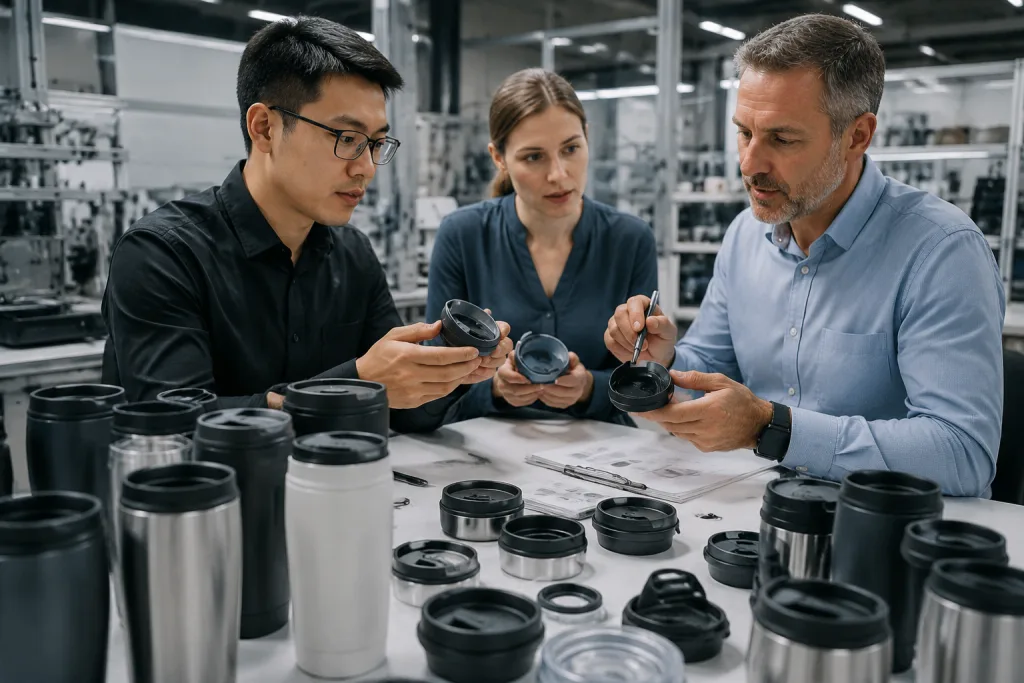
For a bulk coffee travel mug sold as a premium retail item, the lid feel has to match the price tag. If the cap rattles, the buyer flags it in one second. We’ve seen that go sideways on PO number and packaging, especially when the lid and body came from different molds. That is why experienced coffee mug distributors often order two lid options in the same mold family: one low-cost lid for promo runs and one upgraded lid for retail or coffee mug private labeling programs.
Decoration should match margin
I’ll rewrite the section in place, keep the HTML intact, and tighten the sales-engineer tone with a few concrete factory details.Decoration is where a lot of bulk coffee tumbler jobs go off the rails. The logo method has to fit the order size, artwork detail, and target margin. For a simple one-color logo on a coffee mug custom order, screen printing is still the lowest-cost route. For sharp lines on metal, laser engraving gives a cleaner edge, especially on dark powder coat. If the buyer wants a premium retail look, heat transfer or full-wrap printing works, but setup takes longer and the reject rate goes up.
When you compare coffee mug customizable options, ask how the decoration changes dishwasher resistance and the surface warranty. A powder-coated cup with laser engraving usually holds up better than a soft-touch painted mug with a large printed area. For corporate buyers ordering coffee mug promotional products, the real call is speed against finish quality. A screen-printed bulk coffee mug can ship in 25 to 30 days, while a multi-step custom wrap job usually runs 35 to 45 days. In our Hangzhou line, we lock the print jig and carton layout together once the artwork is approved, and that saves a few days; QC pulled one sample last month with a 1.5 mm logo shift, and the buyer flagged it before the batch moved.
If you are comparing coffee mug custom made versus coffee mug customized versus coffee mug private label, the difference is practical: custom made usually means a new mold or new structure, customized means an existing base with your artwork, and private label means your brand system is repeated across SKUs. A coffee mug factory should say that plainly instead of hiding tooling cost in the unit price. We’ve seen that math go sideways on a 3,000-piece PO when the buyer missed the mold fee by 18%; the PO typo was one digit, and it changed the whole margin.
Check compliance before price
I’ll keep the HTML structure intact and rewrite the copy to sound like a real sales engineer: tighter, more specific, and less generic. Next I’m replacing the compliance claims with concrete buyer-side checks and factory-floor detail.For Europe and North America, compliance is not optional, and each part has its own paper trail. A mug can pass on the 304 stainless body and fail on the lid resin or the silicone gasket. Ask the supplier to split the declaration by stainless steel, silicone, PP, and coating. For EU shipments, request REACH declarations and food-contact support where they apply. For the U.S., ask for FDA material declarations and third-party migration testing if the item is sold as food contact. If the tumbler will hold hot liquid, ask for the coating migration result or heavy-metal test report in writing. We have seen buyers skip that step and regret it later.
Buyers ask for BSCI because they want a social compliance baseline from the coffee mug manufacturer. Fair enough. It does not replace product testing. You still need incoming material checks, in-process inspection, and final AQL sampling. For a bulk travel tumbler order, we usually set AQL 2.5 for appearance and AQL 1.0 for leakage if the brand can’t afford returns. Ask for the drop-test height, thermal retention method, and carton drop standard on the PO, not in a chat thread. QC pulled the sample on the line at 1.2 meters last week, and the buyer flagged a loose lid before shipment. That is the right way to run it.
China has plenty of capable factories, but a trading company and a real coffee mug factory direct partner are not the same animal. If you want steady supply from Zhejiang or elsewhere in China, ask for test reports, a production flow chart, and the monthly output for your exact SKU family. We run 60,000 to 80,000 units a month on some travel mug lines, and that number matters more than a glossy brochure. One typo on a PO can also tell you plenty; if the buyer writes 500 ml and the carton spec says 16 oz, the math does not work. Good suppliers answer that fast and show the batch records.

Price the landed unit properly
I’ll rewrite this section in place, keep the HTML unchanged, and tighten the sales language so it sounds like a factory-side pricing note.Buyers often lock onto FOB China and miss the rest of the bill: carton, freight, duty, and labeling. A bulk coffee mug at FOB USD 2.10 is not the same as a landed cup at USD 3.90 once you add master carton, barcode label, FNSKU, ocean freight, and customs handling. If you sell through Amazon or a distributor network, packaging spec drives the math as much as the mug. A coffee mug distributor partner will usually want retail-ready packing, and that can add USD 0.25 to 0.70 per unit depending on print setup and insert count.
For a bulk coffee travel mug program, price it in tiers. Entry promo units often land between USD 2.50 and 4.20. Mid-range retail units usually land between USD 4.80 and 7.50. Premium vacuum mugs with upgraded lids, custom color, and gift boxes sit above that. The wrong question is “what is the cheapest quote?” We have seen that go sideways when the supplier misses color tolerance, seal performance, or a 15% short ship. A coffee mug supplier that saves USD 0.12 and causes a claim later did not save you money.
Good buyers treat the quote like a process map. They ask for tooling if needed, sample lead time, mass production lead time, spare parts availability, and how the factory handles rework. On our Zhejiang line, standard custom bulk coffee travel mug production usually runs 20 to 30 days after sample approval; decorated orders with full-wrap print or special lids can stretch to 35 to 45 days. QC pulled the sample, checked the lid seal at 80°C, and that is the kind of detail you can plan around.
Use the right supplier type
I’ll keep the HTML exactly as-is and rewrite only the prose with a sharper supplier-side voice, concrete factory details, and fewer generic phrases.The phrase coffee mug supplier sounds simple, but the market splits fast. A trading company can move mixed SKUs in 3 days. A coffee mug manufacturer or coffee mug OEM manufacturer gives you tighter control on tooling, QC, and repeat runs. A coffee mug supplier directory may help you collect names, but it will not tell you who owns the mold, who runs the line, or who can take a rush PO without breaking the schedule.
If you are buying coffee mug bulk for a seasonal promotion, the math is simple: a factory running 600,000 units per month with in-house decoration beats a small workshop quoting 0.18 USD less. We saw a buyer flag a typo on the PO last month, and the whole carton mark had to be reprinted. If you need coffee mug factory direct pricing, ask three things straight: do they own the mold, do they print in-house, and can they show current loading on the line? If the answer stays vague, your delivery date is already slipping.
For private label coffee mug private labeling programs, check whether the supplier can hold logo placement within 1.5 mm across repeat POs and keep the same Pantone on the cup body. QC pulled the sample on one run because the lid gap was off by 0.7 mm, and that kind of miss turns into chargebacks later. For coffee mug promotional products, pick the supplier that hits budget and ships on time, not the one with the thickest catalog. We run both a primary coffee mug factory and a backup coffee mug distributor channel for a reason. China has scale, but Zhejiang factories with steady process control usually give the least trouble.
Request a factory quote that matches your spec
Send your target price, lid style, and artwork. We’ll build a practical bulk coffee mug quote with MOQ, lead time, and compliance details.
Frequently asked questions
What MOQ should I expect for a custom travel tumbler?
For a standard bulk coffee travel mug with existing tooling, MOQ is often 1,000 pcs per color. If you want a new powder coat, custom lid color, or special carton, 3,000 pcs is more realistic. For highly customized coffee mug custom made structures, some factories ask for 5,000 pcs because the setup cost is higher. At a real coffee mug factory in Zhejiang or elsewhere in China, ask whether the MOQ is tied to one SKU, one print, or one lid type, because those are not the same.
How do I compare prices from different suppliers?
Compare on the same spec sheet: steel grade, wall thickness, lid type, print method, carton quality, and testing standard. A bulk coffee mug at USD 2.20 with 201 steel is not equal to one at USD 2.75 with 304 steel and a leak-tested lid. Ask for FOB China pricing, then add packaging, freight, duty, and labeling. A proper coffee mug manufacturer should give you a quote that shows each component separately, not one blended number that hides the real cost.
Which decoration method is best for corporate gifts?
For a coffee mug promotional order, screen print is the lowest-cost option and works well for one or two colors. Laser engraving looks cleaner on a bulk coffee tumbler with powder coat and usually lasts longer in wash cycles. Full wrap print can look premium, but it often needs tighter artwork control and longer lead time. If your audience is executives or retail buyers, laser or engraving usually feels more premium than basic print. If your audience is mass giveaway, simple print usually wins on budget.
What compliance documents should I request?
Ask for REACH support for Europe, FDA material declarations for the U.S., and any food-contact test reports that match the exact body, lid, and gasket. If the supplier is a serious coffee mug factory direct partner, request BSCI if social compliance matters to your brand. Also ask for AQL inspection records, leak-test results, and material specs for stainless steel, silicone, and PP. Do not accept a generic certificate if the actual SKU uses different materials than the tested sample.
How long does production usually take?
For a standard bulk coffee mug or bulk coffee travel mug, sample approval may take 7 to 12 days, and mass production usually takes 20 to 30 days. If you add custom tooling, special color matching, or retail gift packaging, lead time can extend to 35 to 45 days. A capable coffee mug supplier in Zhejiang should tell you the schedule by process step: sample, tooling, coating, decoration, packing, and shipment. That makes your launch planning far easier.