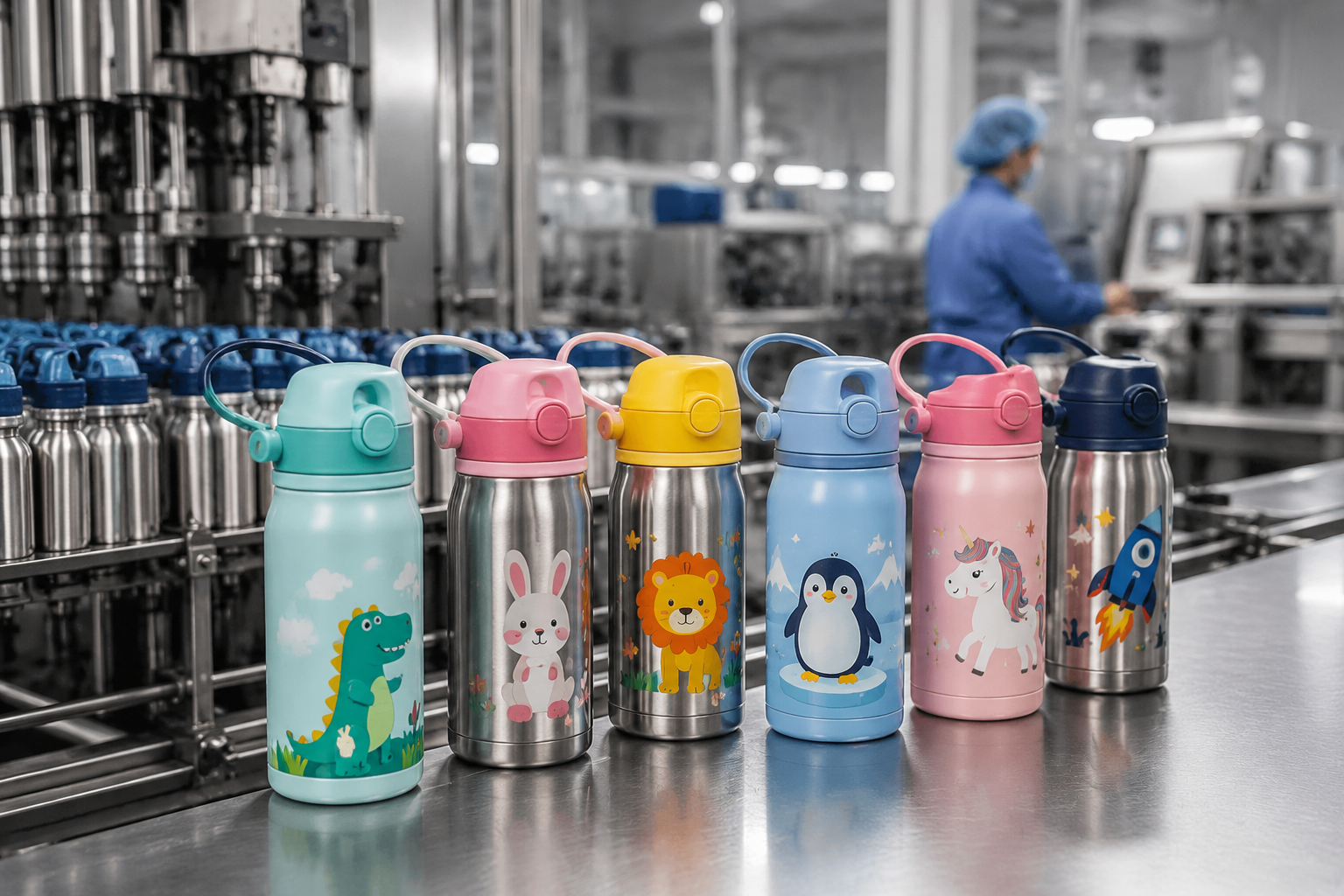
Key Takeaways
- MOQ for a custom kids bottle usually starts at 3,000 pcs, while simple stock colors can drop to 1,000 pcs.
- A basic bulk kids bottle in PP or Tritan typically lands at USD 1.05 to 2.40 EXW before freight and duty.
- Standard lead time is 25 to 35 days after sample approval; complex decoration adds 5 to 10 days.
- School buyers should ask for REACH, food-contact declarations, and AQL 2.5 inspection terms before ordering.
If you are buying for a school district or importing kids products, the hard part is not finding a supplier. It is telling a real children water bottle factory from a middleman who can quote low and vanish when you ask for test reports, cap seals, or ship dates. For suppliers children water bottle, the math is simple: a $1.20 bottle and a $2.60 bottle can both look fine online, but one will fight you on MOQ, print setup, and freight. We have seen this go sideways on a 12 mm lid gasket that passed photos and failed leak checks at the line.
Most buyers start with price and end up debugging lead time. That is the wrong order. In Zhejiang and across China, the better question is what drives unit cost, how many pieces unlock the next tier, and how many days you need for tooling, sampling, production, and inspection. At BottleForge Industrial in Hangzhou, our standard kids bottle programs run 10,000 units per month, with typical MOQ starting at 3,000 pcs and lead times from 25 to 35 days after sample approval. QC pulled the sample, checked the cap torque, and the buyer flagged a PO typo on the carton count before we shipped.
What drives unit cost
I’ll tighten the prose, keep the HTML exactly as-is, and make the cost drivers sound like a factory-side sales note. Then I’ll do a quick consistency pass for the numbers and phrasing.When you compare children water bottle wholesale quotes, do not stare at the printed unit price and call it done. The real stack is resin grade, wall thickness, cap build, decoration, and carton work. A 420 ml PP bottle with a basic flip lid can land at USD 1.05 to 1.40 EXW at 3,000 pcs. Switch to Tritan, add a silicone straw, and ask for a custom logo kids bottle with full-color wrap print, and that same piece moves to USD 2.10 to 3.20. That is normal. We see it on the line every week.
Material choice drives the quote first. PP is the low-cost option, light and easy to run, but it looks more basic. Tritan costs more because the resin is clearer and takes impact better. Stainless steel pushes the number up again because you pay for gauge control, vacuum welding, and leak testing. If you are working with a children water bottle manufacturer in China, ask for the exact resin grade, wall thickness in millimeters, and cap material mix. We had one buyer flag a PO for a 0.8 mm wall, then switch to 1.2 mm after QC pulled the sample and found the bottle flexed too much in drop tests.
- PP stock bottle: USD 1.05 to 1.40 EXW
- Tritan bottle: USD 1.60 to 2.40 EXW
- Stainless steel kids bottle: USD 2.40 to 4.80 EXW
- Silicone straw or soft spout: add USD 0.08 to 0.25
- One-color silk screen: add USD 0.05 to 0.12
If your supplier will not split product cost, decoration, and packaging, the quote is useless. We have seen this go sideways when a buyer accepted one lump sum, then found the carton spec was changed from 12 pcs to 24 pcs without a price reset.
MOQ tiers that actually matter
I’ll rewrite just this section, keep the HTML structure intact, and make the copy sound like a real factory-side sales engineer.MOQ is where a lot of buyers burn a week. A real children water bottle supplier gives you tiered pricing, not one soft number. On our line, bulk children water bottle pricing usually shifts at 1,000 pcs, 3,000 pcs, 5,000 pcs, and 10,000 pcs. At 1,000 pcs, you still carry setup time and a slower slot. At 3,000 pcs, the line starts to run clean. At 10,000 pcs, we can push harder on packaging, insert cards, and spare parts.
For school districts, the wrong question is “Can you do 500?” The real question is “Can you do 500 per color across 6 colors?” That changes mold swaps, ink batches, and pack-out labor. We had one buyer flag a PO that said “blue” in the email and “navy” on the file; QC pulled the sample, and the color gap was obvious at 2 meters. For importers, a bulk children water bottle order should be built around carton efficiency. If you want retail-ready boxes, expect to lose 8 to 12 percent in carton space versus bulk inner bags. That changes ocean freight fast, especially on a FOB China quote from Zhejiang ports.
Typical MOQ behavior
- Stock bottle with one-color logo: 1,000 pcs
- Custom cap color or mixed body color: 3,000 pcs
- Full custom mold or unique lid: 5,000 to 10,000 pcs
- Custom print plus boxed retail pack: 3,000 pcs minimum
At BottleForge in Zhejiang, standard kids bottle programs sit at 3,000 pcs MOQ because that is where QC, packing, and line scheduling stay steady. We run a 48-hour pre-production sample check, and below that the unit cost jumps hard. Past 5,000 pcs, you start saving on decoration and packaging, not just the bottle body.
Lead time by process
I’ll rewrite this section in-place, keep the HTML exactly as-is, and tighten the language so it reads like a factory-side sales engineer wrote it.Lead time is where buyers get burned. A quote that says 20 days often leaves out sampling, artwork signoff, and packing approval. For children water bottle custom projects, break the clock into stages. Sample confirmation usually takes 5 to 10 days if we use an existing mold. If the buyer wants a new cap or custom handle, add 15 to 25 days for tooling. After sample approval, production usually runs 20 to 30 days for 3,000 to 10,000 pcs. Add 3 to 7 days for final inspection and export packing. QC pulled the sample on a 500 ml bottle last week, and the cap fit was off by 1.2 mm.
The honest timeline for a typical bulk school water bottle order is 30 to 45 days door-to-port readiness when decoration is simple. If you need multi-step printing, gift boxes, or individual barcode labels for retail, plan on 40 to 55 days. For Amazon-style fulfillment, labels, polybags, and carton markings add another 2 to 5 days. This is the wrong question to ask if someone only gives you one lead time. On the line, we had a buyer flag a PO typo on carton marks, and that alone cost two extra days.
Ask for a timeline in writing with sample date, production start date, inspection date, and ship date. One date is not a schedule.
- Stock sample: 2 to 5 days
- Custom sample with logo: 5 to 10 days
- Tooling for new parts: 15 to 25 days
- Mass production: 20 to 30 days
- Inspection and packing: 3 to 7 days
If you are buying from China, Zhejiang factories often run faster than inland plants because export logistics are tighter and supplier networks are denser. We ship from Hangzhou every week, and that cuts dead time between print, packing, and booking. It does not remove risk, but it keeps the schedule honest.
Decoration choices change the quote
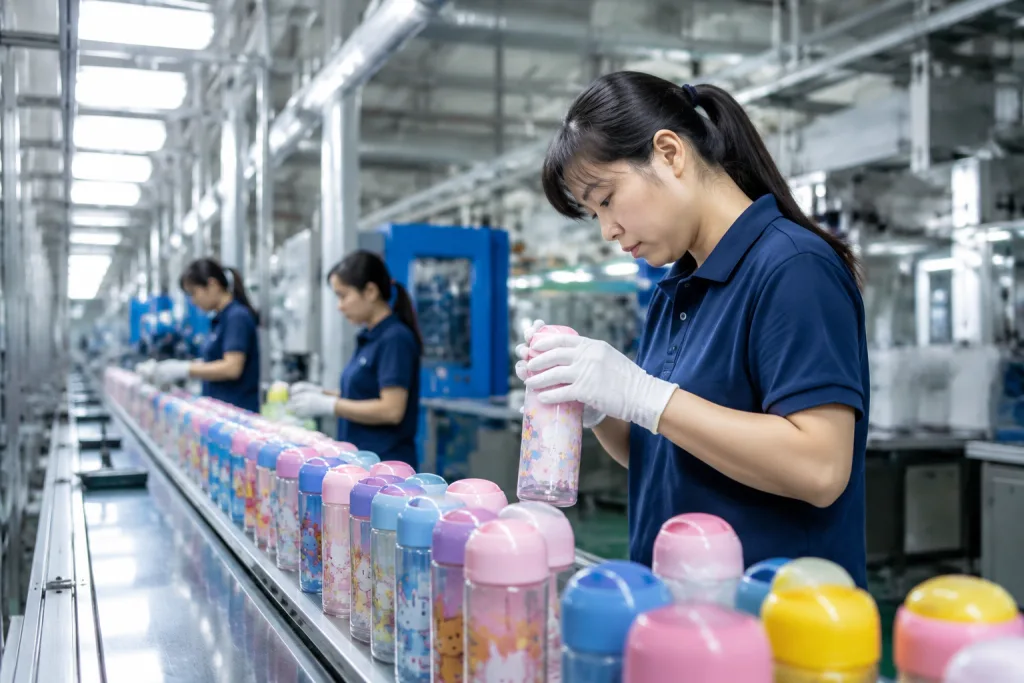
I’ll rewrite the section in a more grounded supplier voice, keep the HTML exactly as-is, and make the pricing/production details feel like they came from the line.Decoration is not cosmetic on a purchase order. It changes labor, reject rate, and drying time. A one-color silk screen on a flat bottle runs clean and stable. A wraparound print on a curved body costs more because the fixture has to hold position. Laser engraving on stainless steel is durable, but the line moves slower. A full-color sleeve or heat transfer makes a custom kids water bottle look stronger on shelf, and it can add USD 0.18 to 0.60 per piece depending on coverage and pass count.
For school buyers, the safer call is usually one or two colors with a matte or satin body finish. Kids can read it faster, and QC pulls fewer bad prints. For brand owners, a children water bottle customizable program should spell out the Pantone reference, print area, and logo tolerance. We had one buyer flag artwork with strokes under 0.3 mm; the line either dropped them or turned them into a thicker version. That is the wrong place to save time. You need pre-production approval, not just a PDF.
- Silk screen: best for 1 to 2 colors
- Pad print: useful for curved cap areas
- Heat transfer: better for full-wrap graphics
- Laser engraving: durable for metal bodies
- UV print: fast for complex visuals, but costlier
If you need children water bottle promotional items for events, ask for artwork on stock molds and keep the logo in a small flat zone. If you need retail, pay for cleaner decoration and tighter inspection. We’ve seen cheap print peel after three dish cycles. That math does not work.
Material and compliance checks
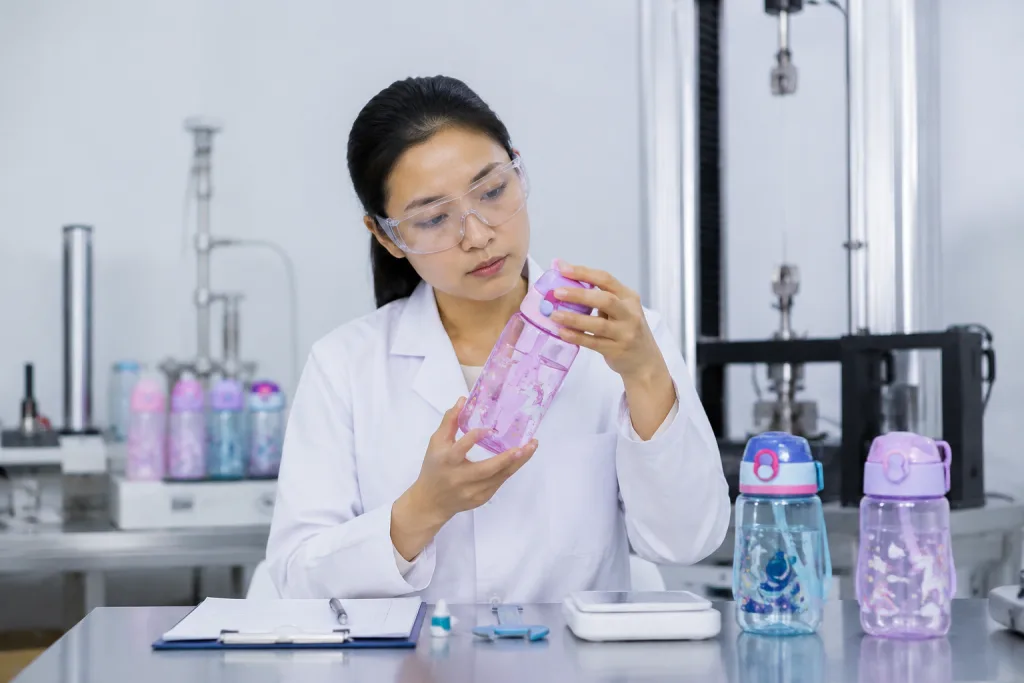
I’ll rewrite the section in-place, keep the HTML tags intact, and tighten the language so it sounds like a factory-side sales engineer.In Europe and North America, compliance is table stakes, and good factories in China know that on day one. A serious children water bottle manufacturer should support food-contact declarations, REACH compliance, and, for some buyers, LFGB or ASTM-related requirements. For school district orders, ask for BPA-free claims, phthalate limits, and dishwasher safety at 70°C if the bottle goes through repeated washing. The body is only half the job; the lid gasket and straw material must pass too.
For a custom school water bottle, the weak point is usually the soft parts. Silicone straws, seals, and bite valves need the same review as the main resin. Ask for a material breakdown by component. If the bottle is Tritan but the gasket comes from an unknown silicone source, the file is thin. We’ve seen that go sideways. A proper supplier should hand over batch records, incoming inspection checks, and a final AQL plan, usually AQL 2.5 for major defects and 4.0 for minor defects.
You should also ask for drop-test data. A 1.0 m drop onto concrete is a fair school-use test. If a bottle only survives a tabletop fall, it is not fit for kids. On our line in Zhejiang, QC checks cap torque, seal leakage, and cycle life before shipment. That is normal export discipline. Not extra service.
How to buy without paying twice
I’ll rewrite the section in place, keep the HTML exactly as-is, and strip the AI-ish phrasing while adding more buyer-floor detail and concrete sourcing language.The cheapest quote usually turns into the costliest buy. If you are comparing children water bottle suppliers, put tooling ownership, sample policy, packaging change fees, and inspection terms side by side. A Hangzhou factory quote should say whether the mold is shared or exclusive, who keeps the tooling after payment, and whether the artwork plate fee comes back if the order falls through. Those points matter more than a 6-cent gap on the unit price.
For school district procurement, work off landed cost. Count FOB price, ocean freight, inland delivery, customs brokerage, and duty. A bottle at USD 1.35 EXW can land at USD 2.20 to 2.80 once you add carton count and the shipping route. Ask for carton size in centimeters, net weight, gross weight, and pallet count. QC pulled a carton that was 58 x 42 x 38 cm instead of the PO’s 60 x 40 x 40, and the freight bill changed overnight. The brochure photo does not pay the invoice.
If volume is steady, freeze the spec and reorder against the same approved sample. That is how we run stable quality. If volume is seasonal, keep one stock shape and change only the print. We’ve seen buyers try three bottle bodies in one season, and the math does not work. A good children water bottle factory keeps cost and lead time in the same conversation, not on separate spreadsheets.
- Confirm tooling ownership before paying any mold fee
- Approve sample, then freeze artwork and packaging
- Demand AQL inspection terms in the PO
- Calculate landed cost, not just EXW price
- Keep one base mold when ordering multiple SKUs
That is the clean way to work with a children water bottle vendor in Zhejiang or anywhere else in China without turning every reorder into a new round of sampling, freight checks, and PO corrections.
Request a real kids bottle quote
Send your target quantity, artwork, and destination port. We will return a costed timeline, MOQ, and sample plan from Zhejiang.
Frequently asked questions
What is a normal MOQ for suppliers children water bottle?
For a standard stock mold with one-color logo, 1,000 pcs is possible. For a true custom kids bottle with color changes or custom packing, 3,000 pcs is the more realistic MOQ. If you need a new lid or handle tooling, expect 5,000 to 10,000 pcs. At BottleForge in Hangzhou, our mainstream kids bottle program is built around 3,000 pcs because that keeps pricing and quality stable for export orders.
How much does a bulk kids water bottle usually cost?
A basic PP bulk kids water bottle usually runs USD 1.05 to 1.40 EXW at 3,000 pcs. Tritan versions are more like USD 1.60 to 2.40 EXW, depending on cap complexity and print. Stainless steel options often start around USD 2.40 and can reach USD 4.80 or more if you add a straw lid, laser logo, and retail box. Freight and duty are separate.
How long does a custom children water bottle order take?
If you approve an existing mold, sample confirmation takes 5 to 10 days and mass production takes 20 to 30 days. A new cap or custom part adds 15 to 25 days for tooling. For a normal export order, expect 30 to 45 days total before shipment readiness. Complex retail packing or multiple decoration steps can stretch that to 40 to 55 days.
What compliance documents should I ask for?
Ask for food-contact declarations, REACH support, and component-level material details for the body, lid, gasket, and straw. For North America or school use, also ask for BPA-free confirmation and if needed ASTM-related test support. Good children water bottle manufacturers in China should provide batch records, AQL inspection terms, and leakage or drop-test evidence before shipment.
Can I order children water bottle customized with school branding?
Yes. Most school district buyers use one- or two-color logo printing, barcode labels, and simple retail or bulk packing. A custom school water bottle usually needs a print file, Pantone references, and a confirmed approved sample. If you want multiple school colors, make sure you understand whether the factory is changing the body color, the lid color, or both, because that changes price and lead time.