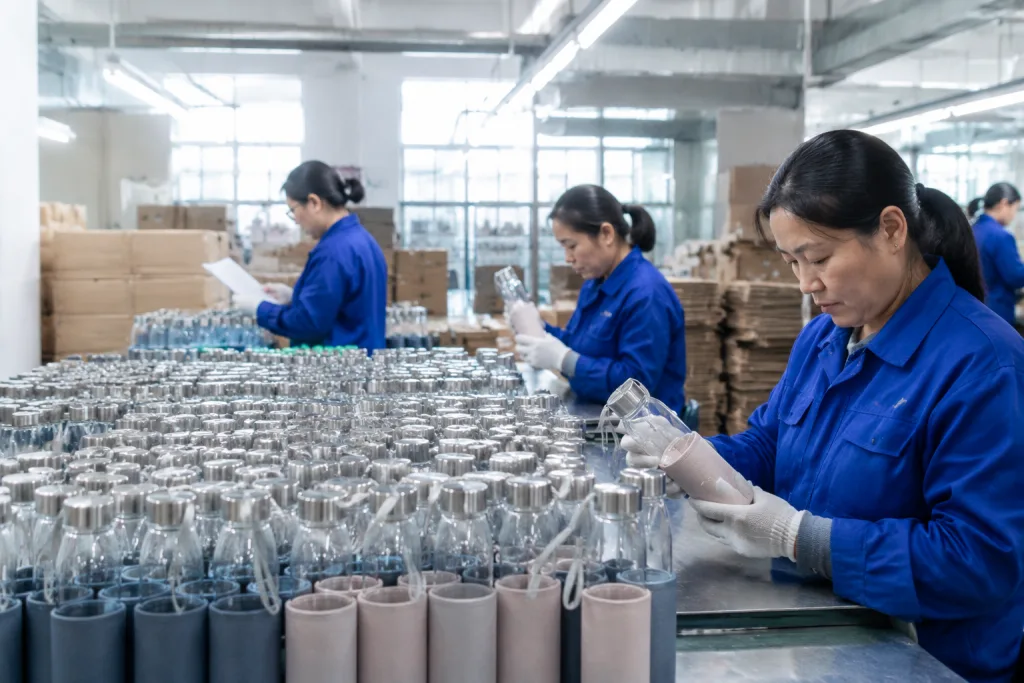
Key Takeaways
- A practical MOQ for borosilicate glass bottle custom orders is usually 3,000-5,000 units per color or sleeve style
- 3.0-3.5 mm wall thickness is common for reusable retail bottles, but shape affects breakage more than thickness alone
- Normal China production lead time is 35-50 days after sample approval, plus sea freight time
- Use AQL 2.5/4.0 inspection, carton drop testing, and FDA/LFGB/REACH documentation before shipment
You can find hundreds of suppliers borosilicate glass bottle listings online. A quote is easy to get. The hard part is knowing whether that quote survives retail handling, dishwasher claims, REACH paperwork, carton drops, and the buyer asking why the silicone sleeve shade changed on shipment 1.
For wellness brands and sustainable retailers, a custom glass water bottle looks simple on paper, and that is the wrong question to ask. At our Hangzhou, Zhejiang team in China, we usually see the trouble start with specs that are too loose: “500 ml glass bottle with logo” tells us nothing useful. You need glass type, wall thickness, cap material, test standard, MOQ, decoration method, and packing locked down before price comparison means anything. QC pulled a 12 mm wall sample last week, and the buyer flagged a PO typo on the carton count before we even ran the line.
Start with the glass specification
I’ll rewrite the section in-place, keep the HTML structure untouched, and make the prose sound like a factory-side sales engineer wrote it.If you ask ten borosilicate glass bottle suppliers for a 500 ml bottle, you can get ten quotes that do not line up. One factory quotes 2.2 mm wall thickness. Another quotes 3.2 mm. A cap can be PP with a silicone ring, or bamboo over stainless steel. Same label, different bottle.
For a retail reusable bottle, we normally push high borosilicate glass with boron content around 12-13%. It takes hot tea and iced water better than soda-lime glass. It is not shatterproof. We had a buyer assume that after QC pulled a dropped sample from a 1.2 m bench test, and that is the wrong question to ask. The real point is daily use, not magic.
Your first RFQ should state:
- Capacity: 350 ml, 500 ml, 550 ml, 750 ml, or 1,000 ml, measured to overflow or practical fill line.
- Glass wall: usually 2.5-3.5 mm for retail bottles; at 4.0 mm the bottle gets heavy fast.
- Mouth size: 35-55 mm affects ice cube use, cleaning, and cap cost.
- Cap system: bamboo, stainless steel, PP, Tritan-style plastic, or tea infuser lid.
- Sleeve: silicone, neoprene, felt, cork, or no sleeve.
A serious borosilicate glass bottle factory in China should answer these points straight. If a supplier only sends lifestyle photos and a unit price, you are not sourcing yet. You are shopping. We see that go sideways when the buyer flags a PO typo on the mouth size and the line has already started.
What MOQ is realistic
I’ll rewrite just the prose inside the existing HTML, keep every tag and list structure intact, and tune the tone to sound like a factory-side sales engineer.MOQ is where a lot of sustainable retailers lose patience. We see it every week. A catalog bottle with a one-color logo can start at 1,000-2,000 units if the borosilicate glass bottle manufacturer has stock glass and stock caps on hand. A true borosilicate glass bottle custom job usually starts at 3,000-5,000 units per SKU, and a new mold can push the first PO to 10,000 units or more. QC pulled a 12-ounce sample last month; the buyer liked the bottle, then flagged the cap cost. The math was still the math.
Here is the clean split:
- Stock shape plus logo: 1,000-2,000 units, around 20-30 days after artwork approval if materials are on the line.
- Stock glass plus custom sleeve color: 3,000 units per color is normal because silicone and fabric dye lots have batch minimums.
- Custom cap tooling: 5,000-10,000 units, with tooling cost often USD 800-3,000 depending on the cap structure.
- New glass mold: 10,000 units or more, because the first forming run throws waste and setup loss.
At BottleForge Industrial in Zhejiang, our monthly glass bottle assembly capacity is about 180,000 units for mixed glass and cap projects, but we still tell buyers to keep the first run tight. We run the line for a 3000-unit trial, not a fantasy launch. If you are testing a wellness retail line, a customizable glass water bottle on an existing mold is the better move than forcing a brand-new shape on order one. The buyer flagged a typo on the PO once—one missing digit changed the carton count and held the shipment for a day.
Do not fight MOQ only on price. Cut custom parts, lock two colors instead of four, and make the packaging retail-ready from day one.
For borosilicate glass bottle bulk buying, the best cost break usually shows up around 5,000-10,000 units, not at 500 units. Below that, export packing, QC, and paperwork costs eat the margin. We’ve seen it go sideways when a buyer chased a tiny MOQ and then paid more per unit after cartons, labels, and inspection.
Decoration choices that survive retail
I’ll rewrite just the prose, keep every HTML tag and the heading intact, and make it read like a factory-side sales note with concrete numbers and field details.A borosilicate glass bottle promo run may only need a logo to carry a conference week. Retail is harsher. The bottle gets shelf rubbing, dishwashing claims, and one-star reviews if the print flakes. That is why decoration choice is not a side note.
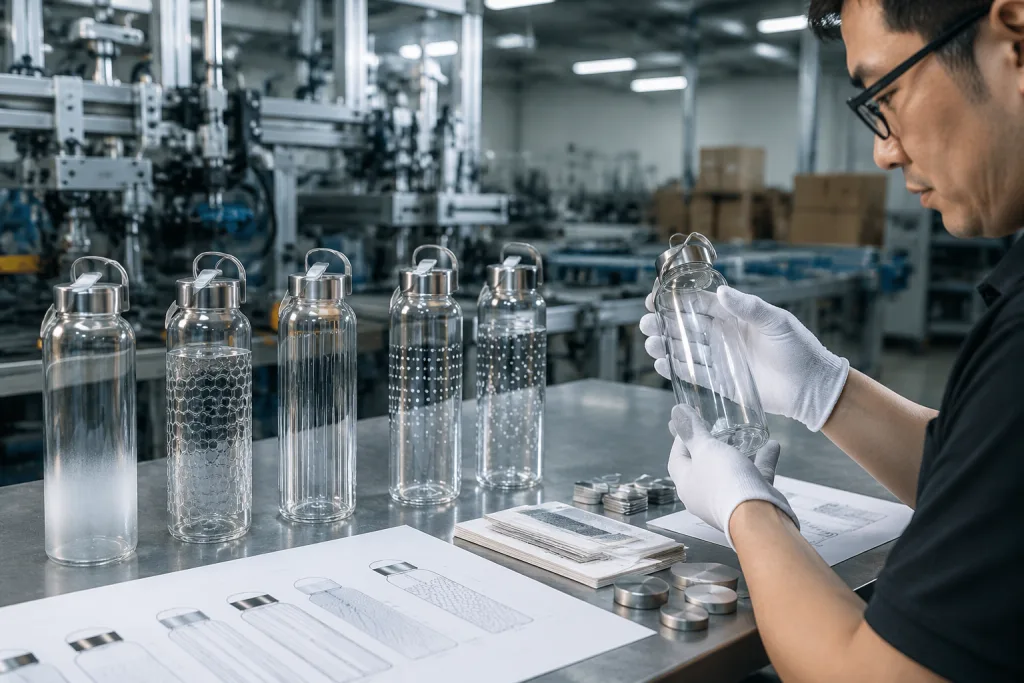
For a custom borosilicate glass bottle, the usual options are silkscreen printing, heat-transfer decal, laser engraving on a metal or bamboo cap, sleeve embossing, and paper belly bands. Direct silkscreen on glass stays the cheapest clean look; on our line, it usually lands around USD 0.08-0.18 per color, depending on order size and print area. Heat-transfer or decal work handles gradients and full graphics, but QC pulled the sample after a scratch test and the edge lifted, so you need to budget for that.
If the design uses a silicone sleeve, print or emboss the sleeve and stop trying to force a huge logo onto the glass. Silicone hides small glass color variation, and it gives the hand a better grip in transit. For sustainable buyers, cork or felt sleeves look more natural, but they pick up dust and color shifts fast. We ask for real swatches, not Pantone screenshots on a phone.
A customized glass water bottle with bamboo cap needs tighter branding control. Bamboo is natural, so grain and shade move from cap to cap. Laser engraving gives a clean premium look, but the burn depth changes with bamboo density. If your brand wants a fixed black, print on the sleeve or carton instead. The buyer flagged one PO where the cap logo was specified as 12 mm, but the actual artwork would not fit after we checked the cap crown.
Ask your borosilicate glass bottle supplier to run 3M tape pull, wet rub, dry rub, and dishwasher cycles if you plan to claim dishwasher-safe. We treat 50 dishwasher cycles as a useful internal checkpoint, but the math does not work for every cap and sleeve material. Be exact about which part is dishwasher-safe; one typo on the PO can turn into a bad claim on the retail box.
Supplier questions worth asking
I’ll rewrite just the prose, keep the HTML structure intact, and make it sound like a factory-side sales engineer wrote it.Most borosilicate glass bottle factories can put a sample on the table. Fewer can tell you how the line runs. When we check a borosilicate glass bottle vendor, the job is not to get a polished company intro. It is to catch weak points before you send the deposit.
Send these questions in the first serious email. We use them at the desk every week, and they save time.
- Is the bottle made from high borosilicate glass or soda-lime glass? State the glass grade.
- What is the wall thickness tolerance, and how do you measure it, for example with a caliper or ultrasonic gauge?
- Do you assemble caps and sleeves in-house, or do you pass them to another plant?
- Can you provide FDA, LFGB, REACH, and California Prop 65 documents if the buyer asks for them?
- What AQL level do you use at final inspection?
- Have you shipped to European or North American retailers before, and which channels?
- Can you support FBA labels, FNSKU application, and 5-ply master cartons?
A real borosilicate glass bottle factory should be fine with AQL 2.5 for major defects and AQL 4.0 for minor defects. Zero tolerance applies to broken glass, sharp edges, contamination, and loose cap sealing rings. We run carton drop tests on export orders with ISTA-style handling in mind, even when the buyer does not ask for full ISTA paperwork. QC pulled one batch at 600 mm last month because the edge finish missed spec by 0.3 mm. That is the kind of detail that saves a claim later.
Watch the borosilicate glass bottle distributor who cannot say where the factory is or when QC happens. Small orders can work through a trader, sure, but if they block inspection or dodge process questions, the math does not work. We’ve seen a buyer flag a PO typo on carton count, then the distributor tried to push the blame to the plant. That goes sideways fast.
Pricing without false savings
I’ll rewrite just this section, keep the HTML structure intact, and tune the tone to sound like a factory-side sales engineer.FOB pricing for a borosilicate glass bottle wholesale order comes down to capacity, cap, sleeve, logo, and packaging. On a 5,000-unit run from Zhejiang, a 500 ml stock high borosilicate bottle with a PP or stainless cap usually lands around USD 1.40-2.20 FOB. Add a silicone sleeve and custom box, and the same job moves to USD 2.10-3.20. Bamboo cap, infuser, premium sleeve, or molded packaging will lift it again. We run these numbers on the line before we quote.
Cheap quotes usually cut one of four areas: thinner glass, lighter cap, poor sleeve material, or weak cartons. The first three hit the buyer's shelf experience. The carton issue hits landed cost, and we've seen a 28 mm neck bottle arrive with chipped shoulders because someone saved a few cents on corrugate. That is the wrong place to save.
For a bulk glass water bottle program, ask the price table to break out:
- Glass body cost
- Cap and gasket cost
- Sleeve cost
- Decoration cost
- Retail packaging cost
- Master carton and pallet cost
- Testing and inspection cost
This split lets you push the right lever. If your target price is USD 2.40 and the supplier quotes USD 2.75, you can trim the sleeve, thin the box, or change the cap spec. One buyer once sent a PO with “bottle color: clear, bottle colo: clear”; QC still had to stop the run because the packaging line was set for amber cartons. Ask for the split, then do the math. Do not just ask for a lower number and hope the spec stays untouched.
For distributor glass water bottle programs, landed cost matters more than FOB. A bottle that saves USD 0.15 FOB but breaks at 3% in warehouse handling is not cheaper. We prefer to design for under 1% transit damage in normal container loading and courier carton tests, and we check that with drop tests from 1.2 m before release.
Sampling and approval checklist
I’ll rewrite the section in-place, keep the HTML structure unchanged, and tighten the copy so it sounds like a factory-side sales engineer wrote it.A borosilicate glass bottle project should not go to mass production because the sample “looks nice.” We run on a written approval file. Plain and simple. Without that, disputes start over small things like a 0.5 mm wall difference or a cap that sits 1 mm high.
Before deposit, confirm the quotation version, Incoterm, payment terms, MOQ, lead time, mold cost ownership, and sample fee. Before sample approval, check capacity, weight, wall thickness, mouth diameter, cap fit, sealing test, sleeve color, logo position, carton layout, barcode, and legal marks. Use a caliper, keep the QC sheet, and save photos with a ruler in frame. If the buyer flagged a logo shift on a PO typo later, the math does not work in your favor.
For mass production, a clean timeline looks like this:
- Artwork and spec confirmation: 2-5 working days.
- Pre-production sample: 7-12 days for stock shape, 20-35 days if tooling is involved.
- Mass production: 30-45 days after sample approval for most 3,000-10,000 unit orders.
- Final inspection and booking: 3-7 days depending on inspector availability and vessel schedule.
At our Hangzhou operation in Zhejiang, China, standard MOQ for a custom glass water bottle with logo is 3,000 units, and a typical lead time is 40 days after approved pre-production sample. Rush orders sound good in email, then the line gets squeezed at annealing and cap assembly. We’ve seen that go sideways when QC pulled the sample at 2.8 mm spec instead of 3.0 mm.
For Amazon or marketplace programs, add FNSKU labels, suffocation warnings if polybags are used, carton weight limits, and drop-test packing. For sustainable retail, add recycling marks, FSC paper requests, and plastic-free packaging rules early. Late packaging changes are one of the most common causes of shipment delay, and a carton art recheck at 48 hours is cheaper than missing a vessel.
Red flags before payment
I’ve got the section and the constraints. I’m rewriting it in a more field-tested sales tone, keeping the HTML intact and tightening the red-flag language so it reads like a factory-side buyer warning, not a generic article.There are plenty of solid borosilicate glass bottle suppliers in China, including Zhejiang factories that know export paperwork and chain-store audits. We also see trading desks that sell yoga mats on Monday and blenders on Friday, then call themselves a borosilicate glass bottle manufacturer. That is the wrong room to stand in.
Red flags are usually plain. A supplier who will not do a video call from the line is a problem. A quote with no glass thickness, no carton spec, and no AQL 2.5 term is not ready for payment. We have seen buyers pay on a clean-looking PI, then QC pulled the sample and the material report was for a different item. Ask again if the test report shows the wrong product, wrong material, or an expired date.
Watch the word “custom.” A borosilicate glass bottle customized with a logo is one thing; a customized borosilicate glass bottle with a new mold, new cap, and exclusive sleeve tooling is another. Spell out which parts are yours and which are stock parts. We run into this all the time: a buyer wants a brand-only bottle, then discovers the same shape on three other shelves next quarter. The math does not work.
A good supplier will say no when the claim is off. No, that lid is not leakproof without a silicone gasket. No, a bamboo cap should not go through a dishwasher at 90°C. No, one sleeve color will not match perfectly across glass, silicone, and print. That answer saves trouble. It shows the factory is protecting the shipment, not just chasing your deposit.
Send your glass bottle spec for review
Share capacity, cap, sleeve, logo, MOQ, and market requirements. We will flag cost risks before you lock the sample.
Frequently asked questions
What is the best MOQ for a first borosilicate glass bottle bulk order?
For a first borosilicate glass bottle bulk order, 3,000 units is usually the sensible starting point if you need logo printing and one custom sleeve color. At 1,000 units, the unit price is often high because setup, carton printing, and inspection costs are spread across too few pieces. At 5,000 units, many factories can offer better FOB pricing and more stable material purchasing. If you are testing a new wellness range, use an existing 500 ml or 750 ml mold, limit the project to one cap type, and spend the savings on better retail packaging and QC. New glass molds usually make sense only when you can support 10,000 units or more.
Can a borosilicate glass bottle custom design be fully dishwasher-safe?
The glass body can usually handle dishwasher use, but the full bottle may not be dishwasher-safe. Bamboo caps, painted metal caps, cork sleeves, felt sleeves, and some printed logos can fail after repeated cycles. If you want a dishwasher-safe claim, define the claim by component: glass body only, cap top-rack only, or full bottle. Ask your borosilicate glass bottle supplier for 50-cycle dishwasher testing and visual checks for logo fading, cap swelling, gasket deformation, and sleeve color change. Many buyers avoid the full-bottle claim and instead print “hand wash lid and sleeve” to reduce complaint risk.
How do I compare borosilicate glass bottle manufacturers fairly?
Compare borosilicate glass bottle manufacturers using the same RFQ sheet, not screenshots or catalog links. Include capacity, wall thickness, cap material, gasket material, sleeve type, logo method, box structure, carton quantity, AQL level, certificates, and Incoterm. Ask each supplier to quote FOB Ningbo or FOB Shanghai if you are sourcing from Zhejiang or nearby China regions. Then request sample weight and packing dimensions. A bottle quoted at USD 1.85 may be worse value than one at USD 2.15 if the first uses thinner glass, weak cartons, or no final inspection. Make suppliers price the same product before you judge price.
What certificates are needed for a customized glass water bottle in Europe or North America?
For a customized glass water bottle, you normally need food-contact documentation for the glass, cap, gasket, and any infuser parts. For Europe, ask about LFGB, EU food-contact compliance, and REACH for restricted substances. For the United States, FDA food-contact expectations and California Prop 65 screening may apply depending on your sales channel. If the bottle is for children, additional ASTM or CPSIA-related checks may be needed. Do not accept one generic certificate for the whole bottle unless it clearly covers every material. A good supplier can map each component to a report and explain report dates, lab names, and tested materials.
Should I buy from a borosilicate glass bottle distributor or factory?
A borosilicate glass bottle distributor can be useful for small test orders, mixed cartons, or fast catalog supply under 1,000 units. A factory is usually better when you need borosilicate glass bottle wholesale pricing, custom packaging, controlled AQL inspection, or repeated retail programs. The tradeoff is MOQ. A distributor may accept lower volume but with less control over glass production, cap sourcing, and inspection timing. A factory may require 3,000-5,000 units but can manage color, logo, packaging, and documentation more tightly. If you choose a distributor, still ask where the factory is, who owns QC, and whether third-party inspection is allowed.