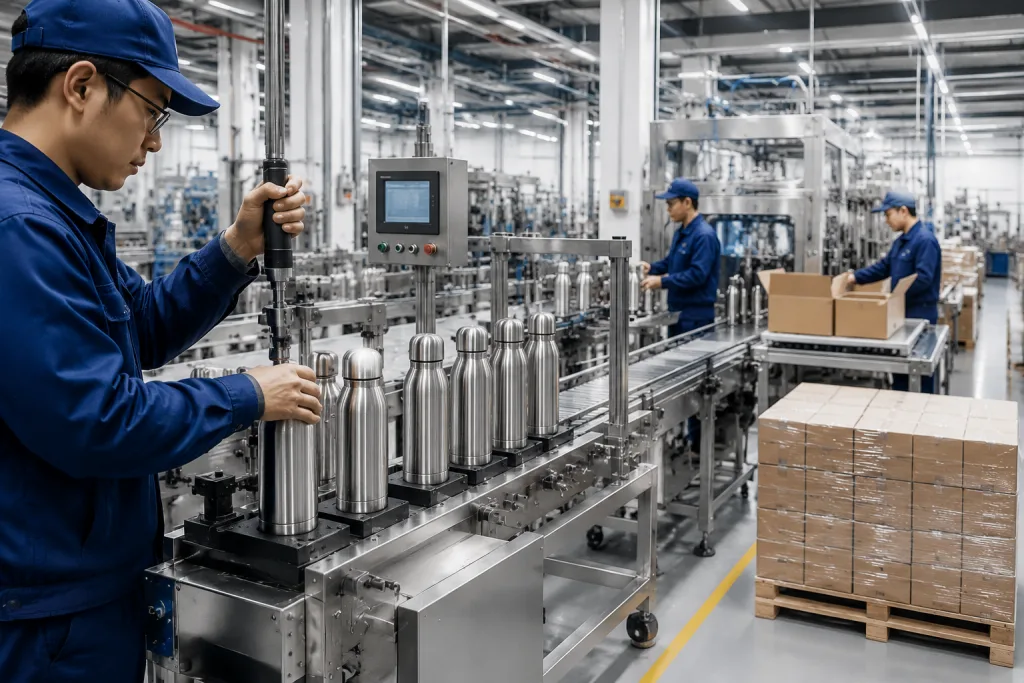
Key Takeaways
- A 0.6 mm wall on a stainless alcohol flask is safer than chasing the lowest FOB by $0.20
- Caps should be tested to at least 0.8-1.2 N·m torque to reduce leak claims
- For custom drinkware, MOQ often starts at 3,000-5,000 pcs per SKU in Zhejiang
- A good canteen manufacturer should quote AQL 2.5 for major defects and 4.0 for minor defects
When you source suppliers alcohol flask programs, the sample is rarely the problem. It looks clean, feels heavy in hand, and clears the showroom test. The trouble starts when 5,000 units hit your warehouse and the cap leaks, the laser mark cuts through the coating, or the seam line lands right under the logo. That is the buyer risk: repeatability, not design.
If you buy in Europe or North America, you know a 0.2 mm spec slip turns into a chargeback, a delayed launch, or a retailer rejection. In Zhejiang, we see this every week: one buyer asked for a canteen custom finish, but the PO missed wall thickness, cap torque, and decoration yield. We run the line with numbers, not talk. A serious canteen factory has to do the same, because one typo on a spec sheet can change the whole order.
Where Flask Orders Break First
I’ll tighten the prose, keep the HTML exactly as-is, and rewrite it in a more shop-floor sales-engineer voice with concrete spec details.The first break usually is not the material. It is spec drift. A buyer asks for a suppliers alcohol flask program, then sales calls it a premium gift, marketing wants a light giveaway, and procurement wants the lowest landed cost. We’ve seen that end with a 180 ml flask that feels flimsy, leaks at the hinge, and loses decoration after one carton drop test.
Start with the hard points: capacity, steel grade, surface finish, cap structure, and packing method. For stainless steel flasks, 304 is the baseline we run; 201 may pass a quick visual check, but the corrosion story is weak and the buyer will flag it later. For a promotional alcohol flask, I’d write 0.6 mm to 0.8 mm wall thickness on the spec sheet, based on shape and target price. Drop below 0.5 mm and denting starts showing up on the line, along with seam distortion during bulk packing.
Common early-stage failure points:
- Drawing uses nominal dimensions, but the factory quotes without tolerance bands.
- Logo placement ignores the weld seam or shoulder curvature.
- Packing is not matched to carton drop risk or Amazon-style fulfillment.
- Cap and liner material are not written into the PO.
Across Zhejiang, the proof can move faster than the buyer’s review. That is fine if the spec is tight. QC pulled the sample at 0.2 mm off on the cap fit once, and the whole order had to wait 12 days for a revised pre-production sample. If you want a canteen customizable program that holds up in mass production, lock the mechanical details before you talk color or gift packaging.
Leakage Is a Systems Problem
I’ll rewrite just the prose, keep the HTML and section structure intact, and make it read like field notes from a factory-side sales engineer.Leakage is the defect that hurts most, because it can pass sample sign-off and show up in transit. The root cause is usually a stack-up: thread pitch, liner hardness, cap flatness, and closure torque all have to land together. A canteen manufacturer that only twists caps by hand is guessing. We run a repeatable closure test, with torque verification and inverted-hold checks on the bench.
For most metal flasks, specify a liner that handles alcohol contact and temperature swings. If the seal is too soft, it crushes unevenly; if it is too hard, it never seats at normal torque. Ask the canteen factory for the leak test method in writing. On a new line, we prefer a 100% inline water inversion check, then random torque sampling with a torque wrench. For a large order, use AQL 2.5 for major defects and spell out the fail points: active drip, cap disengagement, or visible seepage after a 30-minute inversion.
Do not assume the nicer-looking closure is the better one. Hinged caps, screw caps, and captive lids fail in different ways, and we have seen that go sideways when the buyer only checked the photo. A canteen distributor selling into retail should ask for life-cycle testing: at least 500 open-close cycles, then a thread integrity check after packaging vibration. If the program includes a custom canteen gift box, a loose insert will not fix leakage; it just hides the problem until the customer opens the carton. The math does not work.
Leakage is rarely one bad component. It is usually a borderline liner, weak thread control, and no torque spec on the PO.
Decoration Fails Under Real Use
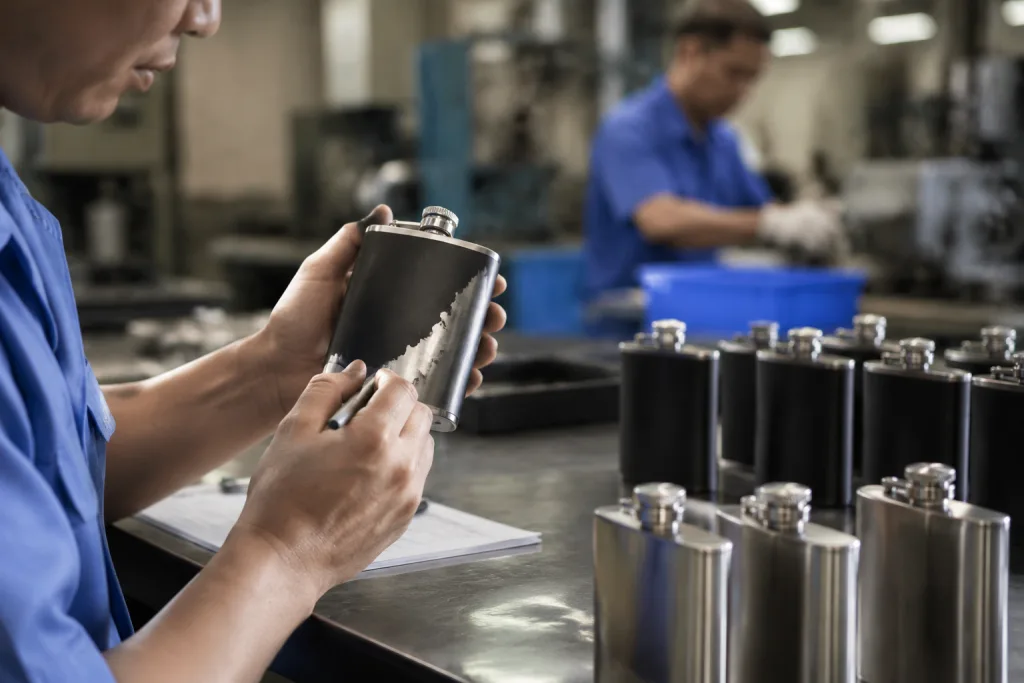
I’ll rewrite the section in place, keep every tag intact, and tighten the prose so it sounds like a factory-side sales engineer.Decoration is where a lot of canteen buyers get caught. A logo that looks clean on a white sample can fail after polishing, coating, or laser marking at production scale. On a powder-coated flask, silkscreen chips at the edge; on a vacuum-plated body, laser will hit the base layer if the depth is off. The real mistake is approving the artwork and skipping the process.
If you are buying custom drinkware for retail, put the decoration method in the contract: laser engraving, silkscreen, heat transfer, or pad print. For a customized canteen or customizable growler line, the process has to match the substrate, not the logo file. A brushed stainless surface takes laser well; glossy coated stock needs abrasion testing first. In our Hangzhou plant, we run about 120,000 units a month across drinkware lines, and QC pulled a batch last quarter because the logo depth drifted 0.08 mm after curing. That batch never should have left the line.
Ask for rub testing, alcohol wipe testing, and carton abrasion testing. If you are sourcing a canteen promotional item for trade shows, the product may only need a 6-12 month life. Even then, the print should hold through at least 50 alcohol wipe cycles without obvious fade. If your buyer wants a customized drinkware range with multiple SKUs, keep the decoration spec tight across the family; we’ve seen claims spike when one SKU uses matte black and another uses bright chrome. The math does not work if the print system changes every time the color changes.
Material Choice Changes the Claim Rate
I’ll rewrite the prose in place, keep the HTML exactly as-is, and tune the wording to sound like a factory-side sales engineer.Material mistakes show up after decoration problems, and the bill is higher. For stainless steel, 304 is the default on most export orders. 201 can cut cost by about $0.15 to $0.35 per piece, depending on the shape, but that saving disappears fast if you are building a premium line or selling to stricter retailers. If the flask is going into a custom growler-style promotion or a bar-gift program, corrosion resistance matters. We run repeat-wash checks on the line, and acidic liquids will expose weak metal fast.
For some custom drinkware programs, buyers try to fold a flask into a broader canteen custom collection. That only works if the use case stays tight. A flask for spirits, a canteen for water, and a growler for beer need different closures and liner specs. A canteen vendor should tell you if the inside is passivated, if the coating is food-safe, and if the adhesive meets REACH for Europe. We had a buyer flag a PO typo once because the lining code was off by one digit, and the whole carton was held.
Material specs should list gauge or wall thickness, not just capacity. A thin body can pass sample approval and still dent during palletization. For ocean freight from China to North America, we add carton compression and vibration tests before sign-off. On a 1.0 mm shell, we have seen the failure show up after a 12-day transit, while 0.8 mm units were fine in the showroom and ugly on arrival. A canteen supplier in Zhejiang should not argue with that; a real factory already has drop-test and pressure-test fixtures on site. If they cannot show you those tools, the price is the wrong question to ask.
MOQ, Lead Time, and Cost Reality
I’ll rewrite the section in place, keep the HTML tags intact, and tighten the sales-engineer tone with concrete shop-floor details and cleaner cost logic.Buyers usually ask price first, then ask why the line slips. That order causes problems. A clean quote should tie unit price to decoration steps, carton spec, and MOQ. For a plain 304 stainless flask with one logo and a standard box, we run 3,000 to 5,000 pcs per SKU. If you want two-color coating or laser plus print, MOQ moves to 5,000 to 10,000 pcs; the setup waste is real, and the math does not work below that.
Lead time on a custom drinkware order from a Zhejiang factory is usually 25 to 35 days after sample sign-off. If the job needs new tooling or a foam insert, add 7 to 12 days. We had a buyer flag a PO once because it said “gift box” but left out the insert size; QC pulled the sample, and the carton test failed by 3 mm. If a supplier promises 10 days for new artwork, new packaging, and full inspection, ask what got cut. It is usually curing time or carton control.
Cost should be judged as landed risk, not FOB alone. A flask at $1.42 FOB can end up costing more than a $1.55 FOB unit if the cheap one creates 4% rework, 2% freight damage, and retailer chargebacks. We saw this go sideways on a 12,000 pcs shipment: one tray spec mismatch turned into crushed corners and a second sort. North American buyers often watch piece price; European buyers watch compliance and pack accuracy. Both are valid, but the quote has to show defect exposure too.
If you also source a canteen distributor program or a broader distributor drinkware catalog, lock carton dimensions early. One carton that is 8 mm too wide can wipe out the savings from a lower unit price.
What to Demand Before PO Release
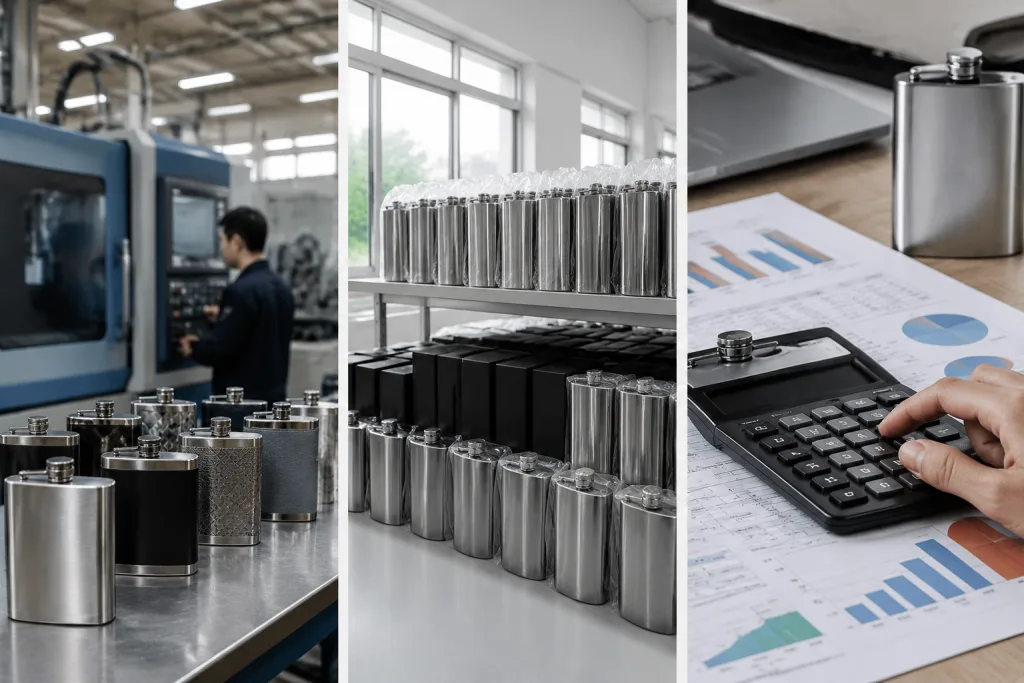
I’ll rewrite the section in-place style, keep every tag and list structure, and tighten the wording so it sounds like a real export-sales handoff.A PO is not paperwork. It is the document that keeps the sample, the line, and the buyer’s email thread aligned after approval. Before release, ask your canteen suppliers for a written spec sheet, pre-production sample photos, and the inspection standard in one file. Put in the dimensional tolerance, logo placement, finish code, and pack count. If you are buying through a canteen distributor or straight from a canteen manufacturer, demand the same detail.
Here is the minimum we put on the order:
- Material grade, wall thickness, and finish code.
- Capacity tolerance, usually +/- 5% unless your market wants tighter control.
- Leak test method, torque target, and hold time.
- AQL level for major, minor, and critical defects.
- Carton spec, drop-test target, and barcode placement.
For Europe, add REACH and, where it applies, food-contact paperwork. For North America, the carton and master case need space for FNSKU or retail labels without hiding warning text or artwork. A canteen distributors program built for retail should also say if replacement parts are in stock. We’ve seen a buyer flag a 2,000-piece shipment because 180 caps came in loose, and the math does not work if one missing cap turns into a write-off.
When a supplier pushes back on written standards, that is a red flag. They are running on memory, not export control. On our line, QC pulled the sample, checked the 0.3 mm wall callout against the PO, and sent it back before packing started. The stronger Zhejiang factories ask for the detailed PO first, then quote against it.
Picking the Right Supplier Type
I’ll rewrite this section in-place, keeping the HTML tags and structure intact while making the prose sound like a real factory-side sales engineer.Not every buyer needs the same partner. A canteen vendor that wins on low-cost promo orders may be the wrong fit for a premium retail flask. We’ve seen that go sideways on 5,000-piece runs. A canteen distributor can handle mixed SKUs and quicker local follow-up, but a direct canteen factory gives you tighter process control, private label consistency, and new mold work. If you need customized drinkware with several finishes, go direct to the factory unless your distributor has real QA authority on the line.
Think in terms of who owns what. A supplier should own production, a vendor should own fulfillment, and a distributor should own stock or regional access. If you are placing a custom canteen for a campaign, a canteen promotional partner can do the job. If you are building a branded line for repeat orders, ask whether the canteen manufacturers on your list have stable inspection records and repeat-order data. QC pulled one sample at 0.8 mm wall variance last month; that kind of miss tells you more than a bright sample room.
For buyers who want a broader assortment, use the same QC logic across a custom canteen, customizable drinkware, and customizable canteen lineup. The product mix can change, but the control points should stay the same. That is the wrong question to ask if someone says “just pick the cheapest source.” On export orders, we run the same checks on print position, cap torque, and carton count, because that is how you protect margin without turning every shipment into a fire drill.
Request a controlled flask quote today
Send your target capacity, finish, MOQ, and carton needs. We’ll quote the real production risk, not just the FOB number.
Frequently asked questions
What MOQ should I expect for suppliers alcohol flask orders?
For a standard stainless flask with one logo, expect 3,000 to 5,000 pcs per SKU from a serious canteen factory in Zhejiang. If you want multiple colors, gift boxes, or two decoration methods, MOQ often rises to 5,000 to 10,000 pcs because setup and scrap risk increase. Small trial orders are possible, but they usually cost more per unit and may not get the same production line attention. If the supplier quotes 500 pcs with full customization, ask how they will control coating, print consistency, and carton packing without inflating defects.
How do I reduce leakage risk on a custom alcohol flask?
Write the closure spec into the PO. Ask for thread type, liner material, and torque target, then require a leak test on every batch. A practical target is 0.8 to 1.2 N·m torque with a 30-minute inversion test. Also check cap flatness and seal compression; one weak point can fail the whole unit. For export orders, combine that with carton vibration and drop testing. If the supplier cannot describe the test method in writing, you are buying hope, not controlled production.
Is 304 stainless always necessary for custom drinkware?
Not always, but it is the safer default for an alcohol flask. 304 gives better corrosion resistance and a more defensible retail story than 201. In some low-price promotional programs, 201 can reduce cost, but the savings are usually modest and the claim risk is higher. For Europe, 304 is usually the cleaner choice when you want fewer questions about durability and surface behavior. If the product will be washed often or used in premium channels, I would not cut this corner.
What inspection standard should I require?
Use AQL 2.5 for major defects and 4.0 for minor defects as a common export baseline, then define critical defects separately. For an alcohol flask, critical defects include active leakage, cap failure, or unsafe burrs. Ask for pre-shipment inspection reports with sample size, defect photos, and carton counts. If the order is for Amazon FBA, make sure the supplier can apply FNSKU labels cleanly and keep barcode placement consistent. A good canteen supplier should not hesitate to share these records.
Can one supplier handle canteen custom and growler programs together?
Yes, if the factory has separate tooling and process control for each shape. A canteen custom line and a custom growler line may share stainless steel sourcing, but they do not share the same closure, wall profile, or packing requirements. A competent canteen manufacturer can manage both, yet you should still treat them as separate SKUs with separate QC points. If the supplier also acts as a canteen distributor, make sure they do not blur stock items with custom items. That is where mistakes happen.