Key Takeaways
- Specify Eastman Tritan grade, wall thickness 1.8-2.2 mm, and AQL 2.5/4.0 before quoting
- A practical MOQ for canteen customized Tritan bottles is 3,000 pcs per color for stable resin and color control
- Lead time is normally 25-35 days after sample approval, not after deposit if artwork is still moving
- Leak testing, drop testing, dishwasher claims, and carton compression must be written into the QC checklist
A supplier tritan water bottle project usually fails in boring ways: lids leak at 0.6 bar, logos scratch after 50 tape-pull checks, cartons crush under 18 kg stacking, or the “Tritan” resin is not the grade shown in the quotation. You will not catch this in a clean showroom. QC pulled one sample last month where the cap passed the buyer’s photo review, then failed on the line because the silicone ring was 0.4 mm too thin.
We manufacture custom drinkware in Hangzhou, Zhejiang, and we see the same 6 or 7 mistakes from Europe and North America every season. Tritan is a solid material when the spec is written tightly: clear, impact-resistant, BPA-free, and lighter than stainless steel. The wrong question is “can you make customized drinkware?” If your PO only says “customized drinkware, 750 ml, logo printed,” the factory has too much room to choose the resin grade, logo process, carton strength, and lid test standard for you.
The Resin Substitution Problem
The first failure is plain: the PO says Tritan, but the bottle body comes out of generic copolyester, PC, or a mixed resin that passes a quick visual check. We have seen this happen when a trading desk forwards “Tritan bottle” to a lower-cost canteen factory and the Eastman grade gets dropped from the Chinese spec line. Same damage. QC pulled one sample after 6 dishwasher cycles at 70°C and the body already showed haze near the shoulder radius; another batch carried a sweet plastic smell after 85°C hot filling. EU food-contact review will not care who made the typo.
For a supplier tritan water bottle order, write the resin as a purchase condition, not a nice-to-have line in the sales chat. Use wording such as: Eastman Tritan TX1001 or TX2001, BPA-free, no PC substitution, resin batch certificate required per production lot. If you approve equivalent material, define it with numbers: food-contact compliance, light transmittance target, Izod impact value, and dishwasher resistance at 70°C for 20 cycles. “Tritan-like” should never appear in a spec sheet. The math doesn't work when a buyer saves USD 0.08 on resin and then pays for 3 cartons of failed samples by DHL.
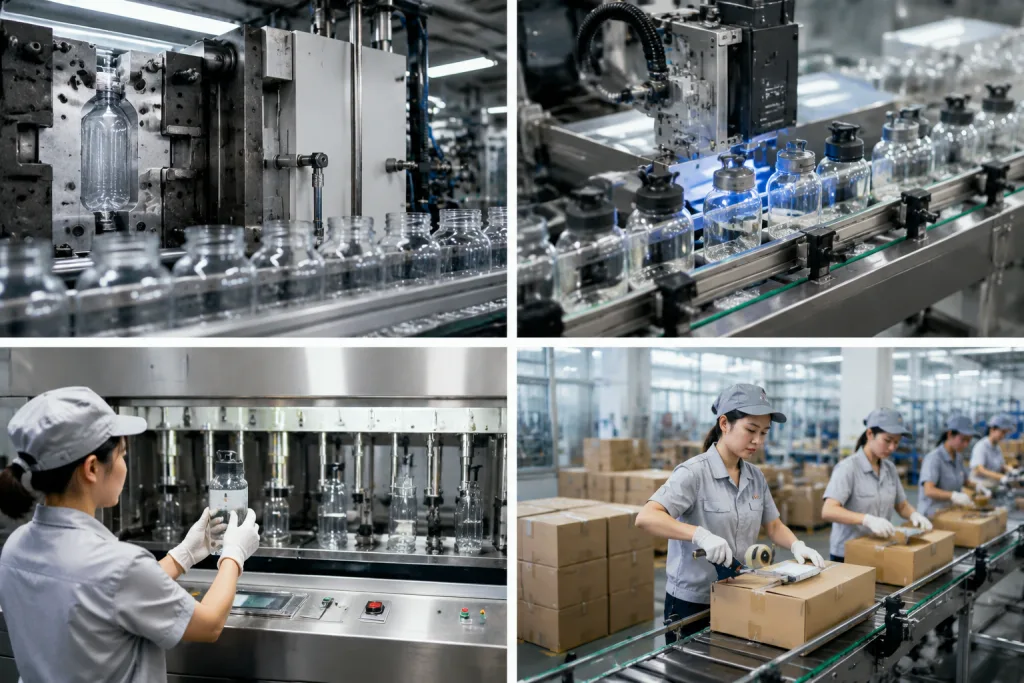
Ask your canteen manufacturer for the resin purchase invoice or batch COA before mass production starts. Serious canteen manufacturers in China will send it. We run resin traceability by injection batch at BottleForge Industrial in Zhejiang because our monthly Tritan and stainless drinkware capacity is about 420,000 units, and one wrong material bin beside a 280-ton injection machine can spoil a full color lot. On the line, the operator records resin lot number, drying temperature, and hopper change time; QC checks that log against the carton label before packing.
For EU buyers, request LFGB or EU 10/2011 food-contact testing on the final bottle, not only on raw resin pellets. For North America, ask for FDA food-contact declaration and, for children’s items, CPSIA-related checks where relevant. If your product is canteen promotional merchandise, testing can look heavy for a giveaway item, but this is the wrong question to ask. One campaign recall from 12 canteen distributors using the same printed logo costs more than 18 days of testing and 6 sealed samples sent to the lab.
Bottle Bodies That Warp
I’ll rewrite just the prose inside the existing HTML, keep the tags intact, and tune it to sound like a factory-side sales engineer. Then I’ll check for any banned phrasing and tighten the technical details.Tritan is tough, but it is not magic. Warping usually starts with weak mold cooling, uneven wall thickness, hard demolding, or a buyer sending us a shape that looks clean in CAD and fights the mold on the line. Tall flat panels cause most of the trouble. They sink, wave, or show flow marks. A custom canteen with a wide clear front panel is a bad bet if the wall drops below spec.
For most 500-1,000 ml Tritan sports bottles, we run body wall thickness at 1.8-2.2 mm, depending on the shape. At 1.6 mm, resin use is lower, but deformation risk goes up and the bottle feels thin in hand. At 2.4 mm and above, cycle time stretches, material cost climbs, and the bottle starts competing with stainless on weight. If you are developing a custom canteen or a custom growler shape, ask for a mold-flow review before you pay tooling. We’ve seen that save a 32-cavity job before steel was cut.
Do not approve the golden sample after checking only capacity and logo. Fill the sample with water, leave it at 50°C for 4 hours, then check base flatness, lid fit, and body ovality. If the bottle will be sold as dishwasher safe, define the test: 20 cycles at 70°C top-rack equivalent, then inspect haze, deformation, printed logo adhesion, and lid sealing. We had one buyer flag a lid as “dishwasher safe” on the PO, but the silicone ring and ink failed first, not the Tritan body.
Customizable drinkware projects also need tight tolerance control. A 0.3 mm thread variation can turn a good bottle into a leaking bottle. Put thread go/no-go checks into the inline QC plan, especially if your China supplier runs multiple cavities or two injection machines during peak season. QC pulled a sample once and found 1 of 6 caps sitting proud by 0.4 mm; that kind of miss is what sends claims back to sales.
Lids Leak Before Bodies Fail
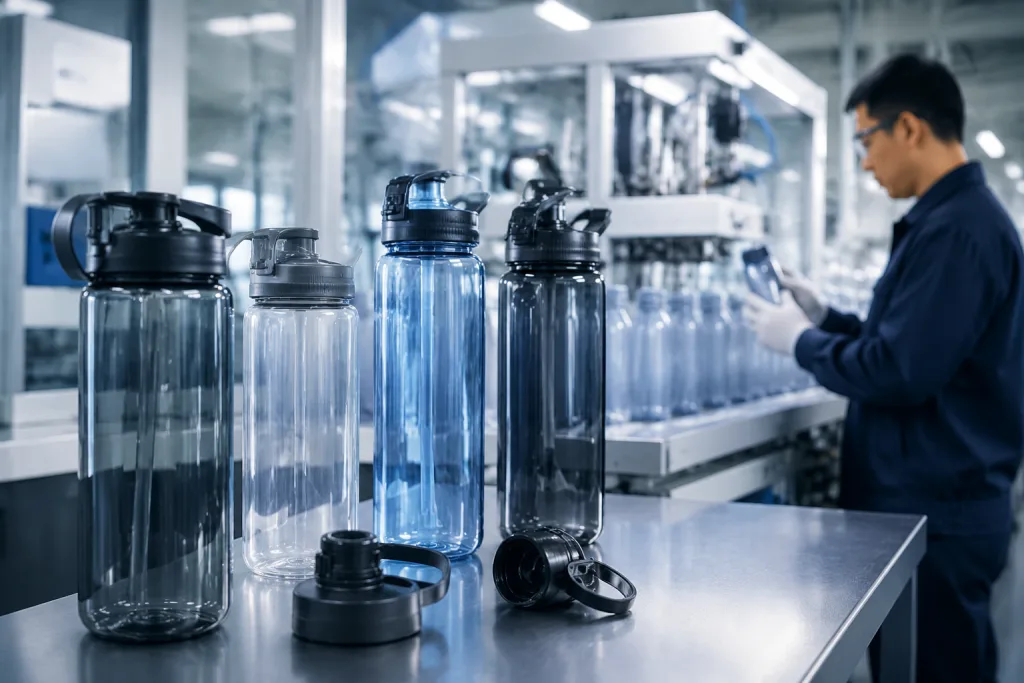
I’ll keep the HTML intact and rewrite the prose with tighter, buyer-facing language and factory-floor specifics. Next I’m checking the exact wording to preserve structure and then I’ll patch only the text inside the tags.Most complaints land on the bottle, but the lid is usually the weak point. Flip straws, push buttons, carry loops, silicone plugs, and gasket channels each add one more failure mode. We’ve seen 750 ml school bottles tip in backpacks all day and still fail at the cap, not the body. If your leak test is only “fill and shake for 5 seconds,” the math doesn’t work.
Write the leak test around the channel you sell into. For standard sports bottles, we run 100% water-fill inversion checks on the line and sample pressure or shake tests at final inspection. For a stronger B2B spec, say: fill to 95%, close the lid, invert for 30 minutes, then shake 20 cycles at room temperature; no continuous droplets allowed. If carbonation is part of the brief, Tritan is usually the wrong body unless the lid and wall are built for pressure. For a custom growler or customized growler, stainless steel is the safer pick when the buyer wants beer, kombucha, or sparkling drinks.
Gasket hardness matters. Silicone that is too soft rolls out of the channel; too hard and it will not compress evenly. Typical food-grade silicone gaskets sit around Shore A 50-60, but the right number depends on lid geometry and groove depth. Ask the canteen supplier to state gasket material, hardness, colorant, and whether replacement gaskets are in stock. For distributor canteen programs, a 200-piece spare-part bag cuts returns faster than another print option.
Button lids need cycle testing. A promotional bottle may pass 1,000 open-close cycles. A higher-grade retail bottle should hit 3,000-5,000 cycles. If you are a canteen distributor selling into outdoor, campus, or corporate wellness channels, do not greenlight an untested hinge just because the pre-production sample clicked cleanly on day one. QC pulled one sample apart last month and the spring pin had already worn at 1.2 mm.
Decoration That Looks Cheap
I’m rewriting this section in-place, keeping the HTML tags and tightening the sales-engineer tone. I’ll preserve the structure, add a couple of factory-floor specifics, and strip the AI-ish phrasing.Logo failure is the first thing buyers notice. The bottle can be structurally fine, but if the print scratches in a week, your customer sees a low-grade canteen promotional product. Tritan runs smooth and low-porosity on the line, so ink adhesion depends on pretreatment, ink type, curing, and artwork shape. Thin white lines, large solid blocks, and wraps over curved shoulders are where we see trouble.
For simple logos, silkscreen printing is the cheapest clean option and usually works on straight-wall bottles. At normal China factory volume, we quote about USD 0.08-0.18 per color per position, depending on coverage and registration. For photo-like artwork or gradients, heat transfer or digital printing is the better call, but QC pulled the sample and adhesion testing matters more. Laser engraving is not standard on clear Tritan bodies like it is on stainless steel, though it can work on some coated parts or accessories.
Every custom drinkware PO should spell out an adhesion standard. We run a 3M tape pull after full curing, then 50 dry-cloth rubs and 20 damp-cloth rubs. If you claim dishwasher resistance, test decorated samples after the same cycle count used for the bottle body. The buyer flagged it once: the bottle passed, the ink failed. That happens.
Color matching is another trap. Transparent colored Tritan shifts with wall thickness, resin batch, and lighting. Give Pantone as the target, then approve against a physical color chip or signed sample. For canteen customizable programs with six colors, lock a realistic tolerance before production. If you demand perfect color across different bottle shapes, lids, and silicone parts, the math does not work and shipment slips.
Cartons Break the Margin
I’ll rewrite the prose in-place, keep the HTML structure intact, and tighten the language so it reads like an export sales engineer wrote it.Packaging looks minor until it blows the margin. Tritan bottles are light, so buyers cut carton specs too far. Then the shipment gets hit by ocean freight, truck transfers, warehouse stacking, and parcel drops. We’ve seen a crushed master carton bend lids and scuff bottles fast. Amazon receiving hates that, and so do retail DCs. One buyer flagged 3% dented caps after a 40HQ landed with weak board.
For export cartons, spec 5-ply corrugated board on most bottle orders and ask the supplier to confirm edge crush strength or burst strength in writing. A 24 pcs carton for 750 ml bottles may only run 7-9 kg, but a warehouse stack at 6 layers will still crush soft board. If the bottle ships with a gift box, lock down paper weight, flute type, and a 60 cm drop test. For FBA, check FNSKU label placement, suffocation warnings for polybags where needed, and carton weight under the marketplace limit. If the PO says “carton as usual,” send it back. That typo costs money.
Inner protection depends on finish. Clear Tritan bottles scratch when they rub against caps, handles, or printed panels during vibration on the line. For a premium customized canteen, we run individual OPP bags or tissue wrap, then add separators if the shape has a protruding handle. For a low-cost canteen promo run, bulk packing is fine, but the scuff limit needs to be approved in writing. QC pulled the sample after a 12-hour shake test and the print still marked the bottle edge.
Do not let the factory set carton dimensions after production starts. Carton size changes CBM, FOB cost split, and how the distributor stores stock. A canteen manufacturer in Zhejiang or another China production hub should give you carton CBM during quotation. If they cannot, the math does not work. They are quoting from a photo, not from a BOM.
QC Plans Written Too Late
I’ll rewrite the section in-place, keep the HTML exactly as-is, and tighten the prose so it sounds like a real factory-side sales engineer.The worst time to talk QC is after the factory says the goods are finished. By then, every defect costs real money. Rework holds the vessel, replacement parts need fresh resin or a new color masterbatch, and sales already told the buyer the ship date. The QC plan belongs in the quotation stage, especially for customizable canteen and distributor growler programs with 4, 8, or 12 SKUs.
Use AQL on the PO, not in a vague email. A common setup for drinkware is AQL 2.5 for major defects and 4.0 for minor defects, with critical defects at 0. Critical defects mean unsafe material, sharp edges, contamination, and severe leakage. Major defects mean lid leaks, wrong capacity beyond tolerance, logo position off by more than the agreed limit, missing accessories, and cracked bodies. Minor defects mean small cosmetic marks within the approved limit. If you do not define this, the canteen vendor defines it for you. We’ve seen that go sideways on a PO with “logo centered” typed in as a note.
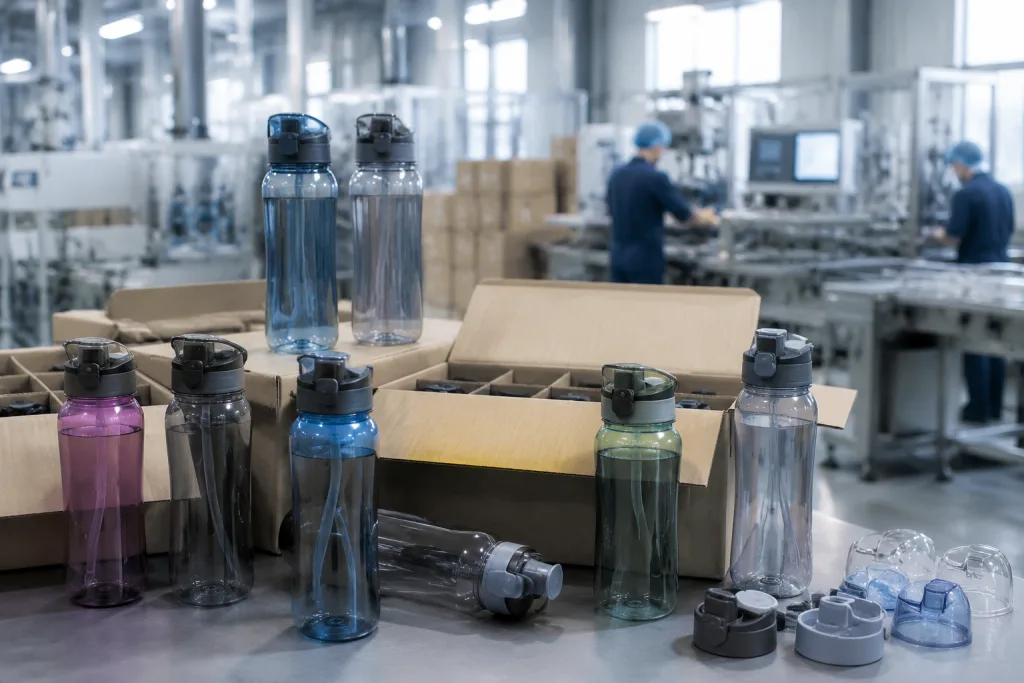
Pre-shipment inspection should cover capacity check, weight check, barcode scan, lid torque or fit check, leak test, logo adhesion, carton drop or compression review, and packing count. For a 10,000 pcs order, pulling 20 pcs is a joke. Use ISO 2859-1 sampling or a similar plan, and make sure the inspector opens cartons from different pallet positions. QC pulled a sample once from the top layer only, and the buyer flagged the missed leak at unpacking.
Our normal MOQ for supplier tritan water bottle orders is 3,000 pcs per color for existing molds and 10,000 pcs for private mold development. Standard lead time is 25-35 days after sample approval and packaging confirmation. If a canteen supplier promises 12 days for a new customized drinkware project during peak season, ask which QC steps they plan to skip. The math does not work, and the line cannot hold a 12-day promise with full inspection, carton testing, and packing confirmation.
Send your Tritan bottle spec for factory review
We will check resin, mold risk, decoration method, MOQ, lead time, and QC points before you commit to a production order.
Frequently asked questions
What MOQ should I expect from a supplier tritan water bottle factory?
For existing molds, a realistic MOQ is 3,000 pcs per color for Tritan bottles because resin drying, color matching, injection setup, and decoration fixtures all need stable volume. Some canteen suppliers may quote 1,000 pcs, but the unit price is usually higher and color consistency can be weaker. For a new private mold, expect 10,000 pcs or more for the first production run, plus tooling cost. At our Zhejiang facility, sampling normally takes 7-12 days after artwork confirmation, and mass production runs 25-35 days after sample approval.
How do I verify the bottle is real Tritan and not cheaper plastic?
Ask for the resin grade in the quotation and PO, then request a batch COA or resin purchase record before production. The spec should name Eastman Tritan TX1001, TX2001, or another approved grade, not just “BPA-free plastic.” For EU orders, test the finished bottle to EU 10/2011 or LFGB where your market requires it. For North America, keep FDA food-contact documentation and consider CPSIA if the product targets children. A reliable China canteen manufacturer should accept third-party testing before shipment.
Can Tritan bottles be dishwasher safe with custom logos?
They can be, but only if the whole system passes testing: Tritan body, PP or Tritan lid, silicone gasket, ink, and curing process. Do not accept a general “dishwasher safe” claim. Specify the test, such as 20 cycles at 70°C top-rack equivalent, then inspect body haze, deformation, leakage, and logo adhesion. Silkscreen logos may pass if the ink and pretreatment are correct, but large prints and metallic inks are riskier. For promotional canteen orders, many buyers choose hand-wash labeling to avoid unnecessary returns.
What defects should be classified as major in AQL inspection?
For Tritan custom drinkware, major defects should include leakage, cracked body, wrong material, wrong capacity beyond agreed tolerance, failed logo adhesion, missing straw or gasket, wrong barcode, incorrect carton count, and serious color mismatch. Minor defects can include small scuffs, slight flow marks, or tiny print specks if they fall within an approved sample limit. Use AQL 2.5 for major defects and 4.0 for minor defects as a practical starting point. Critical defects, such as contamination or sharp edges, should be set at 0.
Is Tritan suitable for a custom growler or distributor growler program?
Tritan works for non-carbonated cold drinks, infused water, and lightweight outdoor bottles, but it is usually not the best material for beer, kombucha, or sparkling beverages. Pressure changes can stress the lid and thread system, and buyers may expect insulation that Tritan does not provide. For a custom growler or customized growler used with carbonated drinks, stainless steel is normally safer and more durable. If you still want a Tritan-style large bottle, define it as non-carbonated use only and test lid sealing at full capacity.