Key Takeaways
- Plan around 3,000 pcs MOQ for standard Tritan bottles and 8,000-10,000 pcs for private mold work
- Ask for BPA-free Tritan resin traceability, REACH/LFGB test options, and AQL 2.5/4.0 inspection terms
- Laser, silk screen, heat transfer, and full-wrap print have different setup costs from USD 45-180 per color or plate
- Typical lead time is 25-35 days after artwork approval for standard models from Zhejiang, China
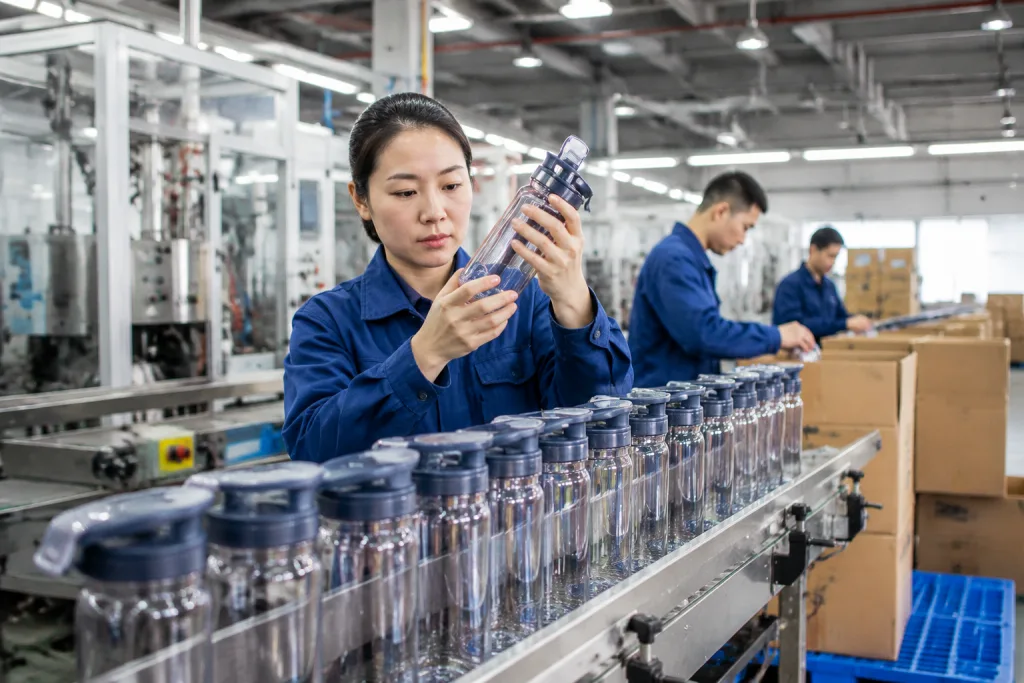
If you are comparing a supplier Tritan bottle for a retail program, school canteen promotion, or distributor drinkware line, finding a factory is the easy part. On Alibaba alone, a buyer can shortlist 40 sellers in one afternoon. The harder job is choosing the bottle wall thickness, cap seal, print method, compliance files, and order plan that still make sense after sea freight, FDA or LFGB testing, and 3% rework allowance. We have seen this go sideways when QC pulled the sample and found a 0.35 mm parting line flash on the lid, then the buyer asked why the “cheap” quote no longer looked cheap.
At BottleForge Industrial in Hangzhou, Zhejiang, we see buyers lose 7 to 12 days when they start with Pantone color and logo size first. Wrong question. Start with four decisions: Tritan grade, cap system, branding process, and packing route. For example, a school canteen order with 6,000 pcs, 1-color silk screen, and 24 pcs per master carton runs differently from a retail gift set with barcode labels and drop-test packing. A good canteen supplier should show these trade-offs before sending a low FOB China price that the line cannot hold.
Start With The Bottle Job
A supplier Tritan bottle quote should start with the bottle job, not a catalog screenshot. Tritan is a copolyester we choose for clear walls, lower breakage risk than glass, and cleaner taste than cheap plastics after hot-water rinse. It is not the budget resin. If the buyer needs a 7-day event giveaway, PP often wins. If the bottle sits on a retail peg, carries dishwasher wording, or goes into a school tender, Tritan earns its cost. On our line, QC checks first-shot clarity against a 2 mm wall sample under the light box before we even talk about logo position.
We sort projects by selling job. canteen promotional use means a short campaign, loud logo, polybag or white box, and a buyer pushing back on every USD 0.03. custom drinkware retail needs tighter Pantone control, smoother cap torque, barcode labels, and cartons that survive the drop test. distributor canteen stock is different again: fewer SKUs, repeat POs, stable replacement caps, and carton marks the warehouse can scan without opening 40 master cartons. This is where we have seen orders go sideways: the PO says “blue,” the approved sample says PMS 2925C, and the carton artwork says navy.
For a standard 600-750 ml Tritan bottle, our Hangzhou, Zhejiang line normally runs 300,000 units/month across plastic bottle formats. A realistic MOQ is 3,000 pcs per color for existing shapes. If you ask for a canteen customized body, new lid tooling, or exclusive embossing, expect 8,000-10,000 pcs and tooling from USD 1,200 to USD 6,500 depending on cavities and cap complexity. The math does not work for 500 pcs with a private mold; the CNC shop still charges for steel, EDM time, and mold trial shots.
Do not hide the sales channel from your canteen manufacturer. Amazon FBA, supermarket retail, sports club resale, and corporate gifting need different control points, from FNSKU label size to outer-carton weight and claim wording. We ship these differently. For one FBA order last quarter, the buyer flagged a 6 mm label shift because the barcode sat too close to the carton seam. A canteen vendor who quotes without asking the channel is quoting the bottle only, not the delivered product you need.
Choose Material And Wall Thickness
I’ll rewrite this section in a supplier-side voice, keep the HTML exactly as-is, and make the claims tighter with concrete factory-floor detail.Tritan bottles get sold as “BPA-free” all the time, but that is not enough for a B2B order. Ask for the resin brand, the exact grade, food-contact test records, and whether the supplier can show EU REACH, LFGB, or US FDA documents. For kids’ programs or school canteens, we also check physical safety and migration data based on the target market. On our side, QC pulled the sample once because the resin COA did not match the PO; that is the kind of miss that causes trouble later.
Wall thickness is where the math shows up. A 0.9-1.1 mm wall cuts resin weight and FOB cost, but the bottle can feel soft, dent under hand pressure, or warp after hot washing. A 1.2-1.6 mm wall is the range we usually see for retail and distributor drinkware that needs to survive daily use. For 1,000 ml bottles, we look at sample weight, drop test results, and cap torque together; chasing the lightest gram count is the wrong question to ask. We have seen the line pass a thin sample that looked fine, then fail after a 1.2 m drop test.
Temperature claims need discipline. Tritan handles hot water better than basic plastics, but it is not a vacuum-insulated steel thermos. If your copy says “boiling water safe,” test the whole build, not just the body. Caps, seals, straws, and print can fail first. A buyer once flagged a PO typo that said 100°C safe on the bottle spec sheet, and the issue was not the Tritan at all—it was the silicone lid insert softening at 95°C.
If you want a sustainability angle, be specific. “Reusable” is a clean claim when the bottle is built for repeated use. “Eco” is too loose and can cause legal headaches. Some buyers ask for recycled-content Tritan-like materials, but supply, clarity, and certificates are inconsistent. For Europe, claim control matters as much as material choice. A practical factory in China should tell you which claims we can back with paperwork and which ones we will not print. We ship that way because the buyer will ask for proof on day one, not after the carton is packed.
Decide The Cap Before The Logo
I’ll rewrite the section in-place, keep the HTML exactly as-is, and tune the sales tone so it sounds like a factory-side buyer guide.Most complaints on Tritan bottle orders come from the lid, not the body. Leakage, weak flip buttons, poor straw fit, loose silicone rings, and broken handles show up fast. We’ve seen a canteen customizable project pass photos and still turn into a return headache after 30 days of use because the cap was built too cheap.
Pick the cap system from real user behavior. Screw caps hold up well and clean fast, but they slow down sports use. Flip lids are easy to open, but the spring and button need cycle testing on the line. Straw lids sell well in school and fitness channels, yet the straw, bite valve, and vent hole need extra hygiene and leak checks. Wide-mouth lids make ice loading and washing easier, while narrow-mouth designs cut spill risk when people drink on the move.
For custom canteen work, ask your canteen manufacturer for these checks before mass production:
- Leak test at 30-60 minutes with the bottle inverted and shaken.
- Cap torque range, usually agreed in kgf·cm or N·m.
- Silicone ring hardness and replacement availability.
- Drop test from 80-100 cm on filled samples, if your channel needs it.
- Spare parts policy for caps, straws, and gaskets.
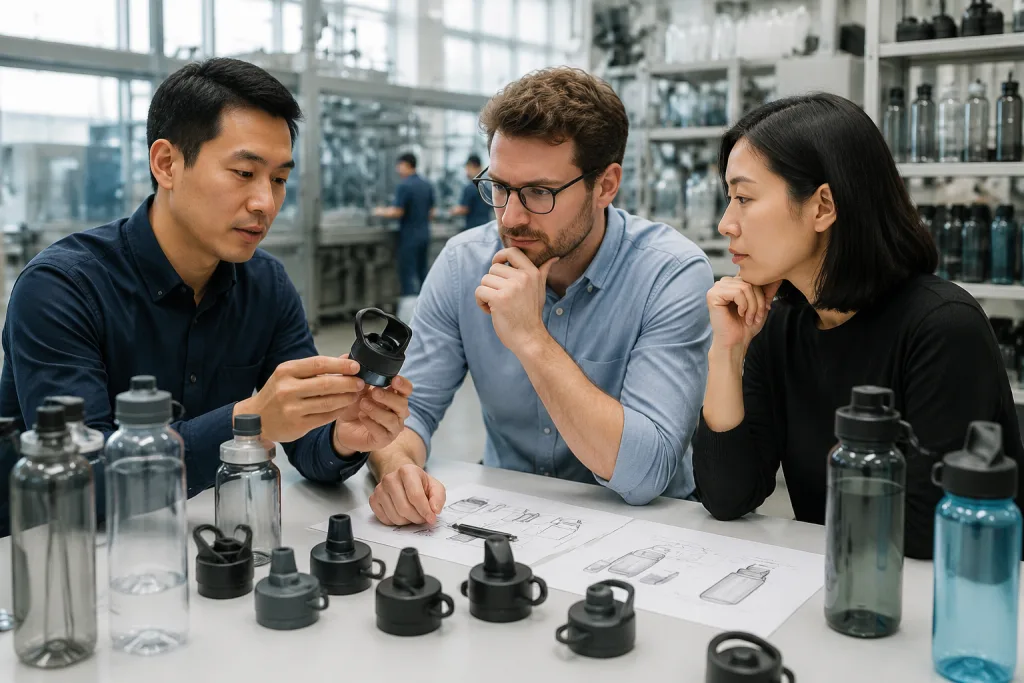
Cap color matching needs care too. Tritan body, PP cap, silicone ring, and nylon strap do not take pigment the same way. If your brand color is strict, approve a physical color chip under D65 light, not just a screen rendering. We run into this all the time: a buyer flags a “same color” sample, and the issue is a 1.5 mm visual shift on the silicone ring. A serious canteen vendor in Zhejiang will ask for Pantone references and still tell you plastic-to-silicone matching has visible tolerance.
Match Decoration To Order Risk
I’ll rewrite the four paragraphs to sound like a real factory sales engineer, keep the HTML intact, and inject a few concrete shop-floor details without changing the headings or tag structure.Branding choice should follow order risk, not personal taste. For a simple canteen promotional bottle, one-color silk screen is still the safest call. We run setup at USD 45-80 per color, and the unit price stays low if the surface is clean and the logo lines are not hair-thin. On the line, we reject more jobs for bad artwork than for bad machines.
Laser engraving is common on stainless steel, not on Tritan. On clear plastic, the mark can come out soft or cloudy, and some buyers flag it as looking unfinished. Pad printing fits curved cap parts, small icons, and measurement marks. UV printing can carry multi-color art, but adhesion testing is mandatory—QC pulled a sample after the 3M tape test failed on one lot, and that lot never shipped.
If you are building a canteen customized or customized growler-style plastic program, lock the artwork early. A 360-degree wrap may need a flatter print zone, registration marks, and a wider artwork tolerance. A bottle with deep ribs, raised measurement marks, or tight curves cuts into the print area fast. Your canteen supplier should give you a dieline with the maximum logo size in millimeters, not a vague “logo can be customized”; we have seen PO typos turn 68 mm into 86 mm, and the math does not work.
For distributor growler or customizable growler requests, check the capacity wording. Some buyers use growler for any large bottle, but in beverage retail it often points to beer or carbonated liquid use. Tritan bottles are not meant for pressurized carbonation unless the structure is built and tested for it. If you need a customized growler for still drinks, say that in the brief and keep the spec tight at the MOQ stage.
Price The Whole Landed Program
I’ll rewrite the section in-place, keeping the HTML tags and the quoted numbers intact while making the copy sound like a real factory-side sales engineer.The lowest FOB bottle price rarely wins once you add packaging, inspection, freight, and replacement risk. A normal 650 ml Tritan sport bottle from a China canteen factory may quote around USD 1.35-2.40 FOB Ningbo or Shanghai, depending on wall thickness, cap type, logo process, and packing. On our line, a switch from bulk pack to a printed color box can add USD 0.12-0.45 per unit, and the extra carton step pushes lead time by 2-4 days.
Ask each canteen vendor to quote the same spec sheet. We’ve seen buyers compare one supplier running 1.0 mm walls with bulk packing against another shipping 1.4 mm walls in individual color boxes. The math does not work. That is a spec gap, not a price gap. QC pulled one sample at 980 g and another at 1,120 g, and the buyer flagged it only after the PO typo left out the cap code.
For distributor canteen and distributor drinkware programs, warehouse handling matters. We usually run 24 or 36 pcs per export carton for mid-size bottles, with carton weight held under 15 kg when we can. If you sell through Amazon or 3PL warehouses, check carton dimensions, scannable FNSKU placement, suffocation warnings on polybags, and whether mixed-color cartons are allowed. A canteen distributor often saves more by cutting receiving errors than by chasing USD 0.03 off the bottle.
Payment terms change the risk profile. For a new buyer, 30% deposit and 70% before shipment is standard in China. For repeat orders, terms can improve once volume stays stable and payment stays clean. If a canteen manufacturer gives loose terms on the first order, ask what they are hiding in the resin batch, the cap mold, or the cash flow.

Audit Quality Before Production
I’ll rewrite the section in-place, keeping the HTML tags and tightening the sales-engineer tone. I’m also checking that the prose gets more specific and less generic, while preserving the exact structure.Quality control should be locked before deposit. Put AQL terms in the purchase order, not loose phrases like “good quality.” For Tritan bottles, we run AQL 2.5 for major defects, 4.0 for minor defects, and 0 for critical defects. Critical defects are sharp edges, cracked bodies, dirty interiors, serious leakage, wrong material, or bad food-contact labeling.
Pre-production samples are not enough. You need an approved golden sample, sealed color chips, and a written defect list. We had a buyer flag a “small” logo issue on a 1.8 mm font, and the line turned that into a dispute fast. If the bottle uses a straw lid, put assembled and disassembled photos in the standard. If the print has fine text, set the minimum readable height at 1.5-2.0 mm, depending on the print method.
Factory credentials matter, but certificates are not a free pass. BSCI, ISO 9001, and Sedex-style audits show process control, yet the order still needs incoming material checks, in-process inspection, and final random inspection. On the floor, we do not release mass production until artwork is signed, Pantone color is confirmed, and packing is approved. Standard lead time is 25-35 days after approval; rush orders under 20 days usually need fewer color options and existing components.
If you use third-party inspection, book it early. Inspectors need the packed goods stage, not loose bottles waiting for caps. For custom canteen orders, the check should cover carton markings, barcode scan, logo position, cap function, leak test, odor check, and quantity count. QC pulled one sample at AQL 2.5 and caught a 2 mm cap gap that would have gone straight into a claim. The inspection fee is small next to one container of unsellable custom drinkware.
Build A Supplier Scorecard
I’ll rewrite the section in place, keep the HTML structure intact, and tune the prose to sound like a buyer-facing factory note with concrete shop-floor detail.When you compare canteen manufacturers or canteen vendors, score them on evidence, not presentation. A solid supplier tritan bottle partner answers technical questions straight: drawing PDF, resin grade, cap cycle data, MOQ, sample fee, packing spec, and a shipment date the line can actually hit. We’ve seen a buyer flag a PO because the cap color was typed as “white” instead of `PMS 7541 C`; that kind of typo turns into a delay fast.
Use a simple scorecard before you place the first PO. Weight material compliance, cap reliability, decoration fit, lead time, price transparency, and reply speed. If the program is for children, safety papers and cap testing beat FOB price. If you are a canteen distributor building a replenishment line, mold ownership, spare cap supply, and color repeatability matter more than a pretty first sample. The math is clear.
Watch the supplier who says yes to everything. A reliable canteen supplier will push back when your artwork is too large for the curve, when a clear color will not match a solid Pantone chip, or when your ship date collides with tooling lead time. We run that check on the line with a 0.2 mm gauge and a drop test jig; QC pulled one sample last month because the lid still opened at the wrong angle. That pushback helps. It means the factory is thinking about mass production, not just chasing the deposit.
For your RFQ, send one clean document: capacity, quantity, target market, compliance needs, logo files, packaging, shipment terms, inspection terms, and target delivery date. If you are also sourcing a custom growler, customizable canteen, or customized drinkware family, state whether the bottles need shared caps, shared cartons, or matching colors. That is where a China supplier can cut tooling and purchasing mess instead of treating each item as a separate job.
Send Your Tritan Bottle RFQ For Engineering Review
Share quantity, market, logo files, compliance needs, and packing plan. We will return a practical China factory quote, not a vague catalog price.
Frequently asked questions
What MOQ should I expect from a supplier Tritan bottle factory?
For an existing Tritan bottle mold, expect around 3,000 pcs per color as a workable MOQ. Some canteen suppliers may accept 1,000-2,000 pcs for stock colors, but unit price and logo setup cost will be higher. For a canteen customized body, new cap, embossed logo, or exclusive shape, 8,000-10,000 pcs is more realistic because tooling, color setup, and line changeover need volume. At our Zhejiang, China facility, standard repeat orders can move faster when the color, cap, and packing are unchanged. If your launch quantity is small, start with an existing bottle and customize logo, sleeve, or color box before paying for private tooling.
Is Tritan better than stainless steel for custom drinkware?
It depends on the job. Tritan is clear, lightweight, and useful when the buyer wants visible water level, lower breakage risk than glass, and a lower price than double-wall stainless steel. A 650 ml Tritan bottle may quote around USD 1.35-2.40 FOB, while a vacuum stainless bottle usually costs more because of welding, vacuum testing, and powder coating. Stainless is better for hot/cold insulation and premium gifting. Tritan is better for school canteen, fitness, and retail hydration programs where clarity and weight matter. A good canteen manufacturer should not force one material; it should explain the trade-off.
Which logo method works best on Tritan bottles?
For most custom canteen orders, one-color silk screen is the safest balance of cost and durability. Setup is usually USD 45-80 per color, and the print works well on simple curved areas. UV printing is better for multi-color logos, but you should require tape and rub testing. Heat transfer works for larger graphics and retail looks, though setup can reach USD 120-180 depending on artwork. Laser engraving is not usually the first choice for clear Tritan because the mark can be faint. Ask your canteen vendor for a print area drawing in millimeters before approving artwork.
What compliance documents do canteen distributors need?
For Europe, ask about REACH, LFGB food-contact testing, and packaging requirements. For North America, FDA food-contact suitability and, when relevant, ASTM-style physical safety checks may matter, especially for kids products. You should also request BPA-free material declaration, resin traceability, and recent test reports for similar Tritan items. If you sell through large retailers, they may ask for BSCI, ISO 9001, or social audit documentation. Do not assume one certificate covers every market. A distributor canteen program shipping to both the EU and US should define the strictest required standard before mass production.
How long does a customized canteen order take?
For an existing Tritan bottle with a custom logo and standard packing, 25-35 days after artwork, color, and sample approval is a normal production window in China. Add 7-10 days for pre-production sampling if color matching or new decoration is involved. Private mold projects can take 45-75 days before mass production because drawings, tooling, trial shots, and corrections are needed. Ocean freight to Europe or North America can add 25-40 days depending on port and season. If your deadline is fixed, choose existing caps, existing colors, and carton packing that the factory already runs.