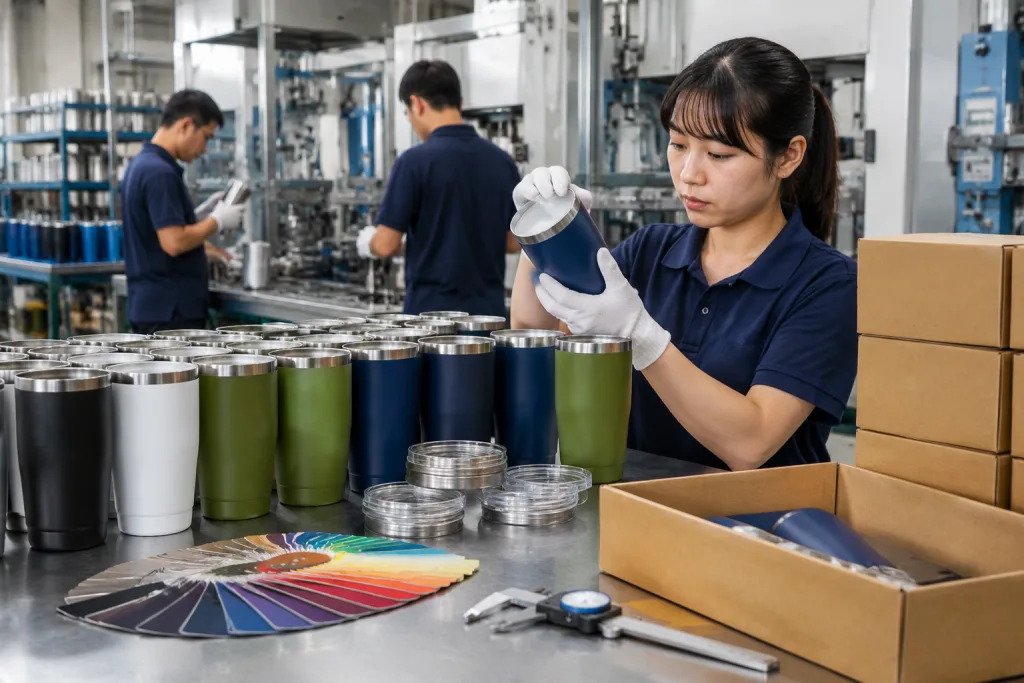
Key Takeaways
- For most coffee brands, 16 oz and 20 oz double-wall 304 stainless steel tumblers cover 70% of reorder demand
- A practical MOQ is 1,000 pcs for one color and one logo method; lower MOQs usually raise unit cost by 12-25%
- Laser engraving is safer for dishwasher claims, while silk screen and UV print work better for multi-color promotional art
- Normal production lead time from Zhejiang, China is 30-40 days after sample approval and deposit
If you buy for a coffee brand or a corporate-gift program, finding a supplier travel tumbler is the easy part. The harder job is choosing a cup that survives 300 dishwasher cycles in real use, prints a 45 mm logo without pinholes, passes retail compliance, and still lands at a price your sales team can explain without discounting on day one.
At our Hangzhou, Zhejiang factory, we see 7 out of 10 new buyers start with the wrong question: “What is your lowest price?” The math doesn't work until the product decisions are fixed. We run different cost sheets for lid structure, powder coating, laser or silk-screen logo, 24 pcs carton packing, and FDA or LFGB testing; last month QC pulled a sample because the lid gasket sat 0.4 mm proud and leaked after the drop test. China can make almost any bulk travel tumbler, but samples only mean something after the spec is locked.
Start with four buying decisions
I’ll rewrite the four paragraphs to sound like a real sales engineer, keep the HTML intact, and strip the AI-ish phrasing.A solid supplier travel tumbler project starts with four buying decisions, not a catalog page. First, pin down the use case: hot coffee commute, office desk, event giveaway, retail shelf, or employee welcome kit. A bulk coffee mug for a café launch has a different spec than a premium corporate onboarding gift. The café watches reorder stability and coffee aroma; the gift buyer checks presentation, logo accuracy, and ship date.
Second, choose the body format. Straight-wall tumblers look clean and stack well on the line, but they do not fit every car cup holder. Tapered 20 oz travel tumblers fit more holders, but the print band near the base gets tight fast. A handle adds value in the buyer’s eye, yet it also adds carton volume and freight cost. If you are comparing a bulk coffee travel mug against a bulk coffee tumbler, ask whether the handle solves a real user problem or just makes the box bigger.
Third, lock the lid. Slider lids cost less and feel familiar, but they are splash-resistant, not leakproof. Flip lids with silicone plugs seal better, though they add parts and QC needs to watch the plug fit. For coffee mug promotional products, a basic slider lid usually gets the job done. For retail private label, the buyer wants a stronger sealing claim and a cleaner leak test result.
Fourth, set your compliance level before you ask for price. If you need LFGB, REACH, FDA food-contact documentation, Prop 65 review, or a BSCI-audited facility, say it up front. A coffee mug factory direct quote without test requirements is not the same quote as one that includes third-party lab testing, AQL inspection, and export cartons built for 30 days on the water.
Choose construction before decoration
I’ll rewrite just the prose, keep every tag intact, and sharpen it into supplier-side language with concrete factory details and cleaner sales-engineer tone.For a serious coffee mug custom program, construction beats artwork every time. We run most travel tumblers with 304 stainless steel inside and outside, then vacuum seal the gap between the walls. Some buyers push for 316 stainless steel because it sounds premium. Fine for salty or acidic use, but for normal coffee, 304 stainless steel with proper passivation is the practical call.
Wall thickness changes dent resistance and the hand feel. A common spec is 0.4-0.5 mm for the inner wall and 0.5-0.6 mm for the outer wall. If a quote looks too cheap, ask the coffee mug manufacturer for the actual gauge, not just the material grade. We’ve seen 0.35 mm outer walls pass sample approval and then fail in carton drops at 80 cm.
Insulation claims need real test data. A 20 oz double-wall tumbler may hold water above 60°C for 4-6 hours in a controlled room-temperature test, but milk coffee drops faster because it starts cooler and gets opened more. Do not buy a 24-hour hot claim without a curve. For cold drinks, 12-18 hours is a normal range for vacuum tumblers, depending on lid design and ambient temperature.
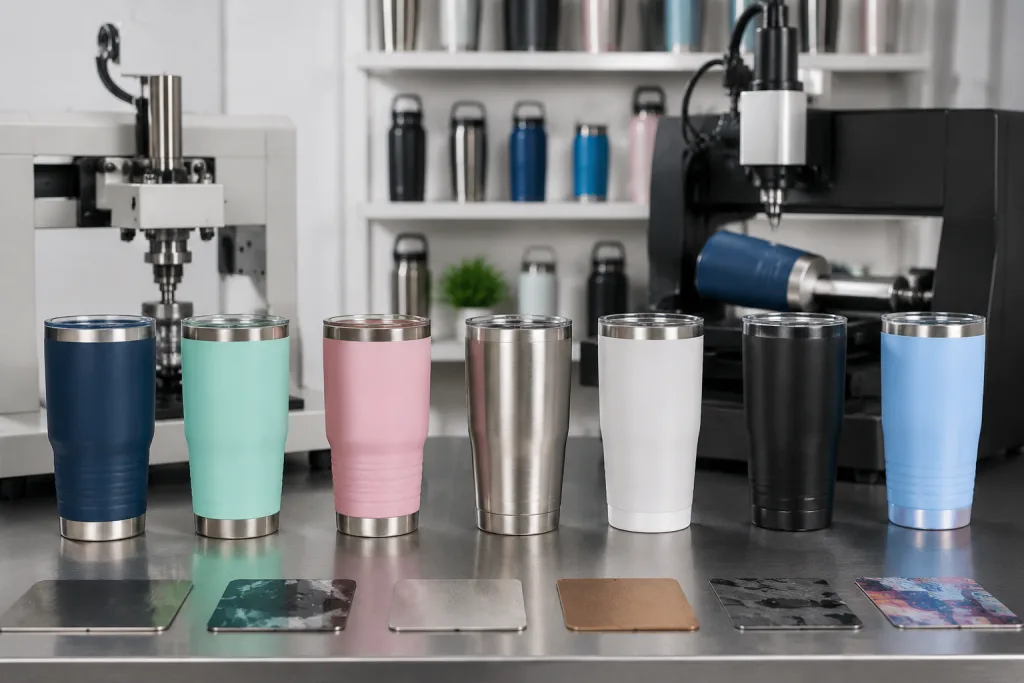
Coating is the other call. Powder coating gives a matte grip and better scratch resistance, and it usually adds USD 0.25-0.55 per piece over plain stainless steel. Spray paint costs less and gives brighter color, but it marks up faster on the line and in retail handling. For coffee mug custom made retail projects, powder coating is usually worth it. For a 3,000-piece event giveaway, spray paint is enough if the buyer accepts the trade-off.
Match logo method to usage
I’ll rewrite the section in place, keep the HTML tags intact, and tighten the sales-engineer voice with concrete shop-floor details.Your logo method should match the tumbler’s real use. Laser engraving burns off the coating and shows the stainless steel below. It holds up, stays clean, and fits one-color logos, names, or 200-piece personalization runs. For executive gifts or loyalty programs, we run engraving first unless the buyer wants a color hit.
Silk screen printing works for simple one- or two-color artwork. It fits a bulk travel mug for conference giveaways, café merch drops, or staff campaigns. The catch is curve and registration. On a tapered tumbler, a 230 mm wrap can drift if the supplier does not set the right jig and print fixture. We have seen buyers flag a PO because the logo sat 3 mm off center.
UV printing covers full-color logos, gradients, and busy promo art. It suits coffee mug promotional jobs where brand color cannot move. The trade-off is cost and wear. UV prints can pass tape and abrasion checks, but they are not engraving. If you want dishwasher-safe wording, spell out the cycle count: 30 cycles, 50 cycles, or 100 cycles. A vague claim is how complaints start.
For premium coffee mug private label programs, mix methods if the budget supports it: laser logo on the front, printed batch message on the back, and a custom lid accent. Each extra step adds setup time and one more QC stop on the line. At BottleForge Industrial in Zhejiang, we ask buyers to approve a pre-production sample with the final logo, final coating, final lid, and final packaging before mass production. A blank sample only checks shape; it does not prove decoration. That is the wrong question to ask.
Read pricing like a factory
I’ll rewrite the section in place, keep the HTML structure intact, and tighten the pricing language so it sounds like a factory-side sales note.When you compare a coffee mug supplier list or a coffee mug supplier directory, the lowest FOB number is rarely the full story. A quote for a 20 oz vacuum travel tumbler may land at USD 3.20 or USD 6.80 FOB Ningbo or Shanghai, depending on steel gauge, coating, lid parts, logo method, packaging, and inspection. If two prices are 30% apart, the spec changed somewhere.
Ask every coffee mug supplier to quote against the same sheet: capacity, steel grade, wall thickness, lid material, coating, logo size, logo method, individual box, carton quantity, test standard, AQL level, Incoterm, and lead time. We run this check on the line with a caliper and a lid sample before we release samples. Without that, you are comparing sales talk, not products.
MOQ is where buyers get burned. On our Hangzhou line, the normal MOQ is 1,000 pcs per color for coffee mug OEM manufacturer projects, and monthly output sits around 450,000 stainless steel drinkware units across travel tumbler and bottle lines. We can take 500 pcs for repeat colors, but the unit price climbs because coating, printing, and packing setup costs stay on the books.
For coffee mug in bulk orders, check carton efficiency too. A 20 oz tumbler with handle may ship 24 pcs per carton, while a straight tumbler may ship 36 pcs. That changes ocean freight, warehouse handling, and Amazon or distributor inbound cost. We’ve seen buyers fixate on a USD 0.18 price gap, then lose it on dimensional weight; ask for carton dimensions and gross weight at quotation stage, not after production.
Private label needs tighter control
I’ll rewrite the section in place, keep the HTML intact, and tighten the sales-engineer tone with concrete factory details and fewer generic phrases.Private label is not just slapping a logo on a stock tumbler. If the cup goes on a retail shelf or moves through a distributor, we run control on color, lid shade, logo position, barcode, insert card, warning copy, carton marks, and sometimes country-of-origin labeling. One wrong PO typo on the artwork code, and QC pulled the sample before packing. A brand only looks stable when those details stay locked.
Packaging changes cost and breakage rate. A white tuck box usually lands at USD 0.18-0.35 per piece. A printed color box runs about USD 0.35-0.80, depending on paper thickness, lamination, and MOQ. Gift boxes with molded pulp trays look cleaner, but they eat space in the carton. For a bulk coffee mug in a corporate kit, the box can matter as much as the tumbler; for café retail, shelf facing and barcode scan speed win. That is the wrong question to ask if you only compare box price.
QC has to be written on paper, not left to memory. For most bulk coffee travel mug orders, we suggest AQL 2.5 for major defects and AQL 4.0 for minor defects. Major defects include vacuum failure, leaking lid, wrong logo, serious coating scratch, sharp edge, or wrong material. Minor defects include small dust marks, slight color shade variation, and tiny print specks within the agreed viewing distance. We checked one run at 1.2 mm logo misalignment, and the buyer flagged it before shipment.
If you work with coffee mug distributors, settle spare parts and after-sales rules early. Lids are the first part users lose or crack, and 1-2% spare lids with the first shipment is cheap insurance. We once saw a resin batch change shift the lid color by a full shade after 6 months, and matching it back was messy. The math does not work if you wait until the claim comes in.
Sampling should remove risk
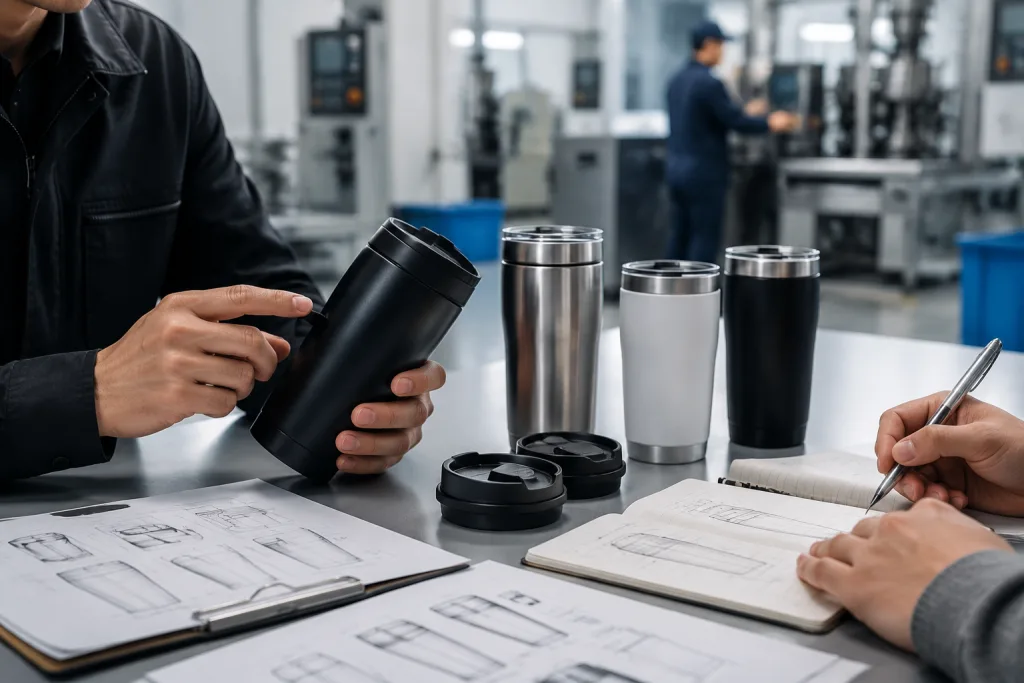
I’ll keep the tags intact and rewrite the prose to sound like a factory-side sales engineer, with concrete timing, QC detail, and less fluff.A sample is not a souvenir. It is a risk-control tool. For a new supplier travel tumbler program, ask for three sample stages if the calendar allows: stock sample, logo sample, and pre-production sample. The stock sample checks hand feel, 20 oz or 30 oz capacity, lid drag, cup-holder fit, and insulation. The logo sample checks decoration. The pre-production sample checks the final mix before we run the line.
Typical sample timing from China is 3-5 days for stock samples, 7-10 days for laser or silk screen logo samples, and 10-14 days for custom color coating samples. Air courier to Europe or North America usually takes 4-7 days, depending on customs and whether the address is residential or commercial. If your event date is fixed, do not burn three weeks on Pantone unless color is the whole buying point. We’ve seen that argument sink a schedule over a shade that nobody can match under warehouse light.
For coffee mug factory direct orders, ask the supplier to test the sample the way users will use it. Fill it with hot water, flip the lid if it is sold as leak-resistant, drop it in a backpack if that claim is on the carton, and wash it 50 cycles if dishwasher language will be printed. QC pulled the sample and found a lid gasket pop-out after the third inversion test. A supplier that dodges this kind of check is not a good fit for coffee mug manufacturers serving retail or corporate accounts.
Do not approve mass production from photos alone unless the order is low risk. Photos hide coating texture, lid friction, rim comfort, and weight. If you are buying coffee mug bulk for a national campaign, one delayed sample sign-off beats 10,000 units with the wrong mouth feel. The math does not work any other way.
Plan the order calendar early
I’ll rewrite the four paragraphs with tighter buyer-language, concrete timing, and a few shop-floor details while preserving the HTML exactly.Travel tumbler orders miss launch dates more often because the calendar is tight than because the factory cannot run the job. A workable timeline is 5-10 days for quotation and sample sign-off, 7-14 days for logo or color samples, 30-40 days for mass production after deposit and approved sample, 3-7 days for inspection and export paperwork, and 25-40 days for ocean freight to most European or North American ports. Air freight moves faster, but on a bulk coffee tumbler program it can wipe out the margin fast.
If the order has a fixed launch date, count backward from that date. Corporate-gift buyers should add at least 10 days for kitting, domestic split shipments, or FNSKU labeling when the cartons go into an e-commerce warehouse. Coffee brands need time for product photos, website setup, and distributor sell-in. A coffee mug distributor does not want pallets landing two days before the seasonal push starts.
Payment terms also shape the schedule. Most China factories start production after a 30% deposit and sample approval, with the 70% balance due before shipment or against copy documents. For repeat buyers with a clean history, we can talk about better terms later. New buyers usually get standard terms; the resin supplier, coating line, and carton printer all want their cash on time, and the math does not work any other way.
A solid supplier will push you to lock the specs early. That is not being difficult; it protects the order. Change the logo size after the printing jig is made, switch lid color after resin is purchased, or revise box art after the plates are approved, and you buy delay plus extra cost. QC pulled the sample twice on one 24oz run because the buyer flagged a 2 mm logo shift. The best bulk travel tumbler jobs are controlled, not rushed.
Send your tumbler spec before requesting a quote
Share capacity, logo, quantity, market, packaging, and target date. We will return a factory-direct option with MOQ, lead time, and FOB pricing.
Frequently asked questions
What MOQ should I expect for a supplier travel tumbler order?
For a standard stainless steel supplier travel tumbler, 1,000 pcs per color is a practical MOQ. At this level, coating, logo setup, packing labor, and carton production can be spread across enough units to keep the FOB price sensible. Some factories in China will accept 300-500 pcs, especially for stock colors, but the unit price often rises by 12-25%. If you need a custom Pantone powder coating, printed retail box, or molded lid color, expect 1,000-3,000 pcs. For coffee mug custom made retail programs, pushing too low on MOQ usually means weaker color control, higher freight share per unit, or fewer packaging options.
Is laser engraving better than printing for coffee mug promotional orders?
Laser engraving is better when durability and a premium look matter more than color. It works well on powder-coated stainless steel and is a strong choice for executive gifts, café loyalty merchandise, and coffee mug private label items. Printing is better when you need exact brand colors, large artwork, campaign slogans, or full-color graphics. For coffee mug promotional products, silk screen is usually economical for one- or two-color designs, while UV printing handles gradients and complex logos. The trade-off is durability. If the tumbler will be washed daily, ask for an abrasion test and define dishwasher cycles, such as 50 cycles, before approving the logo method.
How do I compare quotes from different coffee mug manufacturers?
Force every quote into the same specification table. Include capacity, 304 or 316 stainless steel, wall thickness, coating type, lid structure, logo method, logo size, packaging, carton quantity, FOB port, production lead time, test standards, and AQL inspection level. A USD 3.60 quote and a USD 4.40 quote may not be competing products if one uses a thinner outer wall, cheaper spray paint, or a basic slider lid. Ask for carton dimensions and gross weight too, because freight can change the landed cost by more than USD 0.30 per piece. A serious coffee mug factory will answer these points clearly.
What compliance documents do coffee brands usually need?
For Europe, buyers often ask for LFGB food-contact testing, REACH review for restricted substances, and sometimes BSCI or ISO 9001 factory documentation. For North America, FDA food-contact suitability, Prop 65 screening, CPSIA only if the item targets children, and ASTM-related packaging or labeling review may apply. Requirements depend on the sales channel. A coffee brand selling retail should be stricter than a one-day internal corporate gift. Ask the supplier for existing test reports, but check the model, material, and date. A report for a plastic bottle from 2021 does not prove compliance for a 2026 stainless steel travel tumbler.
Can I order mixed colors for one bulk coffee travel mug order?
Yes, but mixed colors need planning. A common structure is 1,000 pcs total with 500 pcs each of two stock colors, or 3,000 pcs total with 1,000 pcs each of three custom colors. Custom powder coating below 1,000 pcs per color can be expensive because the coating line still needs setup, cleaning, and color matching. Mixed colors also increase QC work because each color needs shade approval and defect review. If you sell through coffee mug distributors, start with two proven colors such as matte black and stainless steel, then add seasonal colors after the first sell-through data is clear.