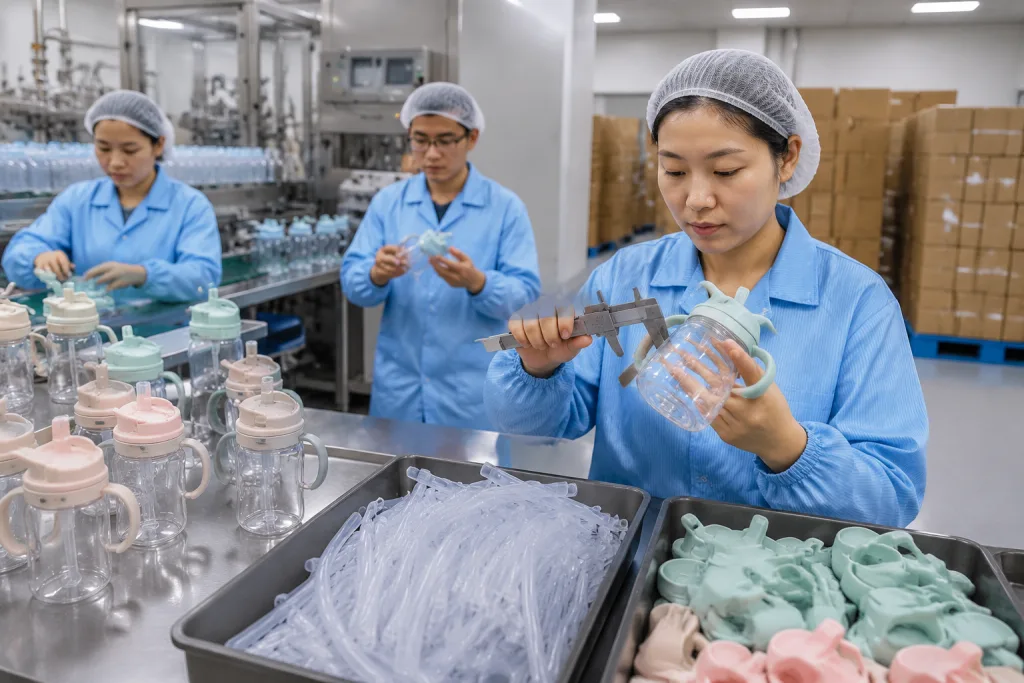
Key Takeaways
- A workable supplier toddler bottle order usually starts at 3,000 units MOQ and 25-35 days lead time in China
- Silicone straw + PP lid is the most common low-risk build for 300-350 mL toddler bottles
- For EU and US buyers, ask for REACH, LFGB or FDA-related material documentation and AQL 2.5 inspection
- Most bottle failures are lid, seal, or straw issues, not the bottle body itself
When you buy a supplier toddler bottle, you are not buying a cute shape. You are buying a stack of decisions that hit safety claims, shelf appeal, freight cost, and the number of complaints your team will handle later. One bad lid sample can turn into a week of rework. We have seen a 1.5 mm seal lip save a carton, and we have seen a loose straw cost a buyer two rounds of QC.
If you source in China or Zhejiang, the real question is not “which bottle is popular?” It is “which spec fits your channel?” A 300 mL straw bottle for retail is a different order from a 350 mL training cup for daycare, and both are different from a canteen custom order with logo printing. We run those jobs on the same line, but the test points change fast—MOQ, drop test, cap torque, and even one typo on the PO can slow the shipment. That is the wrong question to ask if you want clean margins.
What you are really comparing
I’ll rewrite the prose to sound like a field-tested sales engineer, keep the HTML exactly as-is, and avoid the AI filler patterns.Here’s the spec table I would put on the desk before I ask a canteen supplier or canteen manufacturer for samples. Don’t chase every feature. Match the build to the job.
| Spec | Option A: Straw bottle | Option B: Spout bottle | Option C: Flip-top training cup |
|---|---|---|---|
| Typical capacity | 300-350 mL | 280-320 mL | 250-300 mL |
| Body material | Tritan or PP | PP or stainless inner | PP |
| Lid system | Silicone straw, threaded cap | Soft spout, latch cap | Flip top, lock button |
| Leak risk | Low if gasket is thick enough | Moderate if hinge tolerances are loose | Low to moderate |
| Best use | Retail, daycare, travel | Early training, younger toddlers | Promotional sets, bundle packs |
That table shows the real trade-offs. A custom drinkware buyer may care most about logo area and carton count. A distributor watches breakage and replenishment speed. A brand owner selling customized drinkware asks a different question: can the lid take 50 to 100 opening cycles after rough handling on the line? We’ve seen this go sideways. If the hinge is off by 0.3 mm, QC pulled the sample and the buyer flagged it before the first carton moved. If you are sourcing a supplier toddler bottle from Zhejiang, ask for one sample built for function and one built for packaging. The cheap bottle is often the one that destroys cartons at 12 days instead of 18.
Straw bottle versus spout bottle
I’ll rewrite just this section, keep the HTML exactly as-is, and tighten the prose so it reads like a factory-side sales engineer.If you want the cleanest buy decision, compare the straw bottle and the spout bottle first. We run this split on the line all the time. A straw bottle is usually the safer retail pick because toddlers drink with less tilt, and parents see it as easier to live with. A solid build uses a 4.0-4.5 mm silicone straw wall and a lid gasket that lands at 0.8-1.2 mm compression. Too soft, and it seeps. Too tight, and the lid fights the hand, then the buyer flags it after the first carton.
A spout bottle fits younger kids who are moving off sippy cups. It is easier to explain at shelf and easier to handle in daycare. The hinge and latch need tighter control, though. On a China mass-production line, the gap between a clean latch and a trouble latch is often 0.2-0.3 mm in molding consistency, not the sketch on the drawing. We had one PO where the buyer typed the latch code one digit off, and QC pulled the sample before the line started. That is why a true canteen factory or canteen manufacturer talks tooling first, not print.
Use-case fit:
- Retail brand: straw bottle wins for daily repeat use
- Promo set: spout bottle wins when the unit cost has to stay lower
- Distributor order: straw bottle wins when you want fewer complaints
If you are also buying custom canteen or customizable canteen items in the same shipment, keep the toddler line separate in carton labeling. Mixed SKUs from a canteen vendor are fine, but toddler SKUs need cleaner traceability. We ship them with separate carton marks and a different inner-bag count, because mixing them is where the math stops working.
Material choice changes everything
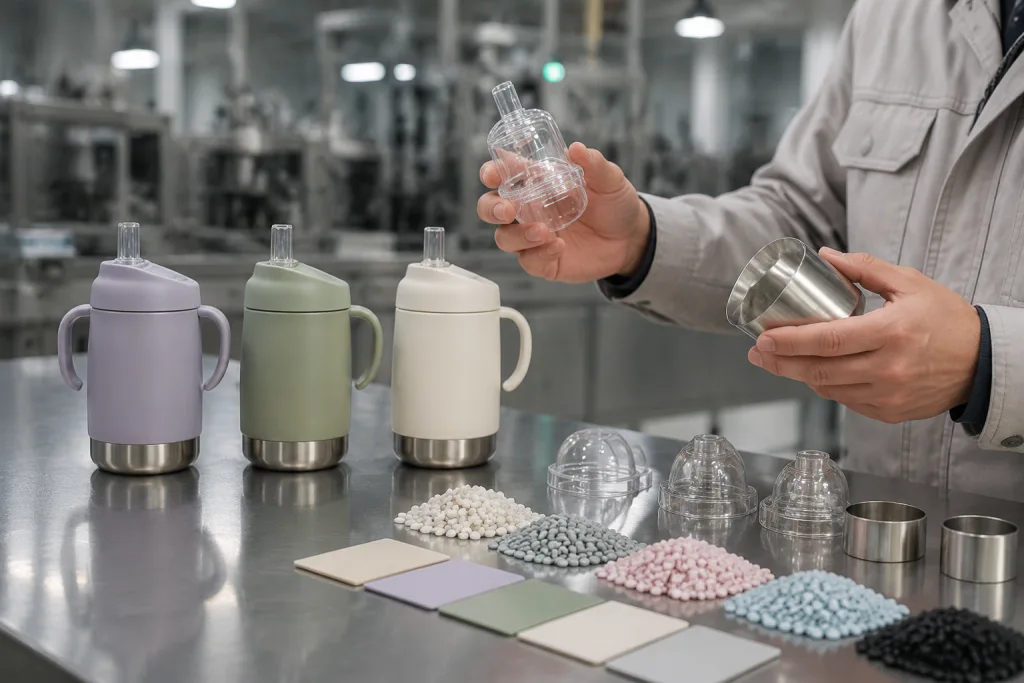
I’ll keep the HTML structure intact and rewrite only the prose, with tighter B2B sales-engineer tone and a few concrete factory-floor details.The body material decides the claims you can make and the price bracket your order can carry. We run Tritan on the premium retail line when the buyer wants clear visibility and better impact resistance. PP is cheaper, easier to scale, and cleaner on the line. Stainless steel brings insulation and a tougher feel, but it also adds unit cost and more assembly steps. For toddler bottles, we see buyers overpay for insulation and underpay for easy washing. A clear PP or Tritan body usually moves faster because parents spot residue at a glance. QC pulled one sample last week and the rinse stain showed up in 3 seconds.
If you are buying customized canteen or customized growler products too, do not assume the same decoration process works on toddler bottles. A laser logo that looks sharp on a custom growler can feel harsh on a small bottle body, and the buyer flagged that on a PO with a 1.5 mm logo note. Screen print or a soft matte label usually fits toddler lines better. For canteen promotional programs, I would rather ship a one-color logo that survives dishwashing than chase a multi-color print that starts chipping after 2 weeks. The math does not work.
Material documents matter in Europe and North America. Ask for REACH declarations, food-contact compliance papers, and test reports matched to FDA or LFGB expectations for your market. A serious canteen supplier in Zhejiang should hand those over without drama. We had one buyer spot a typo on the carton spec sheet, and that same supplier fixed the file in 20 minutes because their file room already kept the signed copies. If they hesitate, move on. Compliance is standard work, not a favor.
Logo and decoration trade-offs
I’ll rewrite the section in-place, keep every tag and heading structure, and tighten the copy so it sounds like a factory-side sales engineer.Decoration is where buyers overbuy. A toddler bottle does not need a premium print system unless the retail price can carry it. Screen printing still gives the best value for simple logos on volume orders. We run a 6-color screen line here, and for 5,000 units the math usually wins. Laser engraving works on metal parts and some lids, but the print area is small, and the brand message can disappear after a few wash cycles. This is a wear issue, not a beauty contest.
For a canteen custom order, especially in distributor channels, keep artwork to one or two colors and place the logo where little hands do not rub it all day. If you want a canteen customizable program, ask whether the factory can change cap color, straw color, and body tint without opening new tooling. We had a buyer flag a PO typo on cap color last month, and fixing it cost 12 days. That kind of flexibility matters more than a polished hero render.
Here is the straight answer: a distributor drinkware buyer often gets more value from a tough plain bottle than from a fashionable printed one. If you are building a distributor canteen or distributor growler line at the same time, standardize the artwork on cartons and vary only the product. That cuts SKUs without making the shelf look cheap. A Zhejiang factory shipping 400,000 units per month usually keeps print repeatability under control, but QC still needs an AQL 2.5 check on registration and scuff marks; we have seen that go sideways on matte bottles more than once.
MOQ, price, and lead time reality
I’ll rewrite the three paragraphs in a more field-tested sales tone, keep every HTML tag intact, and preserve the business numbers already in the copy.For a private-label toddler bottle order from China, the math usually lands here: MOQ 3,000 units per style, sample lead time 7-12 days, mass production 25-35 days, and FOB pricing from roughly USD 1.60 to 3.80, depending on material, lid type, and decoration. We ran a 12,000-piece job last month, and the buyer flagged the quote only after they added a custom box, multilingual insert, and spare straw. The landed price moved fast. That is normal. Ask for a fully loaded quotation, not a body price.
If you are comparing a canteen supplier to a canteen distributors network, the real difference is repeatability. Distributor pricing usually follows clean reorders, not shiny new ideas. We see this on the line: a plain bottle that ships in a 320g carton and passes drop checks beats a fancy bottle that keeps coming back with cap fit issues. This is the wrong question to ask if you only chase the lowest unit price. North American Amazon and European retail programs punish carton damage, FNSKU mistakes, and sloppy barcode placement.
Practical buying rule: if the quote is below USD 1.50 FOB for a full toddler bottle with gasketed lid and packaging, ask what got cut. In one PO, the buyer missed one zero in the carton spec, and QC pulled the sample because the wall thickness was short by 0.4 mm. Usually the missing piece is material thickness, testing, or assembly time. The factories in Zhejiang that keep running are the ones that quote straight and ship on time, not the ones that promise a miracle.

Which order type fits your channel
I’ll rewrite the section in-place, keep the HTML tags and headings unchanged, and tune the prose to sound like a factory-side sales engineer.Different buyers need different bottle behavior. Retail brands want something that feels solid in hand and passes a 1-meter drop without drama. Distributors want steady replenishment, carton counts that stay the same, and fewer complaint emails. Promo buyers want a clean logo hit and volume. There is no universal winner. Pick the channel first.
Retail brand: choose Tritan or thicker PP, a straw lid, a soft-touch grip, and one simple logo. We run this spec a lot because the buyer usually wants the sample to feel premium on day one, and the math works better than chasing a fancy body shape. This is the safer move if you plan to market alongside custom drinkware or a customizable drinkware range.
Distributor program: choose a simpler PP build, fewer moving parts, and standard colors. QC pulled the sample on a 24-hour lid swing test, and that is where cheap hinge designs get exposed. If you are already working with a canteen distributor or canteen distributors, consistency matters more than novelty. A distributor drinkware account usually wants fixed cartons and low defect rates.
Promo bundle: choose a lower-cost bottle with one-color pad print. The buyer flagged a PO typo on a 5,000-piece order once, and the whole job still shipped because the spec was simple enough to recover fast. This is where canteen promotional logic applies. The product must be acceptable, not luxurious.
Mixed category buyer: if you also source custom canteen, custom growler, or customizable growler items, keep your core specs aligned around carton size and print method. We’ve seen this go sideways when one order wants a 48-piece carton and the next wants 24, because the line starts mixing pack-outs. That cuts rework when one factory handles several drinkware families.
Send your spec sheet and target price
We can match your toddler bottle channel, quote FOB China, and flag the real risks before you approve samples.
Frequently asked questions
What MOQ should I expect for a supplier toddler bottle?
A normal MOQ is 3,000 units per style for a custom order from China. If you need multiple cap colors or printed cartons, expect the factory to ask for 5,000 units total across variants. Some Zhejiang factories can sample at 100-300 units, but that is not the production MOQ. For fast-moving distributor drinkware programs, 3,000-5,000 units is the realistic planning range.
What compliance documents should I ask for?
For Europe, ask for REACH-related material declarations and food-contact test reports that match your exact material. For the US, ask for FDA-related food-contact supporting documents. If the bottle includes stainless steel, request material grade confirmation. Also ask for factory audit evidence such as BSCI if your retailer requires it. A serious canteen supplier in China should provide these documents before you approve mass production.
Is Tritan always better than PP for toddler bottles?
No. Tritan is clearer and usually feels more premium, but PP is lighter on cost and easier to scale. For a retail brand, Tritan can justify a higher shelf price. For a canteen promotional order, PP is often the smarter choice. If the bottle is for daycare or mass distribution, PP is usually good enough as long as the lid, straw, and gasket are well made.
How do I reduce leakage complaints?
Focus on the lid system, not just the bottle body. Ask for gasket thickness, thread engagement, and lock strength data. In production, request AQL 2.5 inspection for leak tests, cap torque, and drop performance. A well-made 300-350 mL toddler bottle should survive repeated opening and closing without losing seal performance. Most leaks come from tolerance drift or poor assembly, not from the raw material alone.
Can I combine toddler bottles with other custom drinkware in one order?
Yes, but keep the specs organized. A factory in Zhejiang can often run toddler bottles alongside a custom canteen or custom growler order if the decoration and carton requirements are clear. The smartest approach is to keep one shared packaging standard and separate safety-critical items by SKU. That works well for canteen distributors and custom drinkware buyers who want one production schedule and fewer freight headaches.