Key Takeaways
- A typical supplier thermos flask MOQ is 3,000 units, with 25-35 day lead time for standard stainless builds.
- Double-wall 18/8 stainless with 0.4-0.5 mm inner wall is the safer baseline for retail and promotional use.
- FOB China pricing often starts around USD 3.20-4.80 per unit for 500 ml laser-logo thermos, depending on lid and finish.
- Ask for AQL 2.5/4.0 inspection, REACH paperwork, and closure cycle testing before you approve bulk thermos production.
If you are buying a supplier thermos flask for outdoor retail or a promotional program, the risky part is rarely shown on the quote sheet. Two bottles can both read “500 ml stainless vacuum flask,” but our cap torque tester may show one lid slipping after 2,000 open-close cycles while another still seals after 8,000. Spec first. Glossy samples come later.
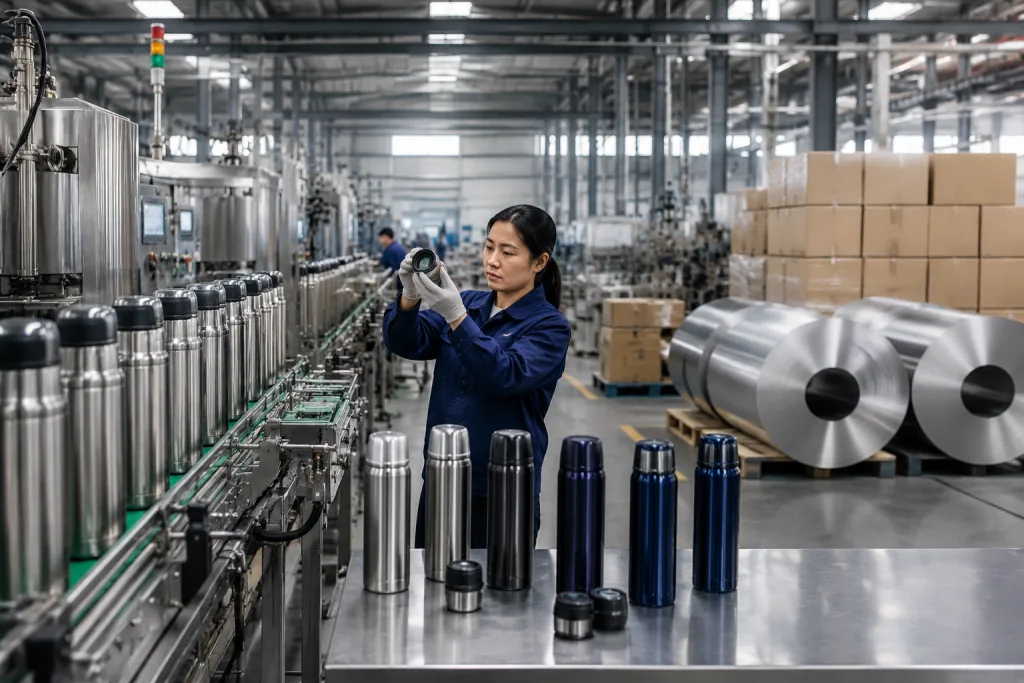
At our Hangzhou, Zhejiang factory, we run into the same issue on the line almost every week: buyers send logo artwork first, then QC pulls the sample for cap wobble, coating rub marks, or a missing LFGB page before shipment. The better question is not “Which bottle looks best?” The right question is which stainless build fits your channel. A promotional thermos usually needs a tighter cost target and 3,000 pcs MOQ; a retail outdoor thermos needs stronger coating and lid testing; a distributor thermos needs stable parts across repeat POs, because one cap change can turn into 18 days of rework instead of 12 days of production.
Three thermos builds, one buyer brief
I’ll rewrite the prose in place, keep the HTML and the table structure intact, and tighten the wording so it sounds like a factory-side sales engineer.Compare a supplier thermos flask the right way, and you are really comparing three builds: the low-cost promo shell, the everyday retail bottle, and the heavier outdoor bottle. Same stainless on paper. Different behavior on the line once we add powder coating, a screw lid, or a one-hand push cap. That is where first-time buyers get caught.
Use the table below as a working filter before you ask for samples. These numbers come from Zhejiang production lines, not brochure math. We run the 0.4 mm inner wall through a drop check from 80 cm; the 0.35 mm sample shows dents faster when the carton gets rough handling.
| Build | Capacity | Wall thickness | MOQ | FOB price | Lead time | Best fit |
|---|---|---|---|---|---|---|
| Promotional thermos | 350-500 ml | 0.35-0.4 mm | 3,000 pcs | USD 3.20-3.90 | 25-30 days | Events, giveaways, corporate gifts |
| Retail thermos | 500-750 ml | 0.4-0.5 mm | 5,000 pcs | USD 3.80-5.20 | 30-35 days | Outdoor shops, e-commerce, distributors |
| Heavy-use thermos | 750-1000 ml | 0.5-0.6 mm | 5,000 pcs | USD 4.60-6.80 | 35-45 days | Hiking, travel, field staff |
My view: if your channel is outdoor retail, chasing the cheapest shell is the wrong question. A 0.35 mm inner wall can look fine in one sample, then start biting you on dent claims and carton damage after the buyer flags the first mixed shipment. We saw this go sideways on a PO with one typo in the lid code. A supplier thermos quote only makes sense when you know what the bottle has to survive.
Specs that change the outcome
I’ll rewrite the section in-place, keep the HTML structure untouched, and tighten the wording so it reads like a factory-side sales engineer.Buyers often price the logo before they price the bottle. That is the wrong order. We run the shell, vacuum, and closure first, because those three decide heat loss, leak complaints, and how many cartons come back. For stainless thermos sourcing in China, the specs that move the needle are 18/8 stainless steel, vacuum retention, cap sealing geometry, and coating adhesion.
For a standard 500 ml custom thermos, I would ask for these numbers on the PO:
- Inner and outer steel: SUS304 / 18/8 stainless
- Wall thickness: 0.4-0.5 mm inner, 0.35-0.4 mm outer
- Vacuum performance: 12 hours hot, 18-24 hours cold depending on lid
- Lid torque test: 1,500-2,000 cycles minimum
- Drop test: 1.0 m, 3 sides, no leakage
These are plain thresholds, not premium specs. On the line, we have seen a cap print that looked rough at 20 cm and still passed, while a weak vacuum failed after one warehouse loop. If you are buying promotional thermos stock, trim the cap style and the finish if you need to, but leave the vacuum body alone. A cheap cap can be fixed. A bad vacuum cannot. For distributors thermos orders, the real question is carton-to-carton consistency, not one pretty sample from QC.
Print methods versus channel
I’ll rewrite the section in a more factory-side voice, keep the HTML exactly intact, and preserve the topic and structure.Decoration changes the selling value of a bottle faster than most buyers expect. A clean logo can turn a plain factory thermos into a branded gift, but the wrong print method will start wearing off after a few wash cycles. For thermos custom programs, we split decoration into three buckets: quick, hard-wearing, and premium.
Quick decoration is pad print or one-color silkscreen. It is fast and fits bulk thermos orders where the unit price has to stay low. Hard-wearing decoration is laser engraving, and on 304 stainless the mark stays put after abrasion and daily handling. Premium decoration is UV print, wrap-around artwork, or a mixed finish such as matte powder coat with a laser logo. If you are comparing thermos customizable options for retail, laser usually gives the cleanest long-term result. If you are sourcing thermos promotional goods for events, silkscreen gives the best cost-to-speed balance. We have seen buyers push for full-color print on a 500-piece order, and the math just does not work.
Do not skip the packaging. A customized thermos with a color box can add USD 0.35-0.90 per unit, but it also helps the product move on shelf. For Amazon or DTC, barcode placement matters too. QC pulled the sample last week because the FNSKU was 8 mm too close to the fold line. If you need FNSKU labels, lock the labeling position before mass production, not after the cartons are sealed.
Promotional or retail?
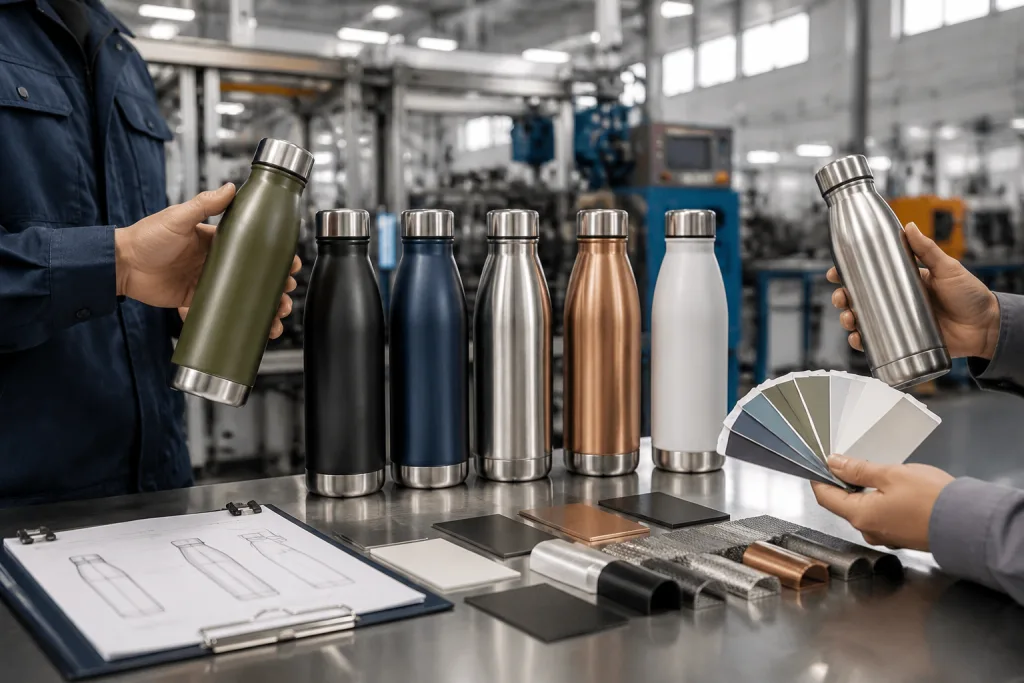
I’ll keep the HTML structure intact and rewrite the prose to sound like a factory-side sales engineer, with sharper numbers and one concrete shop-floor detail per paragraph.This split drives the whole spec. A promotional thermos is a marketing item first, a drinking container second. A retail thermos flips that order. Mix the two, and you end up paying for finish work you do not need while missing the seal or coating that sells the unit.
For promo programs, we run a simple spec: 350-500 ml, one-piece screw cap, one-color logo, carton insert, and a target FOB of USD 3.20-4.20 from China. On the line, that keeps the BOM clean and the pad-print step fast; once a buyer starts asking for a two-color wrap on a low-ticket giveaway, the math does not work. For outdoor retail, we move to 500-750 ml, a tighter lid seal, and a more abrasion-resistant coating. The FOB usually lands around USD 4.00-5.80, and the return rate drops when the bottle feels firm in hand.
Rule of thumb: if the bottle gets handed out, spend on logo clarity; if it gets resold, spend on closure quality.
That is a practical split. A thermos distributor or thermos vendor who knows channel math will ask three things: where the bottle sits, who uses it, and how many times the lid gets opened each day. QC pulled the sample, found the cap torque was off by 0.3 N·m, and that is the kind of detail that decides whether the order runs smooth or gets kicked back.
What Zhejiang factories control
I’ll rewrite the three paragraphs in-place, keep the HTML exactly as-is, and tune the copy to sound like a factory-side sales engineer rather than generic marketing.There is a reason serious buyers keep sourcing from Zhejiang and wider China: the supply chain is packed tight. Stainless tubes, injection lids, coating shops, and carton makers sit within the same province, so we can move a custom thermos order without trucking parts across three regions. That saves 5-8 days versus splitting work across unrelated subcontractors.
At our Hangzhou, Zhejiang plant, stainless drinkware runs at 180,000-240,000 units per month, with a standard MOQ of 3,000 pieces per SKU and a lead time of 25-35 days after sample approval. Those numbers set the job. We had a buyer flag a PO typo once—3,000 became 300—and the whole schedule fell apart, so the math on MOQ and lead time is not a side note. If a supplier thermos flask quote promises tiny MOQ and fast shipment, ask which step they are cutting.
What you want from a factory thermos partner is control you can measure: weld seam consistency, vacuum leak testing, coating adhesion, and carton drop performance. We run the line with a leak tester and pull samples from each batch, not just the first piece off the table. If your retail customer asks for BSCI, REACH, or food-contact declarations for North America, get those papers lined up before mass production starts. Good Zhejiang factories answer fast because the system is already built.
Sampling, QC, and order risk
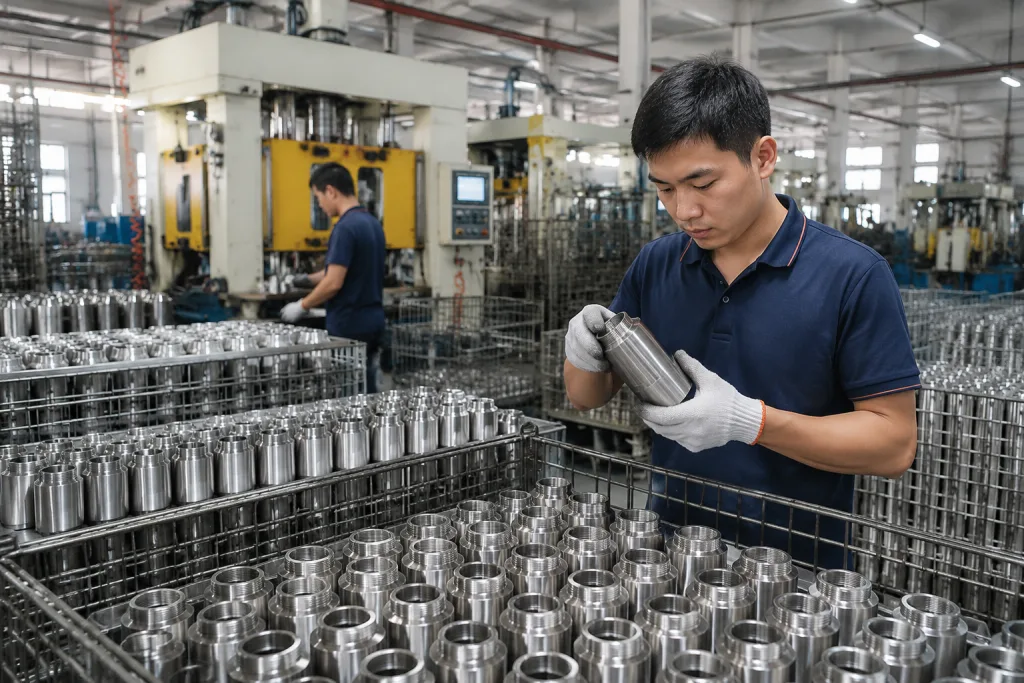
I’ll rewrite the section in place, keep the HTML structure unchanged, and tighten the tone so it reads like a factory-side sales engineer wrote it.Samples can fool you if the test is loose. A glossy sample tells you nothing about 5,000 units after a coating swap or a lid mold tweak. For a stainless thermos project, we ask for one pre-production sample with the final decoration method, then one sealed sample from a pilot run. QC pulled the pilot on a Monday; the buyer flagged a 0.3 mm lid gap, and that saved us a headache.
For bulk thermos production, I’d set these acceptance points:
- AQL 2.5 major, 4.0 minor for appearance and assembly
- Leak test on 100% of lids or a documented sampling plan
- Vacuum hold test on every lot
- Carton compression and drop test for export packaging
If the order is for a distributor thermos program, lock the carton marks, barcode, and country-of-origin label before approval. Rework after packing burns time and money. We’ve seen a PO typo on the origin label force a full reprint. If you are buying thermos bulk for a chain promotion, keep the spec sheet tight: one capacity, one lid, one box, one logo position. That is the right way to run it. The fewer variables on the line, the easier it is for the thermos manufacturer to keep the lot clean.
Best-fit picks by use case
I’ll rewrite the prose to sound like a factory-side sales engineer, keep the HTML intact, and make the specs feel grounded with concrete shop-floor detail.Different buyers want different builds from the same bottle. We see it on the line all the time: purchasing wants one spec, sales wants another, and marketing slips in a third. Use the table below to match the bottle to the channel, not to the loudest opinion in the meeting.
| Use case | Recommended build | Suggested decoration | Why it fits |
|---|---|---|---|
| Outdoor retail | 500-750 ml, 0.4-0.5 mm steel | Laser logo or durable print | Keeps weight down, survives rough handling, and still looks strong on shelf |
| Corporate gifting | 500 ml, powder coat finish | Silkscreen or laser | Gives a clean value feel without pushing the mold cost up |
| Event giveaway | 350-500 ml, simple lid | 1-color print | Protects budget and keeps MOQ at 1,000 pcs instead of drifting higher |
| Distributor program | 750 ml, upgraded seal | Laser plus gift box | Helps retail sell-through and cuts the leakage complaints we’ve seen come back after shipment |
If you need one customizable thermos for more than one channel, start with a 500 ml or 750 ml stainless body and keep the lid family the same. We had a buyer flag a PO typo on lid color once, and that small slip turned into a 12-day delay because the tooling note no longer matched the packing list. A thermos distributor gets faster reorders, and a thermos manufacturer keeps the line stable. That is the right question to ask: what job does the bottle need to do, and what spec can we run without creating extra headaches?
Send your spec sheet for a fast quote
Share capacity, lid type, logo method, and target market. We will return a clear thermos supplier quote with MOQ, lead time, and FOB pricing.
Frequently asked questions
What MOQ should I expect for a supplier thermos flask order?
For a standard stainless supplier thermos flask, 3,000 pcs per SKU is a realistic MOQ from a real China factory. If you want a custom lid, special coating, or full-color box, 5,000 pcs is more common. Small trial runs under 1,000 pcs usually mean higher unit cost, often by 15-30%. For outdoor retail, I would rather see one clean 5,000 pcs run than three small fragmented orders. It keeps the vacuum, print, and packaging stable across the lot.
What is a fair FOB price for bulk thermos production?
For 500 ml stainless bulk thermos items from Zhejiang, a fair FOB China range is usually USD 3.20-5.20 depending on lid, coating, and decoration. A simple promotional thermos with one-color print can sit near the low end. A powder-coated retail bottle with laser logo and better box moves higher. If someone quotes far below USD 3.00, check whether they are using thinner steel, weaker vacuum control, or a loose packaging spec.
How do I choose between silkscreen and laser engraving?
Use silkscreen when you need low cost and a clear one-color logo for thermos promotional orders. Use laser engraving when you want a more durable mark on a custom thermos for retail or outdoor use. Laser usually costs more per unit, but it survives abrasion much better. On stainless surfaces, it also looks cleaner over time. For distributor thermos programs, many buyers choose laser because it reduces after-sales complaints from logo wear.
Which compliance documents should I request?
At minimum, ask for food-contact material declarations, REACH support for Europe, and a batch traceability system. If your retailer requires social compliance, request BSCI. If you need North American sell-through, confirm how the manufacturer thermos program handles food-safe ink, carton labeling, and country-of-origin marks. For QC, ask for AQL 2.5/4.0 inspection records and leak test results. A serious thermos factory in China should provide these without drama.
Can you support private label and Amazon-ready packing?
Yes. A custom thermos or customized thermos program can include logo, color box, barcode, and FNSKU placement before packing. For Amazon-ready supply, ask for polybagging, carton labeling, and master carton counts matched to your inbound plan. A common setup is 12 pcs per carton for 500 ml bottles, but it depends on size and protection needs. If you are shipping to FBA, fixing pack-out early saves rework and avoids label mistakes.