Key Takeaways
- Start with a locked 304 inner wall, 201 or 304 outer wall, and 0.45-0.55 mm body thickness
- For most custom thermos orders, expect 3,000 pcs MOQ per color and 35-45 days mass production
- Use AQL 2.5 major / 4.0 minor plus 100% leak testing before carton sealing
- FOB Ningbo or Shanghai is cleaner than chasing a very low EXW thermos factory quote
You have a stainless thermos order to place: 5,000 units for an outdoor retail launch, or 12,000 units split across three promo designs. The easy part is finding a supplier thermos bottle listing. The hard part is locking the spec before the factory quotes, samples, and packs it.
At our Hangzhou, Zhejiang factory, the rough orders usually start with words like “premium,” “leakproof,” or “same as sample.” Those phrases do not save margin. A clear custom thermos brief, a real MOQ, and an inspection plan do. On the line, QC pulled the sample with a 0.6 mm lid gap and the buyer flagged it fast. That is the kind of detail that keeps an order on track.
Start with the actual use case
I’ll rewrite the section in-place, keep the HTML tags untouched, and make the prose sound like a factory-side sales engineer wrote it. Then I’ll return only the HTML.Let’s pin this down with a real order. You are buying a 750 ml stainless vacuum bottle for an outdoor retailer’s autumn line. It has to survive backpack drops, cup holders, weekend trail use, and a shelf where shoppers lift it, twist the lid, and judge the finish in 10 seconds. We also quote a second version as a customized thermos for a promo brand, same mold, different logo setup and gift box art.
Before you ask any thermos supplier for pricing, put the use case into numbers. Capacity: 750 ml, with a plus or minus 5% tolerance. Height target: under 300 mm so it clears common retail shelving. Mouth diameter: 45-55 mm if the buyer wants ice-cube access; 35-40 mm if heat retention matters more. Empty weight: about 430-520 g, depending on steel gauge, lid structure, and powder coating.
For outdoor retail, I would not chase the lightest body unless the buyer has a hard reason. A 0.38 mm wall looks fine on the table, then dents in the carton lane. For a manufacturer thermos order that needs fewer after-sales claims, 0.45-0.50 mm stainless on the outer shell is the safer baseline. If the product is for premium retail, 0.50-0.55 mm feels better in hand, but the math moves on material cost and freight weight.
The brief should also say whether this is a distributor thermos item for repeat replenishment or a one-off promotional thermos campaign. Replenishment orders need stable color codes, reserved tooling, and carton marks your warehouse can reuse without retyping the PO. One-off campaigns need faster sign-off on logo, packaging, and drop-test terms. QC pulled a sample on a 2 m drop check last month, and the buyer flagged a lid scuff that only showed up after the first carton run. A good thermos vendor in China will price those two jobs differently once they know which one you are actually running.
Choose steel and insulation honestly
I’ve got the section and constraints. I’ll rewrite the prose in place, keep every HTML tag intact, and make it sound like a real sales engineer wrote it.Most stainless vacuum bottles use 304 stainless steel for the inner wall. That is the floor, not the upgrade. For the outer wall, 201 stainless shows up on price-led bulk thermos orders, while 304 outer steel is the safer pick for coastal markets, ski channels, and buyers who ask for salt-spray data. For Europe, ask your thermos manufacturer for LFGB or EU food contact reports where they apply. For North America, FDA food contact compliance and basic paperwork are usually on the table.
Do not let a supplier thermos quote bury the steel grade. Write the spec plainly: inner wall SUS304, outer wall SUS201 or SUS304, PP lid food-grade, silicone ring food-grade, coating to meet REACH for EU orders. We have seen POs type “304 inside” and leave the outer wall blank; that turns into a price fight later. If the bottle is for kids, check CPSIA and ASTM on their own terms. A kids bottle is not just a smaller adult bottle with louder graphics.
Vacuum performance needs test conditions, not a slogan. “Keeps hot 12 hours” tells us nothing. A cleaner spec is: fill with 95°C water, room temperature 20°C, cap closed for 6 hours, measured water temperature no lower than 68°C. For 12 hours, many 750 ml bottles still land around 50-58°C, depending on mouth size and lid build. Cold retention is easier to sell, but the test method still has to be fixed. QC pulled the sample at 2 mm lid gap once, and the claim fell apart.
Our Zhejiang line runs about 450,000 stainless bottles a month across thermos factory and tumbler programs, but output does not rescue a weak brief. If a buyer wants a wide mouth, a low-cost lid, and 24-hour heat retention, the math does not work. We ship those orders, but only after the conversation gets honest: mouth opening, lid seal, body diameter, vacuum quality, coating wear, and target price all move together.
Build the quote from components
I’ll rewrite the section in-place, keep the HTML structure untouched, and tighten the sales language so it sounds like a factory-side quote discussion.A proper supplier thermos bottle quote is never one number. It stacks steel, lid, coating, logo, packaging, testing, and freight terms. For a 750 ml stainless custom thermos, a realistic FOB China price usually lands around USD 4.20-6.80 per piece at 5,000-10,000 pcs, depending on steel grade, lid structure, coating, and carton spec. We’ve seen quote sheets go sideways when a buyer chases a low number and later finds thinner steel, a basic lid, weak QC, or plain brown box packing.
Ask thermos manufacturers to split the cost line by line. Powder coating costs more than basic spray painting, but it gives better grip and a retail-ready finish. Laser engraving stays clean on outdoor models, yet it slows down large logos on the line. One-color silkscreen works for big promo runs; full wrap printing, water transfer, or gradient coating needs tighter sample approval and more scrap allowance. QC pulled one sample with logo drift at 1.5 mm, and the buyer flagged it before we ran the order.
MOQ drives the real setup math. At BottleForge in Hangzhou, Zhejiang, we usually talk 3,000 pcs per color for powder-coated stainless thermos bottles, 1,000-2,000 pcs for some stock-color logo orders, and 5,000 pcs or more when custom color matching and retail packaging are both in play. A three-color order at 1,000 pcs each sounds tidy, but it means three coating setups, three QC records, and three packing streams. The math doesn’t work the same way on the floor.
FOB Ningbo or FOB Shanghai is the cleanest basis for most European and North American buyers. EXW can look cheaper on paper, then your forwarder hits local handling and export paperwork at the gate. CIF can work if you compare landed cost, not just ocean freight. For a thermos distributor planning repeat business, steady FOB costing is easier to track season after season. We ship that way for a reason.
Approve samples without fooling yourself
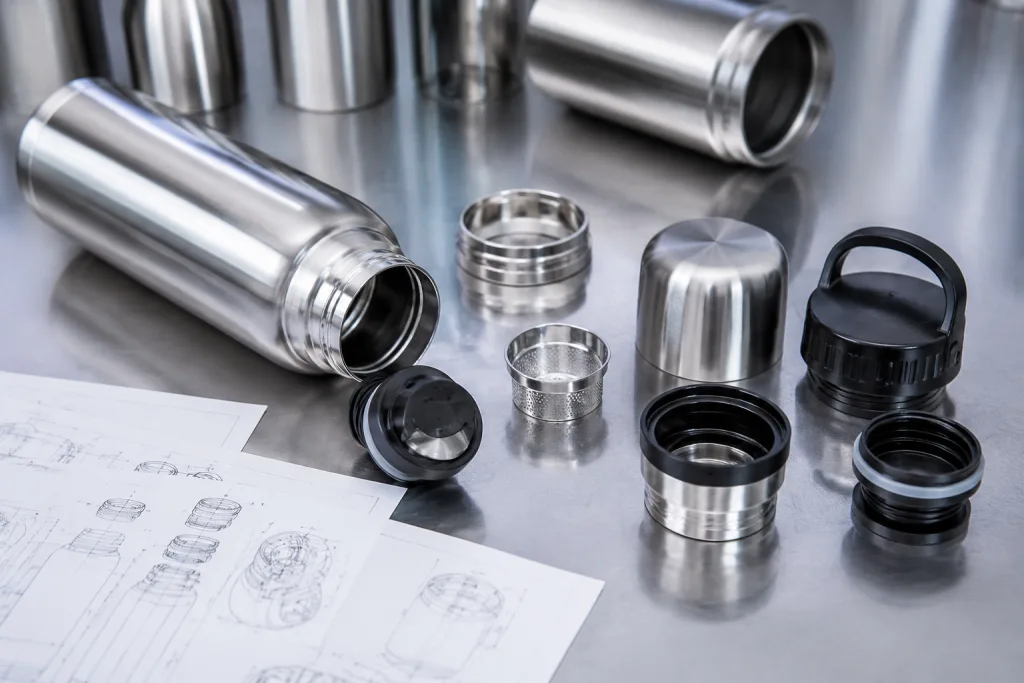
I’ll rewrite this section in a more shop-floor, buyer-facing voice and keep the HTML exactly as-is. Next I’m tightening the sample logic, adding concrete factory detail, and stripping the AI-style filler.Sampling is where a lot of outdoor retailers and promo brands waste 2 to 3 weeks. You sign off on a glossy sample, then the bulk color lands a shade flat, the logo sits 4 mm low, or the gift box barcode is missing. The sample stage is not a trophy shot. Treat it like a short production run.
For a custom thermos order, we split samples into three buckets. First is the structure sample: existing mold, no custom finish, used to check capacity, lid swing, grip feel, mouth size, and net weight. If stock parts are on hand, we can ship this in 5-7 days. Second is the logo sample: laser, silkscreen, heat transfer, or embossing on the real surface. After artwork is confirmed, it takes about 7-10 days. Third is the pre-production sample: final color, final logo, final packaging, final inserts, and carton mark. QC pulled the sample on the line; this is the one your team should sign, not the first shiny piece.
Color needs Pantone or RAL control, but powder coat does not read like paper. We agree the viewing condition under D65 or another fixed light box, then lock the target. For matte powder coating, a little texture shift is normal. Visible specks, thin edges, or orange peel over large areas are not, and this is the wrong point to be flexible on.
If the order is for Amazon FBA or a retailer with strict intake rules, send packaging data early. Carton size, gross weight, FNSKU placement, suffocation warning for polybags, and master carton drop strength should be confirmed before mass production starts. We once had a buyer flag a PO because the carton code was typed as `TN-500` instead of `TM-500`; that typo would have cost a reprint. For a distributor thermos program, carton consistency matters because your warehouse can reorder faster when labels, item codes, and pallet patterns stay the same from shipment to shipment.
Lock production before deposits move
I’ll rewrite the four paragraphs in-place, keep the HTML intact, and tighten the sales-engineering tone with more concrete factory detail.A purchase order that only says “750 ml thermos, black, logo” leaves too much room to argue later. The PO and spec sheet need the material grade, capacity, dimensions, wall thickness target, coating type, logo method, packaging, carton quantity, test standard, inspection level, payment term, incoterm, and ship date. We run this on the line with a 0.1 mm caliper and a printed sample board; if one buyer sends a different sheet from the other three thermos suppliers, the math does not work. You are not comparing the same product anymore.
For timing, a normal stainless thermos custom job runs like this: 2-3 days for quote confirmation, 7-15 days for samples depending on finish, 3-5 days for sample review and corrections, 35-45 days for mass production after deposit and final artwork approval, then 3-7 days for final inspection and loading. Peak season before back-to-school, Black Friday, and Christmas can add 10-20 days. Chinese New Year also shuts down the tooling and packing side, so plan around it instead of trying to push it through after the fact.
For new buyers, the common payment term is 30% deposit and 70% balance before shipment after inspection. Larger accounts sometimes switch to balance against bill of lading copy or trade credit once the order history is clean. If a supplier thermos factory takes a tiny deposit on a heavy-custom order, the buyer should ask why. Powder coating color, printed boxes, and molded lids tie up materials fast, and QC pulled the sample for a reason.
For a manufacturer thermos relationship, a signed golden sample plus a bilingual spec sheet is the real control point. Photos help, but a 1.5 mm lid gasket spec and a drop-test line in writing settle disputes faster. If the buyer changes the logo, color, lid, or carton after deposit, we treat it as an engineering change, not a casual email. We’ve seen that go sideways into mixed cartons and a missed vessel booking more than once.
Inspect like claims are expensive
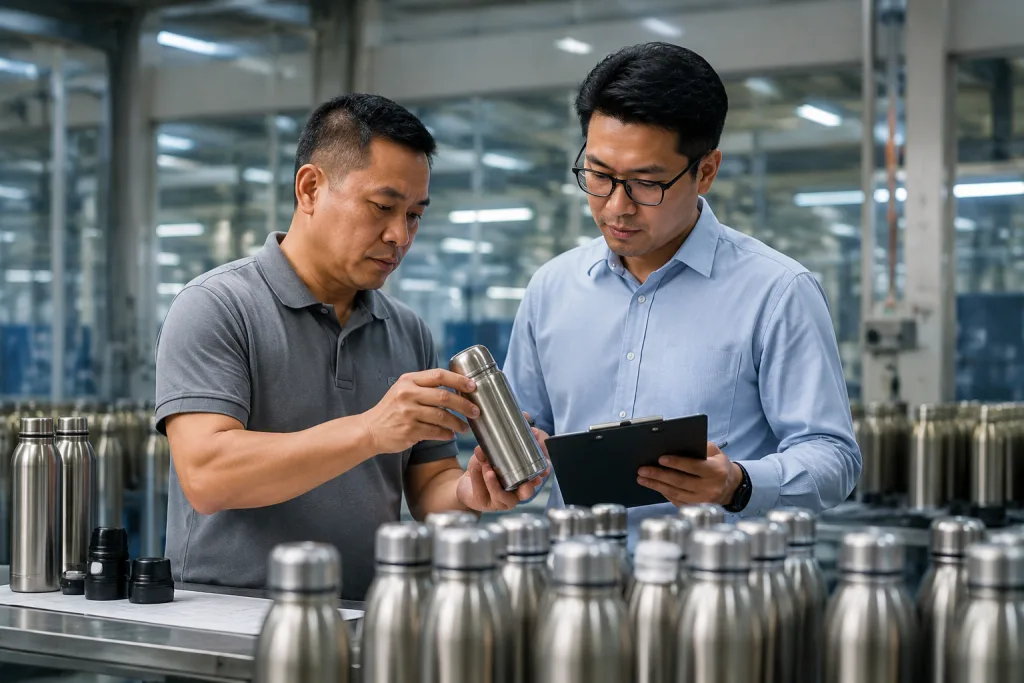
I’ll rewrite the section in-place, keep the HTML untouched, and tighten the prose so it sounds like a factory-side QC note.Inspection has to match the real risk on a stainless vacuum bottle. A pretty bottle that leaks is scrap, full stop. A bottle that holds vacuum but carries a crooked logo can still get bounced by a retailer. Use AQL, but use it with judgment. For most bulk thermos shipments, AQL 2.5 for major defects and 4.0 for minor defects is a sound starting point. Critical defects—leakage, sharp edges, unsafe materials, heavy contamination—get zero tolerance.
At production, the thermos factory should do 100% leak testing. We run water inversion, air pressure checks, and vacuum sampling on the line. For final inspection, pull cartons by ISO 2859-1 sampling. Check capacity, weight, dimensions, lid torque, silicone ring fit, surface finish, logo position, color consistency, odor, barcode scan, carton drop condition, and packing count. On one 500 ml bottle run, QC pulled a sample and found a 1.8 mm logo shift; the buyer flagged it, and that batch would have been a headache at retail. For outdoor retail, add an abrasion check on the coating and a backpack shake test with filled bottles.
Vacuum failure does not always show up on day one. A hot-water retention test during inspection is worth doing: fill selected units with 95°C water, record the start temperature, then check again after 6 hours. You cannot hold every unit for 6 hours at final inspection, but you can catch a bad process before the truck leaves. If the failure rate is high, stop the shipment and sort it. Do not chase a discount and ship known bad product unless the customer has signed off in writing.
For a thermos promotional campaign, logo and packaging mistakes cost more than small cosmetic marks because the event date does not move. For retail, carton damage and barcode errors can trigger chargebacks. That is why the QC checklist needs the boring items: item number, PO number, EAN or UPC, FNSKU when needed, country of origin, and “Made in China” in the right spot. We once saw a PO typo on a carton mark turn 2,000 units into a relabel job. Cheap mistake. Expensive lesson.
Ship for replenishment, not drama
I’ll keep the HTML exactly as-is and rewrite only the prose for a more field-tested, sales-engineer tone. Next I’m tightening the shipping advice with concrete factory details and cleaner buyer-facing language.Once inspection passes, the shipping plan has to protect the goods and the next PO. A typical 750 ml stainless thermos runs 24 pcs per master carton with a gift box, or 20-30 pcs if the insert and inner box change. We try to keep each master carton under 15-18 kg. That is not a soft preference. The line sees fewer crushed retail boxes, and QC pulled the sample fast enough to catch carton crush before the buyer flagged it.
For ocean freight, FOB Ningbo works cleanly for our Zhejiang factory because the trucking lane is stable and export handoff is routine. FOB Shanghai also works when your forwarder is stuffing mixed China cargo there. Air freight is only for rush promotional thermos orders or sample top-ups; on a 750 ml bottle it can add USD 2.00-5.00 per unit, and the math does not work for normal replenishment.
If this is a distributor thermos or thermos distributor program, lock spare parts before the first shipment leaves. Extra lids, silicone rings, straws if used, and retail boxes usually sit at 0.5-2% by channel. We’ve seen this go sideways when a buyer wanted “one spare set later” and the month-three lid break turned into a full bottle replacement. For outdoor retail, after-sales is part of the product, even if the hangtag never says it.
The final supplier scorecard should stay practical: on-time sample, sample match, mass production lead time, inspection pass rate, carton condition, document accuracy, and response speed when a carton count is off or a PO typo shows up. A good thermos supplier is not the one who says yes first. It is the one who tells you a 24-hour claim, a thin wall, and a low target price cannot all fit in the same spec. That honesty matters when your next thermos customized program has to hit a fixed retail calendar.
Send your thermos spec and target landed cost
We will review capacity, steel grade, logo method, packaging, MOQ, and lead time before quoting your next stainless thermos program.
Frequently asked questions
What MOQ should I expect for a custom stainless thermos order?
For a true custom thermos with powder coating, logo, and retail packaging, 3,000 pcs per color is a normal MOQ in China. If you use an existing stock color and only add a laser logo, some factories can support 1,000-2,000 pcs. Custom Pantone coating, molded lid changes, or printed gift boxes usually push the practical MOQ to 5,000 pcs because coating setup, material purchasing, and QC records are not efficient at very small runs. Be careful with very low MOQ offers if you need repeatable color and stable delivery.
How much does a 750 ml supplier thermos bottle usually cost?
A realistic FOB price for a 750 ml stainless vacuum bottle is often USD 4.20-6.80 per piece at 5,000-10,000 pcs. The lower end usually means 304 inner wall, 201 outer wall, simple lid, one-color logo, and standard carton or basic box. The higher end may include 304 outer wall, heavier 0.50-0.55 mm body, premium powder coating, laser engraving, retail gift box, and stricter testing. Prices move with stainless steel costs, exchange rate, packaging material, and order timing.
Which logo method is best for outdoor retail thermos bottles?
For outdoor retail, laser engraving is usually the safest logo method because it will not peel and it matches a rugged product story. It works best on powder-coated or painted bottles where the engraving reveals the steel underneath. For a promotional thermos with a large event graphic, silkscreen or heat transfer can be more cost-effective, especially above 5,000 pcs. If the bottle will face abrasion in backpacks or cup holders, ask for a tape test, alcohol rub test, and simple abrasion test before approving mass production.
How do I compare thermos suppliers without being misled by price?
Send every thermos supplier the same specification sheet and ask for the same incoterm, preferably FOB Ningbo or FOB Shanghai. Compare steel grade, wall thickness, lid material, coating method, logo process, packaging, testing, MOQ, sample time, and production lead time. A USD 0.40 cheaper quote may use thinner steel, a lighter lid, or plain white box instead of printed retail packaging. Ask for AQL terms, recent food-contact reports, and photos of the production line. You are buying a controlled program, not just a product photo.
What quality checks matter most before shipment?
Leak testing is the first priority, and it should be 100% at factory level. During final inspection, use ISO 2859-1 sampling with AQL 2.5 for major defects and 4.0 for minor defects. Check vacuum retention with 95°C water, lid fit, silicone ring placement, capacity, weight, logo position, coating defects, odor, barcode scan, carton count, and master carton strength. For retail or Amazon FBA shipments, also verify FNSKU or UPC placement, carton labels, country-of-origin marking, and gross weight. Small label errors can delay receiving even when the bottle is perfect.