Key Takeaways
- A 500 ml 304 stainless supplier thermal bottle should target 6-12 hours hot retention and 12-24 hours cold retention, not vague 'all day' claims
- For custom drinkware, ask for AQL 2.5/4.0 inspection, vacuum leakage checks, and torque testing before mass production
- Typical MOQ from a Zhejiang canteen factory is 1,000-3,000 pcs per SKU; lead time is often 25-40 days after sample approval
- Decoration failures rise sharply when powder coat thickness exceeds 60-80 microns or laser engraving lands on uneven weld zones
Most buyers do not lose money on a thermal bottle order because the design is bad. They lose money because the supplier thermal bottle spec was vague, the sample looked fine, and the mass run exposed weak seams, poor vacuum retention, or decoration that failed after the first wash. We see that on the line all the time. If you buy custom drinkware for retail, Amazon, or distribution, those defects hit margin fast.
At our Zhejiang factory, this pattern shows up every week: a canteen manufacturer quotes a low FOB price, the buyer accepts a clean pre-production sample, then 10% to 18% of the shipment gets flagged at AQL because the lid leaks, the coating scratches, or the weld line prints through powder coat. QC pulled the sample again last Tuesday with a 0.2 mm gap at the cap thread, and the buyer flagged the same thing. The fix is not luck. It is knowing where thermal bottles fail, writing the spec in plain numbers, and pushing the canteen supplier for proof instead of promises.
Where thermal bottles actually fail
I’ll keep the HTML structure intact and rewrite only the prose to sound like a factory-side sales engineer, with sharper details and fewer AI-style phrases.If you are buying from a canteen supplier or canteen vendor, the first mistake is assuming the bottle body is the only risk. It is not. The failures start at the vacuum layer, then show up in the neck finish, lid seal, coating, and carton spec. We run this check on the line every week, and a weak factory usually hides behind one clean sample.
Vacuum loss is the costly defect because you do not see it right away. A bottle can pass visual QC and still lose heat after a dropped pallet or a bad weld bead. We have seen shoulder dents on thin-wall bodies, especially when the inner wall drops below 0.35 mm on low-cost runs. If you are sourcing a customizable canteen or customized drinkware for retail, ask for process evidence, not product photos. The math does not work otherwise.
- Vacuum retention: request hot-fill hold tests at 95°C water, measured at 6 and 12 hours.
- Leak path: inspect lid threads, silicone rings, and straw assemblies under pressure.
- Surface failure: check coating adhesion and scratch resistance after a 24-hour cure.
- Packing failure: test drop resistance from 80 cm with retail cartons.
A distributor drinkware buyer should care about this more than anyone. One bad SKU can poison reorders across your canteen distributors network, especially if the same lid is used across 3 colors and 2 sizes. We have seen that go sideways when the buyer flagged one PO typo on the cap code and the wrong gasket landed in production.
Specs that stop vacuum loss
I’ll rewrite the section in place, keep the HTML structure untouched, and tighten the language so it sounds like a factory-side sales engineer.The quickest way to cut complaints is to lock the build spec before the line starts. For a standard 500 ml supplier thermal bottle, we usually run 18/8 or 304 stainless on both inner and outer shells, with inner wall thickness around 0.35-0.45 mm and outer wall around 0.35-0.5 mm, depending on target price. Go thinner and the canteen customized order may still look fine in a photo, but it loses dent resistance fast in transit.
For premium retail or branded custom canteen programs, 316 stainless makes sense only in corrosive markets or high-end use. Do not pay for it if the buyer does not need that chemistry. Weld consistency and vacuum stability matter more. The neck thread has to cut clean, and the shoulder weld needs to stay even so the vacuum seam does not print through the powder coat. We had a buyer flag a 0.3 mm seam witness on matte black, and QC pulled the sample straight off the bench. A canteen manufacturer in Zhejiang should show lot-by-lot leak test records, not one showroom demo.
What to put on the PO
- Material grade: 304 stainless steel, BPA-free lid components, food-contact silicone.
- Vacuum test: no visible condensation or temperature failure after 24 hours at room conditions.
- Drop test: 1 meter on concrete for sample validation, 80 cm on cartons for shipping validation.
- Dimensional tolerance: lid fit and mouth opening within ±0.5 mm.
If you are comparing canteen manufacturers, the one that gives you numbers is the safer canteen supplier. The “good quality” line is cheap until the first claim lands. We’ve seen this go sideways on a PO typo for mouth opening, and the math does not work after rework starts.
Lid and seal mistakes
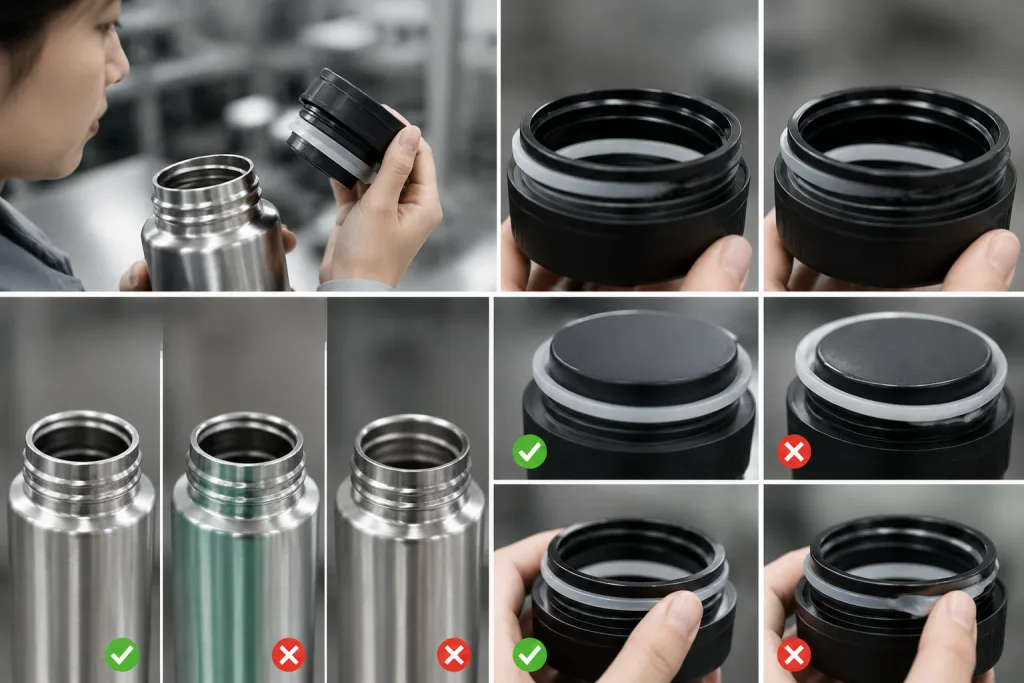
I’ll rewrite just the prose inside the existing tags, keep the structure intact, and make it sound like a factory-side sales engineer wrote it.Most leakage complaints start at the lid, not the bottle body. We treat lid design as part of the product, not an add-on. On a thermos bottle, thread pitch, gasket hardness, and vent size all change the result. We’ve seen a good bottle get returned because the cap was off by 0.3 mm on the sealing face.
The usual failures are easy to spot on the line: a silicone ring gets crushed too hard, the cap bottoms out before it bites, or a flip-top pops open when the bottle is filled hot. We also see this on custom growler runs, where the wider mouth leaves more room for carbonation pressure and hot-liquid expansion. For a customizable growler, ask for cycle testing on the closure. A single leak test is the wrong question.
- Silicone hardness: usually 50-60 Shore A for reliable sealing.
- Torque: enough to seal without stripping threads after repeated use.
- Cycle life: 3,000-5,000 open/close cycles for retail-grade lids.
- Heat deformation: verify lid shape after 95°C exposure.
If you need canteen promotional items for events, do not take the cheapest lid. The buyer flagged this on a 5,000-piece PO before: one drip in a giveaway line turns into a brand problem fast, and QC pulled the sample before shipping for good reason.
Decoration fails that hurt resale
I’ll rewrite the section in-place, keeping the HTML structure and link intact, while stripping the AI-sounding phrasing and adding a few factory-floor specifics.Decoration is where buyers over-spec the look and under-spec the wear. A glossy customized canteen means nothing if the print starts lifting after one dishwasher run. For custom drinkware sold into North America and Europe, the decoration method has to fit the use case, the logo detail, and the washing the customer will actually do.
Silkscreen fits simple logos and large spot colors. Laser engraving gives a permanent mark on stainless steel. Powder coating can look premium, but the film thickness has to stay in range; if it goes too heavy, edge definition drops and thread engagement gets sloppy. We ran a 0.35 mm mask on the line last month, and QC pulled the sample because the Pantone red drifted once it hit the real substrate. That is the wrong place to save cost.
Good decoration is not the one that looks brightest on day one. It is the one that still looks acceptable after 50 wash cycles and one bad shipment.
Ask your canteen factory to lock decoration acceptance by method: adhesion test, rub test, dishwasher test, and UV exposure if the product will sit on retail shelves. A PO typo on a 5,000 pcs reorder once sent us the wrong logo file, and the buyer flagged it before packing. If you are selling as a distributor canteen or distributor drinkware item, a 2% defect rate across 12 SKUs hits margin harder than one weak hero product.
For logo-heavy programs, review options here: silkscreen vs laser engraving for custom drinkware.
MOQ, lead time, and pricing traps
I’ll rewrite the section in place, keep the HTML structure intact, and tune the prose to sound like an experienced factory-side sales engineer.Buying custom drinkware is never a straight unit-price deal. A supplier thermal bottle at USD 2.10 FOB looks fine until you add a lid upgrade, extra packing, and the sorting cost when QC pulls 30 bad lids from one carton. In Zhejiang, a serious canteen factory quotes by material, finish, and accessory set. That is the only clean comparison.
Typical MOQ is 1,000 pcs per color for a standard thermal bottle, and 3,000 pcs if you want mixed finishes or special tooling. Lead time usually runs 25-40 days after sample approval, and it stretches further if you ask for new molds or a custom growler shape with a deep draw body. If a canteen vendor promises 7 days for a fully customized bottle, they are selling stock goods with a logo. We’ve seen that go sideways more than once.
- FOB China price changes with steel grade, finish, lid type, and packing spec.
- Tooling fees apply for new caps, handles, or non-standard necks.
- Sample lead time is often 5-10 days for existing tooling.
- Mass production lead time depends on coating, printing, and final QC capacity.
For buyers comparing canteen suppliers, ask for a full landed-cost model. Put export carton, master carton, inner box, and FNSKU labeling for Amazon on the same sheet; otherwise the math does not work. If you buy through a canteen distributor, you may pay more per unit but cut coordination risk. If you buy direct from China, you keep control, but only if you can manage QC on the line.

QC gates worth paying for
I’ll rewrite the section in place, keep the HTML structure intact, and tighten the prose so it sounds like a factory-side sales engineer wrote it.QC is not one final check. It is three gates. The good canteen factory in China runs it that way. The weak one says end-of-line inspection is enough. It is not. We check incoming coils, watch the line for fit and weld issues, then pull pre-shipment samples against AQL 2.5 or AQL 4.0.
For retail orders, AQL 2.5 works for major defects and 4.0 for minor defects. Major defects are leakage, vacuum loss, wrong logo, cracked lids, and dents that hit saleability. Minor defects are dust specks, slight print shift, or carton scuffs. If the market is premium, tighten the cosmetic line. We reject any bottle with visible weld marks under normal lighting; QC pulled a sample like that in a 500 pcs trial, and the buyer flagged it fast.
Factory audits matter too. Ask for BSCI if social compliance is on your PO, and ask for REACH declarations for Europe when food-contact materials are in scope. For the U.S., you may also need FDA food-contact testing and ASTM-style performance checks where the spec calls for it. We’ve seen this go sideways when a supplier only sends a sample photo. A Zhejiang supplier that can show the paper trail is easier to scale with than one who just talks.
If you want to compare production capability, review our facility details here: drinkware manufacturing capabilities and our quality process here: quality control standards.
How to spec for your channel
I’ll rewrite the section in-place, keep the HTML structure intact, and make the copy sound like a real supplier-side sales engineer.The right canteen promo program is not the same as the right retail bottle or distributor drinkware bundle. The channel sets the spec. A giveaway item needs lighter tooling, simpler decoration, and lower print cost. A retail SKU needs stronger packaging, better drop resistance, and a tighter defect limit. A distributor canteen line often needs 3 to 6 colors on one body, so finishing has to stay steady from one batch to the next. We run that on the line with a color chip and a 600-lumen light box, because one bad lot will cost you more than the unit price ever saves.
If you sell on Amazon, your custom canteen spec should include carton dimensions that cut dimensional weight, barcodes that scan on the outer box, and product labels that fit FNSKU if required. If you sell to brick-and-mortar distributors, focus on shelf appeal, master carton efficiency, and fixed case pack counts. If you need a custom growler for beverage brands, check pressure tolerance, lid style, and filling line fit before you sign off the drawing. The buyer flagged a 2 mm neck mismatch on one PO, and that tiny typo would have stopped the whole run at packing.
- Promotional channel: keep unit cost low and print fast.
- Retail channel: hold finish durability and retail packaging to spec.
- Distribution channel: keep supply stable and carton counts repeatable.
- Brand program: lock the color match and retain the approved sample.
When you are ready to start, ask for a quote with your channel in mind. A canteen distributor, a canteen supplier, and a canteen manufacturer can all send a price. Only one will give you a number that works for your route to market in Europe or North America. We see this go sideways when buyers compare MOQ only; the math does not work if the carton spec or label setup is wrong.
Spec your thermal bottle before defects start
Send your size, lid style, and target price. We’ll quote a production-ready supplier thermal bottle plan from Zhejiang, with QC points and lead time.
Frequently asked questions
What MOQ should I expect for a supplier thermal bottle?
For a standard 500 ml supplier thermal bottle, expect 1,000 pcs per color as a normal MOQ from a Zhejiang factory. If you want a new lid, special powder coat, or a custom growler body, MOQ often moves to 3,000 pcs. For simple logo work on stock tooling, some canteen suppliers can go lower, but the unit price usually rises by 8% to 15%. If you are testing a new market, ask for mixed-color MOQ only if the factory can keep the same cap and body tooling; otherwise you will pay more in setup and QC time.
How do I verify thermal performance before ordering?
Ask for a real performance test, not a marketing statement. For a 500 ml thermal bottle, request hot retention with 95°C water and confirm temperature at 6, 12, and 24 hours. A practical retail spec is 6-12 hours hot and 12-24 hours cold, depending on wall thickness, lid design, and fill volume. Also request a vacuum leak check and a drop test after the thermal test. A sample that looks good but loses heat early usually indicates a vacuum or lid problem, not a decoration issue.
What documents should a canteen manufacturer provide?
At minimum, ask for material declarations, food-contact information, and a production QC report. For Europe, REACH-related documentation is important; for many buyers, a BSCI audit is also useful when verifying a supplier thermal bottle factory. If you are importing into the U.S., keep the food-contact paperwork on file and ask for test reports on stainless steel and silicone components. A serious canteen manufacturer in China should also be able to provide sample photos, AQL inspection records, and packing specifications without delay.
Is laser engraving better than printing?
Not always. Laser engraving is usually more durable because the mark is permanent and does not depend on ink adhesion. That makes it a strong choice for customized drinkware, especially if the product will be washed often. Printing is better when you need color, gradients, or a larger logo area. For a canteen promotional item, silkscreen is often cheaper and faster. For a premium distributor drinkware line, laser engraving usually looks cleaner on stainless steel, especially when the bottle surface is matte or powder coated.
How can I reduce leakage complaints after launch?
Start with the lid, because that is where most leaks happen. Specify gasket hardness, thread fit, and cycle testing in writing. Require pre-shipment AQL inspection with leakage as a major defect, not a minor one. Then test a few cartons from each lot after transit simulation and a simple shake test. If you sell through canteen distributors or as distributor canteen stock, ask the factory to keep lot traceability so you can isolate problems quickly if one batch gets flagged by customers.