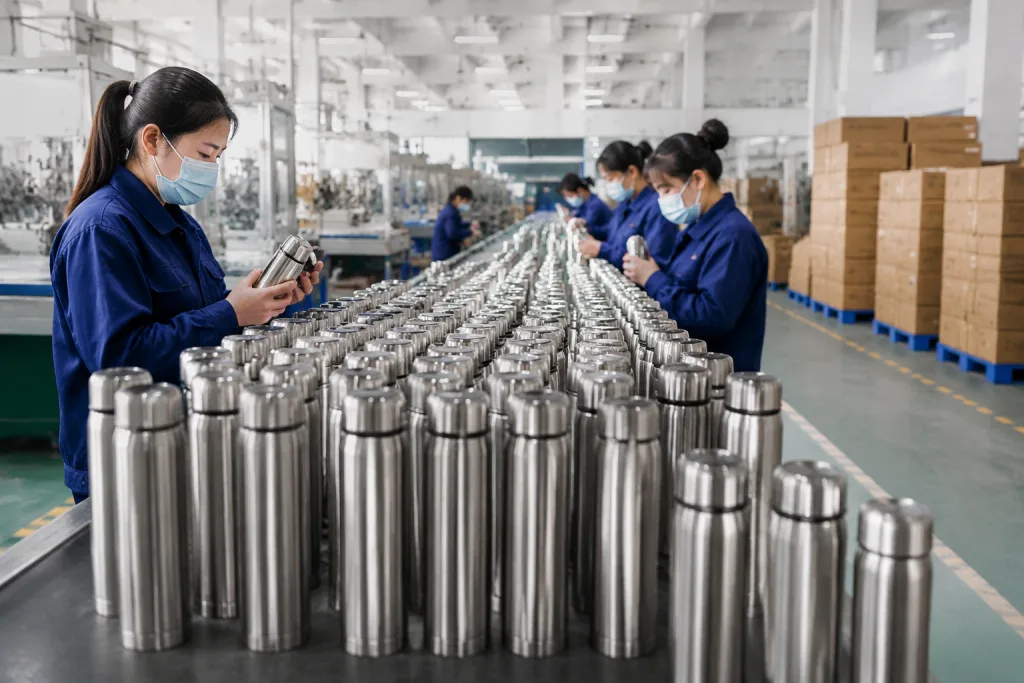
Key Takeaways
- For a 500 ml supplier stainless steel flask, FOB China often starts around USD 2.20 to 4.80 depending on 304 steel, coating, and lid complexity.
- A practical MOQ is usually 500 to 1,000 pcs for custom canteen work; true canteen promotional runs can go lower only with simplified decoration.
- Expect 20 to 35 days for sampling and 30 to 45 days for production from a capable Zhejiang canteen manufacturer with 300,000 units/month capacity.
- For export markets, verify LFGB, REACH, and food-contact testing plus AQL 2.5/4.0 inspection before you approve shipment.
If you are buying a supplier stainless steel flask for retail, corporate gifting, or e-commerce, the first mistake is chasing the logo and picking the wrong bottle. We see this all the time. Start with four points: steel grade, capacity and wall structure, decoration method, and the supplier’s actual production capacity. Those choices hit landed cost, defect rate, and whether the order leaves in 35 days or slips to 75.
In Zhejiang and across China, the best canteen factory is not the one with the flashiest catalog. It is the one that holds a 0.2 mm tolerance on lid fit, passes AQL 2.5, and keeps your custom canteen or customized drinkware order moving when QC pulls the sample on a Friday. If a buyer flags a loose cap or a 1 mm print shift on the PO, we stop and fix it. That is the wrong question to ask if you start with the brochure; you need the line data, not a sales pitch.
Start with the use case
I’ll rewrite the section in-place, keep the HTML exactly as-is, and sharpen the copy so it sounds like a buyer-facing factory note rather than generic web text.The first decision is not whether the flask looks “premium.” It is where the bottle will live. A distributor drinkware program for outdoor retail needs better dent resistance and a tighter lid seal than a canteen promotional giveaway for an event chain. A custom growler for brewery merch has different volume, mouth size, and label space than a slim custom canteen for corporate gifting. Mix those jobs together and the math stops working fast.
Define the use case in plain numbers. For office gifting, 350 ml to 500 ml is easier to ship and cheaper to decorate. For hiking or travel, 750 ml to 1,000 ml makes more sense. For a canteen distributor serving mass retail, a double-wall 304 body with powder coating and a PP lid is a safer baseline than a bare polished shell. We run this check every week: QC pulled a sample, the lid failed a 1.2 m drop, and the buyer flagged it before mass production. A good canteen supplier will ask about drop tests, dishwasher exposure, and whether the product goes into a box, a sleeve, or a retail hanger. If they do not ask, that is a warning sign.
- Gift channel: prioritize print area and perceived value.
- Retail channel: prioritize scratch resistance and color consistency.
- Outdoor channel: prioritize lid seal and dent resistance.
Choose the steel and build
I’ll keep the tags intact and rewrite the prose so it sounds like a real factory-side sales engineer, with tighter wording and a few concrete shop-floor details.Buyers say they want stainless steel, but that phrase hides the real spec. For beverage contact, 304 is the baseline we run. If the flask goes into coastal channels or rough outdoor use, 316 gives better corrosion resistance, but it usually adds 15% to 30% on material cost. For office packs and travel sets, 304 is enough. If your buyer wants margin, ask the right question: do they need 316 on the inner wall, or are they just guessing from a catalog sheet?
Build matters just as much. A single-wall canteen customized for cold drinks is lighter and cheaper, but it sweats and feels like a budget item. Double-wall vacuum construction solves that and lifts shelf value. On our line, the outer wall usually sits at 0.4 mm to 0.6 mm, while the inner wall runs 0.35 mm to 0.45 mm; QC pulled a 0.38 mm sample last week and the buyer flagged the weight immediately. Lids change the price too: PP is the low-cost route, Tritan gives a cleaner look, and stainless lids add grams and cost. If a canteen manufacturer cannot state the gauge, finish, and weld method, you are not buying a process.
Ask for cut-section photos, not just glossy renders. A supplier stainless steel flask should show the inner wall, vacuum seam, and base weld before you place a repeat order.
Decide the decoration route
I’ll rewrite just this HTML section, keep the tags and list structure intact, and tighten the copy so it sounds like a factory-side sales engineer.Decoration is where a lot of buyers burn margin for no reason. On a canteen custom run, one-color silkscreen with no special coating usually lands around USD 0.20 to 0.45 per unit. Laser engraving costs more at the start, but it holds up better on brushed steel. We run the same choice on the line every week.
Pick the decoration route by how you sell. If you need 5,000 units for a distributor canteen program and the art is fixed, laser engraving or one-color print is the safer call. If the order is for canteen promotional use, a simple wrap print is enough when speed beats long shelf life. For a customizable growler or customized growler, the bigger cylinder gives you more logo space, but it also raises the risk of a shifted seam, so the artwork must be approved at actual size. We have seen the buyer flag a 3 mm drift and kill the whole run. Do not skip a physical proof on a curved body.
- Silkscreen: low cost, good for simple logos, fast on repeat orders.
- Laser engraving: durable, premium look, works well on brushed steel.
- UV print: wider color range, but needs scratch testing before approval.
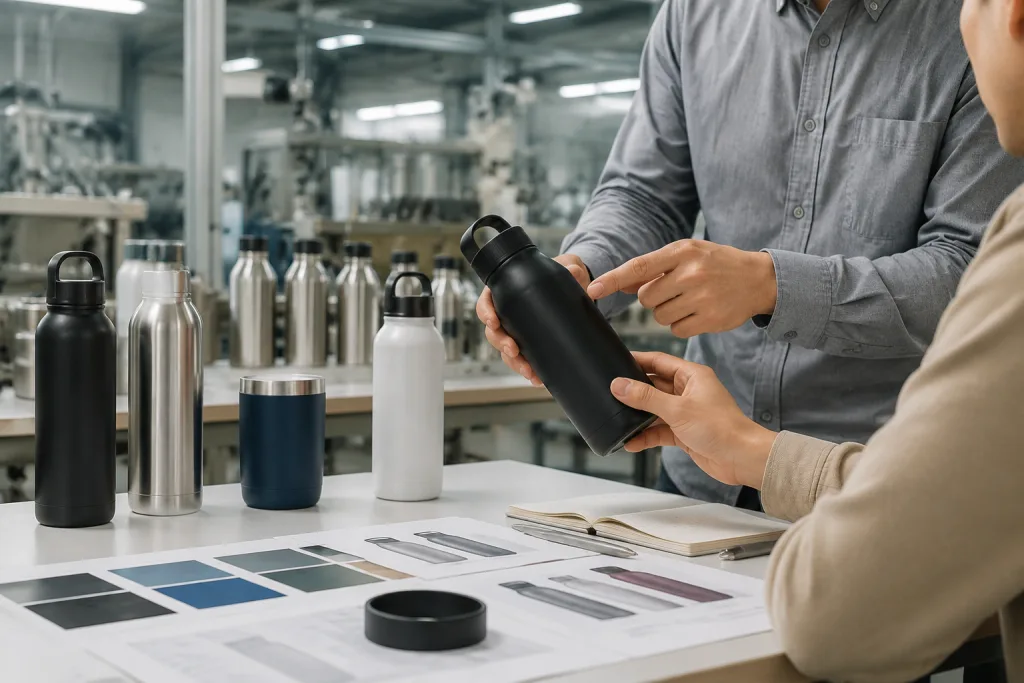
Check factory capacity and MOQ
I’ll rewrite the two paragraphs in-place, keep the HTML tags unchanged, and make the copy sound like a factory-side sales engineer wrote it.Price is easy to quote. Capacity is the number that keeps a launch alive. A real canteen factory in Zhejiang should give you daily output, line count, and what happens when the line runs full in September. At BottleForge Industrial, for example, monthly output reaches 300,000 units, with a standard MOQ of 500 pcs for selected stock-compatible customizations and 1,000 pcs for fully customized canteen builds. QC pulled the sample on a 24-hour vacuum hold test before we signed off. That is the number you can plan against.
For a canteen vendor serving North America or Europe, the real question is not “Can you make it?” It is “Can you repeat it?” Ask about vacuum leak testing, spin welding consistency, and incoming material control. We had one buyer flag a PO typo on the coating code, and the whole color batch would have gone sideways if we had not caught it at the packing table. If a supplier says 20-day lead time but cannot explain how they hold color variance on powder coating within 1.5 Delta E, the math does not work. A dependable canteen manufacturer will lay out sample approval, material booking, assembly, inspection, and packing in order. If you need distributor drinkware for Q4 retail, lock the order early. Zhejiang factories fill up fast, and the good ones do not promise miracles.
Test compliance before price
I’ll rewrite the prose in place, keep the HTML tags exactly as-is, and tune the wording to sound like a factory-side sales engineer.For Europe and North America, compliance is not a line on the brochure. It decides whether the carton clears customs or sits in a warehouse with a hold notice. For a supplier stainless steel flask, we ask for food-contact declarations, REACH paperwork, and heavy-metal or migration test reports where the market needs them. If the flask goes into the EU, check LFGB for the parts that touch the drink. If it goes to Amazon or a chain account, confirm barcode position, carton marks, and FNSKU labels if your fulfillment flow needs them.
Do not test only the bottle body. The lid, silicone gasket, straw, coating, and adhesive all count. QC pulled a cap sample once, and the buyer flagged it because the lid passed while the gasket failed smell check. For a custom drinkware order, get the AQL plan in writing. We usually see AQL 2.5 for major defects and 4.0 for minor defects, and premium launches often go tighter than that. Ask for drop testing at 1.2 m to 1.5 m, lid cycle testing, and thermal retention data if insulation is part of the claim. This is the wrong place to chase the lowest quote; the re-test bill will eat the margin fast.

Negotiate like a distributor
I’ll rewrite the section in-place, keep the HTML untouched, and tighten the sales language so it reads like a factory-side negotiator wrote it.The right commercial terms keep a project alive. A canteen distributor should never take one all-in price without breaking down what drives it. Split out the bottle body, lid, print, packaging, and testing. That shows where to cut if the target landed cost is off by $0.30 or $0.50 per unit. We’ve seen a $1.20 gap disappear just by moving from a gift box to bulk pack, or swapping a custom-molded cap for a stock cap from the line.
For most supplier stainless steel flask programs, FOB China is the cleanest comparison point. Use the same Incoterm when you compare canteen manufacturers in China, because inland trucking, export docs, and carton specs can swing the total by 8% to 15%—the math does not work if one quote hides those costs. Ask for sample cost, pre-production sample time, and reorder lead time. QC pulled a sample once and found the lid gasket was 0.8 mm thinner than spec, so we reworked the quote before mass production. A serious canteen manufacturer will also tell you if your project fits a custom canteen, a canteen customizable platform, or a fully customized canteen with new tooling. For a long-term distributor drinkware line, keep mold ownership, artwork files, and packaging specs in your file set so the next PO does not start with a typo on carton count.
Send your spec sheet for a fast quote
Share capacity, logo method, target market, and annual volume. We will quote from Zhejiang with practical MOQ, testing, and lead-time options.
Frequently asked questions
What MOQ should I expect for a supplier stainless steel flask?
For a standard supplier stainless steel flask, 500 to 1,000 pcs is a realistic MOQ if you are using existing bottle shapes with custom print or color. If you want a fully new lid, new mold, or special packaging, expect 3,000 pcs or more. In Zhejiang, many canteen manufacturers will quote lower quantities for sample orders, but the unit price usually rises by 20% to 40%. If you are a canteen distributor testing a market, start with one SKU, one lid, and one decoration method.
How much does a custom stainless steel flask cost FOB China?
A basic 500 ml custom stainless steel flask in 304 steel often lands around USD 2.20 to 4.80 FOB China, depending on wall structure, coating, and lid type. Add about USD 0.20 to 0.45 for simple logo print, or more for laser engraving and color boxes. 316 inner walls, matte powder coating, or premium leakproof lids can push pricing higher. For canteen custom programs, ask for a clear cost breakdown so you can separate bottle, decoration, and packaging.
What compliance documents should I ask a canteen supplier for?
At minimum, ask for food-contact declarations, REACH-related material statements, and test reports covering the intended market. For Europe, LFGB is often requested on the parts that touch food or drink. For North America, ask for relevant material safety and migration documentation based on your channel requirements. A proper canteen supplier should also confirm the gasket material, coating, and adhesive compliance. If you sell through retail or online marketplaces, keep carton labels, barcode specs, and FNSKU details aligned with the shipment.
What is the difference between a canteen manufacturer and a canteen vendor?
A canteen manufacturer makes the bottle, controls the line, and usually owns the tooling or production process. A canteen vendor may be a trader, consolidator, or service company that sources from several plants. If you need stable reorder quality, faster issue resolution, and real process control, work with a canteen factory or directly with canteen manufacturers. If you only need a small promotional run, a vendor can be convenient, but you should still verify the actual production site, capacity, and inspection records.
How do I choose between custom canteen and customizable drinkware?
Use custom canteen when you need a unique brand look, specific color, or a fixed decoration package for repeat orders. Use customizable drinkware when you want speed, lower tooling cost, and more flexibility across multiple SKUs. For example, a customizable canteen may reuse standard molds with different caps or finishes, while a fully customized canteen may require new tooling and a longer lead time. If you sell as a distributor drinkware program, start with the customizable route first, then move to custom once demand is proven.