Key Takeaways
- A workable MOQ for a custom stainless thermos is usually 1,000 units, with sample lead time around 7-10 days and bulk lead time around 25-35 days.
- 304 stainless is the baseline; 316 is worth it for harsher use, with typical inner wall thickness at 0.35-0.45 mm and outer wall at 0.30-0.40 mm.
- For outdoor retail, demand a 24-hour hot retention claim only if the lab result supports it; many factory thermos models land at 12-18 hours in real production.
- A disciplined QC plan should include AQL 2.5 for appearance and 4.0 for function, plus leak, vacuum, and drop checks before shipment.
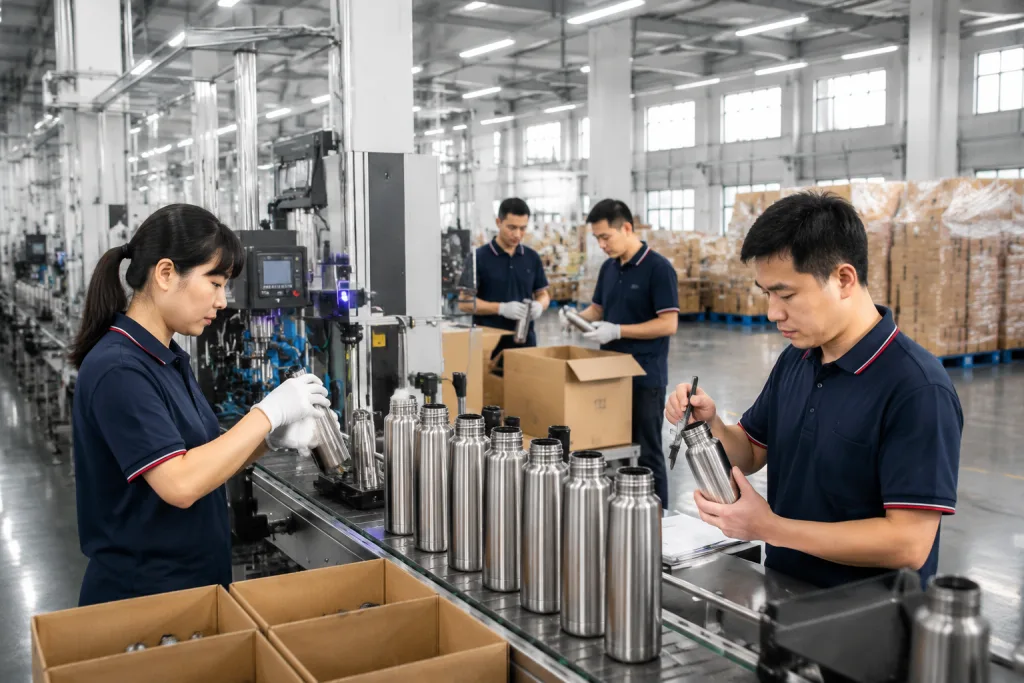
You are not buying a mug. You are buying a repeatable part that has to survive shipping, branding, retail handling, and daily use. A supplier stainless steel bottle order needs more than a clean sample. It needs the right 304 or 316 grade, wall thickness held within 0.3 mm, vacuum performance that stays stable, and decoration that still looks good after abrasion. Skip those basics, and the first complaint usually lands after the second carton reaches your warehouse.
At BottleForge in Zhejiang, we run orders the way a procurement manager should: start with the use case, then material, cap style, decoration, packaging, and QC. QC pulled the sample at 24 hours, because that is where weak insulation shows up. A factory thermos that looks good in a mockup but fails the test is a dead order. If you buy for outdoor retail or promotion, you need a distributor thermos or supplier thermos program that can go from 1,000 to 50,000 units without changing the spec every week.
Start with the buyer scenario
I’ll rewrite the prose in place, keep the HTML structure untouched, and tune the copy to sound like a sales engineer from the factory floor.Picture a Colorado outdoor retailer or a promotional brand in Germany. You need a 500 ml stainless thermos for winter campaigns, hiking kits, or employee gifts. Sales wants a black matte body, laser logo, and a retail carton. The buyer is pushing for under USD 4.20 FOB China at 3,000 units. Product wants 12-hour heat retention. Warehouse wants cartons that survive a 40-foot pallet run to Hamburg. All fair. The math only works when the spec is locked in the right order.
Start with how people actually drink from it. Coffee, tea, or cold water? Backpack, truck cup holder, or shelf display? A supplier stainless steel bottle for hiking needs a tighter lid seal and a tougher powder coat than a desk giveaway. If it is a promo thermos, we can trim the cap and packaging to protect margin. If it is a distributor thermos program, you need one spec that survives 3 reorder cycles without color drift or label bleed. QC pulled a sample with a 0.6 mm lid gap last month; that kind of miss is small on paper and ugly in a claim.
At BottleForge in Zhejiang, the standard stainless thermos line runs 80,000 units per month across vacuum bottles and tumblers, so we do not guess at what the line can hold. We match your target price to the tooling, lid family, and decoration method before anything else. Last week a buyer flagged a PO typo on the carton count, and it would have broken the pallet plan if we had not caught it early. That is where most import headaches start.
Lock the material and construction
I’m rewriting this section in place, keeping the tags and structure intact while making the copy sound like a factory-side sales engineer. Next I’ll tighten the wording, add a few concrete shop-floor details, and keep the numbers and technical calls grounded.The material call is where a buyer saves cost without cutting the bottle open later. For most custom thermos runs, 304 stainless steel does the job. It handles beverage contact, passes common compliance checks for Europe and North America, and our polishing line runs it every day. If the bottle goes into salty air, marine use, or harsher wash cycles, 316 is the safer pick, but the math is not subtle: expect about 8-15% more than a similar 304 build.
Skip vague wall copy like “double wall stainless.” Ask for numbers. A solid 500 ml thermos usually runs an inner wall around 0.35-0.45 mm and an outer wall around 0.30-0.40 mm. That gives enough stiffness without turning the bottle into a brick. Weight matters too. For retail outdoor work, a 500 ml unit often lands at 270-340 g once you count the lid and finish. Go thinner and QC sees dents on the corner drop test; go thicker and you pay for extra metal that the customer never asked for.
For a supplier thermos order, check the vacuum method and the seam line. You want a clean weld, stable vacuum retention, and no pinhole leak. Ask the factory thermos supplier for an insulation test report with a fixed fill temperature and ambient condition. If the spec says 24 hours hot, pin them down on the setup. We’ve seen buyers flag a PO typo on the test temperature, then wonder why the numbers drift. A real manufacturer thermos partner will tell you the bottle was tested at 20°C ambient with a filled, sealed sample — not some showroom claim.
Buyer note: If your brand sells both thermos bulk and retail units, keep the same shell and change only the lid, finish, and packaging. We run that setup often. It cuts tooling cost, keeps MOQ cleaner, and the line can replenish faster when the buyer pushes a reorder.
Choose the lid and finish wisely
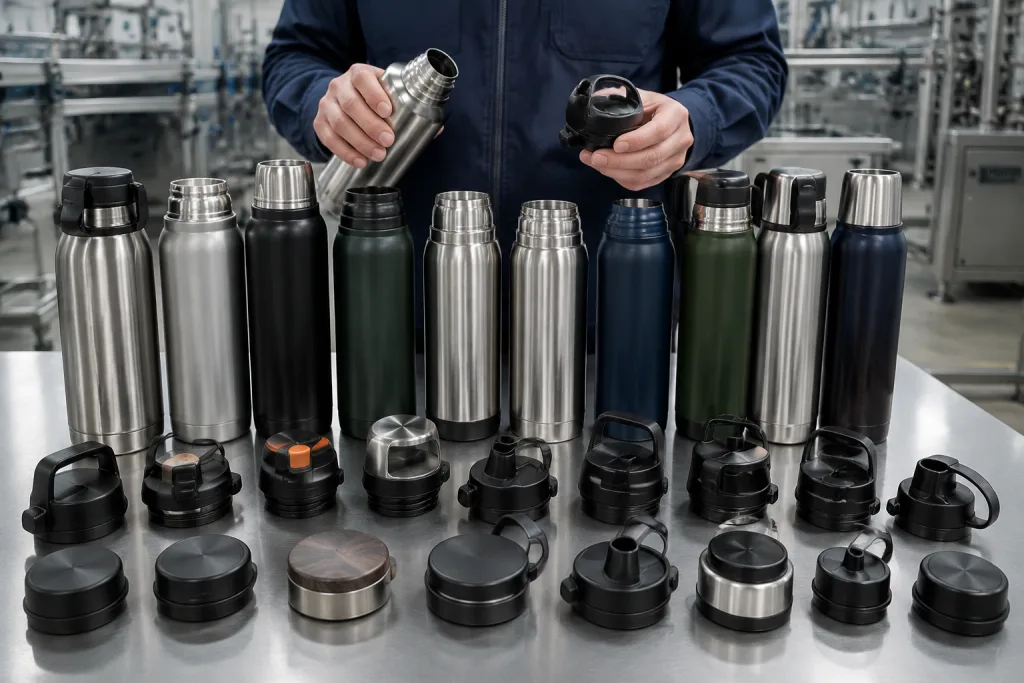
I’ll rewrite the prose in-place, keep every HTML tag and structure intact, and tune the copy to sound like a real factory sales engineer.Most returns do not come from the bottle body. They come from the lid. We’ve seen a custom thermos pass shell QC and still come back because the cap leaks, the thread feels gritty, or the gasket walks during transit. For promo buyers, the cheapest lid is usually the wrong call. A straight screw cap with a silicone ring is simple, steady, and easy to run on the line. A push-button lid or one-hand-open cap looks better on retail shelves, but it adds parts, longer assembly, and more inspection points.
For outdoor retail, matte powder coating still makes sense. It hides fingerprints and gives better shelf value than glossy paint. We usually target 70-90 micron on stainless thermos bodies. Go under that, and carton rub plus warehouse handling will show fast. Go too thick, and the logo edge starts to soften. If you want a customized thermos with a laser-etched logo, powder coating and laser work well together because the laser cuts through the coating cleanly. If you want a printed logo for a thermos promotional campaign, silk screen costs less, but scratch resistance drops. The math does not lie.
There is a clear gap between a thermos customizable program and a thermos customized order. Customizable means the platform already supports multiple lids, colors, and print positions. Customized means we change the structure, and that usually means new tooling, new samples, and more lead time. A good supplier stainless steel bottle partner should say that straight, not blur the two just to win the PO. We had one buyer flag a PO typo on the lid code, and that saved a week.
Price the order like a buyer
I’ll keep the HTML intact and rewrite the prose to sound like a buyer-side sales engineer, with tighter pricing language and one factory-floor detail per paragraph.Bad pricing starts when the quote rolls shell, lid, finish, decoration, and carton into one soft number. Then nobody can see where the money goes. On a normal 500 ml supplier stainless steel bottle order at 3,000 units FOB Ningbo or FOB Shanghai, a plain 304 double-wall thermos usually lands around USD 3.20-3.80, depending on lid style and surface finish. Add powder coating, laser logo, and a retail box, and the same unit can move to USD 4.00-4.60. Switch to 316, and the math changes again. We run this kind of quote through the line all the time, and the buyer flags it fast when the lid spec is missing.
Ask for separate lines on body, lid, logo, packaging, testing, and carton. That is the only clean way to compare suppliers thermos offers without getting baited by a low headline price and a weak accessory package. Ask straight out whether the quote includes AQL inspection, carton drop testing, or third-party report handling. A real thermos supplier knows these items are part of export work, not extras. If the seller cannot state the Incoterms in plain words, the comparison is broken. FOB is still the normal start point for most importers; DDP gives you a different level of freight and customs control. On one PO, the buyer typed `DPP` instead of `DDP`, and we had to stop the booking before the ship-out.
For promotional thermos runs, a leaner spec makes sense if the job is reach, not premium positioning. For outdoor retail, do not cut the coating or gasket budget just to save USD 0.18. The math does not work. We have seen that go sideways into refunds, replacements, and shelf damage after a 1.2 mm gasket failed the hot-water hold test on the bench. Price the order with your end use in mind, or the quote looks cheap and the job gets expensive.
QC the first order properly
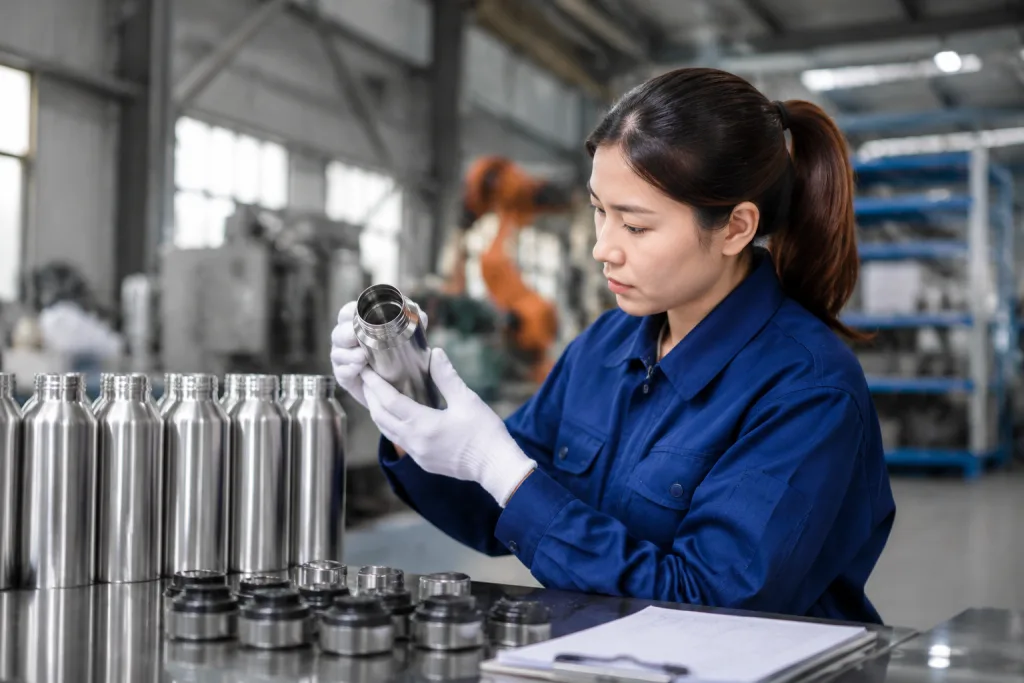
I’ll rewrite the section in-place, keep the HTML structure unchanged, and make the copy sound like a factory-side sales engineer wrote it.The first order is a production audit, not a buying event. Start with pre-production samples. Check logo placement with a steel ruler, lid fit, coating color, and the fill line. Then lock one golden sample and keep it on the line during mass production. If the thermos manufacturer skips that step, you are trusting memory. That is the wrong way to run QC.
A real inspection plan for a factory thermos order should cover appearance under AQL 2.5 and function under AQL 4.0. Test leakage after repeated opening and closing, drop the packed carton from at least 70-80 cm, and verify vacuum performance with a fixed temperature hold test. For hot drinks, ask for a 24-hour retention test only if the bottle is built for that claim. We’ve seen 18-hour bottles win repeat orders because the retail promise matched the actual test curve, and the buyer stopped arguing with the math.
For Europe and North America, ask for REACH conformity where relevant, and keep food-contact documents on file. If retail onboarding needs proof, the supplier should send it without back-and-forth. A serious manufacturer thermos line in Zhejiang should also trace every batch by code, so if one shipping lot gets flagged, QC can pull the sample and isolate it fast.
Ship it like a retail program
I’ll rewrite the section in-place, keeping the HTML exactly as-is and tightening the copy so it sounds like a factory sales engineer wrote it.Packaging is not an afterthought. It decides whether your distributor thermos order lands shelf-ready or lands in rework. For outdoor retail, each bottle needs its own carton to protect the finish and stop the lid from rubbing the shell in transit. A plain white box works for promos, but retail runs usually need a printed carton with barcode, SKU, and country-of-origin marking. If you sell through Amazon or a similar channel, the box size also has to fit the FNSKU and the master carton plan.
For thermos bulk orders, we build the pack plan around the pallet. That is the right order. We check master carton count, carton BCT strength, and pallet height before production starts, not after the line is already running. If you ship mixed SKUs, ask the factory to mark cartons by color and lid type. We’ve seen warehouses waste half a shift sorting boxes because one PO typo mixed black lids with silver lids. For larger orders, the shipping plan matters as much as the bottle. Peak season in China fills up fast, and Zhejiang factories that know the game book line time early instead of making promises they cannot keep.
If the same shell goes out under three brands, make the packaging modular. Then one thermos distributor order can turn into three regional programs without rebuilding the spec from scratch. That saves money, cuts QC questions, and keeps the buyer from chasing three separate carton drawings. Simple. Practical. It works.
Send your thermos spec for a fast quote
Share capacity, lid style, logo method, and target price. We’ll map the right supplier stainless steel bottle build for your next order.
Frequently asked questions
What MOQ should I expect for a custom stainless thermos?
For a normal custom stainless thermos with logo and standard color, 1,000 units is the practical MOQ at many China factories. If you need a special lid, engraved shell, or new tooling, the MOQ may rise to 3,000 units. Sample orders are often possible at 1-5 pcs, but sample freight can add USD 30-80. At BottleForge in Zhejiang, a standard sample lead time is 7-10 days and bulk production is usually 25-35 days after sample approval.
Is 304 stainless enough for an outdoor retail bottle?
Yes, 304 stainless is the standard choice for most supplier stainless steel bottle programs. It handles normal coffee, tea, and water use well and keeps costs controlled. If the bottle will be used in harsher conditions, near salt air, or in premium gift channels, 316 is safer but usually adds 8-15% to the cost. For most promotional thermos orders, 304 is the right balance between performance and price.
How do I check insulation claims before I place a bulk order?
Ask for a test report with the fill temperature, ambient temperature, and measurement time clearly stated. A decent 500 ml thermos may hold hot liquid for 12-18 hours in real use, while some higher-spec builds can reach 24 hours under controlled conditions. Do not accept a claim without the test setup. If the supplier thermos partner cannot explain the method, the number is not useful for your retail or distributor thermos program.
What decoration method is best for a custom thermos?
Laser engraving is the most durable for a custom thermos because it does not chip like paint can. Silk screen is cheaper and works well for promotional thermos runs, but it is less scratch resistant. UV print can work for full-color designs, though it needs better surface prep. If you want a customizable thermos for multiple campaigns, laser and powder coat are usually the safest combination for outdoor retail.
What QC checks should I require before shipment?
At minimum, request AQL 2.5 for appearance, AQL 4.0 for function, leak tests, lid torque checks, and carton drop tests. Also check color consistency, logo alignment, and vacuum performance. For a factory thermos order, I recommend keeping one golden sample sealed and one approved production sample in your file. That way, if the shipment arrives with issues, you can compare against a fixed reference instead of arguing from memory.